Jianshanopodia
| Jianshanopodia Temporal range: | |
|---|---|
 | |
| Reconstruction of Jianshanopodia decora | |
Scientific classification  | |
| Kingdom: | Animalia |
| Clade: | Panarthropoda |
| Phylum: | †Lobopodia |
| Class: | †Xenusia |
| Order: | †Siberiida |
| Family: | †Siberiidae |
| Genus: | †Jianshanopodia Liu et al., 2006 |
| Species: | †J. decora |
| Binomial name | |
| †Jianshanopodia decora Liu et al., 2006 | |
Jianshanopodia is a monotypic genus of Cambrian lobopodian, discovered in the Maotianshan Shales of Yunnan, China.[1]
Description


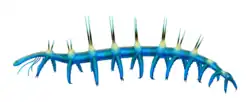
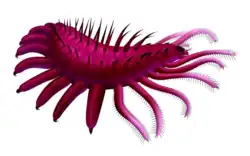
Jianshanopodia resembled the closely related siberiid Megadictyon. The head possessed a pair of grasping frontal appendages which bore wedge-shaped plates.[2] The pharynx was surrounded by rows of denticles, resembling those of radiodonts and priapulids.[3][4] The trunk was annulated, with a pair of stout legs (lobopods) on each body segment. Due to the lack of a complete specimen, the exact number of body segments and leg pairs is uncertain. If it had 12 body segments, the living animal might have grown over 20 cm.[1] Each leg was lined with rows of tubercles and tree-like branches,[1] instead of being tipped with claws as in many other lobopodians.[2] The trunk terminated with a large median lobe and a pair of small lateral lobes, forming a fan-like structure.[1] Inside the trunk was a sediment-filled gut surrounded by serially repeated diverticulae.[2][1]
It has been suggested that Jianshanopodia mainly crawled on the sea floor, but could swim with its fan-like tail when necessary.[1][2] The leg branches might have functioned as external gills.[1] It is thought to be predatory and have sucked up prey with its short 'trunk',[2] consuming food items with its robust mouthparts and gut diverticulae.[5]
Phylogeny
Phylogenetic position of Jianshanopodia according to Knecht et al. 2025:[6]
| |||||||||||||||||||||||||||||||||||||||||||||||||||||||||||||||||||||||||||||||||||||||||||||||||||||||||||||||||||||||||||||||||||||||||||||||||






Cladogram after McCall 2023:[7]
| Total group Euarthropoda |
| |||||||||||||||||||||||||||||||||||||||


References
- 1 2 3 4 5 6 7 Jianni Liu; Degan Shu; Jian Han; Zhifei Zhang; Xingliang Zhang (2006). "A large xenusiid lobopod with complex appendages from the Lower Cambrian Chengjiang Lagerstätte". Acta Palaeontologica Polonica. 51 (2): 215–222. Retrieved 2015-03-13.
- 1 2 3 4 5 Liu, J.; Shu, D.; Han, J.; Zhang, Z.; Zhang, X. (2008). "Origin, diversification, and relationships of Cambrian lobopods". Gondwana Research. 14 (1–2): 277–283. Bibcode:2008GondR..14..277L. doi:10.1016/j.gr.2007.10.001.
- ↑ Vannier, Jean; Liu, Jianni; Lerosey-Aubril, Rudy; Vinther, Jakob; Daley, Allison C (2014). "Sophisticated digestive systems in early arthropods". Nature Communications. 5: 3641. Bibcode:2014NatCo...5.3641V. doi:10.1038/ncomms4641. PMID 24785191.
- ↑ Smith; Caron (2015). "Hallucigenia's head and the pharyngeal armature of early ecdysozoans" (PDF). Nature. 523 (7558): 75–8. Bibcode:2015Natur.523...75S. doi:10.1038/nature14573. PMID 26106857. S2CID 205244325.
- ↑ Vannier, Jean; Liu, Jianni; Lerosey-Aubril, Rudy; Vinther, Jakob; Daley, Allison C. (2014-05-02). "Sophisticated digestive systems in early arthropods". Nature Communications. 5 (1): 3641. Bibcode:2014NatCo...5.3641V. doi:10.1038/ncomms4641. ISSN 2041-1723. PMID 24785191.
- ↑ Knecht, Richard J.; McCall, Christian R. A.; Tsai, Cheng-Chia; Rabideau Childers, Richard A.; Yu, Nanfang (23 July 2025). "Palaeocampa anthrax, an armored freshwater lobopodian with chemical defenses from the Carboniferous". Communications Biology. 8 (1) 1080. doi:10.1038/s42003-025-08483-0. PMC 12287526. PMID 40702124.
- ↑ McCall, C. R. A. (2023). "A large pelagic lobopodian from the Cambrian Pioche Shale of Nevada". Journal of Paleontology. 97 (5): 1–16. Bibcode:2023JPal...97.1009M. doi:10.1017/jpa.2023.63.
| ||||||||
| Controversial taxa |
| 
 | ||||||
| Arthropod relatives |
| |||||||
| Onychophoran relatives | ||||||||
| Tardigrade relatives |
| |||||||