Portal:Visual arts

Introduction

The visual arts are art forms such as painting, drawing, printmaking, sculpture, ceramics, photography, video, image, filmmaking, design, crafts, and architecture. Many artistic disciplines such as performing arts, conceptual art, and textile arts, also involve aspects of the visual arts, as well as arts of other types. Within the visual arts, the applied arts, such as industrial design, graphic design, fashion design, interior design, and decorative art are also included.
Current usage of the term "visual arts" includes fine art as well as applied or decorative arts and crafts, but this was not always the case. Before the Arts and Crafts Movement in Britain and elsewhere at the turn of the 20th century, the term 'artist' had for some centuries often been restricted to a person working in the fine arts (such as painting, sculpture, or printmaking) and not the decorative arts, crafts, or applied visual arts media. The distinction was emphasized by artists of the Arts and Crafts Movement, who valued vernacular art forms as much as high forms. Art schools made a distinction between the fine arts and the crafts, maintaining that a craftsperson could not be considered a practitioner of the arts.
The increasing tendency to privilege painting, and to a lesser degree sculpture, above other arts has been a feature of Western art as well as East Asian art. In both regions, painting has been seen as relying on the imagination of the artist to the highest degree and being the furthest removed from manual labour – in Chinese painting, valued styles were "scholar-painting", at least in theory practiced by gentleman amateurs. The Western hierarchy of genres reflected similar attitudes. (Full article...)
Selected article

Portrait of Mariana of Austria is a 1652–1653 oil-on-canvas painting by Diego Velázquez, the leading artist of the Spanish Golden Age, existing in a number of versions. Its subject, Doña Mariana (known as Maria Anna), was the daughter of Emperor Ferdinand III and Maria Anna of Spain. She was nineteen years old when the painting was completed. Although described as vivacious and fun-loving in life, she is given an unhappy expression in Velázquez's portrait. The portrait is painted in shades of black and red, and her face is heavily made up. Her right hand rests on the back of a chair, and she holds a lace handkerchief in her left hand. Her bodice is decorated with jewellery, including a gold necklace, bracelets and a large gold brooch. A clock rests on scarlet drapery behind her, signifying her status and discernment.
Mariana had been betrothed to her first cousin, Prince Baltasar Carlos. He died in 1646 aged sixteen, and in 1649 she married her uncle, Baltasar Carlos's father, Philip IV, who sought her hand so as to preserve the hegemony of the Habsburg dynasty. She became queen consort on their marriage, and after her husband's death in September 1665, regent during the minority of her son, Charles II, until he came of age in 1675. Owing to Charles' inhibiting physical weaknesses, she dominated the political life in Spain until her death in 1696. (Full article...)
Selected picture
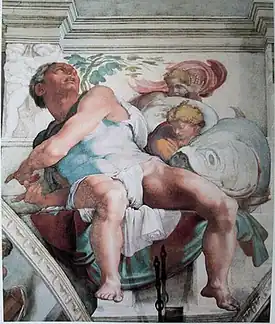
Selected quote
| “ | When I've painted a woman's behind so that I want to touch it, then it's finished! | ” |
| — Pierre-Auguste Renoir, Vollard, Ambroise (1925). Renoir: an initimate record. Translated by Van Dooren, Harold L.; Weaver, Randolph T. New York: Alfred A. Knopf. p. 57. OCLC 631984646. |
Related portals
Selected biography

François Auguste René Rodin (/roʊˈdæn/; French: [fʁɑ̃swa oɡyst(ə) ʁəne ʁɔdɛ̃]; 12 November 1840 – 17 November 1917) was a French sculptor generally considered the founder of modern sculpture. He was schooled traditionally and took a craftsman-like approach to his work. Rodin possessed a unique ability to model a complex, turbulent, and deeply pocketed surface in clay. He is known for such sculptures as The Thinker, Monument to Balzac, The Kiss, The Burghers of Calais, and The Gates of Hell.
Many of Rodin's most notable sculptures were criticized, as they clashed with predominant figurative sculpture traditions in which works were decorative, formulaic, or highly thematic. Rodin's most original work departed from traditional themes of mythology and allegory. He modeled the human body with naturalism, and his sculptures celebrate individual character and physicality. Although Rodin was sensitive to the controversy surrounding his work, he refused to change his style, and his continued output brought increasing favor from the government and the artistic community. (Full article...)
Did you know (auto generated) -

- ... that scriptwriter Ang Eng Tee created The Little Nyonya by drawing inspiration from the rich Peranakan-Chinese heritage in Singapore's Joo Chiat?
- ... that in 1933 Nazi sympathisers attempted to kidnap two German-Jewish filmmakers in Liechtenstein?
- ... that Edmund Cheng helped to transform an old church into an art venue named Sculpture Square in 1995?
- ... that a drawing of a dog was promoted by the president of El Salvador, caused an unaffiliated song to peak on the TikTok Billboard Top 50, and got its original creator doxxed?
- ... that a Syrian filmmaker repurposed footage from his first film in his last film in order to criticize his younger self?
- ... that Io Kaziwara developed tendonitis while drawing the first volume of the manga series Reincarnated into Demon King Evelogia's World?
- ... that the filmmakers of 100 Litres of Gold brewed 20 litres of sahti at the Finnish embassy in Rome for its premiere?
- ... that director Peyton Reed likened the collaboration between the filmmakers of Phase Three of the Marvel Cinematic Universe to the studio system of Golden Age Hollywood?
General images

 Gwion Gwion rock paintings found in the north-west Kimberley region of Western Australia c. 15,000 BC (from History of painting)
 Francis Picabia, (Left) Le saint des saints c'est de moi qu'il s'agit dans ce portrait, 1 July 1915; (center) Portrait d'une jeune fille americaine dans l'état de nudité, 5 July 1915: (right) J'ai vu et c'est de toi qu'il s'agit, De Zayas! De Zayas! Je suis venu sur les rivages du Pont-Euxin, New York, 1915 (from History of painting)
 Hand stencils in the "Tree of Life" cave painting in Gua Tewet, Kalimantan, Indonesia (from History of painting)
 Two Scribes Seated with Books and a Writing Table Fragment of a decorative margin Northern India (Mughal school), ca. 1640–1650 (from History of painting)
 Young Mother Sewing, Mary Cassatt (from History of painting)

 Spring Morning in the Han Palace, by Ming-era artist Qiu Ying (1494–1552 AD) (from History of painting)
 Loquats and Mountain Bird, anonymous artist of the Southern Song dynasty; paintings in leaf album style such as this were popular in the Southern Song (1127–1279). (from History of painting)


 Cueva de las Manos (Spanish for Cave of the Hands) in the Santa Cruz province in Argentina, c. 7300 BC (from History of painting)

 Cover of the Thanksgiving 1895 issue of The Chap-Book, designed by Will H. Bradley (from Graphic design)

 Bharat Mata by Abanindranath Tagore (1871–1951), a nephew of the poet Rabindranath Tagore, and a pioneer of the movement (from History of painting)


 Lascaux, Bulls and Horses (from History of painting)
 A Chinese painted jar from the Western Han Era (202 BCE – 9 CE) (from History of painting)
 Poster to promote the Centennial of Argentina (1910) (from Graphic design)
 Irbid, Jordan, "We are Arabs. We are Humans". Inside Out is a global participatory art project, initiated by the French photographer JR, an example of Street art. (from Contemporary art)

 The Eternal Father Painting the Virgin of Guadalupe. Attributed to Joaquín Villegas (1713 – active in 1753) (Mexican) (painter, Museo Nacional de Arte. (from History of painting)
 Lascaux, Horse (from History of painting)

 Wayang beber, 17th century (from History of painting)
 Golden section in book design (from Graphic design)

 Book of Hours (from History of painting)
 Silk painting depicting a man riding a dragon, painting on silk, dated to 5th–3rd century BC, Warring States period, from Zidanku Tomb no. 1 in Changsha, Hunan Province (from History of painting)

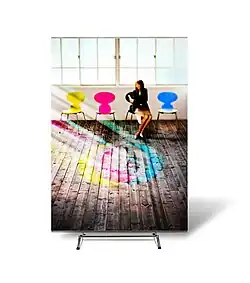 Colour (from Graphic design)
 A fresco from Cave 1 of Ajanta. (from History of painting)


 Graphic symbols are often functionalist and anonymous, as these pictographs from the US National Park Service illustrate. (from Graphic design)
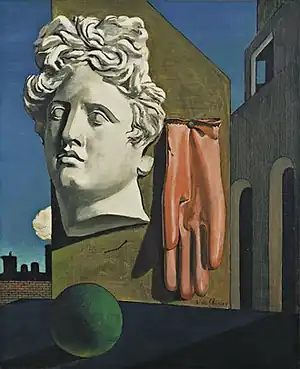


 Diego Rivera, Recreation of Man at the Crossroads (renamed Man, Controller of the Universe), originally created in 1934, Mexican muralism movement (from History of painting)
 Pictographs from the Great Gallery, Canyonlands National Park, Horseshoe Canyon, Utah, c. 1500 BCE (from History of painting)
 Due to its interdisciplinary nature, graphic design can be performed in different areas of application: branding, technical and artistic drawing, signage, photography, image and video editing, 3D modeling, animation, programming, digital drawing, video creation among other fields. (from Graphic design)
 Joan Miró, Horse, Pipe and Red Flower, 1920, abstract Surrealism, Philadelphia Museum of Art (from History of painting)
 A Boeing 747 aircraft with livery designating it as Air Force One. The cyan forms, the US flag, presidential seal and the Caslon lettering, were all designed at different times, by different designers, for different purposes, and combined by designer Raymond Loewy in this one single aircraft exterior design. (from Graphic design)

 A fresco showing Hades and Persephone riding in a chariot, from the tomb of Queen Eurydice I of Macedon at Vergina, Greece, 4th century BC (from History of painting)
Major topics
- Types of visual art – Architecture • Art intervention • Ceramic art • Computer art • Drawing • Fashion • Film • Installation art • Land art • Mixed media • Painting • Performance art • Photography • Printmaking • Sculpture • Stained glass; • Artists' Books
- Art history – Pre-historic art • Ancient art • Art of Ancient Egypt • Art in Ancient Greece • Minoan pottery • Scythian art • Roman art • Women artists
- Western art periods and movements – Medieval art • Gothic art • Renaissance • Mannerism • Baroque • Rococo • Neoclassicism • Romanticism • Realism • Modern Art • Impressionism • Symbolism • Fauvism • Proto-Cubism • Cubism • Futurism • Dada • Art Deco • Surrealism • Abstract Expressionism • Lyrical abstraction • Conceptual Art • Contemporary Art • Postmodern art visual arts.
- Eastern and Middle Eastern art – Buddhist art • Chinese art • Islamic art • Japanese art • Laotian art • Thai art • Tibetan art
- Lists – Architects • Art movements • Art periods • Painters • Printmakers • Sculptors • Statues
- Lists of basic topics – Visual arts • Architecture • Film • Painting • Photography • Sculpture
Subcategories

Architecture | Ceramic art | Comics | Crafts | Design | Drawing | Illustration | Film | Glass | Graphic design | Industrial design | Landscape architecture | Multimedia | Painting | Photography | Pottery | Printmaking | Public art | Sculpture | Typography | Mosaic
Artists | Visual arts awards | Artist collectives | Art collectors | Art critics | Art curators | Visual arts exhibitions | Art forgery | Art history | Visual arts materials | Art schools | Artistic techniques |
WikiProjects
Things you can do
|
|
Here are some Open Tasks :
|

Associated Wikimedia
The following Wikimedia Foundation sister projects provide more on this subject:
-
 Commons
Free media repository -
 Wikidata
Free knowledge base -
 Wikiquote
Collection of quotations -
 Wikisource
Free-content library -
 Wikiversity
Free learning tools -
 Wiktionary
Dictionary and thesaurus
References
More portals
-
 List of all portals
-

-

-

-

-

-

-

-

-

-
 Random portal
-
 WikiProject Portals