Painting is a visual art, characterized by the practice of applying paint, pigment, color, or other medium to a solid surface. The medium is commonly applied to the base with a brush. Other implements, such as palette knives, sponges, airbrushes, the artist's fingers, or even a dripping technique that uses gravity may be used. One who produces paintings is called a painter.
In art, the term "painting" describes both the act and the result of the action (the final work is called "a painting"). The support for paintings includes such surfaces as walls, paper, canvas, wood, glass, lacquer, pottery, leaf, banners, copper and concrete; the painting may incorporate other materials, in single or multiple form, including sand, clay, paper, cardboard, newspaper, plaster, gold leaf, and even entire objects.
A range-finder painting, sometimes called range-finding painting, is a large landscape painting produced as a training device to help gunners improve their accuracy. Historically, the best-documented use of such paintings was in the United States during World War I. (Full article...)
In America, James Abbott McNeill Whistler titled works as nocturnes to identify those paintings with a "dreamy, pensive mood" by applying the musical term, and likewise also titled (and retitled) works using other music expressions, such as a "symphony", "harmony", "study" or "arrangement", to emphasize the tonal qualities and the composition and to de-emphasize the narrative content. The use of the term "nocturne" can be associated with the Tonalist movement of the American of the late 19th century and early 20th century which is "characterized by soft, diffused light, muted tones and hazy outlined objects, all of which imbue the works with a strong sense of mood." Along with winter scenes, nocturnes were a common Tonalist theme. Frederic Remington used the term as well for his nocturne scenes of the American Old West. (Full article...)
Image 3
The Arnolfini Portrait by Jan van Eyck (1434). Among other changes made, the husband's face was higher by about the height of his eye, the wife's was higher, and her eyes looked more to the front. Each of the husband's feet was underdrawn in one position, painted in another, and then overpainted in a third. These alterations can be seen in infra-red reflectograms.
In painting, a pentimento (Italian for 'repentance'; from the verb pentirsi, meaning 'to repent'; plural pentimenti) is "the presence or emergence of earlier images, forms, or strokes that have been changed and painted over". Sometimes the English form "pentiment" is used, especially in older sources. (Full article...)
A coloring book (British English: colouring-in book, colouring book, or colouring page) is a type of book containing line art to which a person (usually a child) is intended to add color using crayons, colored pencils, marker pens, paint or other artistic media. Traditional coloring books and coloring pages are printed on paper or card. Some coloring books have perforated edges so their pages can be removed from the books and used as individual sheets. Others may include a story line and so are intended to be left intact. Today, many children's coloring books feature popular characters. They are often used as promotional materials for motion pictures and television. Coloring books may also incorporate other activities such as connect the dots, mazes and other puzzles. Some also incorporate the use of stickers. (Full article...)
Early paint robots were hydraulic versions, which are still in use today but are of inferior quality and safety to the latest electronic offerings. The newest robots are accurate and deliver results with uniform film builds and exact thicknesses. (Full article...)
The tradition was founded in Scotland in the late eighteenth century by David Allan, who moved from classical and mythological themes to scenes of everyday life, including his most famous work Illustrations of the Gentle Shepherd. As a result he earned the title of "the Scottish Hogarth". By the end of the eighteenth century genre art had become a Scottish speciality. The tradition was successfully taken up by David Wilkie, who was one of the most internationally influential artists of this day. (Full article...)
Image 8
Raphael, The Expulsion of Heliodorus from the Temple, from the Vatican, 1512. The original grand manner. Grand manner refers to an idealized aesthetic style derived from classicism and the art of the High Renaissance. In the eighteenth century, British artists and connoisseurs used the term to describe paintings that incorporated visual metaphors in order to suggest noble qualities. It was Sir Joshua Reynolds who gave currency to the term through his Discourses on Art, a series of lectures presented at the Royal Academy from 1769 to 1790, in which he contended that painters should perceive their subjects through generalization and idealization, rather than by the careful copy of nature. Reynolds never actually uses the phrase, referring instead to the "great style" or "grand style", in reference to history painting: :How much the great style exacts from its professors to conceive and represent their subjects in a poetical manner, not confined to mere matter of fact, may be seen in the cartoons of Raffaelle. In all the pictures in which the painter has represented the apostles, he has drawn them with great nobleness; he has given them as much dignity as the human figure is capable of receiving yet we are expressly told in Scripture they had no such respectable appearance; and of St. Paul in particular, we are told by himself, that his bodily presence was mean. Alexander is said to have been of a low stature: a painter ought not so to represent him. Agesilaus was low, lame, and of a mean appearance. None of these defects ought to appear in a piece of which he is the hero. In conformity to custom, I call this part of the art history painting; it ought to be called poetical, as in reality it is.
Originally applied to history painting, regarded as the highest in the hierarchy of genres, the Grand Manner came thereafter also to be applied to portrait painting, with sitters depicted life size and full-length, in surroundings that conveyed the nobility and elite status of the subjects. Common metaphors included the introduction of classical architecture, signifying cultivation and sophistication, and pastoral backgrounds, which implied a virtuous character of unpretentious sincerity undefiled by the possession of great wealth and estates. (Full article...)
Image 9
Paint Dancing is an American art and dance craze which involves both painting and dancing. Paint Dancers, using paint, brushes and paper, attend organized events dressed in ready-to-paint and dance clothing. The concept of combining movement and painting originated during the later part of the American and European Modern art period; however, Evangeline Welch of Shreveport, Louisiana has been credited with being the "brainchild" of Paint Dancing in the United States of America. This departure from traditional painting styles was often referred to as Action painting. Over the years, several variations of the art form have evolved, including an adaptation introduced by the Hippies during the Summer of Love, that integrated the art of body painting with dancing. One of the more recent introductions of Paint Dancing to American culture is being popularized by a grassroots movement created in 2006 by Seattle artist and activist Matt Jones. The phrases "paint dancing" and "paint dancer" and other variations were originally coined in 1996 by Gloria M. Buono, author, illustrator and publisher of The Painting Ballerina. (Full article...)
Hue relationships between the primary and secondary colors in the ISCC-NBS system of color designation The ISCC–NBS System of Color Designation is a system for naming colors based on a set of 13 basic color terms and a small set of adjective modifiers. It was first established in the 1930s by a joint effort of the Inter-Society Color Council (ISCC), made up of delegates from various American trade organizations, and the National Bureau of Standards (NBS), a US government agency. As suggested in 1932 by the first chairman of the ISCC, the system's goal is to be "a means of designating colors in the United States Pharmacopoeia, in the National Formulary, and in general literature ... such designation to be sufficiently standardized as to be acceptable and usable by science, sufficiently broad to be appreciated and used by science, art, and industry, and sufficiently commonplace to be understood, at least in a general way, by the whole public." The system aims to provide a basis on which color definitions in fields from fashion and printing to botany and geology can be systematized and regularized, so that each industry need not invent its own incompatible color system.
In 1939, the system's approach was published in the Journal of Research of the National Bureau of Standards, and the ISCC formally approved the system, which consisted of a set of blocks within the color space defined by the Munsell color system as embodied by the Munsell Book of Color. Over the following decades, the ISCC–NBS system's boundaries were tweaked and its relation to various other color standards were defined, including for instance those for plastics, building materials, botany, paint, and soil. (Full article...)
Image 12
Lady Writing a Letter with her Maid by Jan Vermeer 1670/71) Genre painting (or petit genre) is the painting of genre art, which depicts aspects of everyday life by portraying ordinary people engaged in common activities. One common definition of a genre scene is that it shows figures to whom no identity can be attached either individually or collectively, thus distinguishing it from history paintings (also called grand genre) and portraits. A work would often be considered as a genre work even if it could be shown that the artist had used a known person—a member of his family, say—as a model. In this case it would depend on whether the work was likely to have been intended by the artist to be perceived as a portrait—sometimes a subjective question. The depictions can be realistic, imagined, or romanticized by the artist. Because of their familiar and frequently sentimental subject matter, genre paintings have often proven popular with the bourgeoisie, or middle class.
Initially serving imperial, private, civic, and religious patronage, Western painting later found audiences in the aristocracy and the middle class. From the Middle Ages through the Renaissance painters worked for the church and a wealthy aristocracy. Beginning with the Baroque era artists received private commissions from a more educated and prosperous middle class. The idea of "art for art's sake" began to find expression in the work of the Romantic painters like Francisco de Goya, John Constable, and J. M. W. Turner. During the 19th century commercial galleries became established and continued to provide patronage in the 20th century. (Full article...)
Image 14
Live painting by Beo Beyond at Shôko Club in Barcelona, working with fluorescent colors which glow under blacklight. Live painting is a form of visual performance art in which artists complete a visual art piece in a public performance, often at a bar, music concert, wedding reception, or public event, accompanied by a DJ or live music. The artwork which is created live may be planned or improvisational. This live art form is often contrasted with more studied fine art compositions from the same artists, which are generally executed in an artist studio or other private space.
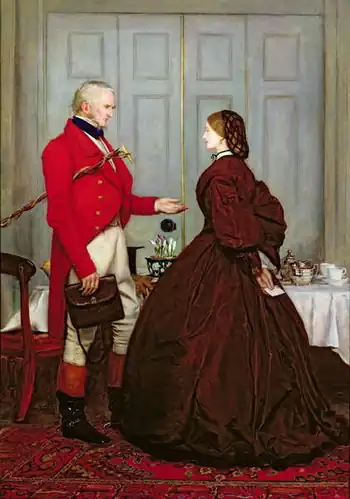
Trust Me (1860–62), by John Everett Millais, an early example of the problem picture. A problem picture is a genre of art popular in late Victorian painting, characterised by the deliberately ambiguous depiction of a key moment in a narrative that can be interpreted in several different ways, or which portrays an unresolved dilemma. It has some relation to the problem play. The viewer of the picture is invited to speculate about several different possible explanations of the scene. The genre has much in common with that of book illustration, then at its most popular, but with the text belonging to the illustration omitted.
The genre began to emerge in the second half of the nineteenth century, along with the development of book illustrations that depicted "pregnant" moments in a narrative. One of the earliest problem pictures is John Everett Millais' Trust Me, which depicts an older man demanding that a young woman hand him a letter she has received. Either character might be uttering the words. The significance and content of the letter is left to the imagination. Their relationship is also unclear; in view of their ages, they might be a married couple, or a father and daughter. (Full article...)
Image 16
Robert Delaunay, 1912–13, Le Premier Disque, 134 cm (52.7 in.), private collection Abstract art uses visual language of shape, form, color, and line to create a composition which may exist with a degree of independence from visual references in the world. Abstract art, non-figurative art, non-objective art, and non-representational art are all closely related terms. They have similar, but perhaps not identical, meanings.
Western art had been, from the Renaissance up to the middle of the 19th century, underpinned by the logic of perspective and an attempt to reproduce an illusion of visible reality. By the end of the 19th century, many artists felt a need to create a new kind of art that would encompass the fundamental changes taking place in technology, science, and philosophy. The sources from which individual artists drew their theoretical arguments were diverse and reflected the social and intellectual preoccupations in all areas of Western culture at that time. (Full article...)
A house painter and decorator is a tradesperson responsible for the painting and decorating of buildings, and is also known as a decorator, or house painter. The purpose of painting is to improve the appearance of a building and to protect it from damage by water, corrosion, insects and mold. House painting can also be a form of artistic and/or cultural expression such as Ndebele house painting. (Full article...)
Image 20
A picture frame is a protective and decorative edging for a picture, such as a painting or photograph. It makes displaying the work safer and easier and both sets the picture apart from its surroundings and aesthetically integrates it with them. (Full article...)
Image 21
The Old Town Hall of Amsterdam by Pieter Jansz. Saenredam, 1657, Rijksmuseum, Amsterdam Architectural painting (also Architecture painting) is a form of genre painting where the predominant focus lies on architecture, including both outdoor and interior views. While architecture was present in many of the earliest paintings and illuminations, it was mainly used as background or to provide rhythm to a painting. In the Renaissance, architecture was used to emphasize the perspective and create a sense of depth, like in Masaccio's Holy Trinity from the 1420s. In Western art, architectural painting as an independent genre developed in the 16th century in Flanders and the Dutch Republic, and reached its peak in 16th and 17th century Dutch painting. Later, it developed in Romantic painting, with e.g. views of ruins becoming very popular. Closely related genres are architectural fantasies and trompe-l'oeils, especially illusionistic ceiling painting, and cityscapes. (Full article...)
Image 22
Harvest near Auvers (1890), a size 30 canvas, by Vincent van Gogh. French standard sizes for oil paintings refers to a series of different sized canvases for use by artists. The sizes were fixed in the 19th century. Most artists—not only French—used this standard, as it was supported by the main suppliers of artist materials. Only some contemporary artist material suppliers continue to use these standards today, as most artists no longer differentiate canvas sizes by subject.
The main separation from size 0 (toile de 0) to size 120 (toile de 120) is divided in separate runs for faces/portraits (figure), landscapes (paysage), and marines (marine) which more or less keep the diagonal. That is, a figure 0 corresponds in height to a paysage 1 and a marine 2. In modern times in the USA size is usually stated height by width, where as in this article it is width by height. (Full article...)
Animal-made art consists of works by non-human animals, that have been considered by humans to be artistic, including visual works, music, photography, and videography. Some of these are created naturally by animals, often as courtship displays, while others are created with human involvement.
There have been debates about the copyright status of these works, with the United States Copyright Office stating in 2014 that works that lack human authorship cannot have their copyright registered at the US Copyright Office. (Full article...)
Image 24
Incised painting is a technique used to decorate stone surfaces. First, a channel is scratched in the stone. Then, a thick paint or stucco plaster is laid across the surface. Last, the paint is scraped off the surface of the stone, leaving paint in the incision. This technique was used in decorating the Taj Mahal. (Full article...)
Image 25
A binder or binding agent is any material or substance that holds or draws other materials together to form a cohesive whole mechanically, chemically, by adhesion or cohesion.
More narrowly, binders are liquid or dough-like substances that harden by a chemical or physical process and bind fibres, filler powder and other particles added into it. Examples include glue, adhesive and thickening. (Full article...)
Selected painting techniques
Image 1
Christ and the Woman Taken in Adultery, Pieter Bruegel the Elder, 1565, 24cm ×34cm (9.4in ×13.4in) Grisaille (/ɡrɪˈzaɪ/ or /ɡrɪˈzeɪl/; French: grisaille, lit.'greyed'French pronunciation:[ɡʁizaj], from gris 'grey') is a painting executed entirely in shades of black and grey or of another neutral greyish colour. It is particularly used in large decorative schemes in imitation of sculpture. Many grisailles include a slightly wider colour range.
A grisaille may be executed for its own sake, as underpainting for an oil painting (in preparation for glazing layers of colour over it), or as a model for an engraver or other printmaker to work from. "Rubens and his school sometimes use monochrome techniques in sketching compositions for engravers." By the 19th century many illustrations for books or magazines were made reproducing grisailles in watercolour. Full colouring of a subject makes many more demands of an artist, and working in grisaille was often chosen as being quicker and cheaper, although the effect was sometimes deliberately chosen for aesthetic reasons. Grisaille paintings resemble the drawings, normally in monochrome, that artists from the Renaissance onward were trained to produce; like drawings they can also betray the hand of a less talented assistant more easily than a fully coloured painting. (Full article...)
Image 2
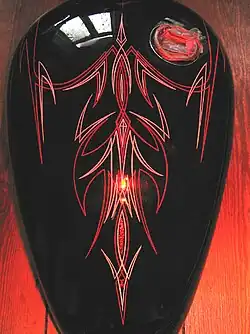
Pin striping on a motorcycle fuel tank.
Pin striping (or pinstriping) is the application of a very thin line of paint or other material called a pin stripe, and is generally used for decoration. Freehand pin stripers use a specialty brush known as a pinstriping brush.
Automotive, bike shops, and do-it-yourself car and motorcycle mechanics use paint pin striping to create their own custom look on the automotive bodies and parts. (Full article...)
Modern graffiti is a controversial subject. In most countries, marking or painting property without permission is considered vandalism. Modern graffiti began in the New York City subway system and Philadelphia in the early 1970s and later spread to the rest of the United States and throughout the world. (Full article...)
Image 5
Nōtan (濃淡) is a design aesthetic referring to the use of light and shade while also implying a balance or harmony in their respective contrast. Its origins are said to lie in Asian art, best represented by the Taoist symbol of the yin and yang, although the concept itself is unique to art education in the United States and is generally described as an American idea. Nōtan, as it is used this way, refers to the relationship between positive and negative space, and in composition, the connection between shape and background. This use of dark and light translates shape and form into flat shapes on a two-dimensional surface. Art historian Ernest Fenollosa (1853–1908) is credited with introducing nōtan to the United States in the waning years of the fin de siècle. It was subsequently popularized by Arthur Wesley Dow in his book Composition (1899). (Full article...)
Image 6
A drawing of an airplane with motion lines to indicate that it is moving fast In comics and art more broadly, motion lines (also known as movement lines, action lines, speed lines, or zip ribbons) are the abstract lines that appear behind a moving object or person, parallel to its direction of movement, to make it appear as if it is moving quickly. They are common in Japanese manga and anime, of which Speed Racer is a classic example.
Lines depicting wind and the trajectory of missiles appear in art as early as the 16th century. By the 19th century artists were drawing naturally occurring speed lines when showing the passage of an object through water or snow, but it was not until the 1870s that artists like Wilhelm Busch and Adolphe Willette began drawing motion lines to depict the movement of objects through air. (Full article...)
Image 7
Freehand brush work is a genre of Chinese traditional painting which includes poem, calligraphy, painting and seal. In Chinese, it is called Hsieh yi (traditional Chinese:寫意; simplified Chinese:写意; pinyin:Xiěyì), which literally means "writing ideas". It was formed in a long period of artistic activities and promoted by the literati. Through the inheritance and development in the past dynasties, freehand brush work has gradually become the most influential and popular genre.
The freehand brush work emphasizes the semblance in the spiritual aspect. This kind of artwork does not chase for the physical similarity and the cooperation of reality. And it might be the essence of freehand brush work that it mostly grasps the most obvious or essential spiritual characteristics. The first rule of freehand brush work is the use of connotation which is a kind of spiritual meaning. It focuses on the personality and the cooperation of every element in the painting. (Full article...)
Image 8
The assembly and painting of models is a major aspect of the hobby of miniature wargaming.
In addition to the painting of models, the creation of scenic basing for the model to be affixed to is also an important part of the hobby (although not all figure painters are concerned about the basing of their models). These can range from very simple applications of textured pastes, grit, and static grass for gaming bases, to larger scenic bases for display models, and even full dioramas depicting a scene of a single model or a group of models together in tableau to create a story in one moment. It can also include aspects of sculpting, for the purpose of creating additional details for models and bases, as a means of customizing the model to make them more unique, or to create entirely scratch built models for painting. Many figure painters also paint scale busts as part of the hobby, often in bigger scales than figures with a higher level of detail, and display bases and backdrops for them. (Full article...)
Wet-on-wet, or alla prima (Italian, meaning at first attempt), direct painting or au premier coup, is a painting technique in which layers of wet paint are applied to previously administered layers of wet paint. Used mostly in oil painting, the technique requires a fast way of working, because the work has to be finished before the first layers have dried. (Full article...)
Image 10
Kangaroo totemic ancestor - Bark painting, Arnhem Land, c. 1915Bark painting is an Australian Aboriginal art form, involving painting on the interior of a strip of tree bark. While examples of painted bark shelters were found in the south-eastern states (then colonies) of Tasmania, Victoria, and New South Wales in the 19th century, as well as later on bark shelters in northern Australia, it is now typically only found as a continuing form of artistic expression in Arnhem Land and other regions in the Top End of Australia, including parts of the Kimberley region of Western Australia.
Bark paintings were traditionally produced (especially among the Yolngu peoples) for instructional and ceremonial purposes and were transient objects. Today, they are keenly sought after by collectors and public arts institutions. (Full article...)
Restoring and displaying double-sided paintings can pose additional challenges for museums and galleries. When repairing canvases, restorers must ensure that their restoration efforts do not damage the image on either side. They must also use stretcher bars that do not obscure either side of the image, and they cannot use crossbars to help keep tension. (Full article...)
Image 12
White leadpastiglia on an Italian casket, late 15th century, with Marcus Curtius at left, British Museum. Pastiglia[paˈstiʎʎa], an Italian term meaning "pastework", is low relief decoration, normally modelled in gesso or white lead, applied to build up a surface that may then be gilded or painted, or left plain. The technique was used in a variety of ways in Italy during the Renaissance. The term is mostly found in English applied to gilded work on picture frames or small pieces of furniture such as wooden caskets and cassoni, and also on areas of panel paintings, but there is some divergence as to the meaning of the term between these specialisms.
On frames and furniture the technique is in origin a cheaper imitation of woodcarving, metalwork or ivory carving techniques. Within paintings, the technique gives areas with a three-dimensional effect, usually those representing inanimate objects, such as foliage decoration on architectural surrounds, halos and details of dress, rather than parts of figures. In white lead pastiglia on caskets, the subject matter is usually classical, with a special emphasis on stories from Ancient Roman history. (Full article...)
Image 13
Xia Gui (Song dynasty) – Mountain Market- Clear with Rising Mist, one of the 8 scenes of the Eight Views of Xiaoxiang, a favourite subject in the Chinese ink wash painting tradition, showing the variety of effects achievable with black ink. A wash is a term for a visual arts technique resulting in a semi-transparent layer of colour. A wash of diluted ink or watercolor paint applied in combination with drawing is called pen and wash, wash drawing, or ink and wash. Normally only one or two colours of wash are used; if more colours are used the result is likely to be classified as a full watercolor painting.
painting relining The lining of paintings is a process of conservation science and art restoration used to strengthen, flatten or consolidate oil or tempera paintings on canvas by attaching a new support to the back of the existing one. The process is sometimes referred to as relining. Most often a new support will be added directly to the back of an existing canvas. In cases of extreme decay, however, the original canvas may be completely removed and replaced. The height of the practice's use peaked in the late 19th century and in the following years its usefulness has been debated. There are many different factors that influence whether lining a painting will be successful. By paying close attention to an artwork's condition and response to treatment, conservation professionals better understand the lining process and when to apply it. (Full article...)
Image 15
Triumph of the Name of Jesus, by Giovanni Battista Gaulli, on the ceiling of the Church of the Gesu. The decorations of the vault over the nave date back to the 17th century. The fresco is the work of Giovanni Battista Gaulli, known as Baciccia. The stucco reliefs were executed by Ercole Antonio Raggi and Leonardo Reti, following the drawings of Baciccia who wanted to effect a real continuity between painting and sculpture.
Illusionism in art history means either the tradition of art that appears to share the physical space with the viewer or more broadly the attempt to represent physical appearances precisely – also called mimesis. The latter can also be called realism, but the term can also mean the use of everyday subject-matter, or the avoidance of idealizing subjects. Illusionism encompasses a long history, from the deceptions of Zeuxis and Parrhasius to the works of muralistRichard Haas in the twentieth century, that includes trompe-l'œil, anamorphosis, optical art, abstract illusionism, and illusionistic ceiling painting techniques such as di sotto in sù and quadratura. Sculptural illusionism includes works, often painted, that appear real from a distance. Other forms, such as the illusionistic tradition in the theatre, and Samuel van Hoogstraten's "peepshow"-boxes from the seventeenth century, combine illusionistic techniques and media. (Full article...)
Image 16
French Atelier of Painters: titled "School of Fine Arts - Painter Workshop" (Ecole des Beaux-Arts - Atelier de Peintre) An atelier (French:[atəlje]) is the private workshop or studio of a professional artist in the fine or decorative arts or an architect, where a principal master and a number of assistants, students, and apprentices can work together producing fine art or visual art released under the master's name or supervision.
Ateliers were the standard vocational practice for European artists from the Middle Ages to the 19th century, and common elsewhere in the world. In medieval Europe this way of working and teaching was often enforced by local guild regulations, such as those of the painters' Guild of Saint Luke, and of other craft guilds. Apprentices usually began working on simple tasks when young, and after some years with increasing knowledge and expertise became journeymen, before possibly becoming masters themselves. This master-apprentice system was gradually replaced as the once powerful guilds declined, and the academy became a favored method of training. However, many professional artists continued using students and assistants as they had been in ateliers; sometimes the artist paid the student-assistants, while sometimes they paid the artist fees to learn. (Full article...)
Papier collé (French: pasted paper or paper cut outs) is a type of collage and collaging technique in which paper is adhered to a flat mount. The difference between collage and papier collé is that the latter refers exclusively to the use of paper, while the former may incorporate other two-dimension (non-paper) components. As the term papier collé is not commonly used, this type of work is often simply called collage.
Painting of a dragon (China) Silk painting refers to paintings on silk. They are a traditional way of painting in Asia. Methods vary, but using traditional supplies of 100% silk fabric, stretched in a frame, and applying textile paints or dyes are the beginnings of the process of making textile art. (Full article...)
Image 19
In art, prestezza is a painting technique that utilizes rapid brushstrokes to make impressions of faces and objects as opposed to painting them out in detail. The technique allows for faster painting and makes the undercoat an integral part of the painting itself. (Full article...)
Image 20
Splashed-ink Landscape (破墨山水, Haboku sansui) by Sesshū Tōyō, 1495Haboku (破墨) and Hatsuboku (溌墨) are both painting techniques employed in suiboku (ink-wash painting) in China and Japan, as seen in landscape paintings, involving an abstract simplification of forms and freedom of brushwork. The two terms are often confused with each other in ordinary use. Generally, haboku relies on a layered contrast black, gray and white, whereas hatsuboku utilizes "splashes" of ink, without leaving clear contours or outlines. The style apparently started in the Tang dynasty China with the painter Wang Qia (王洽, fl. 785–805, also known as Wang Mo), but none of his paintings remains. According to Zhu Jingxuan:
Whenever he wanted to paint a picture, Wang Mo would first drink wine, and when he was sufficiently drunk, would splash the ink onto the painting surface. Then, laughing and singing all the while, he would stamp on it with his feet and smear it with his hands, besides swashing and sweeping it with the brush. The ink would be thin in some places, rich in others; he would follow the shapes which brush and ink had produced, making these into mountains, rocks, clouds and mists, wash in wind and rain, with the suddenness of Creation. It was exactly like the cunning of a deity; when one examined the painting after it was finished he could see no traces of the puddles of ink.
During the Song dynasty, some landscapes of Mu Qi's paintings on the Xiao and Xiang rivers exhibit many of its characteristics, and were highly praised in Japan. It was with Yu Jian (玉澗) in China when we have the first paintings in the style, for example Evening Market. In Japan, these styles of painting were spread by the Japanese painter Sesshū Tōyō. Later, the Kano school of painting also made many paintings in this style. (Full article...)
Image 21
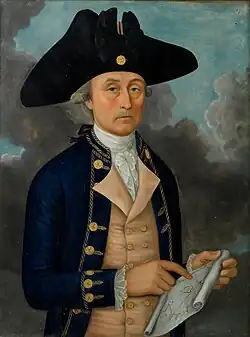
Captain Joseph Huddart – Chinese reverse glass painting from c. 1785 – 1789. Reverse painting on glass is an art form consisting of applying paint to a piece of glass and then viewing the image by turning the glass over and looking through the glass at the image. Another term used to refer to the art of cold painting and gilding on the back of glass is verre églomisé, named after the French decorator Jean-Baptiste Glomy (1711–86), who framed prints using glass that had been reverse-painted. In German it is known as Hinterglasmalerei.
This art form has been around for many years. It was widely used for sacral paintings since the Middle Ages. The most famous was the art of icons in the Byzantine Empire. Later the painting on glass spread to Italy, where in Venice it influenced its Renaissance art. Since the middle of the 18th century, painting on glass became favored by the Church and the nobility throughout Central Europe. A number of clock faces were created using this technique in the early-to-mid-19th century. Throughout the 19th century painting on glass was widely popular as folk art in Austria, Bavaria, Moravia, Bohemia and Slovakia. Unfortunately, during the inter-war period (1914–1945) this traditional "naive" technique fell nearly to a complete oblivion and its methods of paint composition and structural layout had to be re-invented by combining acrylic and oil paints. A new method of reverse painting emerged using polymer glazing methods that permitted the artworks to be painted direct to an acrylic UV coating on the glass. The unique under glass effect retains a curious depth even though the layered painting on the glass was bonded to a final linen support and now stretcher bar mounted after being carefully removed from the original 'glass easel'. Current glass painting may disappear with the advent of using aerospace mylar as a preliminary support. (Full article...)
Image 22
Rangoli, a popular form of Indian sandpainting in Singapore. Sandpainting or drypainting is the art of pouring colored sands, and powdered pigments from minerals or crystals, or pigments from other natural or synthetic sources onto a surface to make a fixed or unfixed sand painting. Unfixed sand paintings have a long established cultural history in numerous social groupings around the globe, and are often temporary, ritual paintings prepared for religious or healing ceremonies. Drypainting is practiced by Native Americans in the Southwestern United States, by Tibetan and Buddhist monks, as well as Indigenous Australians and Latin Americans for festivals. (Full article...)
Image 23
Detail from Seurat's Parade de cirque, 1889, showing the contrasting dots of paint which define Pointillism
Pointillism (/ˈpwæ̃tɪlɪzəm/, also US: /ˈpwɑːn-ˌˈpɔɪn-/) is a technique of painting in which small, distinct dots of color are applied in patterns to form an image.
Georges Seurat and Paul Signac developed the technique in 1886, branching from Impressionism. The term "Pointillism" was coined by art critics in the late 1880s to ridicule the works of these artists, but is now used without its earlier pejorative connotation. The movement Seurat began with this technique is known as Neo-impressionism. The Divisionists used a similar technique of patterns to form images, though with larger cube-like brushstrokes. (Full article...)
Image 24
Overspray refers to the application of any form of paint, varnish, stain or other non-water-soluble airborne particulate material onto an unintended location. This concept is most commonly encountered in graffiti, auto detailing, and when commercial paint jobs drift onto unintended objects. (Full article...)
Need help?
Do you have a question about Painting that you can't find the answer to?
Consider asking it at the Wikipedia reference desk.
Get involved
For editor resources and to collaborate with other editors on improving Wikipedia's Painting-related articles, see WikiProject Painting.
General images
The following are images from various painting-related articles on Wikipedia.
Image 8Francis Picabia, (Left) Le saint des saints c'est de moi qu'il s'agit dans ce portrait, 1 July 1915; (center) Portrait d'une jeune fille americaine dans l'état de nudité, 5 July 1915: (right) J'ai vu et c'est de toi qu'il s'agit, De Zayas! De Zayas! Je suis venu sur les rivages du Pont-Euxin, New York, 1915 (from History of painting)
Image 12Female painter sitting on a campstool and painting a statue of Dionysus or Priapus onto a panel which is held by a boy. Fresco from Pompeii, 1st century (from Painting)
Image 27In 2021, researchers discovered ancient cave art in Leang Tedongnge, Sulawesi, Indonesia, estimated to be at least 45,500 years old. Depicting a warty pig, this artwork is recognized as the world's oldest known example of figurative or representational art. (from History of painting)
Image 28The Three Graces (1636–1638). Museo del Prado, Madrid (from Painting)
Image 33The Eternal Father Painting the Virgin of Guadalupe. Attributed to Joaquín Villegas (1713 – active in 1753) (Mexican) (painter, Museo Nacional de Arte. (from History of painting)
Image 35Loquats and Mountain Bird, anonymous artist of the Southern Song dynasty; paintings in leaf album style such as this were popular in the Southern Song (1127–1279). (from History of painting)
Image 42In 2021, researchers discovered ancient cave art in Leang Tedongnge, Sulawesi, Indonesia, estimated to be at least 45,500 years old. Depicting a warty pig, this artwork is recognized as the world's oldest known example of figurative or representational art. (from Painting)
Image 43The depiction of a bull found in the Lubang Jeriji Saleh, Indonesia, in 2018, is the world's oldest known figurative painting. The painting is estimated to have been created around 40,000 to 52,000 years ago, or even earlier. (from Painting)
Image 44Yun Bing, Album Leaf (17th century), ink and color on paper (from Painting)
Iran says it barred two French embassy employees from returning for allegedly violating the Vienna Convention through activities supporting Iranian civil society. France says their work involved programs for civil society, students, and artists. (Reuters)


 A range-finder painting, sometimes called range-finding painting, is a large landscape painting produced as a training device to help gunners improve their accuracy. Historically, the best-documented use of such paintings was in the United States during World War I. (Full article...)








 Bharat Mata by Abanindranath Tagore (1871–1951), a nephew of the poet Rabindranath Tagore, and a pioneer of the movement (from History of painting)




 19th Century Mysore Painting of Goddess Saraswathi (from Painting)
 A fresco showing Hades and Persephone riding in a chariot, from the tomb of Queen Eurydice I of Macedon at Vergina, Greece, 4th century BC (from History of painting)
 Francis Picabia, (Left) Le saint des saints c'est de moi qu'il s'agit dans ce portrait, 1 July 1915; (center) Portrait d'une jeune fille americaine dans l'état de nudité, 5 July 1915: (right) J'ai vu et c'est de toi qu'il s'agit, De Zayas! De Zayas! Je suis venu sur les rivages du Pont-Euxin, New York, 1915 (from History of painting)

 Spanish cave painting of Bulls (from History of painting)
 The Sakyamuni Buddha, by Zhang Shengwen, 1173–1176 AD, Song dynasty period. (from History of painting)


 A fresco from Cave 1 of Ajanta. (from History of painting)

 Francisco de Zurbarán, Still Life with Pottery Jars (Spanish: Bodegón de recipientes) (1636), oil on canvas, 46 x 84 cm, Museo del Prado, Madrid (from Painting)
 Krishna and Radha, might be the work of Nihâl Chand, master of Kishangarh school of Rajput Painting (from Painting)
 Rudolf Reschreiter, Blick von der Höllentalangerhütte zum Höllentalgletscher und den Riffelwandspitzen, Gouache (1921) (from Painting)

 Gwion Gwion rock paintings found in the north-west Kimberley region of Western Australia c. 15,000 BC (from History of painting)
 Max Beckmann, The Night (Die Nacht), 1918–1919, Kunstsammlung Nordrhein-Westfalen, Düsseldorf (from History of painting)

 Diego Rivera, Recreation of Man at the Crossroads (renamed Man, Controller of the Universe), originally created in 1934, Mexican muralism movement (from History of painting)


 In 2021, researchers discovered ancient cave art in Leang Tedongnge, Sulawesi, Indonesia, estimated to be at least 45,500 years old. Depicting a warty pig, this artwork is recognized as the world's oldest known example of figurative or representational art. (from History of painting)
 The Three Graces (1636–1638). Museo del Prado, Madrid (from Painting)
 Book of Hours (from History of painting)
 Khan Bahadur Khan with Men of his Clan, c. 1815, from the Fraser Album, Company Style (from Painting)

 Maurice Quentin de La Tour, Portrait of Louis XV of France (1748), pastel (from Painting)
 The Eternal Father Painting the Virgin of Guadalupe. Attributed to Joaquín Villegas (1713 – active in 1753) (Mexican) (painter, Museo Nacional de Arte. (from History of painting)

 Loquats and Mountain Bird, anonymous artist of the Southern Song dynasty; paintings in leaf album style such as this were popular in the Southern Song (1127–1279). (from History of painting)
 An Ethiopian illuminated Evangelist portrait of Mark the Evangelist, from the Ethiopian Garima Gospels, 6th century AD, Kingdom of Aksum (from History of painting)
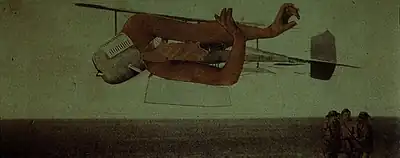
 Jean de Court (attributed), painted Limoges enamel dish in detail (mid-16th century), Waddesdon Bequest, British Museum (from Painting)


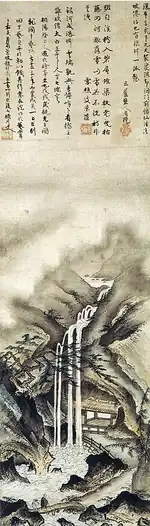 Muromachi period, Shingei (1431–1485), Viewing a Waterfall, Nezu Museum, Tokyo. (from History of painting)
 The depiction of a bull found in the Lubang Jeriji Saleh, Indonesia, in 2018, is the world's oldest known figurative painting. The painting is estimated to have been created around 40,000 to 52,000 years ago, or even earlier. (from Painting)

 Ray Burggraf, Jungle Arc (1998), acrylic paint on wood (from Painting)


 Hand stencils in the "Tree of Life" cave painting in Gua Tewet, Kalimantan, Indonesia (from History of painting)
 White Angel (fresco, c. 1235), Mileševa monastery, Serbia (from Painting)

 Commons
 Wikidata
 Wikiquote
 Wikisource
 Wikiversity
 Wiktionary
 List of all portals






 Random portal
 WikiProject Portals