Portal:Television

The Television Portal

Television (TV) is a telecommunication medium for transmitting moving images and sound. Additionally, the term can refer to a physical television set rather than the medium of transmission. Television is a mass medium for advertising, entertainment, news, and sports. The medium is capable of more than "radio broadcasting", which refers to an audio signal sent to radio receivers.
Television became available in crude experimental forms in the 1920s, but only after several years of further development was the new technology marketed to consumers. After World War II, an improved form of black-and-white television broadcasting became popular in the United Kingdom and the United States, and television sets became commonplace in homes, businesses, and institutions. During the 1950s, television was the primary medium for influencing public opinion. In the mid-1960s, color broadcasting was introduced in the U.S. and most other developed countries.
In 2013, 79% of the world's households owned a television set. The replacement of earlier cathode-ray tube (CRT) screen displays with compact, energy-efficient, flat-panel alternative technologies such as LCDs (both fluorescent-backlit and LED), OLED displays, and plasma displays was a hardware revolution that began with computer monitors in the late 1990s. Most television sets sold in the 2000s were still CRT, and it was only in early 2010s that flat-screen TVs decisively overtook CRT. Major manufacturers announced the discontinuation of CRT, Digital Light Processing (DLP), plasma, and even fluorescent-backlit LCDs by the mid-2010s. LEDs are being gradually replaced by OLEDs. Also, major manufacturers have started increasingly producing smart TVs in the mid-2010s. Smart TVs with integrated Internet and Web 2.0 functions became the dominant form of television by the late 2010s. (Full article...)
Selected article -
Selected image -

A teleprompter (also known as an autocue) is a display device that prompts the person speaking with an electronic visual text of a speech or script. Using a teleprompter is similar to the practice of using cue cards.
Did you know (auto-generated) -

- ... that William, Prince of Wales, inspired the character of Prince Wheeliam in Cars 2?
- ... that broadcaster Van Hackett returned to the industry a decade after lamenting the "trivialization" of television news?
- ... that Demi Sims was described in December 2020 as one of the "very few openly bisexual women on mainstream reality television"?
- ... that television producer Paul Graham insisted on "a big game feel" for the sportscast he considered his "baby"?
- ... that a television series about the forthcoming 2026 FIFA World Cup mentions neither FIFA nor the World Cup?
- ... that Michael Gove, now a member of the House of Lords, appeared on the television quiz show Top Club?
Selected quote -
More did you know

- ...that the Simpsons short Good Night aired April 19, 1987 on The Tracey Ullman Show and was the first ever appearance of the Simpson family on television?
- ...that the air-date of "The Beginning of the End", the fourth season premiere of the television series Lost, means that the season may be interrupted by the 2007 Writers Guild of America strike even if a settlement is reached?
- ...that the proposed BBC television special Planet Relief, created to raise awareness of climate change, was cancelled before it was made, for fear that it would be biased against climate sceptics?
- ...that the color signals of Israel Broadcasting Authority television transmissions were erased until 1981, to insure equality for families who couldn't afford color-tv?
- ...that Great American Country television host Nan Kelley (then Nan Sumrall) became Miss Mississippi in 1985 after her fellow Mississippian Susan Akin was crowned Miss America?
Selected biography -

George Formby (born George Hoy Booth; 26 May 1904 – 6 March 1961) was an English actor, singer-songwriter and comedian who became known to a worldwide audience through his films of the 1930s and 1940s. On stage, screen and record he sang light, comic songs, usually accompanying himself on the ukulele or banjolele, and became the UK's highest-paid entertainer.
Born in Wigan, Lancashire, he was the son of George Formby Sr, from whom he later took his stage name. After an early career as a stable boy and jockey, Formby took to the music hall stage after the early death of his father in 1921. His early performances were taken exclusively from his father's act, including the same songs, jokes and characters. In 1923 he made two career-changing decisions – he purchased a ukulele, and married Beryl Ingham, a fellow performer who became his manager and transformed his act. She insisted that he appear on stage formally dressed, and introduced the ukulele to his performance. He started his recording career in 1926 and, from 1934, he increasingly worked in film to develop into a major star by the late 1930s and 1940s, and became the UK's most popular entertainer during those decades. The film historian Brian McFarlane writes that on film, Formby portrayed gormless Lancastrian innocents who would win through against some form of villainy, gaining the affection of an attractive middle-class girl in the process. (Full article...)
General images
 The earliest photograph of a television picture, showing the face of Oliver Hutchinson in June 1926. The television picture was projected using Baird's television camera. (from History of television)
 This live image of actress Paddy Naismith was used to demonstrate Telechrome, John Logie Baird's first all-electronic color television system, which used two projection CRTs. The two-color image would be similar to the basic Telechrome system. (from Color television)
 The Philco Predicta, 1958. In the collection of The Children's Museum of Indianapolis (from History of television)
 Philo Farnsworth in 1924 (from History of television)
 Hovannes Adamian c. 1900s (from Color television)
 Manfred von Ardenne in 1933 (from History of television)
 Samsung's discontinued Orsay platform (from Smart TV)
 The Nipkow disk. This schematic shows the circular paths traced by the holes, which may also be square for greater precision. The area of the disk outlined in black shows the region scanned. (from History of television)
 Family watching TV, 1958 (from History of television)
 The first mass-produced Czechoslovak TV-set Tesla 4001A (1953–57) (from History of television)
 First television test broadcast transmitted by the NHK Broadcasting Technology Research Institute in May 1939 (from History of television)
 John Logie Baird in 1925 with his televisor equipment and dummies "James" and "Stooky Bill" (right) (from History of television)
 LG Electronics smart TV from 2011 (from Smart TV)
- An early Smart TV from 2012 running the discontinued Orsay platform (from History of television)
 Color bars used in a test pattern, sometimes used when no program material is available (from History of television)
 Comparison of image quality between ISDB-T (1080i broadcast, top) and NTSC (480i transmission, bottom) (from Digital television)
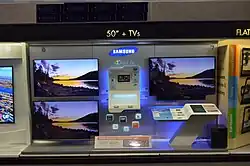 Samsung Smart TVs on display (from Smart TV)
 Tihanyi' Radioskop patent (1926) was recognized as Document of Universal Significance by the UNESCO (from History of television)
 RCA CT-100 at the SPARK Museum of Electrical Invention playing Superman. The RCA CT-100 was the first mass-produced color TV set. (from Color television)
 A map depicting digital terrestrial television standards (from Digital television)
 RCA 630-TS, the first mass-produced television set, which sold in 1946–1947 (from History of television)

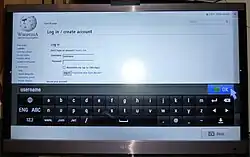 LG smart TV using the Web browser (from Smart TV)
 DBS satellite dishes (from History of television)
 An RCA Victor Color TV ad featuring milliner Lilly Daché in 1959. (from Color television)
 Ad for the beginning of experimental television broadcasting in New York City by RCA in 1939 (from History of television)
 Featured lists -
 The third season of Degrassi: The Next Generation, a Canadian serial teen drama television series, commenced airing in Canada on September 17, 2003 and concluded on April 5, 2004, consisting of twenty-two episodes. This season depicts the lives of a group of high school freshmen and sophomores as they deal with some of the challenges and issues teenagers face such as dysfunctional families, sex, homosexuality, homophobia, theft, self-harm, domestic violence, abortion, emancipation and relationships.
Every episode is named after a song from the 1980s. Filming began on May 26, 2003, and ended in November 2003. (Full article...)- The second season of Seinfeld, an American television series created by Jerry Seinfeld and Larry David, began airing on January 23, 1991, on NBC.
Because of the commencement of the first Gulf War, the second season's premiere was postponed one week. The season comprised 12 episodes, and concluded its initial airing on June 26, 1991. It introduced a number of characters who played significant roles in later episodes, such as Jerry's Uncle Leo and Jerry's neighbor Newman. (Full article...) - The fourth season of the American animated sitcom The Simpsons aired on Fox between September 24, 1992, and May 13, 1993. It began with "Kamp Krusty". The showrunners for the fourth production season were Al Jean and Mike Reiss. The aired season contained two episodes which were hold-over episodes from season three, which Jean and Reiss also ran. Following the end of the production of the season, Jean, Reiss and most of the original writing staff left the show. The season was nominated for two Primetime Emmy Awards and Dan Castellaneta would win one for his performance as Homer and Barney in "Mr. Plow". The fourth season was released on DVD in Region 1 on June 15, 2004, Region 2 on August 2, 2004, and in Region 4 on August 25, 2004. (Full article...)
- This is a list of television episodes from the British television show Press Gang. Press Gang was produced by Richmond Film & Television for Central, and screened on the ITV network in its regular weekday afternoon children's strand, Children's ITV. All 43 episodes across five series were written by Steven Moffat. The first episode was transmitted on 16 January 1989, and the final transmitted on 21 May 1993. The show gained an adult audience in an early evening slot when repeated on Sundays on Channel 4.
The show was based on the activities of the staff of the Junior Gazette, a children's newspaper initially produced by pupils from the local comprehensive school. The main story arc was the on-off romance between the newspaper's editor Lynda Day (Julia Sawalha) and Spike Thomson (Dexter Fletcher). The other main characters were assistant editor Kenny Phillips (Lee Ross), Sarah Jackson (Kelda Holmes), the paper's enterprising accountant Colin Mathews (Paul Reynolds) and Frazz Davies (Mmoloki Chrystie). (Full article...) - The third season of the American serial drama television series Lost commenced airing in the United States and Canada on October 4, 2006, and concluded on May 23, 2007. The third season continues the stories of a group of over 40 people who have been stranded on a remote island in the South Pacific, after their airplane crashed 68 days prior to the beginning of the season. In the Lost universe, the season takes place from November 28 to December 21, 2004. The producers have stated that as the first season is about introducing the survivors and the second season is about the hatch, the third season is about the Others, a group of mysterious island inhabitants.
In response to fan complaints about scheduling in the previous seasons, ABC decided to air the episodes without reruns, albeit in two separate blocks. In the United States, the first block consisted of six episodes aired on Wednesdays at 9:00 pm and after a twelve-week break, the season continued with the remaining 16 episodes at 10:00 pm. In addition, three clip-shows recapped previous events on the show. "Lost: A Tale of Survival" aired a week before the season premiere, "Lost Survivor Guide" aired before the seventh episode and "Lost: The Answers" aired before the season finale. Buena Vista Home Entertainment released the season under the title Lost: The Complete Third Season – The Unexplored Experience on December 11, 2007, in Region 1 on DVD and Blu-ray Disc. (Full article...)
The Bill is a British police procedural television series that ran from 1983 to 2010. The show, whose name is derived from "old bill"—a British slang term for police officers—was unusual among police dramas in that it focused on the lives and work of one shift of police officers, rather than on any particular aspect of police work. The series originated in 1983 as a one-off drama titled Woodentop (another British slang term for the police, derived from the helmets worn by British police officers), written by Geoff McQueen and produced by Thames Television. ITV were sufficiently impressed with Woodentop that they commissioned a full series, which started in 1984 under the title of The Bill. From 2009 until the show's cancellation in 2010, the number of episodes was reduced to one episode a week in a post-watershed slot of 9pm which incorporated a new format and a new theme tune. At the time of the series' end on 31 August 2010 due to a drop in ratings, The Bill was the United Kingdom's longest-running police drama and was among the longest-running of any British television series, having run for almost 27 years.
The Bill has earned various awards and nominations during its run, with the nominations in categories ranging from Best Drama to its camera and editing work to the cast's acting performance. It received nominations for eight awards from the British Academy of Film and Television Arts, winning Best Video Cameraman in 1990 and Best Continuing Drama in 2009—an award for which it was unsuccessfully nominated in a further three years. In addition, The Bill enjoyed success at the Inside Soap Awards, where it won Best Drama six times, including four consecutive wins, as well as a nomination in 2010—losing to Waterloo Road. Other awards include a Writers' Guild of Great Britain award for Best Soap/Continuing Drama Series in 2008, Best Serial Drama at the Digital Spy Soap Awards of the same year and a nomination for Most Popular Overseas Drama at the 2005 Logie Awards. The Bill has also received multiple nominations at the EMMAs, National Television Awards, where it won Most Popular Drama in 1996 and 2004, and six Royal Television Society award nominations, having won awards in 2006 and 2008. (Full article...)- The Best Fighter ESPY Award is an annual award honoring the achievements of an individual from the world of combat sports. The Best Fighter ESPY Award trophy is presented to the professional or amateur boxer or mixed martial artist adjudged to be the best in a given calendar year at the annual ESPY Awards ceremony in Los Angeles. It was first awarded as part of the ESPY Awards in 2007, subsuming the Best Boxer ESPY Award until 2019, when the Best MMA Fighter ESPY Award was established, and the ESPY Awards began awarding boxers and mixed martial arts fighters separately. In 2026, the separate awards were discontinued, and boxers and mixed martial arts fighters were once again nominated together in a single category. Balloting for the award was undertaken by fans over the Internet from between three and five choices selected by the ESPN Select Nominating Committee, which is composed of a panel of experts. It was conferred in July to reflect performance and achievement over the preceding twelve months.
The inaugural winner of the Best Fighter ESPY Award was American welterweight champion Floyd Mayweather Jr., who defeated the incumbent category title holder Oscar De La Hoya two months prior. He is one of three people to have been presented with the award more than once, winning the accolade a total of six times; Mayweather was also nominated in 2015. Filipino boxer Manny Pacquiao and American boxer Terence Crawford are tied for the second-most awards won, with Pacquiao winning in 2009 and 2011 and Crawford in 2018 and 2026. It has been presented to one woman in its history, American bantamweight mixed martial arts fighter Ronda Rousey in 2015. Between 2007 and 2018, boxers were most successful at the ESPY Awards with nine victories and twenty-four nominations, followed by mixed martial arts with three wins and nineteen nominations. (Full article...) 
Game of Thrones is an American fantasy drama television series created by David Benioff and D. B. Weiss. The series is based on George R. R. Martin's series of fantasy novels, A Song of Ice and Fire. The series takes place on the fictional continents of Westeros and Essos, and chronicles the power struggles among noble families as they fight for control of the Iron Throne of the Seven Kingdoms. The series starts when House Stark, led by Lord Eddard "Ned" Stark (Sean Bean), is drawn into schemes surrounding King Robert Baratheon (Mark Addy).
The series premiered on April 17, 2011, on HBO. David Benioff and D. B. Weiss both serve as executive producers, along with Carolyn Strauss, Frank Doelger, Bernadette Caulfield, and George R. R. Martin. Filming for the series took place in a number of locations, including Croatia, Northern Ireland, Iceland, and Spain. Episodes were broadcast on Sunday at 9:00 pm Eastern Time, and the episodes are between 50 and 82 minutes in length. All eight seasons are available on DVD, Blu-ray, and Ultra HD Blu-ray. (Full article...)
The Good Place is an American fantasy comedy television series created by Michael Schur. The series aired for four seasons consisting of a total of fifty-three episodes on NBC from September 19, 2016, to January 30, 2020. It focuses on Eleanor Shellstrop (Kristen Bell), who arrives in the afterlife and is welcomed by Michael (Ted Danson) to "the Good Place", a highly selective Heaven-like utopia he designed. However, she realizes that she was sent there by mistake and must hide her morally imperfect behavior while trying to become a better and more ethical person. William Jackson Harper, Jameela Jamil, and Manny Jacinto co-star as fellow Good Place residents Chidi Anagonye, Tahani Al-Jamil, and Jason Mendoza, respectively, while D'Arcy Carden co-stars as Janet, an artificial being who assists the residents.
During its run, The Good Place received critical acclaim and earned many awards and nominations. The series was nominated for fourteen Primetime Emmy Awards, including two nominations for Outstanding Comedy Series and three nominations for Danson for Outstanding Lead Actor in a Comedy Series. It was also nominated for two Golden Globe Awards, including a nomination for Best Television Series – Musical or Comedy and a nomination for Bell for Best Actress – Television Series Musical or Comedy. In addition, the show was nominated for six Hugo Awards, winning four times for "The Trolley Problem", "Janet(s)", "The Answer", and "Whenever You're Ready". It was nominated for three Nebula Awards, winning one for "Whenever You're Ready", and for three Saturn Awards. In 2017, The Good Place was named by the American Film Institute as one of its top 10 television programs of the year, and in 2019, the show was honored with a Peabody Award for its contributions to entertainment. (Full article...)- The seventh season of the Bleach anime series is named the Arrancar: The Hueco Mundo Sneak Entry arc (破面・虚圏 潜入篇, Arankaru Weko Mundo Sennyū Hen). In the English adaptation of the anime released by Viz Media, the title of the season is translated as The Hueco Mundo. The episodes are directed by Noriyuki Abe, and produced by TV Tokyo, Dentsu, and Studio Pierrot. The season adapts Tite Kubo's Bleach manga series from the rest of the 26th volume to the 28th volume (chapters 229–251), with the exception of episodes 132–137 (filler) and 147–149 (canon expansion). The season follows Ichigo Kurosaki and his friends heading to Hueco Mundo on a journey to save Orihime Inoue, when she was kidnapped by the Arrancar under the command of Sousuke Aizen. Although a small story arc focused on the character Ashido Kanō was not featured in the manga as was originally intended due to timing issues, Kubo helped the anime staff produce the episodes for it.
The season aired from July to December 2007. The English adaptation of the Bleach anime is licensed by Viz Media, and the season aired from July to September 2009 on Cartoon Network's Adult Swim in the United States. Five DVD compilations, each containing four episodes of the season, were released by Aniplex between December 19, 2007, and April 23, 2008, in Japan. While Viz Media released a single DVD volume on September 21, 2010, featuring the season's first episodes, the entire season has only been released within others DVDs. Episodes 132 and 133 were also released in Viz's seventh English DVD box on December 21, 2010. Episodes 134–145 were released on March 22, 2011, as Viz's eighth compilation while the remaining ones were released on June 21, 2011. Manga Entertainment released the first volume from the season on September 26, 2011, while the second one is due to October 17, 2011. A collection of the two volumes was released on December 12, 2011. (Full article...) 
The NBC superhero serial drama series Heroes follows the lives of people around the globe who possess various superhuman powers as they struggle to cope with their everyday lives and prevent foreseen disasters from occurring. The series premiered on American and Canadian television on September 25, 2006. The first season, which finished 21st of 142 American primetime television programs in Nielsen ratings, was released on DVD and HD DVD on August 28, 2007. The second season ranked 21st of 220 in the ratings, and was released on DVD and Blu-ray Disc on August 26, 2008, with the Blu-ray release of the first season. The third season aired in two blocks generally without reruns; it premiered on September 22, 2008, on NBC in the United States and on Global in Canada, with a one-hour clip-show and two regular episodes. The fourth season aired from September 21, 2009, to February 8, 2010. Although cast members had stated and speculated that there would be a fifth season, NBC announced on May 14, 2010, that the show was officially cancelled, but that the network was looking at plans to tie up some loose ends in either a miniseries or TV movie.
Within the seasons of Heroes are "volumes", which focus on shorter story arcs. The first season comprises a single volume of 23 episodes called Genesis, which is also the title of the pilot episode. The second season was designed to contain three volumes called Generations, Exodus, and Villains, but Exodus was scrapped due to viewer criticism and the 2007–08 Writers Guild of America strike. Villains was carried over to the show's third season, leaving the second season with only 11 episodes, 13 fewer than were originally ordered by NBC. The third season included 25 episodes, 13 episodes comprising Villains and 12 episodes in a volume titled Fugitives. The fourth season consisted of a fifth volume of 18 episodes titled Redemption. The final scene of the last episode began a sixth volume entitled Brave New World, which became the title of the first episode of Heroes Reborn. (Full article...)
Gielgud in 1936
Sir John Gielgud (/ˈɡiːlɡʊd/ GHEEL-guud; 1904–2000) was an English actor and theatre director. He appeared on stage, television and radio and in film in a career that spanned eight decades. Film historian Brian McFarlane, writing for the British Film Institute, wrote of Gielgud that "in terms of the performing arts, it is no exaggeration to say that he towered over the century".
Gielgud, a member of the theatrical dynasty the Terry family, began working on stage in 1921 before attending the Royal Academy of Dramatic Art. After completing his studies he worked in repertory theatre and in the West End before establishing himself at the Old Vic in the 1930s. He continued working on the stage until 1990 both as a director and actor. Although he made some films early in his career, he did not start working regularly in the medium until he was in his sixties; in the course of just over thirty years between 1964 and 1998 he appeared in over sixty films. He was active on television and radio, appearing in numerous plays and interviews, and was also in demand as a narrator. (Full article...)- The Best Male Action Sports Athlete ESPY Award is an annual award honoring the achievements of a male athlete from the world of action sports. It was first awarded as part of the ESPY Awards in 2004 after the non-gender-specific Best Action Sports Athlete ESPY Award was presented the previous two years (with American snowboarder Shaun White receiving the 2003 award). The Best Male Action Sports Athlete ESPY Award trophy, created by sculptor Lawrence Nowlan, is presented to the male adjudged to be the best action sports athlete in a given calendar year. Balloting for the award is undertaken by fans over the Internet from between three and five choices selected by the ESPN Select Nominating Committee, which is composed of a panel of experts. It is conferred in July to reflect performance and achievement over the preceding twelve months.
The inaugural winner of the Best Male Action Sports Athlete ESPY Award at the 2004 awards was freestyle BMX rider Ryan Nyquist. During 1997 and 2003, Nyquist won eleven out of eighteen available freestyle BMX medals at the X Games. He became the first freestyle BMX rider to be nominated for, and thus the first to win, an ESPY Award. The 2006 winner of the Best Male Action Sports Athlete ESPY Award was Shaun White. He was nominated a further five consecutive times between the 2008 and 2012 ceremonies, all of which he won, making him the athlete with the most victories with six. The two other athletes to have earned successive awards are street skateboarder Nyjah Huston and motocross rider Ryan Dungey. Canadian snowboarder Mark McMorris became the first non-American to win the accolade in 2017 by earning three medals at that year's X Games in Minneapolis. Snowboarders are the most successful sportspeople with seven awards, followed by motocross riders, with four, and street skateboarders, with three. It was not awarded in 2020 due to the COVID-19 pandemic. The most recent winner of the award was American Motocross and Supercross racer Eli Tomac in 2022. (Full article...)
Parks and Recreation is an American situation comedy created by Greg Daniels and Michael Schur. The show premiered on NBC on April 9, 2009, and concluded on February 24, 2015, after airing seven seasons. The series stars Amy Poehler as Leslie Knope, an ambitious, mid-level bureaucrat working in the Parks and Recreation Department of Pawnee, a fictional town in Indiana. The sitcom features an ensemble cast, including Rashida Jones, Aziz Ansari, Nick Offerman, Aubrey Plaza, Chris Pratt, Adam Scott, Rob Lowe, Paul Schneider, Jim O'Heir and Retta, among others.
The show was nominated for a variety of different awards throughout its run, including sixteen Primetime Emmy Award nominations, twice as a comedy series and twice for writing. Parks and Recreation was also nominated for fifteen Critics' Choice Television Awards (three wins), two Art Directors Guild Awards, four Golden Globe Awards (one win), a Peabody Award (one win), a Producers Guild of America Award, five Satellite Awards, and five Writers Guild of America Awards, among other awards. (Full article...)- Grey's Anatomy is an American television medical drama that debuted on the American Broadcasting Company (ABC), as a mid-season replacement for Boston Legal on March 27, 2005. While creating the show, producers emphasized the casting process. The series has aired for twenty-two seasons, and focuses on the fictional lives of surgical interns and residents, as they gradually evolve into seasoned doctors, while trying to maintain personal lives. The show's premise originated with Shonda Rhimes, who serves as an executive producer, along with Betsy Beers, Mark Gordon, Krista Vernoff, Rob Corn, Mark Wilding, and Allan Heinberg. It is primarily filmed in Los Angeles, California. The series was created to be racially diverse, utilizing a color-blind casting technique. All roles for the series are cast without the characters' races being pre-specified, in keeping with Rhimes' vision of diversity.
The series' protagonist, Meredith Grey, is portrayed by Ellen Pompeo. Pompeo starred in the leading role in Moonlight Mile, which led to her being cast as Meredith. Meredith is assigned to work under Miranda Bailey, the only character developed with a racial description in mind, who is portrayed by Chandra Wilson. On Wilson's addition to the cast Rhimes reported, "[Wilson] is exactly who Miranda is." The other interns working with Meredith under Bailey are Cristina Yang, George O'Malley, Izzie Stevens, and Alex Karev played by Sandra Oh, T.R. Knight, Katherine Heigl and Justin Chambers respectively Chambers' character was not originally part of the pilot but was added later as the fifth and final intern. Oh was initially brought to play the character of Bailey, but she was pressed to read for the role of Cristina instead at the audition. Many actors read for the role of Dr. Derek Shepherd including Isaiah Washington, but when Patrick Dempsey read for the part, "he was just perfect", according to Rhimes. Washington was cast as Burke because the original actor to play Burke had to withdraw. (Full article...)


Television news
- 31 July 2026 – Morocco–Spain relations
- Spanish authorities close the Melilla border crossing with Morocco after around 400 migrants stormed the border barrier. RTVE reports the sound of gunfire and explosions. (AA)
- 7 July 2026 – Iraq in the 2026 Iran war
- Iraqi state television says that former Iranian supreme leader Ali Khamenei's remains has arrived in Iraq's Shi'ite holy city of Najaf for viewing following funeral ceremonies in Tehran and Qom, Iran. (Reuters)
- 6 July 2026 – Impact of the 2026 Iran war on Iran
- Iranian state television reports that Khamenei's body arrives in Qom, where he studied, ahead of a planned procession. (AFP via Al-Ahram)
- 1 July 2026 – Middle Eastern crisis
- Iranian state television reports that a foreign container ship was grounded in shallow waters after using an unapproved route through the strait. (MS Now)
- 28 June 2026 – Mass media in Uganda
- Uganda's military surrounds the offices of Nation Media Group outlets in Kampala after army chief Muhoozi Kainerugaba orders the shutdown of the company's newspapers, television station, and radio networks. (AFP via The Daily Star)
Featured content



Main topics

History of television: Early television stations • Geographical usage of television • Golden Age of Television • List of experimental television stations • List of years in television • Mechanical television • Social aspects of television • Television systems before 1940 • Timeline of the introduction of television in countries • Timeline of the introduction of color television in countries
Inventors and pioneers: John Logie Baird • Alan Blumlein • Walter Bruch • Alan Archibald Campbell-Swinton • Allen B. DuMont • Philo Taylor Farnsworth • Charles Francis Jenkins • Boris Grabovsky • Paul Gottlieb Nipkow • Constantin Perskyi • Boris Rosing • David Sarnoff • Kálmán Tihanyi • Vladimir Zworykin
Technology: Comparison of display technology • Digital television • Liquid crystal display television • Large-screen television technology • Technology of television
Terms: Broadcast television systems • Composite monitor • HDTV • Liquid crystal display television • PAL • Picture-in-picture • Pay-per-view • Plasma display • NICAM • NTSC • SECAM
Categories

WikiProjects
 |
You are invited to participate in WikiProject Television, a WikiProject dedicated to developing and improving articles about Television. |
- Main projects
Entertainment • Television

- Sub-projects
Television Stations • American animation • American television • Australian television • British TV • BBC • Canadian TV shows • Television Game Shows • ITC Entertainment Productions • Digimon • Buffyverse • Doctor Who • Degrassi • EastEnders • Episode coverage • Firefly • Futurama • Grey's Anatomy • Indian television • Lost • Nickelodeon • The O.C. • Professional Wrestling • Reality TV • The Simpsons • Seinfeld • South Park • Stargate • Star Trek • Star Wars • Soap operas • Avatar: The Last Airbender • House
- Related projects
Animation • Anime and manga • Comedy • Comics • Fictional characters • Film • Media franchises
What are WikiProjects?
Things you can do

- Place the {{WikiProject Television}} project banner on the talk pages of all articles within the scope of the project.
- Write: Possible Possum
- Cleanup: color television, Alien Nation: Body and Soul, The Sopranos, Alien Nation: Dark Horizon, Alien Nation: The Enemy Within, Alien Nation: Millennium, Aang
- Expand: Timeline of the introduction of color television in countries
- Stubs: Flow (television), Just for Kicks (TV series), Play of the Month, Nova (Dutch TV series), More stubs...
Subportals
Related portals
Associated Wikimedia
The following Wikimedia Foundation sister projects provide more on this subject:
-
 Commons
Free media repository -
 Wikidata
Free knowledge base -
 Wikiquote
Collection of quotations -
 Wikisource
Free-content library -
 Wikiversity
Free learning tools -
 Wiktionary
Dictionary and thesaurus
-
 List of all portals
-

-

-

-

-

-

-

-

-

-
 Random portal
-
 WikiProject Portals