Portal:Systems science

The systems science portal
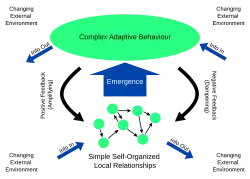 |
| Complex systems approach |
Systems science is a transdisciplinary[1] field that studies the nature of systems—from simple to complex—in nature, society, cognition, engineering, technology and science itself. To systems scientists, the world can be understood as a system of systems. The field aims to develop interdisciplinary foundations that are applicable in a variety of areas, such as psychology, biology, medicine, communication, business management, engineering, and social sciences.
Systems science covers formal sciences such as complex systems, cybernetics, dynamical systems theory, information theory, linguistics or systems theory. It has applications in the field of the natural and social sciences and engineering, such as control theory, operations research, social systems theory, systems biology, system dynamics, human factors, systems ecology, systems engineering and systems psychology. Themes commonly stressed in system science are (a) holistic view, (b) interaction between a system and its embedding environment, and (c) complex (often subtle) trajectories of dynamic behavior that sometimes are stable (and thus reinforcing), while at various 'boundary conditions' can become wildly unstable (and thus destructive). Concerns about Earth-scale biosphere/geosphere dynamics is an example of the nature of problems to which systems science seeks to contribute meaningful insights.
Selected article -

Management cybernetics is concerned with the application of cybernetics to management and organizations. "Management cybernetics" was first introduced by Stafford Beer in the late 1950s and introduces the various mechanisms of self-regulation applied by and to organizational settings, as seen through a cybernetics perspective. Beer developed the theory through a combination of practical applications and a series of influential books. The practical applications involved steel production, publishing and operations research in a large variety of different industries. Some consider that the full flowering of management cybernetics is represented in Beer's books. However, learning continues (see below). (Full article...)
Selected picture

The Lorenz attractor is a 3-dimensional structure corresponding to the long-term behavior of a chaotic flow, noted for its butterfly shape. The map shows how the state of a dynamical system (the three variables of a three-dimensional system) evolves over time in a complex, non-repeating pattern.
The attractor itself, and the equations from which it is derived, were introduced by Edward Lorenz in 1963, who derived it from the simplified equations of convection rolls arising in the equations of the atmosphere.
'WikiProjects
- Wikiproject Systems
- WikiProject Science
- WikiProject Philosophy
- WikiProject History of Science
Selected biography -

Stuart Anspach Umpleby (born March 5, 1944) is an American cybernetician and professor in the Department of Management and Director of the Research Program in Social and Organizational Learning in the School of Business at the George Washington University. (Full article...)
Did you know
- ... that the anthropologist, linguist, and cyberneticist Gregory Bateson's most noted writings are Steps to an Ecology of Mind (1972) and Mind and Nature (1980).
- ... that a successful experimental system must be stable and reproducible enough for scientists to make sense of the system's behavior, but unpredictable enough that it can produce useful results?
- ... * continuing vertically with a science of design,
- ... * and next a science of action, called "Interactive management".
Categories

Related portals
Topics


Tasks
 |
Here are some tasks awaiting attention:
|
Associated Wikimedia
-
 List of all portals
-

-

-

-

-

-

-

-

-

-
 Random portal
-
 WikiProject Portals