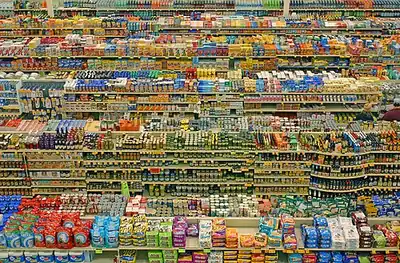
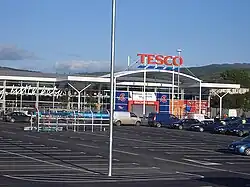
A supermarket is a self-serviceshop offering a wide variety of food, beverages and household products, organized into sections under one roof. The supermarket retail format first appeared around 1930 in the United States as the culmination of almost two decades of retail innovations to the grocery store, and began to spread to other countries after extensive worldwide publicity in 1956. In everyday American English usage, "grocery store" is often used interchangeably with "supermarket", while in other regions a supermarket is larger and has a wider selection, but is smaller and more limited in the range of merchandise than a hypermarket or megastore, which developed decades later.
The supermarket typically has places for fresh meat, fresh produce, dairy, deli items, baked goods, and similar foodstuffs. Shelf space is also reserved for canned and packaged goods and for various non-food items such as kitchenware, household cleaners, pharmacy products and pet supplies. Some supermarkets also sell other household products that are consumed regularly, such as alcohol (where permitted), medicine, and clothing, and some sell a much wider range of non-food products: DVDs, art supplies, sporting equipment, board games, and seasonal items (e.g., Christmaswrapping paper, Easter eggs, school uniforms, Valentine's Day themed gifts, Mother's Day gifts, Father's Day gifts and Halloween).
A larger full-service supermarket combined with a department store is sometimes known as a hypermarket. Other services may include those of banks, cafés, childcare centers/creches, insurance (and other financial services), mobile phone sales, photo processing, video rentals, pharmacies, and filling stations. In the US, if the eatery in a supermarket is substantial enough, the facility may be called a "grocerant", a portmanteau of "grocery" and "restaurant".
The traditional supermarket occupies a large amount of floor space, usually on a single level. It is usually situated near a residential area in order to be convenient to consumers. The basic appeal is the availability of a broad selection of goods under a single roof, at relatively low prices. Other advantages include ease of parking and frequently the convenience of shopping hours that extend into the evening or even 24 hours of the day. Supermarkets usually allocate large budgets to advertising, typically through newspapers and television. They also present elaborate in-shop displays of products. (Full article...)
The group operates the Woolworths supermarket chain in Australia and New Zealand, as well as the smaller Woolworths Metro chain. The group operates the Big W discount department store chain in Australia. In New Zealand, the group operates the SuperValue and FreshChoice supermarkets. The group also owns the Everyday Rewards program, serving both Australia and New Zealand. (Full article...)
The group operates the Woolworths supermarket chain in Australia and New Zealand, as well as the smaller Woolworths Metro chain. The group operates the Big W discount department store chain in Australia. In New Zealand, the group operates the SuperValue and FreshChoice supermarkets. The group also owns the Everyday Rewards program, serving both Australia and New Zealand. (Full article...)
The group operates the Woolworths supermarket chain in Australia and New Zealand, as well as the smaller Woolworths Metro chain. The group operates the Big W discount department store chain in Australia. In New Zealand, the group operates the SuperValue and FreshChoice supermarkets. The group also owns the Everyday Rewards program, serving both Australia and New Zealand. (Full article...)
Image 4
FoodWorks is an Australian supermarket chain run by independent retail group Australian United Retailers (AUR). It is Australia's second largest independent supermarket retailing group behind Metcash, supporting in excess of A$2.6 billion in annual sales at the retail level. Its main competitors are Woolworths, Coles, IGA and Aldi.
The AUR and FoodWorks Management team is led by CEO Rick Wight and Executive General Manager Jon Yarnall. (Full article...)
Image 5
Kirkcaldie & Stains (known informally as Kirkcaldie's or Kirks) was a department store in Wellington, New Zealand. It was established in 1863 by John Kirkcaldie and Robert Stains with a capital of £700. The first store was opened on Lambton Quay. In 1868 Kirkcaldie & Stains moved to its final location at the corner of Lambton Quay and Brandon Street, expanding several times. There was a branch on Cuba Street, Wellington, from 1870 –1876 and one in Napier from 1897 until 1917.
Kirkcaldie & Stains announced on 4 June 2015 that the store would close in January 2016, when the site, after a multi-million dollar refit, would become a David Jones department store. Shareholders approved the plan on 31 July 2015 in a special meeting. The store closed on 16 January 2016. The main store on Lambton Quay reopened as 'David Jones Wellington', a branch of Australian department store chain David Jones, on 28 July 2016. David Jones closed on 12 June 2022. (Full article...)
Image 6
Restaurant Brands New Zealand Limited (RBD), trading as Restaurant Brands, is a New Zealand fast food company. Restaurant Brands currently operates and owns the master franchising rights for the Carl's Jr., KFC, Pizza Hut, and Taco Bell brands in New Zealand. Restaurant Brands operates most of New Zealand's stores for the brands they own rights to and provides management and support services to New Zealand's independent franchisees of the remaining stores. (Full article...)
Image 7
Match is a Belgian multinational chain of supermarkets owned by Louis Delhaize Group. As 2023, the supermarket chain is present with 77 supermarkets in Belgium, 115 in northeast France and 25 in Luxembourg. The network also includes Smatch supermarkets in Belgium and Luxembourg.
Louis Delhaize Group, which owns Cora, Match and Smatch supermarkets, announced in 2023 that it will exit from food retail by selling activities in Belgium to Colruyt, in Luxembourg to E.Leclerc and in France to Carrefour. (Full article...)
Image 8
Haywrights was a New Zealand department store chain that was founded in 1929 and eventually grew to be one of the largest department store chains in New Zealand. (Full article...)
Image 9
Z Energy is a New Zealand fuel distributor with branded service stations. It has been a subsidiary of Australian petroleum company Ampol since May 2022. It owns some of the former assets of Shell New Zealand and Chevron New Zealand.
Shell left the New Zealand fuel distribution business in April 2010, selling its operations to Infratil and the New Zealand Superannuation Fund, with the operations being rebranded as Z Energy in 2011. Z Energy acquired Chevron's New Zealand subsidiary Caltex in June 2016. (Full article...)
FoodWorks is an Australian supermarket chain run by independent retail group Australian United Retailers (AUR). It is Australia's second largest independent supermarket retailing group behind Metcash, supporting in excess of A$2.6 billion in annual sales at the retail level. Its main competitors are Woolworths, Coles, IGA and Aldi.
The AUR and FoodWorks Management team is led by CEO Rick Wight and Executive General Manager Jon Yarnall. (Full article...)
Ed was a French brand of discount stores founded in 1978. It was part of the Carrefour Group and primarily offered food products, with its own brand. It dissolved in 2013, but continues to franchise its name to small-format hard discounts stores in France as part of Promodès. (Full article...)
Image 15
Cotton On Group is an Australian retail company known for its fashion, clothing and stationery brands. As of 2020, it has over 1,500 stores in 18 countries employing 22,000 people across eight brands: Cotton On, Cotton On Kids, Cotton On Body, Factorie, Typo, Rubi, Supré, Ceres and Cotton On Foundation.
The design team in the company's Australian office control the steps of production from merchandise planning to establishing specifications, and production is outsourced to approximately 850 suppliers and factories globally. Cotton On Group sources its materials and products from a number of locations worldwide with the majority of its suppliers being located in China, Bangladesh, India and Australia. It also works with suppliers in Sri Lanka, Hong Kong, the United States, and other parts of Asia. These facilities are used for horizontal division of labour, rather than being integrated. (Full article...)
The overall size of the sector has been increasing since the end of the 1997 Asian financial crisis, with retail sales increasing by 30% between 1999 and 2005. One contributing factor was the growth of larger stores with greater buying power and economies of scale, at the cost of smaller bricks and mortar merchants. Another contributing factor was low price inflation, with the price of imported goods falling 12% during that period. (Full article...)
Image 20
David Jones Pty Ltd, trading as David Jones (colloquially DJs), is an Australian upper mid range department store. It was founded in 1838 by David Jones, a Welsh merchant and future politician, after he emigrated to Australia, and is the oldest continuously operating department store in the world still trading under its original name.
In 1980, the Adelaide Steamship Company acquired a substantial interest in David Jones, culminating in a complete takeover. The recession of the early 1990s caused the department store assets to be floated as "David Jones Limited". For the next two decades, the company went through turbulent times, eventually leading to discussions of a merger with Myer, and then, in 2014, a takeover by South African retail group Woolworths Holdings Limited. In 2016, Woolworths sold the iconic 1938 Market Street store and announced the relocation of David Jones' head office to Richmond, Victoria. In December 2022, David Jones was sold to private equity firm Anchorage Capital Partners for approximately $100m. (Full article...)
Image 21
Mountain Designs is an outdoor clothing and equipment business based in Australia. They sell hiking, rockclimbing and general outdoor and recreational equipment. The company stocks a variety of international and local brands, as well as their own brands of clothing, accessories, sleepwear and bags. (Full article...)
Image 22
Permewan Wright Limited was the third largest chain of grocery stores in Australia in the mid twentieth century trailing Woolworths and Coles.
The company traces its origins to Browne, Osborne & Co. founded in 1854 in Geelong, Victoria. (Full article...)
For editor resources and to collaborate with other editors on improving Wikipedia's Supermarket-related articles, see WikiProject Companies and WikiProject Food and drink.
Related portals
Did you know...
... that the rapper Jords did not know his father was a musician until a chance encounter in a British supermarket?
... that South African president Jacob Zuma requested a tour of a Sainsbury's supermarket during his state visit to the United Kingdom in 2010?
... that Jagoda Lazarević's ministry launched a platform that lets citizens monitor the prices at all 27 major supermarket chains in Serbia?
... that during a 1989 visit to the United States, Boris Yeltsin said that "there would be a revolution" if the average Soviet citizen knew of the quality of grocery stores in the United States?
Two people are killed and three others injured in a mass shooting at a Korean supermarket in Carrollton, Texas, U.S., after a 69-year-old man opened fire on his coworkers at a business meeting. The suspect is taken into custody. (NBC News)
Do you have a question about supermarket-related content on Wikipedia that you can't find the answer to? Consider asking it at the Wikipedia reference desk.