Portal:Spain

The Spain Portal (Bienvenido al portal español)

Spain, officially the Kingdom of Spain, is a country in Southern and Western Europe with territories in North Africa. Featuring the southernmost point of continental Europe, it is the largest country in Southern Europe and the fourth-most populous European Union (EU) member state. Spanning the majority of the Iberian Peninsula, its territory also includes the Canary Islands, in the Eastern Atlantic Ocean; the Balearic Islands, in the Western Mediterranean Sea; and the autonomous cities of Ceuta and Melilla, in mainland Africa. Peninsular Spain is bordered to the north by France, Andorra, and the Bay of Biscay; to the east and south by the Mediterranean Sea, Gibraltar and Morocco (the latter being through its exclaves in North Africa); and to the west by Portugal and the Atlantic Ocean. Spain's capital and largest city is Madrid; other major urban areas include Barcelona, Valencia, Zaragoza, Seville, Bilbao, Málaga, Murcia, Palma de Mallorca and Las Palmas.
In early antiquity, the Iberian Peninsula was inhabited by Iberians, Celts, and other pre-Roman peoples. The Roman conquest of the Iberian Peninsula created the province of Hispania, which became deeply Romanised and later Christianised. After the fall of the Western Roman Empire, the peninsula was conquered by tribes from Central Europe, among them the Visigoths, who established the Visigothic Kingdom centred on Toledo. In the early 8th century, most of the peninsula was conquered by the Umayyad Caliphate, with Al-Andalus centred on Córdoba. The northern Christian kingdoms of Iberia launched the so-called Reconquista, gradually repelling and ultimately expelling Islamic rule from the peninsula, culminating with the fall of the Nasrid Kingdom of Granada. The dynastic union of the Crown of Castile and the Crown of Aragon in 1479 under the Catholic Monarchs is often seen as the de facto unification of Spain as a nation state. (Full article...)
 Featured article –
 Muhammad II (Arabic: محمد الثاني) (also known by the epithet al-Faqih, "the canon-lawyer", c. 1235 – 8 April 1302; reigned from 1273 until his death) was the second Nasrid ruler of the Emirate of Granada in Al-Andalus on the Iberian Peninsula, succeeding his father, Muhammad I. Already experienced in matters of state when he ascended the throne, he continued his father's policy of maintaining independence in the face of Granada's larger neighbours, the Christian kingdom of Castile and the Muslim Marinid state of Morocco, as well as an internal rebellion by his family's former allies, the Banu Ashqilula. (Full article...)
- Muhammad III (Arabic: محمد الثالث; 15 August 1257 – 21 January 1314) was the ruler of the Emirate of Granada in Al-Andalus on the Iberian Peninsula from 8 April 1302 until 14 March 1309, and a member of the Nasrid dynasty. He ascended the Granadan throne after the death of his father Muhammad II, which according to rumours, was caused by Muhammad III poisoning him. He had the reputation of being both cultured and cruel. Later in his life, he became visually impaired—which caused him to be absent from many government activities and to rely on high officials, especially the powerful Vizier Ibn al-Hakim al-Rundi. (Full article...)
- Abu'l-Walid Ismail I ibn Faraj (3 March 1279 – 8 July 1325) was the fifth Nasrid ruler of the Emirate of Granada on the Iberian Peninsula from 1314 to 1325. A grandson of Muhammad II on the side of his mother Fatima, he was the first of the lineage of sultans now known as the al-dawla al-isma'iliyya al-nasriyya (lit. 'the Nasrid dynasty of Ismail'). Historians characterise him as an effective ruler who improved the emirate's position with military victories during his reign. (Full article...)

An M48 Patton tank of the Spanish Army on display at the El Goloso Museum of Armored Vehicles in October 2007.
Tanks in the Spanish Army have over 90 years of history, from the French Renault FTs first delivered in 1919 to the Leopard 2 and B1 Centauro models of the early 21st century. The Spanish FTs took part in combat during the Rif War and participated in the first amphibious landing with tanks in history, at Alhucemas. In 1925, the Spanish Army began to undertake a program to develop and produce a Spanish tank, an upgraded version of the Renault FT, called the Trubia A4. Although the prototype performed well during testing, the tank was never put into mass production. Spain also experimented with the Italian Fiat 3000, acquiring one tank in 1925, and with another indigenous tank program called the Landesa. However, none of these evolved into a major armor program, and as a result the FT remained the most important tank, in numbers, in the Spanish Army until the beginning of the Spanish Civil War. (Full article...)
The Panzer I was a light tank produced by Nazi Germany in the 1930s. Its name is short for Panzerkampfwagen I (German for "armored fighting vehicle mark I"), abbreviated as Pz.Kpfw. I. The tank's official German ordnance inventory designation was Sd.Kfz. 101 ("special purpose vehicle 101"). (Full article...)
Hieronymus Bosch, The Garden of Earthly Delights, oil on oak panels, 205.5 cm × 384.9 cm (81 in × 152 in), Museo del Prado, Madrid
The Garden of Earthly Delights (Dutch: De tuin der lusten, lit. 'The garden of lusts') is the modern title given to a five-panel triptych (three oil-painted panels when open, two oak panels when closed) by the Early Netherlandish master Hieronymus Bosch, between 1490 and 1510, when Bosch was between 40 and 60 years old. Because of Bosch's religious beliefs, interpretations of the work typically assume it is a warning against the perils of temptation. The outer panels place the work on the Third Day of Creation. The intricacy of its symbolism, particularly that of the central panel, has led to a wide range of scholarly interpretations over the centuries. (Full article...)
The Battle of Halmyros, known by earlier scholars as the Battle of the Cephissus or Battle of Orchomenos, was fought on 15 March 1311, between the forces of the Frankish Duchy of Athens and its vassals under Walter of Brienne against the mercenaries of the Catalan Company, resulting in a decisive victory for the mercenaries. (Full article...)
The Battle of Bicocca or La Bicocca (Italian: Battaglia della Bicocca) was fought on 27 April 1522, during the Italian War of 1521–26. A combined French and Venetian force under Odet de Foix, Vicomte de Lautrec, was decisively defeated by an Imperial–Spanish and Papal army under the overall command of Prospero Colonna. Lautrec then withdrew from Lombardy, leaving the Duchy of Milan in Imperial hands. (Full article...)
The Italian War of 1521–1526, sometimes known as the Four Years' War (French: Sixième guerre d'Italie, lit. 'sixth war of Italy'), was a part of the Italian Wars. The war pitted Francis I of France and the Republic of Venice against the Holy Roman Emperor Charles V, Henry VIII of England, and the Papal States. It arose from animosity over the election of Charles as Emperor in 1519–1520 and from Pope Leo X's need to ally with Charles against Martin Luther. (Full article...)
The Battle of the Gebora took place during the Peninsular War between Spanish and French armies on 19 February 1811, northwest of Badajoz, Spain. An outnumbered French force routed and nearly destroyed the Spanish Army of Extremadura. (Full article...)
The Second Punic War (218 to 201 BC) was the second of three wars fought between Carthage and Rome, the two main powers of the western Mediterranean in the 3rd century BC. For 17 years the two states struggled for supremacy, primarily in Italy and Iberia, but also on the islands of Sicily and Sardinia and, towards the end of the war, in North Africa. After immense materiel and human losses on both sides, the Carthaginians were once again defeated. Macedonia, Syracuse and several Numidian kingdoms were drawn into the fighting, and Iberian and Gallic forces fought on both sides. There were three main military theatres during the war: Italy, where Hannibal defeated the Roman legions repeatedly, with occasional subsidiary campaigns in Sicily, Sardinia and Greece; Iberia, where Hasdrubal, a younger brother of Hannibal, defended the Carthaginian colonial cities with mixed success before moving into Italy; and Africa, where Rome finally won the war. (Full article...)
The black stork (Ciconia nigra) is a large bird in the stork family Ciconiidae. It was first described by Carl Linnaeus in the 10th edition of his Systema Naturae. Measuring on average 95 to 100 cm (37 to 39 in) from beak tip to end of tail with a 145-to-155 cm (57-to-61 in) wingspan, the adult black stork has mainly black plumage, with white underparts, long red legs and a long pointed red beak. A widespread but uncommon species, it breeds in scattered locations across Europe (predominantly in Portugal and Spain, and central and eastern parts), and east across the Palearctic to the Pacific Ocean. It is a long-distance migrant, with European populations wintering in tropical Sub-Saharan Africa, and Asian populations in the Indian subcontinent. When migrating between Europe and Africa, it avoids crossing broad expanses of the Mediterranean Sea and detours via the Levant in the east, the Strait of Sicily in the center, or the Strait of Gibraltar in the west. An isolated non-migratory population lives in Southern Africa. (Full article...)
The Rokeby Venus (/ˈroʊkbi/ ROHK-bee; also known as The Toilet of Venus, Venus at her Mirror, Venus and Cupid and, in Spanish, La Venus del espejo) is a painting by Diego Velázquez, the leading artist of the Spanish Golden Age. Completed between 1647 and 1651, and probably painted during the artist's visit to Italy, the work depicts the goddess Venus in a sensual pose, lying on a bed with her back facing the viewer, and looking into a mirror held by the Roman god of physical love, her son Cupid. The painting is in the National Gallery, London. (Full article...)
Alfonso XIII was the second of three España-class battleships built in the 1910s for the Spanish Navy. Named after King Alfonso XIII of Spain, the ship was not completed until 1915 owing to a shortage of materials that resulted from the start of World War I the previous year. The España class was ordered as part of a naval construction program to rebuild the fleet after the losses of the Spanish–American War; the program began in the context of closer Spanish relations with Britain and France. The ships were armed with a main battery of eight 305 mm (12 in) guns and were intended to support the French Navy in the event of a major European war. (Full article...)
A carillonist plays the 56-bell carillon of the Plummer Building in Rochester, Minnesota, US
A carillon is a pitched percussion instrument that is played with a keyboard and consists of at least 23 bells. The bells are cast in bronze, hung in fixed suspension, and tuned in chromatic order so that they can be sounded harmoniously together. They are struck with clappers connected to a keyboard of wooden batons played with the hands and pedals played with the feet. Often housed in bell towers, carillons are usually owned by churches, universities, or municipalities. They can include an automatic system through which the time is announced and simple tunes are played throughout the day. (Full article...)
North View of Gibraltar from Spanish Lines by John Mace (1782)
The history of Gibraltar, a small peninsula on the southern Iberian coast near the entrance of the Mediterranean Sea, spans over 2,900 years. The peninsula was a place of reverence in ancient times, and it later became "one of the most densely fortified and fought-over places in Europe". Gibraltar's location has given it an outsized role in the history of Europe. Its fortified town, established in the Middle Ages, has hosted garrisons that have fought in numerous sieges and battles over the centuries. The Rock of Gibraltar is a limestone monolith and fortress in Gibraltar that has held historical and military significance and has become a tourist attraction. (Full article...)- The battle of New Carthage took place in early 209 BC when a Roman army under Publius Cornelius Scipio successfully assaulted New Carthage, the capital of Carthaginian Iberia, which was defended by a garrison under Mago. The battle was part of the Second Punic War. (Full article...)
The Spanish conquest of Petén was the last stage of the conquest of Guatemala, a prolonged conflict during the Spanish colonisation of the Americas. A wide lowland plain covered with dense rainforest, Petén contains a central drainage basin with a series of lakes and areas of savannah. It is crossed by several ranges of low karstic hills and rises to the south as it nears the Guatemalan Highlands. The conquest of Petén, a region now incorporated into the modern republic of Guatemala, climaxed in 1697 with the capture of Nojpetén, the island capital of the Itza kingdom, by Martín de Ursúa y Arizmendi. With the defeat of the Itza, the last independent and unconquered native kingdom in the Americas fell to European colonisers. (Full article...)
The European rabbit (Oryctolagus cuniculus) or coney is a species of rabbit native to the Iberian Peninsula and southwestern France. It has been introduced to hundreds of locations around the world. Wild and domesticated European rabbits around the world can vary widely in size, shape, and colour. The average adult European rabbit is smaller than the European hare, though size and weight vary with habitat and diet. (Full article...)
Europejara is a genus of tapejarid pterosaur that lived during the Barremian age of the Early Cretaceous epoch in what is now Spain. The only known specimen was found at the Las Hoyas site of Cuenca, a location noted for its exceptional Konservat-Lagerstätte preservation. In 2012, the new genus and species Europejara olcadesorum was named based on it. The generic name refers to Europe, where it was found, and to the related genus Tapejara from what is now Brazil, while the specific name refers to the Olcades, an ancient people that lived in the region. The holotype specimen consists of an incomplete, crushed skull; the bones of the postorbital region are displaced while the mandible is almost complete. (Full article...)
The AMX-30E (E stands for España, Spanish for Spain) is a Spanish main battle tank based on France's AMX-30. Although originally the Spanish government sought to procure the German Leopard 1, the AMX-30 was ultimately awarded the contract due to its lower price and the ability to manufacture it in Spain. 280 units were manufactured by Santa Bárbara Sistemas for the Spanish Army, between 1974 and 1983. (Full article...)- The Colossus of Rhodes is a 1954 oil painting by the Spanish surrealist Salvador Dalí. It is one of a series of seven paintings he created for the 1956 film Seven Wonders of the World, each depicting one of the wonders. The work shows the Colossus of Rhodes, the ancient statue of the Greek titan-god of the sun, Helios. The painting was not used for the film and was donated to the Kunstmuseum Bern in 1981, where it remains. (Full article...)
- Nasr (1 November 1287 – 16 November 1322), full name Abu al-Juyush Nasr ibn Muhammad (Arabic: أبو الجيوش نصر بن محمد), was the fourth Nasrid ruler of the Emirate of Granada from 14 March 1309 until his abdication on 8 February 1314. He was the son of Muhammad II al-Faqih and Shams al-Duha. He ascended the throne after his brother Muhammad III was dethroned in a palace revolution. At the time of his accession, Granada faced a three-front war against Castile, Aragon and the Marinid Sultanate, triggered by his predecessor's foreign policy. He made peace with the Marinids in September 1309, ceding to them the African port of Ceuta, which had already been captured, as well as Algeciras and Ronda in Europe. Granada lost Gibraltar to a Castilian siege in September, but successfully defended Algeciras until it was given to the Marinids, who continued its defense until the siege was abandoned in January 1310. James II of Aragon sued for peace after Granadan defenders defeated the Aragonese siege of Almería in December 1309, withdrawing his forces and leaving the Emirate's territories by January. In the ensuing treaty, Nasr agreed to pay tributes and indemnities to Ferdinand IV of Castile and yield some border towns in exchange for seven years of peace. (Full article...)
- El Alma al Aire (transl. The Bared Soul) is the sixth studio album by Spanish singer-songwriter Alejandro Sanz. It was released on 25 September 2000 by Warner Music Spain, following the success of Más (1997) and his hiatus from the music scene in 1999. El Alma al Aire is a pop album, which in comparison to its predecessor, leans more towards ballads. The album was produced by Sanz's frequent collaborator Emanuele Ruffinengo, while other musicians, including Vicente Amigo, returned to collaborate with him following Más. (Full article...)
Doménikos Theotokópoulos (Greek: Δομήνικος Θεοτοκόπουλος, pronounced [ðoˈminikos θeotoˈkopulos]; 1 October 1541 – 7 April 1614), most widely known as El Greco (Spanish pronunciation: [el ˈɣɾeko]; "The Greek"), was a Greek painter, sculptor and architect of the Spanish Renaissance, regarded as one of the greatest artists of all time. El Greco was a nickname, and the artist normally signed his paintings with his full birth name in Greek letters often adding the word Κρής (Krḗs), which means "Cretan" in Ancient Greek. (Full article...)


Selected biography

Sebastián Francisco de Miranda y Rodríguez (March 28, 1750 – July 14, 1816), commonly known as Francisco de Miranda, was a Venezuelan revolutionary. Although his own plans for the independence of the Spanish American colonies failed, he is regarded as a forerunner of Simón Bolívar, who during the South American wars of independence successfully liberated a vast portion of South America. Miranda led a romantic and adventurous life. An idealist, he developed a visionary plan to liberate and unify all of Spanish America. His military initiatives failed in 1812, and he was handed over to his enemies, dying four years later in a Spanish prison dungeon. Within fourteen years of his death, most of Spanish America was independent.
Born and raised in Caracas, Miranda was the son of a wealthy merchant from the Canary Islands, a region of Spain. He traveled throughout Europe, becoming a social sensation and garnering support for the independence of Spanish America. He had made friends with many important leaders and political figures throughout Europe, such as British Prime Minister William Pitt the Younger, and Catherine the Great of Russia, with whom supposedly he had an affair (most historians do not give much credence to the affair story). In the American Revolutionary War, he commanded Spanish troops aiding American insurgents in Florida and Mississippi. In the United States, he met George Washington, Thomas Paine, Alexander Hamilton, and Thomas Jefferson. He had a home in London, where he married a British lady and had two children. During this time he met Colonel William S. Smith secretary to John Adams's American Legation.
Selected picture
 Photograph: Diego DelsoThe Assut de l'Or Bridge is a white single-pylon cable-stayed bridge in the City of Arts and Sciences, Valencia, Spain. Completed in 2008, it was designed by Valencian architect and civil engineer Santiago Calatrava as a variant of his cantilever spar cable-stayed bridge in Seville.
 Photograph: Benny TrappThe Spanish painted frog (Discoglossus jeanneae) is a species of frog in the family Alytidae. Endemic to Spain, it mostly lives in open areas, pine groves and shrublands. It feeds mostly on insects and worms.
 Gaspar de Guzmán, Count-Duke of Olivares (1587–1645) was a Spanish royal favourite of Philip IV and minister. As prime minister from 1621 to 1643, he over-exerted Spain in foreign affairs and unsuccessfully attempted domestic reform. His policies of committing Spain to recapture the Dutch Republic led to his major involvement in the Thirty Years War. This portrait was completed in 1634, with its composition referring to Olivares' military leadership in the service of King Philip.
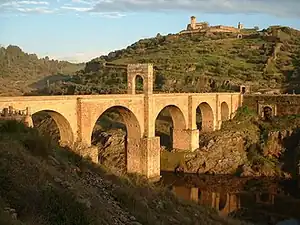
Alcántara bridge Credit:
The Roman bridge of Alcántara, located in the province of Cáceres, Extremadura.
Timanfaya National Park Credit: Yummifruitbat
Timanfaya National Park (Spanish: Parque Nacional de Timanfaya) is a national park, covering the southern area of Tinajo, Las Palmas and the northern area of Yaiza, Las Palmas. The parkland is made up of volcanic soil, with the strongest recorded eruptions occurring between 1730 and 1736.
Aneto Peak Credit: BrugesFR
Aneto is a mountain located in Benasque municipality, Aragon, area of the Pyreenes. The mountain is the highest mountain in the Pyrenees, and Spain's third-highest mountain. Painting: Francisco GoyaThe Third of May 1808 is a painting completed in 1814 by the Spanish master Francisco Goya, now in the Museo del Prado, Madrid. Along with its companion piece of the same size, The Second of May 1808 (or The Charge of the Mamelukes), it was commissioned by the provisional government of Spain at Goya's suggestion. Goya sought to commemorate Spanish resistance to Napoleon's armies during the Peninsular War.

An exterior view of the Museo del Prado. The Museo del Prado is a museum and art gallery located in Madrid; the capital of Spain. It features one of the world's finest collections of European art, from the 12th century through the early 19th century, based on the former Spanish Royal Collection. Banknote: Bank of SpainThe Spanish peseta is a former currency of Spain and, alongside the French franc, a former de facto currency in Andorra. It was introduced in 1868, replacing the peso, at a time when Spain was considering joining the Latin Monetary Union. Spain joined the euro in 1999, and the peseta was replaced by euro notes and coins in 2002.
This picture shows a 1000 peseta banknote from 1957. The obverse depicts the Catholic Monarchs while the reverse shows the coat of arms of Spain.
Las Médulas mine. Credit: Rayet
Las Médulas, located near the town of Ponferrada in León province, Spain, used to be the most important gold mine in the Roman Empire. Las Médulas Cultural Landscape is listed by the UNESCO as one of the World Heritage Sites. Painting: Marià FortunyThe Spanish Wedding is an oil on panel painting by Marià Fortuny completed over a two-year period ending in 1870. It depicts the signing of a wedding contract in 18th century Spain and was influenced heavily by the works of Francisco Goya, whom the artist admired. It is currently exhibited at the National Art Museum of Catalonia.
 Photo: Mick StephensonThe peaks of the Central Massif overlook the village of Sotres in Cabrales, located in the Picos de Europa, a mountain range in northern Spain forming part of the Cantabrian Mountains. The name (literally: "Peaks of Europe") is believed to derive from being the first European landforms visible to mariners arriving from the Americas.
 Photo credit: DiliffA stitched panorama taken from St Jerome, the summit of Montserrat, a 1,236 m (4,055 ft) mountain near Barcelona, Spain. The mountain's name means "jagged mountain" and is used because of the peculiar aspect of the formation, which is visible from a great distance.
 Photograph credit: Biblioteca Nacional de EspañaAna Santos Aramburo (born 1957) has been the director of the National Library of Spain since February 2013. Having received a degree in geography and history from the University of Zaragoza in Spain, she has spent much of her career working at the Complutense University of Madrid, first at the library of the Faculty of Economics and Business Sciences, and later serving as deputy director of the university library. Later she served as Director of the Historical Library Marquis of Valdecilla, General Director of Libraries and Archives of the City of Madrid, and Director of Cultural Action at the National Library. This photograph of Santos shows her at the headquarters of the National Library of Spain in Madrid.

A view of Barcelona Free Port. Credit: Lofor
The Barcelona Free Port or Zona franca de Barcelona is a tariff-free industrial park that has developed within the Port of Barcelona, across the flat land of the Llobregat delta between the city of Barcelona and Barcelona International Airport to the south. Painting credit: Federico de Madrazo y KuntzAmalia de Llano (April 29, 1822 – July 6, 1874) was a Spanish countess and writer. This 1853 oil-on-canvas portrait by Federico de Madrazo y Kuntz shows her seated in a fine armchair wearing sumptuous clothes, with her youth and beauty accentuated by the dark background, and is quite unlike a traditional Spanish portrait of the period.
 Photo credit: David IliffThe Tagus River, seen here passing through the World Heritage listed city of Toledo, Spain. It is the longest river on the Iberian Peninsula at 1,038 kilometres (645 mi). It begins its journey in the Albarracín mountains in Spain, and follows a very constricted course for much of its length before reaching the Atlantic Ocean in Portugal.
 Photo credit: DiliffThe Torre Agbar is a landmark skyscraper and the third tallest building in Barcelona, Spain. It was designed by French architect Jean Nouvel, who stated that the shape of the Torre Agbar was inspired by the mountains of Montserrat that surround Barcelona, and by the shape of a geyser of water rising into the air. Its design combines a number of different architectural concepts, resulting in a striking structure built with reinforced concrete, covered with a facade of glass, and over 4,500 window openings cut out of the structural concrete.
 Artist: UnknownFerdinand I, Holy Roman Emperor, is represented in this anonymous portrait as a young archduke in his native Spain. He left Spain in his early twenties, to start his life as future King of the Romans and successor to his grandfather, Maximilian I. His older brother Charles eventually succeeded as Holy Roman Emperor, but Ferdinand was elected after Charles's abdication. Philip, Charles's son, inherited Spain and became King Philip II of Spain. Ferdinand ruled between 1558 and 1564, for nearly six years.

Pablo Picasso Credit: TyreniusPablo Picasso (October 25, 1881 — April 8, 1973) was an artist and sculptor. Picasso was born in Málaga, Spain. This image was taken of him in 1962, eleven years before his death. Photograph: J.Ligero & I.BarriosA three-month old Spanish ibex (Capra pyrenaica) in Sierra de Gredos, Spain. These ibexes are strong mountain animals characterized by their large and flexible hooves and short legs.
The two sexes of adults form separate social groups; juveniles stay with the female groups from birth until the following birth season, when they leave. Yearling males then join male groups, while females eventually return to their mothers' groups and stay several years. Photo credit: David IliffThe Queen Sofia Palace of the Arts (Valencian: Palau de les Arts Reina Sofía) is an opera house located in Valencia, Spain. The last to be completed of the City of Arts and Sciences complex, it was designed by architect Santiago Calatrava. The 14-story structure opened on 8 October 2005.
Did you know...
- ... that Manuel García de Sena's 1811 translation of U.S. founding documents into Spanish influenced the first constitutions of Argentina, Chile, Mexico, Uruguay and Venezuela?
- ... that a song uses satire in Spanish and English to critique anti-Mexican sentiment in the U.S. and anti-American sentiment in Mexico?
- ... that a fixture of Madrid nightlife in the 1990s was a trans woman who was often seen at concerts wearing a large picture hat?
- ... that the 12th-century murals of Sant Quirze de Pedret were featured on Spanish Tourism Board posters in 1930?
- ... that the 12th-century murals of Sant Quirze de Pedret were featured on Spanish Tourism Board posters in 1930?
- ... that chloroform extracts from the seeds of the Spanish fennel flower have exhibited anti-inflammatory properties?
 Good article –
Luis Buñuel Portolés (Spanish: [ˈlwis βuˈɲwel poɾtoˈles]; 22 February 1900 – 29 July 1983) was a Spanish filmmaker who worked in Spain, Mexico and France. Buñuel is noted for his distinctive use of mise-en scene, distinctive sound editing, and original use of music in his films. Often Buñuel applies the techniques of mise-en-scène to combine multiple single scenes within a film directed by him to represent more encompassing aspects of the film when viewed as a whole. (Full article...)- Pic-Nic was a Spanish teenage folk-pop and sunshine pop band formed in Barcelona in the mid-to-late 1960s, composed of lead singer Jeanette, guitarists Toti Soler and Al Cárdenas, drummer Jordi Barangé and bassist Isidoro "Doro" de Mentaberry. Although keyboardist Jordi Sabatés is often mentioned as a member of the band, he does not appear on any of the group's releases, having joined after their only published recording sessions had taken place. Pic-Nic was the successor to the short-lived group Brenner's Folk, originally founded by German-Venezuelan brothers Haakon and Vytas Brenner together with Soler, Barangé and Jeanette, an English girl who had recently moved to Spain after being raised in the United States. After releasing a four-song extended play for the label Edigsa in 1966, the Brenner brothers left the band, being replaced by Cárdenas and de Mentaberry. (Full article...)
The grey heron (Ardea cinerea) is a long-legged wading bird of the heron family, Ardeidae, native throughout temperate Europe and Asia, and also parts of Africa. It is resident in much of its range, but some populations from the more northern parts migrate southwards in autumn. A bird of wetland areas, it can be seen around lakes, rivers, ponds, marshes and on the sea coast. It feeds mostly on aquatic creatures which it catches after standing stationary beside or in the water, or stalking its prey through the shallows. (Full article...)
Hadrian (/ˈheɪdriən/ ⓘ HAY-dree-ən; born Publius Aelius Hadrianus, 24 January 76 – 10 July 138) was Roman emperor from 117 to 138. His form of address as Roman emperor was Imperator Caesar Traianus Hadrianus Augustus. Hadrian was born in Italica, in the present-day Andalusian province of Seville in southern Spain, an Italic settlement in Hispania Baetica; his gens Aelia came from the town of Hadria in central Italy. He was a member of the Nerva–Antonine dynasty. (Full article...)
The Battle of Zutphen was fought on 22 September 1586, near the village of Warnsveld and the town of Zutphen, the Netherlands, during the Eighty Years' War and the Anglo-Spanish War (1585–1604). It was fought between the forces of the United Provinces of the Netherlands, aided by the English, against the Spanish. In 1585, England signed the Treaty of Nonsuch with the States-General of the Netherlands and formally entered the war against Spain. Robert Dudley, Earl of Leicester, was appointed as the Governor-General of the Netherlands and sent there in command of an English army to support the Dutch rebels. When Alessandro Farnese, Duke of Parma and commander of the Spanish Army of Flanders, besieged the town of Rheinberg during the Cologne War, Leicester, in turn, besieged the town of Zutphen, in the province of Gelderland and on the eastern bank of the river IJssel. (Full article...)
Teresa Mañé i Miravet (1865–1939), also known by her pen name Soledad Gustavo, was a Catalan teacher, editor and writer. As a proponent of progressive education, Mañé founded some of the first secular schools in Catalonia. With her husband Joan Montseny, she edited the magazine La Revista Blanca, in which she elaborated her ideas on anarchism, feminism and pedagogy. Her daughter Frederica Montseny i Mañé went on to become a leading figure in the Spanish anarchist movement and the Minister of Health of the Second Spanish Republic. (Full article...)
Marina de Escobar Montaña (8 February 1554 – 9 June 1633) was a Spanish Catholic mystic of the Counter-Reformation era. Restricted in her activity due to poor health, she devoted herself to prayer and contemplation under the guidance of her Jesuit confessors and spiritual advisors. Marina experienced visions of a number of saints, and within her lifetime she acquired a reputation throughout Spain as a holy woman, especially in her home city of Valladolid. (Full article...)
The Cagots (pronounced [ka.ɡo]) were a persecuted minority who lived in the west of France and northern Spain: the Navarrese Pyrenees, Basque provinces, Béarn, Aragón, Gascony and Brittany. Evidence of the group exists as far back as 1000 CE. The name they were known by varied across the regions where they lived. (Full article...)
The Spanish coup of July 1936 was a military uprising against the Second Spanish Republic launched on 17–18 July 1936 by a coalition of conservative, monarchist, and far-right officers and civilians. Planned chiefly by Generals Emilio Mola and José Sanjurjo and joined by Francisco Franco, it was intended to overthrow the Popular Front government and replace it with an authoritarian regime. Instead of securing a rapid transfer of power, the coup only partially succeeded and precipitated the Spanish Civil War. (Full article...)- "Rhythm Divine" is a song by Spanish singer Enrique Iglesias from his fourth studio album, Enrique (1999). The song was written by Paul Barry and Mark Taylor with Taylor and Brian Rawling handling its production. It is a dance-pop rhythmic romantic ballad that mixes with Latin and Mediterranean music. Lyrically, Iglesias asks the listener if they can hear the rhythm, and one music journalist compared it to USA for Africa's "We Are the World" (1985). A Spanish-language translation of the song titled "Ritmo Total" was also recorded and features additional lyrical contributions by Rafael Pérez-Botija. (Full article...)

Girl with a Mandolin (Fanny Tellier) is a 1910 Cubist painting by Pablo Picasso. The artwork was one of Picasso’s early Analytic Cubist creations, through which he aimed to reduce organic forms to geometric shapes. It shows the model Fanny Tellier in the nude, with her hands on a mandolin. Tellier volunteered to model for Picasso but, according to the latter, eventually refused to continue sitting for him after the painting took longer to complete than she had expected. Picasso accordingly left the portrait unfinished, though later suggested that he could have done nothing further to improve it. (Full article...)
The Alconétar Bridge (Spanish: Puente de Alconétar), also known as Puente de Mantible, was a Roman segmental arch bridge in the Extremadura region, Spain. The ancient structure, which featured flattened arches with a span-to-rise ratio of 4–5:1, is one of the earliest of its kind. Its design suggests that the bridge was erected in the early 2nd century AD by the emperors Trajan or Hadrian, possibly under the guidance of Apollodorus of Damascus, the most famous architect of the time. (Full article...)- Mad Dogs is a British psychological thriller television series, written and created by Cris Cole, that began airing on Sky1 on 10 February 2011, and ended on 29 December 2013 after four series and 14 episodes. It is produced by Left Bank Pictures, and co-produced by Palma Pictures. The series stars John Simm, Marc Warren, Max Beesley, and Philip Glenister as four long-time and middle-aged friends getting together in a villa in Majorca to celebrate the early retirement of their friend Alvo (Ben Chaplin). After Alvo is murdered, the group find themselves caught up in the world of crime and police corruption. (Full article...)
- The Reina Victoria Eugenia class was a class of three battleships of the Spanish Navy authorized as the Plan de la Segunda Escuadra under the Navy Law of 1913. The class, as well as the lead ship, were named for King Alfonso XIII's English queen consort, Victoria Eugenie of Battenberg. The other two ships were classified as "B" and "C". It was supposed to be designed by Vickers-Armstrongs, and built by John Brown. The ships were never built due to Britain's involvement in World War I, which halted all foreign projects being constructed in British yards. (Full article...)
After the Spanish general election of 3 March 1996 failed to deliver an overall majority for any political party, extensive negotiations ensued to form a government in the country. As a result, the previous cabinet headed by Felipe González was forced to remain in a caretaker capacity for 62 days until the next government could be sworn in, the longest cabinet formation period in Spain until that time, to be surpassed only in 2015–2016. (Full article...)- "Eaea" (IPA: [eːäeːä]) is a song by Spanish singer Blanca Paloma. The song was co-written by Blanca Paloma alongside José Pablo Polo and Álvaro Tato, with Polo serving as the song's solo producer. It was released on 20 December 2022 through Universal. The song represented Spain in the Eurovision Song Contest 2023, where it finished in 17th at the final with 100 points. (Full article...)

The current Basque coat of arms (Euskal autonomi erkidegoaren armarria) is the official coat of arms of the Basque Country, an autonomous community of Spain. It consists of a party per cross representing the three historical territories of Álava, Gipuzkoa and Biscay, as well as a fourth, void quarter. The arms are ringed by a regal wreath of oak leaves, symbolic of the Gernikako Arbola. The fourth quarter constituted since the late 19th century the linked chains of Navarre; however, following a legal suit by the Navarre Government claiming that the usage of the arms of a region on the flag of another was illegal, the Constitutional Court of Spain ordered the removal of the chains of Navarre in a judgement of 1986. (Full article...)- The long term causes of the Spanish Civil War date back to the end of the 19th century, when the owners of large estates, called latifundios, held most of the power in a land-based oligarchy. The landowners' power was unsuccessfully challenged by the industrial and merchant sectors. In 1868 popular uprisings led to the overthrow of Queen Isabella II of the House of Bourbon. In 1873 Isabella's replacement, King Amadeo I of the House of Savoy, abdicated due to increasing political pressure, and the short-lived First Spanish Republic was proclaimed. After the restoration of the Bourbons in December 1874, Carlists and anarchists emerged in opposition to the monarchy. Alejandro Lerroux helped bring republicanism to the fore in Catalonia, where poverty was particularly acute. Growing resentment of conscription and of the military culminated in the Tragic Week in Barcelona in 1909. After the First World War, the working class, the industrial class, and the military united in hopes of removing the corrupt central government, but were unsuccessful. Fears of communism grew. A military coup brought Miguel Primo de Rivera to power in 1923, and he ran Spain as a military dictatorship. Support for his regime gradually faded, and he resigned in January 1930. There was little support for the monarchy in the major cities, and King Alfonso XIII abdicated; the Second Spanish Republic was formed, whose power would remain until the culmination of the Spanish Civil War. Monarchists would continue to oppose the Republic. (Full article...)
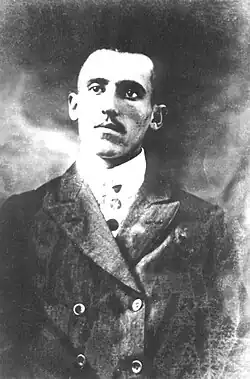
Simón Radowitzky (Yiddish: סימאָן ראַדאָוויצקי; 1891–1956) was a Ukrainian-Argentine anarchist militant, known for his assassination of Buenos Aires police chief Ramón Lorenzo Falcón. (Full article...)
The twelfth siege of Gibraltar was fought between September 1704 and May 1705 during the War of the Spanish Succession. It followed the capture in August 1704 of the fortified town of Gibraltar, at the southern tip of Spain, by an Anglo–Dutch naval force led by Sir George Rooke and Prince George of Hesse-Darmstadt. The members of the Grand Alliance, the Holy Roman Empire, England, the Netherlands, Pro-Habsburg Spain, Portugal and Savoy, had allied to prevent the unification of the French and Spanish thrones by supporting the claim of the Habsburg pretender Archduke Charles VI of Austria as Charles III of Spain. They were opposed by the rival claimant, the Bourbon Philip, Duke of Anjou, ruling as Philip V of Spain, and his patron and ally, Louis XIV of France. The war began in northern Europe and was largely contained there until 1703, when Portugal joined the confederate powers. From then, English naval attentions were focused on mounting a campaign in the Mediterranean to distract the French navy and disrupt French and Bourbon Spanish shipping or capture a port for use as a naval base. The capture of Gibraltar was the outcome of that initial stage of the Mediterranean campaign. (Full article...)
The House of Flowers (Spanish: La Casa de las Flores) is a Mexican dark comedy drama television series created by Manolo Caro for Netflix. It depicts a dysfunctional upper-class Mexican family that owns a prestigious floristry shop and a struggling cabaret, both called 'The House of Flowers'. The series, almost entirely written and directed by its creator, stars Verónica Castro, Cecilia Suárez, Aislinn Derbez, Darío Yazbek Bernal, Arturo Ríos, Paco León, Juan Pablo Medina, Luis de la Rosa, María León, and Isela Vega. (Full article...)
During the Spanish Civil War, most European countries followed a policy of non-intervention to avoid potential escalation or expansion of the war to other states. This policy led to the signing of the Non-Intervention Agreement in August 1936 and the setting up of the Non-Intervention Committee, which first met in September. Primarily arranged by the French and British governments, the committee included the Soviet Union, Fascist Italy, and Nazi Germany. Ultimately, the committee had the support of 27 states. (Full article...)
Marmalade is a sweet, tangy fruit preserve made from the juice and peel of citrus fruits boiled with sugar and water. The well-known version is made from bitter orange, but other citrus fruits such as lemons and limes can also be used. Bitter orange is mostly used in marmalade because of its high pectin content, which gives a thick consistency to its marmalade. In addition, the balance of acid and pectin is needed for consistency. Fruits with low pectin have it added to make the marmalade. (Full article...)- Jonah ibn Janah (Judeo-Arabic: יוֹנָה אִבְּן גַּ֗נָאח, romanized: Yonā ibn Janāḥ) or Abū al-Walīd Marwān ibn Janāḥ (Arabic: أبو الوليد مروان بن جناح), (c. 990 – c. 1055), was a Jewish rabbi, physician and Hebrew grammarian active in al-Andalus (Muslim-ruled Spain). Born in Córdoba, ibn Janah was mentored there by Isaac ibn Gikatilla and Isaac ibn Mar Saul ben Levi before he moved around 1012 due to the siege and sack of the city by Berbers. He then settled in Zaragoza, where he wrote Kitab al-Mustalhaq, which expanded on the research of Judah ben David Hayyuj and led to a series of controversial exchanges with Samuel ibn Naghrillah that remained unresolved during their lifetimes. (Full article...)

Trails taken by Spanish explorers from Mexico into Texas
Spanish Texas refers to the period of Spanish claim, exploration, and colonial administration in the region that became Texas, within the Viceroyalty of New Spain, from 1519 until 1821. During the later colonial period, Texas was associated with the interior provinces. Spanish slave-raiding expeditions into what became Texas began in the 16th century and contributed to conflict and distrust between Spaniards and Native American peoples. Spain did not attempt to establish a permanent settlement in Texas until after France established the colony of Fort Saint Louis in 1685. In 1688, the French colony collapsed amid internal dissension and attacks by the Karankawa. In 1690, responding to concerns about French encroachment, Spanish explorer Alonso de León escorted several Catholic missionaries to east Texas, where they established the first mission in Texas. (Full article...)




General images
 The greatest extent of the Visigothic Kingdom of Toulouse, c. 500, showing Territory lost after Vouillé in light orange (from History of Spain)
 Plaza Mayor built in 1619 during the reign of Philip III (from Spanish Golden Age)
 Inner view of Granada Cathedral (from Spanish Golden Age)
 Charles I of Spain (better known in the English-speaking world as the Holy Roman Emperor Charles V) was the most powerful European monarch of his day. (from History of Spain)

 Cabeza de Luis Buñuel, sculptor's work by Iñaki, in the center Buñuel Calanda. (from Culture of Spain)
 Ethnology of the Iberian Peninsula c. 200 BC (from History of Spain)
 The successful 1925 Alhucemas landing turned the luck in the Rif War towards Spain's favour. (from History of Spain)
 Recognition of the Duke of Anjou as King of Spain, under the name of Philip V, November 16, 1700 (from History of Spain)
 Paella mixta (from Culture of Spain)
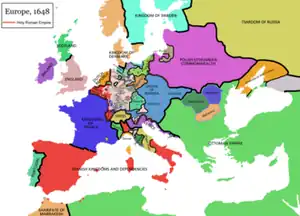 A map of Europe in 1648, after the Peace of Westphalia (from History of Spain)

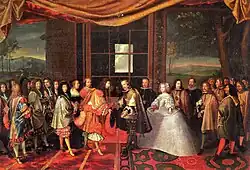 Louis XIV of France and Philip IV of Spain at the Meeting on the Isle of Pheasants in June 1660, part of the process to put an end to the Franco-Spanish War (1635–59). (from History of Spain)
 The Iberian Peninsula in the 3rd century BC (from History of Spain)
 Title page of a comedy by Spanish playwright Lope de Vega (from Spanish Golden Age)
 Members of the provisional government after the 1868 Glorious Revolution, by Jean Laurent. (from History of Spain)
 Visigothic King Roderic haranguing his troops before the Battle of Guadalete (from History of Spain)

 The realms of Philip II of Spain (from Spanish Golden Age)
 Map of territories that were once part of the Spanish Empire (from History of Spain)
 Felipe González signing the treaty of accession to the European Economic Community on 12 June 1985. (from History of Spain)
 Cathedral of Saint Mary of the See in Sevilla. (from Culture of Spain)
 The Port of Seville in the late 16th century. Seville became one of the most populous and cosmopolitan European cities after the expeditions to the New World. (from History of Spain)
 A battle of the Reconquista from the Cantigas de Santa Maria (from History of Spain)
 Episode of the 1854 Spanish Revolution in the Puerta del Sol, by Eugenio Lucas Velázquez. (from History of Spain)
 Wedding portrait of the Catholic Monarchs (from History of Spain)

 The Third of May 1808, Napoleon's troops shoot hostages. Goya (from History of Spain)
 The Second of May 1808 was the beginning of the popular Spanish resistance against Napoleon. (from History of Spain)


 Ruins of Guernica (from History of Spain)
 The title page of the Gramática de la lengua castellana (1492), the first grammar of a modern European language to be published. (from History of Spain)
 Royal Site of San Lorenzo de El Escorial. Built between 1563 and 1584 by order of King Philip II, it is the largest Renaissance building in the world. (from Spanish Golden Age)

 The pro-independence forces delivered a crushing defeat to the royalists and secured the independence of Peru in the 1824 battle of Ayacucho. (from History of Spain)
 The Christian kingdoms of Hispania and the Islamic Almohad empire c. 1210

 al-Andalus at its greatest extent, 720 (from History of Spain)
 Taking of Oran by Francisco Jiménez de Cisneros in 1509. (from History of Spain)
 An 18th-century map of the Iberian Peninsula (from History of Spain)
 Contemporary printing of the sheet music for Tomás Luis de Victoria's Officium Defunctorum (from Spanish Golden Age)
 Illustration depicting the (now lost) Luzaga's Bronze, an example of the Celtiberian script. (from History of Spain)
 Jamón ibérico (from Culture of Spain)
 Panoramic view of the lower level patio of the Palace (from Spanish Golden Age)
 1894 satirical cartoon depicting the tacit accord for seamless government change (turnismo) between the leaders of two dynastic parties (Sagasta and Cánovas del Castillo), with the country being lied in an allegorical fashion. (from History of Spain)
 El paseo de las Delicias, a 1784–1785 painting by Ramón Bayeu depicting a meeting of members of the aristocracy in the aforementioned location. (from History of Spain)
 Franco visiting Tolosa in 1948 (from History of Spain)
In the news
- 18 August 2026 –
- A second Mw 4.7 earthquake strikes the province of Granada, in Spain. Damage and injures are reported in Granada and the surrounding area, while the Alhambra is evacuated. (BBC News)
- 16 August 2026 – Russo-Ukrainian war
- A Spanish F/A-18 Hornet jet shoots down a Russian drone in Romanian airspace. The drone was downed near Galați after entering from Moldova. (Politico)
- 16 August 2026 –
- Three people, including a teenager, are killed and two others are injured in a shooting in Isla Cristina, Andalusia, Spain. Police investigate the attack as a possible dispute between rival drug-trafficking groups and search for the gunman. (Reuters)
- 15 August 2026 – 2026 Ceuta migrant crisis
- Police in Morocco arrest 111 migrants who attempted to enter Spain's autonomous community Ceuta, amidst tightened security on both sides of the border with Spain. (CBC)
- 14 August 2026 –
- A Mw 4.8 earthquake strikes the province of Granada in Spain, with damage reported in Granada and the surrounding area, and being felt in Madrid. (The News International)
Spain topics
Categories

WikiProjects
- Main project
WikiProject Spain

- Related projects
WikiProject Basque • WikiProject Catalan-speaking Countries • WikiProject Galicia • Spanish Translation of the Week
Things you can do

- Add {{WikiProject Spain}} to article talk pages which have some relation to Spain
- Help write new Spain-related articles and improve and expand existent ones
- Assess: unassessed Spain-related articles
- Suggest: selected articles, biographies, pictures, did you knows? and quotes for this Portal
Related portals
Associated Wikimedia
The following Wikimedia Foundation sister projects provide more on this subject:
-
 Commons
Free media repository -
 Wikidata
Free knowledge base -
 Wikiquote
Collection of quotations -
 Wikisource
Free-content library -
 Wikiversity
Free learning tools -
 Wikivoyage
Free travel guide -
 Wiktionary
Dictionary and thesaurus
-
 List of all portals
-

-

-

-

-

-

-

-

-

-
 Random portal
-
 WikiProject Portals