The socialist political movement includes political philosophies that originated in the revolutionary movements of the mid-to-late 18th century and out of concern for the social problems that socialists associated with capitalism. By the late 19th century, after the work of Karl Marx and his collaborator Friedrich Engels, socialism had come to signify anti-capitalism and advocacy for a post-capitalist system based on some form of social ownership of the means of production. By the early 1920s, communism and social democracy had become the two dominant political tendencies within the international socialist movement, with socialism itself becoming the most influential secular movement of the 20th century. Many socialists also adopted the causes of other social movements, such as feminism, environmentalism, and progressivism. (Full article...)
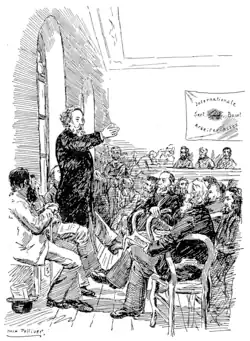
Image 27Russian anarchist Mikhail Bakunin opposed the Marxist aim of dictatorship of the proletariat in favour of universal rebellion and allied himself with the federalists in the First International before his expulsion by the Marxists (from History of socialism)
Image 28Barricades Boulevard Voltaire, Paris during the uprising known as the Paris Commune (from History of socialism)
Image 33"Is The World Turning Socialist?" An article by Allen D. Albert published in The Rotarian commenting on the rising popularity of socialism in the postwar era, January 1918 (from History of socialism)
Image 34The first anarchist journal to use the term libertarian was Le Libertaire, Journal du Mouvement Social, published in New York City between 1858 and 1861 by French libertarian communistJoseph Déjacque, the first recorded person to describe himself as libertarian. (from Socialism)
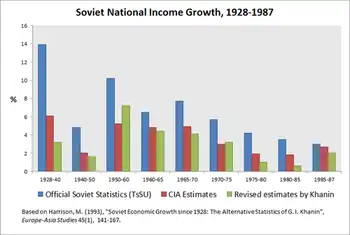
Image 36Soviet national income 1928–1987 growth in% based on estimates of the official statistical agency of the Soviet Union, the CIA and revised estimates by Grigorii Khanin (from Socialism)
Image 37The capital letter A surrounded by a circle is a common symbol of anarchism. (from Socialism)
... that Haiti's Popular Socialist Party supported a conservative in the indirect presidential election of 1946 because it believed its candidate would not be popular enough to win?
... that although the 1950 Mexican film Un día de vida (pamphlet pictured) bombed with domestic audiences, it became a classic in Yugoslavia?
What the Captain of Kopenick means for militarism in the domain of practical swindling, the inimitable Gustav Tuch was for it in the domain of honest theorizing, towards the end of the eighties. In his bulky volume, "The Expanded German Military State in its Social Significance," he sketched a future society of which the all illuminating, warming, directing central sun is militarism, its heart and soul, the only true "national and civilized socialism"; where the whole state is transformed into the image of the barracks, the barracks being grammar school, high-school and a factory for producing patriotic spirit, the army an all comprising organization of strike-breakers. That ecstatic hallucination about the millennium of militarism was indeed mere methodical madness, but the very fact that it was a methodical madness, which imagined the militaristic aims and methods apart from all checks and carried them to their extreme conclusions, lends to it a symptomatic significance.
At least in one sphere of prime importance militarism, as will be shown more conclusively later on, is to-day already the central sun around which move the solar systems of class legislation, bureaucracy, police rule, class-justice and the clericalism of all denominations. It is the ultimate, sometimes recondite, sometimes patent regulator of all class politics, all tactics of the class-struggle, not only for the capitalist classes, but also for the proletariat, in regard to its economic organization no less than in regard to its political organization.