Portal:Singapore

 Welcome to the Singapore Portal   Map of Singapore Singapore, officially the Republic of Singapore, is an island country in Southeast Asia. Its territory comprises a main island, over 60 satellite islands and islets, and one outlying islet. The country is about one degree of latitude (137 kilometres or 85 miles) north of the equator, off the southern tip of the Malay Peninsula, bordering the Strait of Malacca to the west, the Singapore Strait to the south along with the Riau Islands in Indonesia, the South China Sea to the east and the Straits of Johor along with the State of Johor in Malaysia to the north.
In its early history, Singapore was a maritime emporium known as Temasek; subsequently, it was a major constituent of several successive thalassocratic empires. Its contemporary era began in 1819, when Stamford Raffles established Singapore as an entrepôt trading post of the British Empire. In 1867, Singapore came under direct British control as part of the Straits Settlements. During World War II, Singapore was occupied by Japan in 1942 and returned to Britain as a Crown colony following Japan's surrender in 1945. Singapore gained self-governance in 1959 and in 1963 became part of the new federation of Malaysia, alongside Malaya, North Borneo and Sarawak. Ideological differences led to Singapore's expulsion from the federation two years later; it became an independent sovereign country in 1965. After early years of turbulence and despite lacking natural resources and a hinterland, the nation rapidly developed to become one of the Four Asian Tigers. As a highly developed country, Singapore has the highest PPP-adjusted GDP per capita in the world and is the only country in Asia with a AAA sovereign credit rating from all major rating agencies. Identified as a tax haven, it is a major aviation, financial and maritime shipping hub and has consistently been ranked as one of the most expensive cities for expatriates and foreign workers. Singapore ranks highly in key social indicators: education, healthcare, housing, peacefulness, passport strength, personal safety and infrastructure, with a high home-ownership rate. Singaporeans enjoy one of the longest life expectancies, fastest Internet connection speeds, lowest infant mortality rates and lowest levels of corruption in the world. Singapore is organised into five regions, 55 planning areas and hundreds of subzones. It has the second highest population density of any country, although there are numerous green and recreational spaces as a result of urban planning. With a multicultural population and in recognition of the cultural identities of the country's major ethnic groups, Singapore has four official languages: English, Malay, Mandarin and Tamil. English is the common language, with exclusive use in numerous public services. Multi-racialism is enshrined in the constitution and continues to shape national policies. Singapore is a parliamentary republic and its legal system is based on common law. While it is constitutionally a multi-party democracy where free elections are regularly held, it functions as a de facto one-party state, with the People's Action Party (PAP) maintaining continuous political dominance since 1959. The PAP's longstanding control has resulted in limited political pluralism and a highly centralised governance structure over national institutions. One of the five founding members of ASEAN, Singapore is also the headquarters of the Asia-Pacific Economic Cooperation Secretariat, the Pacific Economic Cooperation Council Secretariat and is the host city of many international conferences and events. Singapore is also a member of the United Nations, the World Trade Organization, the East Asia Summit, the Non-Aligned Movement and the Commonwealth of Nations. (Full article...)Selected article -"Majulah Singapura" is the national anthem and motto of Singapore. Composed by Zubir Said in 1958 as a theme song for official functions of the City Council of Singapore, the song was selected in 1959 as the nation's anthem when it attained self-government. Upon full independence in 1965, "Majulah Singapura" was formally adopted as Singapore's national anthem. By law, the anthem must be sung with Malay lyrics, but there are authorised translations of the lyrics of the anthem in Singapore's three other official languages: English, Mandarin and Tamil. The national anthem is regularly performed or sung in schools and armed forces camps at ceremonies held at the beginning and/or the end of each day, during which the national flag is also raised and lowered and the national pledge is taken. Singaporeans are especially encouraged to sing the national anthem on occasions of national celebration or national significance such as at the National Day Parade (NDP), National Day Concert (NDC), at National Day observance ceremonies conducted by educational institutions and government departments and at sporting events at which Singapore teams are participating. (Full article...) Selected picture The new and old buildings of the Supreme Court of Singapore. The older building was constructed in the 1930s and is now the National Art Gallery of Singapore. The new supreme court building was constructed between 2002 and 2005. Read more... General imagesThe following are images from various Singapore-related articles on Wikipedia.
Selected biography -Kelvin Tan Wei Lian (陈伟联, born 5 October 1981) is a Singaporean Mandopop singer who earned a living as a busker before he won the first edition of Project SuperStar in 2005. He has released three albums, All I Want Is... (2006), i-Weilian (2007) and Moving Notes...Kelvin Tan (2009). He also had a solo concert at the Singapore Expo, lead a choir at the opening ceremony at the 2008 Summer Paralympics, and singing Singapore's 2009 National Day Parade's theme song. (Full article...) Did you know (auto-generated)
In this month
More did you know -
Selected panoramaThe National Stadium (Chinese: 国家体育场; Malay: Stadium Nasional Singapura) is located in Kallang. Opened in July 1973, the National Stadium was officially closed on June 30, 2007 and will be demolished in late 2008 to make way for the Singapore Sports Hub which is expected to open in 2011. Singapore topicsRelated portalsSoutheast Asia Other Countries Tasks
CategoriesSelect [►] to view subcategories
 Images of Singapore WikiprojectsRelated Wikiprojects:
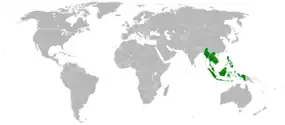 South East Asia Associated WikimediaThe following Wikimedia Foundation sister projects provide more on this subject:
Discover Wikipedia using portals
|