Portal:Sierra Leone

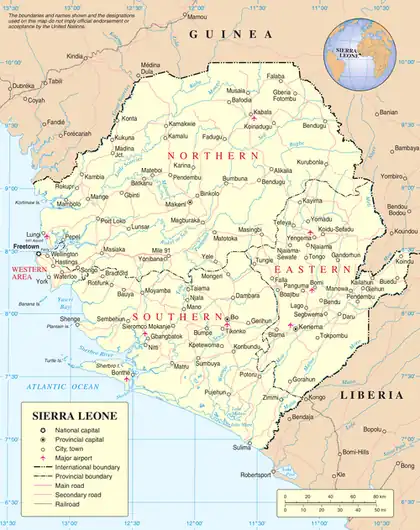
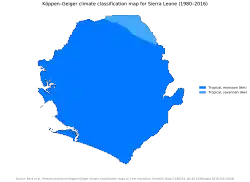
The Sierra Leone Portal  Sierra Leone, officially the Republic of Sierra Leone, is a country on the west coast of West Africa. It is bordered to the southeast by Liberia and by Guinea to the north. Sierra Leone's land area is 73,252 km2 (28,283 sq mi). It has a tropical climate and environments ranging from savannahs to rainforests. As of the 2023 census, Sierra Leone had a population of 8,460,512. Freetown is its capital and largest city. Sierra Leone is a presidential republic, with a unicameral parliament and a directly elected president. It is a secular state. Its constitution provides for the separation of state and religion and freedom of conscience. Muslims constitute three-quarters of the population, and there is a significant Christian minority. Religious tolerance is very high. Sierra Leone's current territorial configuration was established in two phases: in 1808, the coastal Sierra Leone Colony was founded as part of the British Empire, to be a place to resettle returning Africans after the abolition of the slave trade; then in 1896, the inland Protectorate was created as a result of the Berlin Conference of 1884–1885. This led to the formal recognition of the territory as the Sierra Leone Colony and Protectorate. Sierra Leone attained independence from the United Kingdom in 1961 under the leadership of Prime Minister Sir Milton Margai of the Sierra Leone People's Party (SLPP). In 1971, under Prime Minister Siaka Stevens of the All People's Congress (APC), the country adopted a new constitution, transforming Sierra Leone into a presidential republic, with Stevens as the inaugural president. In 1978, Stevens declared the APC to be the sole legally recognised party. In 1985, he was succeeded by Joseph Saidu Momoh. Momoh's enactment of a new constitution in 1991 reintroduced a multi-party system. That same year, a protracted civil war broke out between the government and the Revolutionary United Front (RUF) rebel group. The conflict, characterised by multiple coups d'état, persisted for 11 years. Intervention by ECOMOG forces and later by the United Kingdom resulted in the defeat of the RUF in 2002, ushering in a period of relative stability. (Full article...) Selected article -The Sierra Leone Creole people (Krio: Krio pipul) are an ethnic group of Sierra Leone. The Sierra Leone Creole people are descendants of freed African-American, Afro-Caribbean, and Liberated African slaves who settled in the Western Area of Sierra Leone between 1787 and about 1885. The colony was established by the British, supported by abolitionists, under the Sierra Leone Company as a place for freedmen. The settlers called their new settlement Freetown. Today, the Sierra Leone Creoles are 1.2 percent of the population of Sierra Leone. The Creoles of Sierra Leone have varying degrees of European ancestry, similar to their Americo-Liberian neighbours and sister ethnic group in Liberia. In Sierra Leone, some of the settlers intermarried with English colonial residents and other Europeans. Through the Jamaican Maroons, some Creoles probably also have indigenous Amerindian Taíno ancestry. The mingling of newly freed black and racially-mixed Nova Scotians and Jamaican Maroons from the 'New World' with Liberated Africans – such as the Bakongo, Ewe, Igbo, and Yoruba – over several generations in the late 18th and early 19th centuries, led to the eventual formation of a Creole ethnicity. (Full article...) General images -The following are images from various Sierra Leone-related articles on Wikipedia.
|











|
|
|

Associated Wikimedia
The following Wikimedia Foundation sister projects provide more on this subject:
-
 Commons
Free media repository -
 Wikidata
Free knowledge base -
 Wikiquote
Collection of quotations -
 Wikisource
Free-content library -
 Wikiversity
Free learning tools -
 Wikivoyage
Free travel guide -
 Wiktionary
Dictionary and thesaurus
Things to do
 |
Here are some tasks awaiting attention:
|
-
 List of all portals
-

-

-

-

-

-

-

-

-

-
 Random portal
-
 WikiProject Portals