Nihonium was first reported to have been created in experiments carried out between 14 July and 10 August 2003, by a Russian–American collaboration at the Joint Institute for Nuclear Research (JINR) in Dubna, Russia, working in collaboration with the Lawrence Livermore National Laboratory in Livermore, California, and on 23 July 2004, by a team of Japanese scientists at Riken in Wakō, Japan. The confirmation of their claims in the ensuing years involved independent teams of scientists working in the United States, Germany, Sweden, and China, as well as the original claimants in Russia and Japan. In 2015, the IUPAC/IUPAP Joint Working Party recognised the element and assigned the priority of the discovery and naming rights for the element to Riken. The Riken team suggested the name nihonium in 2016, which was approved in the same year. The name comes from the common Japanese name for Japan (日本, Nihon). (Full article...)
Image 2
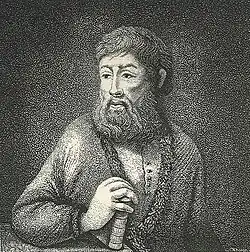
Nikita Zotov, rotogravure by Alexandr Osipov, 1882–1883
Count Nikita Moiseevich Zotov (Russian:Никита Моисеевич Зотов, romanized: Nikita Moiseyevich Zotov, IPA:[nʲ'kʲtamoɨ'sʲɛɪvʲɪt͡ɕ'zotv]ⓘ) (1644– December 1717) was a childhood tutor and lifelong friend of Russian TsarPeter the Great. Historians disagree on the quality of Zotov's tutoring. Robert K. Massie, for example, praises his efforts, but Lindsey Hughes criticizes the education that he gave to the future tsar.
Not much is known about Zotov's life aside from his connection to Peter. Zotov left Moscow for a diplomatic mission to Crimea in 1680 and returned to Moscow before 1683. He became part of the "Jolly Company", a group of several dozen of Peter's friends that eventually became The All-Joking, All-Drunken Synod of Fools and Jesters. Zotov was mockingly appointed "Prince-Pope" of the Synod, and regularly led them in games and celebrations. He accompanied Peter on many important occasions, such as the Azov campaigns and the torture of the Streltsy after their uprising. Zotov held a number of state posts, including from 1701 a leading position in the Tsar's personal secretariat. Three years before his death, Zotov married a woman 50years his junior. He died in December 1717 of unknown causes. (Full article...)
Diamond is a mineral form of the element carbon with its atoms arranged in a crystal structure called diamond cubic. Diamond is a tasteless, odorless, strong, brittle solid, a poor conductor of electricity, colorless in pure form, and insoluble in water. Another solid form of carbon known as graphite is the chemically stable form of carbon at room temperature and pressure, but diamond is metastable and converts to it at a negligible rate under those conditions. Diamond has the highest hardness and thermal conductivity of any natural material, properties that are used in major industrial applications such as cutting and polishing tools.
Because the arrangement of atoms in diamond is extremely rigid, few types of impurity can contaminate it (two exceptions are boron and nitrogen). Small numbers of defects or impurities—about one per million of lattice atoms—can color a diamond blue (boron), yellow (nitrogen), brown (defects), green (radiation exposure), purple, pink, orange, or red. Diamond also has a very high refractive index and a relatively high optical dispersion. (Full article...)
The Firebird (French: L'Oiseau de feu; Russian: Жар-птица, romanized:Zhar-ptitsa) is a ballet and orchestral concert work by the Russian composer Igor Stravinsky. It was written for the 1910 Paris season of Sergei Diaghilev's Ballets Russes company; the original choreography was by Michel Fokine, who collaborated with Alexandre Benois and others on a scenario based on the Russian fairy tales of the Firebird and the blessing and curse it possesses for its owner. It was first performed at the Opéra de Paris on 25 June 1910 and was an immediate success, catapulting Stravinsky to international fame and leading to future Diaghilev–Stravinsky collaborations including Petrushka (1911) and The Rite of Spring (1913).
The Firebird's mortal and supernatural elements are distinguished with a system of leitmotifs placed in the harmony dubbed "leit-harmony". Stravinsky intentionally used many specialist techniques in the orchestra, including ponticello, col legno, flautando, glissando, and flutter-tonguing. Set in the evil immortal Koschei's castle, the ballet follows Prince Ivan, who battles Koschei with the help of the magical Firebird. (Full article...)
In the early days of sound cinema, among the various distinguished composers ready to try their hand at film music, Prokofiev was not an obvious choice for the commission. Based in Paris for almost a decade, he had a reputation for experimentation and dissonance, characteristics at odds with the cultural norms of the Soviet Union. By early 1933, however, Prokofiev was anxious to return to his homeland, and saw the film commission as an opportunity to write music in a more popular and accessible style. (Full article...)
The construction of the cathedral was approved in 1894 by the Ministry of Internal Affairs of the Russian Empire. Groundbreaking was in 1899; construction work began in 1901 and was completed ten years later. Three-aisled and built from red brick, the cathedral is based on a design by architect Tomasz Bohdanowicz-Dworzecki. The style was influenced by Westminster Abbey and Milan Cathedral. With the help of funds from Catholic parishes in Russia and its neighbouring states, the church was consecrated as a chapel for Moscow's Polish parish in 1911. In the aftermath of the Russian Revolution in 1917, the Provisional Government was overthrown by the Bolsheviks and Russia eventually became part of the Soviet Union in 1922. Because the promotion of state atheism was a part of Marxist–Leninist ideology, the government ordered many churches closed; the cathedral was closed in 1938. During World WarII, it was threatened with demolition, and was used after the war for civil purposes, as a warehouse and then a hostel. Following the fall of communism in 1991, it returned to being a church in 1996. In 2002 it was elevated to the status of cathedral. Following an extensive and costly programme of reconstruction and refurbishment, the cathedral was reconsecrated in 2005. (Full article...)
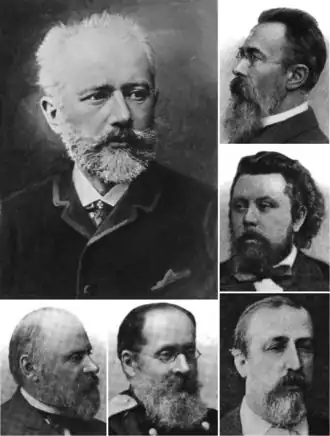
In mid- to late-19th-century Russia, Pyotr Ilyich Tchaikovsky and a group of composers known as The Five had differing opinions as to whether Russian classical music should be composed following Western or native practices. Tchaikovsky wanted to write professional compositions of such quality that they would stand up to Western scrutiny and thus transcend national barriers, yet remain distinctively Russian in melody, rhythm and other compositional characteristics. The Five, made up of composers Mily Balakirev, Alexander Borodin, César Cui, Modest Mussorgsky, and Nikolai Rimsky-Korsakov, sought to produce a specifically Russian kind of art music, rather than one that imitated older European music or relied on European-style conservatory training. While Tchaikovsky himself used folk songs in some of his works, for the most part he tried to follow Western practices of composition, especially in terms of tonality and tonal progression. Also, unlike Tchaikovsky, none of The Five were academically trained in composition; in fact, their leader, Balakirev, considered academicism a threat to musical imagination. Along with critic Vladimir Stasov, who supported The Five, Balakirev attacked relentlessly both the Saint Petersburg Conservatory, from which Tchaikovsky had graduated, and its founder Anton Rubinstein, orally and in print.
As Tchaikovsky had become Rubinstein's best-known student, he was initially considered by association as a natural target for attack, especially as fodder for Cui's printed critical reviews. This attitude changed slightly when Rubinstein left the Saint Petersburg musical scene in 1867. In 1869 Tchaikovsky entered into a working relationship with Balakirev; the result was Tchaikovsky's first recognized masterpiece, the fantasy-overture Romeo and Juliet, a work which The Five wholeheartedly embraced. When Tchaikovsky wrote a positive review of Rimsky-Korsakov's Fantasy on Serbian Themes he was welcomed into the circle, despite concerns about the academic nature of his musical background. The finale of his Second Symphony, nicknamed the Little Russian, was also received enthusiastically by the group on its first performance in 1872. (Full article...)
Born and raised in Georgia, in the Russian Empire, Ordzhonikidze joined the Bolsheviks at an early age and quickly rose within the ranks to become an important figure within the group. Arrested and imprisoned several times by the Russian police, he was in Siberian exile when the February Revolution began in 1917. Returning from exile, Ordzhonikidze took part in the October Revolution that brought the Bolsheviks to power. During the subsequent Civil War he played an active role as the leading Bolshevik in the Caucasus, overseeing the invasions of Azerbaijan, Armenia, and Georgia. He backed their union into the Transcaucasian Socialist Federative Soviet Republic (TSFSR), which helped form the Soviet Union, in 1922 and served as the First Secretary of the TSFSR until 1926. (Full article...)
She was born in Baku to a friend of Stalin, a revolutionary, and was raised in Saint Petersburg. Having known Stalin from a young age, they married when she was 18, and had two children. Alliluyeva worked as a secretary for Bolshevik leaders, including Vladimir Lenin and Stalin, before enrolling at the Industrial Academy in Moscow to study synthetic fibres and become an engineer. She had health issues, which had an adverse impact on her relationship with Stalin. She also suspected he was unfaithful, which led to frequent arguments with him. On several occasions, Alliluyeva reportedly contemplated leaving Stalin, and after an argument, she fatally shot herself early in the morning of 9 November 1932. (Full article...)
Tintin in the Land of the Soviets (French: Tintin au pays des Soviets) is the first volume of The Adventures of Tintin, the comics series by Belgian cartoonist Hergé. Commissioned by the conservative Belgian newspaper Le Vingtième Siècle as anti-communist satire for its children's supplement Le Petit Vingtième, it was serialised weekly from January 1929 to May 1930 before being published in a collected volume by Éditions du Petit Vingtième in 1930. The story tells of young Belgian reporter Tintin and his dog Snowy, who are sent to the Soviet Union to report on Stalin's government. Knowing of his intentions, however, the secret police of the OGPU are sent to hunt him down.
Bolstered by publicity stunts, Land of the Soviets was a commercial success in Belgium, and also witnessed serialisation in France and Switzerland. Hergé continued The Adventures of Tintin with Tintin in the Congo, and the series became a defining part of the Franco-Belgian comics tradition. Damage to the original plates prevented republication of the book for several decades, while Hergé later expressed embarrassment at the crudeness of the work. As he began to redraw his earlier Adventures in second, colour versions from 1942 onward, he decided against doing so for Land of the Soviets; it was the only completed Tintin story that Hergé did not reproduce in colour. Growing demand among fans of the series resulted in the production of unauthorised copies of the book in the 1960s, with the first officially sanctioned republication appearing in 1969, after which it was translated into several other languages, including English. Critical reception of the work has been largely negative, and several commentators on The Adventures of Tintin have described Land of the Soviets as one of Hergé's weakest works. (Full article...)
Image 13
With the pale yellow rump visible. Buryatia, Russia.
Pallas's leaf warbler is one of the smallest Palearcticwarblers, with a relatively large head and short tail. It has greenish upperparts and white underparts, a lemon-yellow rump, and yellow double wingbars, supercilia and central crown stripe. It is similar in appearance to several other Asian warblers, including some that were formerly considered to be subspecies of it, although its distinctive vocalisations aid identification. (Full article...)
During World War I, she bombarded German fortifications during the siege of Qingdao. The Japanese government sold Tango back to the Russians at their request in 1916. She was renamed Chesma (Чесма) as her former name had been given to a new ship. En route to the White Sea, she joined an Allied force that persuaded the Greek government to disarm their ships. Her crew declared for the Bolsheviks in October 1917, but made no effort to resist when the British captured her during the North Russia intervention in early 1918. In poor condition, the ship was used as a prison hulk. Abandoned by the British when they withdrew in 1919 and recaptured by the Bolsheviks, she was scrapped in 1924. (Full article...)
An Alaskan parchment scrip banknote in the denomination of 1 ruble, printed on vellum or parchment by the Russian-American Company. On the obverse, the horizontal text immediately beneath the double-headed eagle reads "Seal of the Russian American Company". The oval text reads "under august protection of His Imperial Majesty", and under the oval is the value of the note "one ruble".
Alaskan parchment scrip was used as a form of company scrip in Alaska when it was a possession of the Russian Empire. In circulation from 1816 to 1867, such scrip could be printed on vellum, parchment, or pinniped skin. Denominations of 10, 25, 50 kopecks and 1, 5, 10, and 25 rubles were issued.
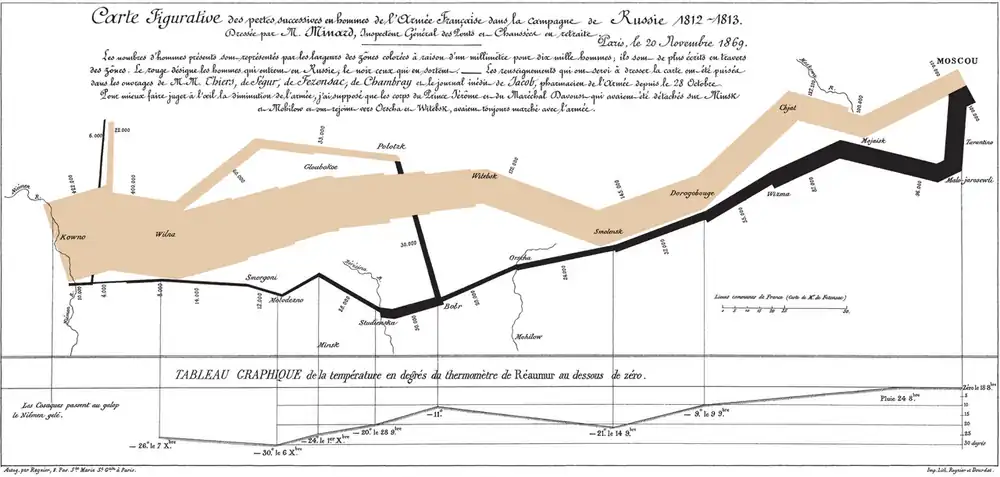
Charles Minard'sCarte figurative (1869), which details the losses of men, the position of the army, and the freezing temperatures on Napoleon's disastrous 1812 invasion of Russia. Created in an effort to show the horrors of war, the graph "defies the pen of the historian in its brutal eloquence" and has been called the best statistical graphic ever drawn.
A Boyar Wedding Feast is an oil-on-canvas painting created by Russian artist Konstantin Makovsky in 1883. The boyars were members of the highest rank of the feudal aristocracy of Russia in the 16th and 17th centuries, and a wedding was an important social event. In this painting, the guests are depicted toasting a newlywed couple. They stand at the head of the table, where the groom sees his bride without her veil for the first time; she appears timid and bashful as the men toast for the first kiss. Behind the couple, the Lady of Ceremony gently urges on the bride. A roasted swan is being brought in on a large platter, the last dish to be served before the couple retires to the bedroom. The work is in the collection of the Hillwood Estate, Museum & Gardens, in Washington, D.C.
The Portrait of Chaliapin is an oil-on-canvas painting by Boris Kustodiev, produced in 1921. Feodor Chaliapin was a Russian opera singer; possessing a deep and expressive bass voice, he enjoyed an important international career at major opera houses. He is depicted here wearing an expensive fur coat, which had come from a Soviet warehouse containing items confiscated from rich people during the Russian Revolution, and which he had received in lieu of payment for a performance. The background shows festivities at the traditional folk holiday of Maslenitsa. Dressed in a smart suit and holding a cane, Chaliapin is portrayed as having risen above his contemporaries. His favourite dog is at his feet and, at the bottom left, his two daughters stroll on the festive square in front of a poster promoting his concert. This copy of the painting is in the collection of the Russian Museum in Saint Petersburg.
An aerial view of the Field of Mars, a large park in central Saint Petersburg, Russia, pictured in 2016. It is named after Mars, the Roman god of war. The park's history goes back to the 18th century, when it was converted from bogland and named the Grand Meadow. Later, it was the setting for celebrations to mark Russia's victory over Sweden in the Great Northern War. Its next name, the Tsaritsyn Meadow, appears after the royal family commissioned Francesco Bartolomeo Rastrelli to build the Summer Palace for Empress Elizabeth. It became the Field of Mars during the reign of PaulI. Towards the end of the 18th century, the park became a military drill ground, where they erected monuments commemorating the victories of the Russian Army and where parades and military exercises took place regularly. After the February Revolution in 1917, the Field of Mars became a memorial area for the revolution's honoured dead. In the summer of 1942, as the city was besieged by the German army in the Siege of Leningrad, the park was covered with vegetable gardens to supply food. An eternal flame was lit in the centre of the park in 1957, in memory of the victims of various wars and revolutions.
A map detailing the events of the 2008 South Ossetia war, which began one year ago today, when Georgia launched an operation in the disputed region of South Ossetia. Ossetian, Russian, and Abkhazian forces ejected the Georgian forces after five days of heavy fighting. All parties reached a ceasefire agreement on August 12, and Russian troops remain stationed in Abkhazia and South Ossetia to this day.
Although James Clerk Maxwell made the first color photograph in 1861, the results were far from realistic until Prokudin-Gorsky perfected the technique with a series of improvements around 1905. His process used a camera that took a series of monochrome pictures in rapid sequence, each through a different colored filter. Prokudin-Gorskii then went on to document much of the country of Russia, travelling by train in a specially equipped darkroomrailroad car.
A female Siberian tiger (Panthera tigris altaica), a subspecies of tiger native to Central Asia, and her cub. The Siberian tiger is the largest of the extant tiger subspecies as well as the largest felid, attaining 320kg (710lb) in an exceptional specimen. Considered an endangered subspecies, the wild population is down to several hundred individuals and is limited to eastern Siberia.
The Last Day of Pompeii is an oil painting on canvas completed by the Russian artist Karl Bryullov between 1830 and 1833. The painting is based on sketches the artist completed in 1828 while visiting Pompeii, a city destroyed by the eruption of Mount Vesuvius in 79AD. It is now held in the State Russian Museum.
Image 16
Nilov Monastery on Stolobnyi Island in Lake Seliger in Tver Province, Russia
This photo of the Nilov Monastery on Stolobny Island in Tver Oblast, Russia, was taken by Sergey Prokudin-Gorsky in 1910 before the advent of colour photography. His process used a camera that took a series of monochrome pictures in rapid sequence, each through a different coloured filter. By projecting all three monochrome pictures using correctly coloured light, it was possible to reconstruct the original colour scene.
The Sukhoi Superjet 100 is a modern fly-by-wiretwin-engineregional jet with 8 to 108 passenger seats. Development began in 2000; the aircraft had its maiden flight on 19 May 2008 and entered commercial service on 21 April 2011. This aircraft is seen flying off the coast of Italy near Sanremo.
Fyodor Dostoevsky (1821–81; depicted in 1872) was a Russian novelist, short story writer, essayist and philosopher. After publishing his first novel, Poor Folk, at age 25, Dostoyevsky wrote (among others) eleven novels, three novellas, and seventeen short novels, including Crime and Punishment (1866), The Idiot (1869), and The Brothers Karamazov (1880).
Dressed herring, colloquially known as shuba, herring under a fur coat, or furry herring (Russian: "сельдь под шубой", romanized:"sel'd pod shuboy" or "селёдка под шубой", "selyodka pod shuboy"), is a layered salad composed of diced spekesild covered with layers of grated boiled eggs, vegetables (potatoes, carrots, beetroots), chopped onions, and mayonnaise. Some variations of this dish include a layer of fresh grated apple while some do not.
A final layer of grated boiled beetroot covered with mayonnaise is what gives the salad its characteristic rich purple color. Dressed herring salad is often decorated with grated boiled eggs (whites, yolks, or both). (Full article...)
El Lissitzky (Russian: Эль Лиси́цкий; born Lazar Markovich Lissitzky [Ла́зарь Ма́ркович Лиси́цкий, ]; 23 November[O.S. 11 November]1890 – 30 December 1941) was a Russian and Soviet artist, active as a painter, illustrator, designer, printmaker, photographer, and architect. He was an important figure of the avant-garde, helping develop suprematism with his mentor, Kazimir Malevich, and designing numerous exhibition displays and propaganda works for the Soviet Union.
Lissitzky began his career illustrating Yiddishchildren's books in an effort to promote Jewish culture. He started teaching at the age of 15, maintaining his teaching career for most of his life. Over the years, he taught in a variety of positions, schools, and artistic media, spreading and exchanging ideas. He took this ethic with him when he worked with Malevich in heading the suprematist art groupUNOVIS, when he developed a variant suprematist series of his own, Proun, and further still in 1921, when he moved to Weimar Republic. In his remaining years he brought significant innovation and change to typography, exhibition design, photomontage, and book design, producing critically respected works and winning international acclaim for his exhibition design. This continued until his deathbed, where in 1941 he produced one of his last works– a Soviet propaganda poster rallying the people to construct more tanks for the fight against Nazi Germany. (Full article...)
WikiProject Countries
• WikiProject Asia
• WikiProject Europe
Main project
WikiProject Russia
Sister projects
WikiProject Caucasia
• WikiProject Soviet Union
• Russian, Soviet and CIS military history task force of the Military history WikiProject
• Soviet and post-Soviet cinema task force of the Film WikiProject
What are WikiProjects?
Selected quote
Featured content
Extended content
This is a list of recognized content, updated weekly by JL-Bot (talk·contribs) (typically on Saturdays). There is no need to edit the list yourself. If an article is missing from the list, make sure it is taggedor categorized (e.g. Category:WikiProject Russia articles)correctly and wait for the next update. See WP:RECOG for configuration options.
Deletion sorting: Please see the collection of discussions on the deletion of articles related to Russia - compiled by WikiProject Deletion sorting
Help out with articles placed in Category:Russia articles needing attention
Notability: Articles with notability concerns, listed at WikiProject Notability
Rate the Unassessed Russia articles in the Russia WikiProject.
Requested articles:Russian Union of Journalists, Bureau for Russian Emigrants in Manchuria, Assel River, Todzha Depression, Municipal reform of Catherine II, Vennik, More...