Entries here consist of Good articles, which meet a core set of high editorial standards.
Image 1
The Early Middle Ages in Romania started with the withdrawal of the Roman troops and administration from Dacia province in the 270s. In the next millennium a series of peoples, most of whom only controlled two or three of the nearly ten historical regions that now form Romania, arrived. During this period, society and culture underwent fundamental changes. Town life came to an end in Dacia with the Roman withdrawal, and in Scythia Minor–the other Roman province in the territory of present-day Romania–400 years later. Fine vessels made on fast potter's wheels disappeared and hand-made pottery became dominant from the 450s. Burial rites changed more than once from cremation to inhumation and vice versa until inhumation became dominant by the end of the 10thcentury.
Justina Szilágyi de Horogszeg (Hungarian: horogszegi Szilágyi Jusztina; before 1455 – 1497) was a Hungarian noblewoman, who became the second wife of Vlad Dracula, Voivode of Wallachia. She was the daughter of Ladislaus or Osvát Szilágyi and therefore, a cousin of Matthias Corvinus, King of Hungary. Corvinus first gave her in marriage to Wenceslas Pongrác of Szentmiklós. Pongrác had inherited estates in Upper Hungary, present-day Slovakia, but was forced to renounce them in exchange for landed property he and Justina jointly received in Transylvania following their marriage. After Pongrác died in 1474, the widowed Justina married Vlad, whom Corvinus acknowledged as the lawful voivode of Wallachia in 1475. Vlad seized Wallachia in late 1476, but soon died in battle. To strengthen her claim to her Transylvanian estates, she married Paul Suki, who was related to the former owners of those territories. After the death of Suki, in 1479, Justina was married to John Erdélyi of Somkerék, until her death in 1497. (Full article...)
Image 3
"On a Sunday" is a song recorded by Romanian singer Ester Peony. It was independently released for digital download and streaming as a single on 17 January 2019. Ioana Victoria Badea wrote the lyrics, while Peony composed the music alongside Alexandru Șerbu. Musically, the track is a mid-tempo blues, R&B, soul and 2000s-influenced electropopballad backed by percussion, guitar, synthesizers and trance beats. Its lyrics discuss a failed relationship and include Peony reflecting upon a former love interest and the futile idea that he might return. Observers likened the track to the American folk song "The Wayfaring Stranger".
"On a Sunday" represented Romania in the Eurovision Song Contest 2019 in Tel Aviv, Israel, after winning the pre-selection show Selecția Națională. The country failed to qualify for the final, marking their second and consecutive year to achieve this result. During a large portion of Peony's acclaimed goth-inspired performance, Peony was singing from a red armchair while accompanying dancers enacted a battle between good and evil visually amplified by various dark graphics showed on the LED screens. The show was the first one in Romania's Eurovision participation history to be significantly invested in by the Romanian Television (TVR), with costs amounting to a reported 100,000 euros. (Full article...)
Balaur bondoc is a species of paraviantheropoddinosaur from the late Cretaceous period, in what is now Romania. It is the type species of the monotypicgenusBalaur, after the balaur (Romanian pronunciation:[baˈla.ur]), a dragon of Romanian folklore. The specific name bondoc (Romanian pronunciation:[bonˈdok]) means "stocky", so Balaur bondoc means "stocky dragon" in Romanian. This name refers to the greater musculature that Balaur had compared to its relatives. The genus, which was first described by scientists in August 2010, is known from two partial skeletons (including the type specimen). Some researchers suggest that the taxon might represent a junior synonym of Elopteryx.
"Me Gusta" (English: "I Like") is a song recorded by Romanian singer Inna. Written by Inna and produced by David Ciente, the track was released for digital download and streaming on 14 February 2018 by Roton and Empire Music Management. "Me Gusta" is a Spanish language song, featuring an electronic production and beat drops. A reviewer noted an Asian sound. Lyrically, Inna admires a man's presence and dance abilities.
Music critics were positive towards "Me Gusta", praising its production and catchiness, and predicting its commercial success. An accompanying music video for the song was uploaded onto Inna's official YouTube channel on 13 February 2018 to positive response. Shot by Barna Nemethi, it shows Inna performing to the track on streets of Bucharest and Barcelona. Prior to the single's release, Inna sang "Me Gusta" on Romanian radio station Radio ZU. Commercially, it peaked at number 89 in Romania. (Full article...)
Image 7
ABBA: You Can Dance is a dance video game for the Wii published by Ubisoft in November 2011. A spin-off of the Just Dance series, the game features 26 songs by the Swedish pop group ABBA. The game tasks up to four players with matching the movements of ABBA members by dancing with the Wii Remote motion controller in hand, with accuracy being the goal. It includes a multiplayer "Karaoke Mode", allowing two players to sing using USB microphones while two other players can dance. This game is based on the Wii version of Michael Jackson: The Experience.
The uniting-people-through-dance philosophy of Just Dance and ABBA's music greenlit the idea of a ABBA dance game. Ubisoft's Paris and Bucharest divisions developed ABBA: You Can Dance, putting in effort to ensure that they accurately represented the group by examining a variety of ABBA content. The game was met with mixed reviews, with criticism directed at the lack of available songs but appreciation towards the low price, choreography and high amount of content. The game sold more than 725,000 copies by 2014. (Full article...)
Image 8
Romania was set to be represented at the Eurovision Song Contest 2020 with the song "Alcohol You", written by Ionuț Armaș, Viky Red, and Breyan Isaac, and performed by Roxen. The Romanian participating broadcaster, Televiziunea Română (TVR), selected its entry through the national final Selecția Națională 2020, after having previously selected the performer internally. TVR announced Roxen on 11 February 2020, while the national selection competition took place on 1 March.
Prior to the scheduled Eurovision Song Contest 2020, "Alcohol You" was promoted by a lyric video, while Roxen appeared on several native talk shows and radio stations. Romania was drawn to compete in the first semi-final of the Eurovision Song Contest which would have taken place on 12 May 2020. However, the contest was cancelled due to the COVID-19 pandemic. (Full article...)
I. C. Filitti had an auspicious debut in diplomacy and politics, but his career was mired in controversy. A "Germanophile" by the start of World War I, he secretly opposed the pact between Romania and the Entente Powers, and opted to stay behind in German-occupied territory. He fell into disgrace for serving the collaborationist Lupu Kostaki as Prefect and head of the National Theatre, although he eventually managed to overturn his death sentence for treason. Filitti became a recluse, focusing on his scholarship and press polemics, but was allowed to serve on the Legislative Council after 1926. (Full article...)
Image 11
Romania was represented at the qualifying round for the Eurovision Song Contest 1993 with the song "Nu pleca", written and performed by Dida Drăgan. The Romanian participating broadcaster, Televiziunea Română (TVR), selected its entry through the national final Selecția Națională 1993 on 16 January 1993. The entry, which would have been the first-ever entry from Romania in the Eurovision Song Contest, failed to make it through the pre-selection round ranking last. Predominantly negative reactions from Romanian media followed as a result of Drăgan's poor performance. (Full article...)
Image 12
Tate in 2023
Emory Andrew Tate III (born 1 December 1986) is an American and British social media personality and former professional kickboxer who built a webcam pornography business before gaining notoriety for promoting various highly controversial positions in the manosphere. His commentary has resulted in his expulsion from various social media platforms and concern that he promotes misogynistic views to his audience. A divisive influencer, Tate has amassed 9.9million followers on Twitter as of August 2024 and was the third-most googled person in 2023. He has been dubbed the "king of toxic masculinity", has called himself a misogynist, and is politically described as right-wing or far-right.
As of mid-2026, Andrew Tate has been arrested in Miami and is in US custody. Tate has faced numerous criminal and civil legal proceedings in Romania, the United Kingdom, and the United States relating to allegations including rape, human trafficking, and tax evasion. The Romanian trafficking case remained unresolved but stalled by procedural delays, and Tate had been released from Romania's travel ban and all bail conditions; separate UK proceedings remained active, where the Crown Prosecution Service authorised 21 charges in May 2025 and police reopened an earlier investigation into 2015-era allegations following a misconduct inquiry into how it had originally been handled. (Full article...)
Image 13
Peony during an interview in 2019
Ester Alexandra Crețu (Romanian pronunciation:[ˈesteralekˈsandraˈkret͡su]; born 21 July 1993), known professionally as Ester Peony (formerly only Ester), is a Romanian singer and songwriter. She represented Romania in the Eurovision Song Contest 2019 with the song "On a Sunday" after winning the selection show Selecția Națională 2019. However, she failed to qualify for the Grand Final in Tel Aviv. Peony started to compose music for Romanian artists before gaining recognition for posting covers on YouTube in 2015. Later that year, she attained commercial success in Romania with her single "Sub aripa ta" featuring Vescan. (Full article...)
Tristan Tzara (/ˈzɑːrə/; French:[tʁistɑ̃dzaʁa]; Romanian:[trisˈtanˈt͡sara]; born Samuel or Samy Rosenstock, also known as S. Samyro; 28 April[O.S. 16 April]1896 – 25 December 1963) was a Romanian and French avant-garde poet, essayist and performance artist. Also active as a journalist, playwright, literary and art critic, composer and film director, he was known best for being one of the founders and central figures of the anti-establishmentDada movement. Under the influence of Adrian Maniu, the adolescent Tzara became interested in Symbolism and co-founded the magazine Simbolul with Ion Vinea (with whom he also wrote experimental poetry) and painter Marcel Janco.
During World War I, after briefly collaborating on Vinea's Chemarea, he joined Janco in Switzerland. There, Tzara's shows at the Cabaret Voltaire and Zunfthaus zur Waag, as well as his poetry and art manifestos, became a main feature of early Dadaism. His work represented Dada's nihilistic side, in contrast with the more moderate approach favored by Hugo Ball. (Full article...)
Heartbreaker was created over the course of three weeks in a mansion where Inna resided with Romanian songwriters and producers Sebastian Barac, Marcel Botezan, David Ciente, Alexandru Cotoi and Minelli. To document the progress made on what was initially planned to be an extended play (EP), Inna uploaded daily YouTubevlogs that constituted the first season of her Dance Queen's House series. However, the EP was ultimately scrapped after the creation of over 50 songs to choose from. Heartbreaker was aided by the release of two singles—"Flashbacks" and "Maza". The former reached number one on Russia's radio ranking, and the top ten in Romania, Bulgaria, Ukraine, and the Commonwealth of Independent States. (Full article...)
Romani slaves belonged to boyars (aristocrats), Orthodox monasteries, or the state. They were used as blacksmiths, goldsmiths and agricultural workers, but when the principalities were urbanized, they also served as servants. (Full article...)
George Enescu (Romanian:[ˈdʒe̯ordʒeeˈnesku]ⓘ; 19 August[O.S. 7 August]1881 – 4 May 1955), known in France as Georges Enesco, was a Romanian composer, violinist, pianist, conductor, teacher and statesman. He is regarded as one of the greatest musicians in Romanian history. (Full article...)
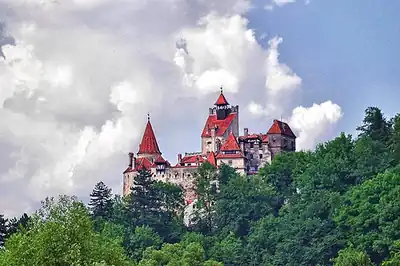
Bran Castle is situated near Bran and in the immediate vicinity of Brașov, is a national monument and landmark in Romania, and is commonly known outside Romania as Dracula's Castle.
Did you know (auto generated)
... that Soviet politician Pavel Chioru wanted "Moldovan", which he developed from a dialect of Romanian, to serve as a language of the "exploited" against the supposedly upper-class Romanian?
... that at age 15, Lilia Cosman moved from the United States to Romania to compete for Romania's Olympic gymnastics team?
... that some forms of the Romanian lăutari violin have extra strings that are added only for resonance and never played directly?
...that Romania's Palace of Parliament, despite the building process not being completely finished, is the biggest building in Europe and the second-largest building in the world?
General images
The following are images from various Romania-related articles on Wikipedia.
Image 20Romania after the territorial losses of 1940. The recovery of Bessarabia and Northern Bukovina was the catalyst for Romania's entry into the war on Germany's side. (from History of Romania)
Image 31The upper map shows Dacia’s territory at the beginning of Burebista’s rule, while the lower map depicts its territory at the end of his reign. (from History of Romania)
Image 37Bran Castle (German: Törzburg, Hungarian: Törcsvár) built in 1377, is commonly known as Dracula's Castle and is situated in the center of present-day Romania. In addition to its unique architecture, the castle is famous because of persistent myths that it was once the home of Vlad III Dracula. (from History of Romania)
Image 40Ethnic map of Greater Romania according to the 1930 census. Sizeable ethnic minorities put Romania at odds with Hungary, Bulgaria, and the Soviet Union throughout the interwar period. (from History of Romania)
Image 43Map depicting the Dacian Kingdom, including its annexed territories and areas of approximate influence including Pannonia and Bohemia. (from History of Romania)
Image 44The Principalities of Moldavia and Wallachia in 1786, Italian map by G. Pittori, since the geographer Giovanni Antonio Rizzi Zannoni (from History of Romania)
Image 45Physical and administrative map of Romania, with the historic regions in grey (Țara Românească means Wallachia). (from Geography of Romania)
Image 46Territories inhabited by Romanians before WWI (from History of Romania)
This is a list of recognized content, updated weekly by JL-Bot (talk·contribs) (typically on Saturdays). There is no need to edit the list yourself. If an article is missing from the list, make sure it is tagged(e.g. {{WikiProject Romania}})or categorized correctly and wait for the next update. See WP:RECOG for configuration options.





















 Commons
 Wikidata
 Wikiquote
 Wikisource
 Wikiversity
 Wikivoyage
 Wiktionary
 List of all portals






 Random portal
 WikiProject Portals