Portal:Nudity

Introduction
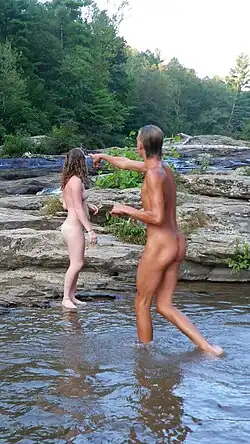
Nudity is the state of being in which a human is without clothing. While estimates vary, for the first 90,000 years of pre-history, anatomically modern humans were naked, having lost their body hair, living in hospitable climates, and not having developed the crafts needed to make clothing. As humans became behaviorally modern, body adornments such as jewelry, tattoos, body paint and scarification became part of non-verbal communications, indicating a person's social and individual characteristics. Indigenous peoples in warm climates used clothing for decorative, symbolic or ceremonial purposes but were often nude, having neither the need to protect the body from the elements nor any conception of nakedness being shameful. In many ancient as well as modern societies, children might be naked until the beginning of puberty, and women often do not cover their breasts, which are locally associated more with nursing than with sexuality.
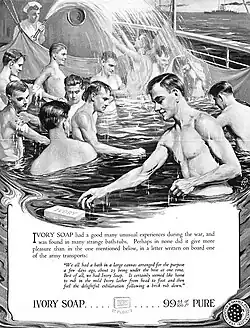
In the ancient civilizations of the Mediterranean, from Mesopotamia to the Roman Empire, proper attire was required to maintain social standing. The majority might possess a single piece of cloth that was wrapped or tied to cover the lower body; slaves might be naked. However, through much of Western history until the modern era, people of any status were also unclothed by necessity or convenience when engaged in labor and athletics; or when bathing or swimming. Such functional nudity occurred in groups that were usually, but not always, segregated by sex. Although improper dress might be socially embarrassing, the association of nudity with sin regarding sexuality began with Abrahamic beliefs, spreading through Europe in the post-classical period. Traditional clothing in temperate regions worldwide also reflect concerns for maintaining social status and order, as well as by necessity due to the colder climate. However, societies such as Japan and Finland maintain traditions of communal nudity based upon the use of baths and saunas that provided alternatives to sexualization.
The spread of Western concepts of modest dress was part of colonialism, and continues today with globalization. Contemporary social norms regarding nudity reflect cultural ambiguity towards the body and sexuality, and differing conceptions of what constitutes public versus private spaces. Norms relating to nudity are different for men than they are for women. Individuals may intentionally violate norms relating to nudity; those without power may use nudity as a form of protest, and those with power may impose nakedness on others as a form of punishment. (Full article...)
Selected general article

Toplessness refers to the state in which a woman's breasts, including her areolas and nipples, are exposed, especially in a public place or in a visual medium. The male equivalent is known as barechestedness.
Social norms around toplessness vary by context and location. Many indigenous societies consider breast exposure to be normal and uncontroversial. At specific beaches and resort destinations, notably in Europe and Australia, girls and women may sunbathe topless either by statute or by custom. However, in most countries, norms of female modesty require girls and women to cover their breasts in public, and many jurisdictions prosecute public toplessness as indecent exposure. The topfreedom movement opposes such laws on the grounds of gender equality.
Art and visual media throughout history, from painting and sculpture to film and photography, have frequently featured toplessness. Such representations are often defended on the grounds of artistic merit; toplessness may also be defended on educational, medical, or political grounds. Toplessness also features prominently in erotica, pornography, and at adult venues ranging from strip clubs to upmarket cabarets (such as the Moulin Rouge). (Full article...)
Did you know...
- ... that Ettore Sottsass's design of the Olivetti Valentine typewriter was inspired by the pop-art nudes of Tom Wesselmann?
- ... that the music video for "It's OK I'm OK" was edited to make its singer appear naked?
- ... that the Indian politician Diwan Chaman Lall failed to get rid of the painting Nude of Indira?
- ... that multiple dancers were arrested at the Capitol Theatre in San Francisco for allegedly not wearing bras during striptease numbers?
- ... that a nude painting of a Mexican revolutionary is housed at the Museum of Forbidden Art in Spain?
- ... that a roadside sandbox full of mostly nude Barbie dolls was the subject of an art gallery exhibit and a documentary?
- ... that having painted a domestic scene depicting his nude wife, Robert Ballagh felt that he had to produce a nude painting of himself as a follow-up?
- ... that, during production of the documentary Live Nude Girls Unite!, Julie Query told her mother on camera that she was a sex worker?
Need help?
Do you have a question about Nudity that you can't find the answer to?
Consider asking it at the Wikipedia reference desk.
Get involved
For editor resources and to collaborate with other editors on improving Wikipedia's Nudity-related articles, see WikiProject Nudity.
General images
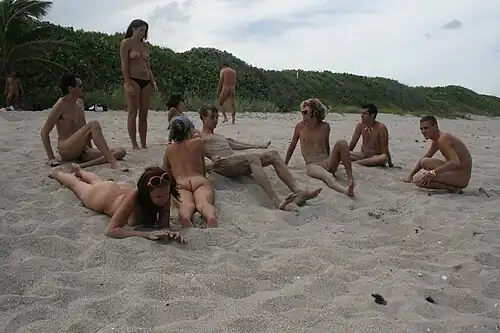 Florida naturists (from Naturism)
 Naturist swimmers in Australia (from Naturism)
 Five nude people on the rocks around Black Pond, McLean, Virginia in July 1980 (from Nudity)
 One of the photographs of the Abu Ghraib prison torture scandal: a naked prisoner being forced to crawl and bark like a dog on a leash. (from Nudity)
 Using birch branches in a Finnish sauna, 1967 (from Nudity)
 Photograph by Jean Louis Marie Eugène Durieu, c. 1855 (from Nude photography)
 Signpost at Mpenjati Naturist Beach (from Naturism)
 The Barricade (1918), oil on canvas, by George Bellows. A painting inspired by an incident in August 1914 in which German soldiers used Belgian townspeople as human shields. (from Nude (art))
 Public naturist recreation area at Lake Unterbach; Strandbad Süd, Düsseldorf-Unterbach, Germany (from Naturism)
 A publicity photo showing a North American naturist couple making tea (from Naturism)
 The Venus of Willendorf (made between 24,000 and 22,000 BCE) (from Nude (art))
 Families bathing nude at a hot spring in Taiwan (from Naturism)


 Nude men at the Przystanek Woodstock festival, 2014 (from Naturism)
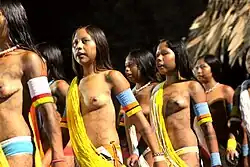 Kayapo women, Pará State, Brazil
 A necklace reconstructed from perforated sea snail shells from Upper Palaeolithic Europe, dated between 39,000 and 25,000 BCE. The practice of body adornment is associated with the emergence of behavioral modernity. (from Nudity)
 Finnish Sauna (1802) (from Naturism)
 A woman breastfeeding in Rio de Janeiro, Brazil, 2017 (from Nudity)
 Zoë Mozert was one of Earl Moran's first nude models in the 1930s. (from Nude photography)
 Couple walking naked in the streets of Barcelona, Spain (from Naturism)
 David (1504)
"And what barbarous judge is there that cannot understand that the foot of a man is more noble than his shoe? His skin than that of the sheep from which his clothes are made?"
— Michelangelo (from Nude (art)) Nudist couple at Terra Cotta Inn, Palm Springs, California, US (from Naturism)


 Naturist family on Lake Senftenberg in 1983 (from Naturism)
 Susanna and the Elders, 1610, Artemisia Gentileschi. This work may be compared with male depictions of the same tale. (from Nude (art))

 Sunrise on the beach, Taitung County, Taiwan (from Naturism)

 People taking part in the World Naked Bike Ride in London, 2012 (from Nudity)

 A woman naked on the beach at Valalta, Croatia (from Naturism)
 Banya (1913) by Zinaida Serebriakova (from Nudity)

 Nudist hiker in British Columbia (from Naturism)

 A Nude Boy on a Beach (1878) by John Singer Sargent (from Nude (art))
 Ariadne Asleep on the Island of Naxos (1808–1812) by John Vanderlyn. The painting was initially considered too sexual for display in the Pennsylvania Academy of the Fine Arts. "Although nudity in art was publicly protested by Americans, Vanderlyn observed that they would pay to see pictures of which they disapproved." (from Nude (art))
 Photograph by Jean Louis Marie Eugène Durieu, part of a series made with Eugène Delacroix (from Nude photography)


 Crayon-style print by Gilles Demarteau with a nude man after original drawing by Edmé Bouchardon was acquired by Academy of Fine Arts in Warsaw as a teaching material (from Nude (art))

 Odalisque (1857) by Eugène Delacroix, a painting with similar pose (from Nude photography)
 World Naked Bike Ride in London, 2016 (from Naturism)
 The far west end of Zipolite Beach, Oaxaca, Mexico (from Naturism)
Subcategories

- Select [►] to view subcategories
Related portals
Subtopics
| Nakedness and clothing | |
|---|---|
| Nudity and sexuality | |
| Issues in social nudity | |
| Naturism | |
| Nude recreation | |
| By location | |
| Social nudity advocates | |
| Depictions of nudity | |
| Related | |


Associated Wikimedia
The following Wikimedia Foundation sister projects provide more on this subject:
-
 Commons
Free media repository -
 Wikidata
Free knowledge base -
 Wikiquote
Collection of quotations -
 Wikisource
Free-content library -
 Wikiversity
Free learning tools -
 Wiktionary
Dictionary and thesaurus
-
 List of all portals
-

-

-

-

-

-

-

-

-

-
 Random portal
-
 WikiProject Portals