Portal:Nova Scotia

Introduction


Nova Scotia is a province in the Maritimes region of Canada, located on the nation's east coast. With an estimated population of over 1 million as of 2026, Nova Scotia is the most populous province in Atlantic Canada. Nova Scotia is also the second-most densely populated province in Canada, and the second-smallest province by area. The province comprises the Nova Scotia peninsula and Cape Breton Island, as well as 3,800 other coastal islands. The province is connected to the rest of Canada by the Isthmus of Chignecto, on which the province's sole land border, with New Brunswick, is located.
Nova Scotia's capital and largest city is Halifax, which is home to over 45% of the province's population as of the 2021 census. Halifax is the twelfth-largest census metropolitan area in Canada, the largest municipality in Atlantic Canada, and Canada's second-largest coastal municipality after Vancouver.
In subsequent years, the British began settling "foreign Protestants" in the region and deported the French-speaking Acadians en masse. There was ambivalence in Nova Scotia over whether the colony should join the Americans in the war against Britain. During the American Revolutionary War (1775–1783), thousands of Loyalists settled in Nova Scotia. (Full article...)
Selected article -

On the morning of 6 December 1917, the French cargo ship SS Mont-Blanc and the Norwegian vessel SS Imo collided in the harbour of Halifax, Nova Scotia, Canada. Laden with high explosives, Mont-Blanc caught fire and detonated, devastating the Richmond district of Halifax. At least 1,782 people, largely in Halifax and Dartmouth, were killed by the blast, debris, fires, or collapsed buildings, and an estimated 9,000 others were injured. The blast was the largest human-made explosion at the time. It released the equivalent energy of roughly 2.9 kilotons of TNT (12 TJ).
Mont-Blanc was under orders from the French government to carry her cargo from New York City via Halifax to Bordeaux, France. At roughly 8:45 am, she collided at low speed, about one knot (1.2 mph; 1.9 km/h), with the unladen Imo, chartered by the Commission for Relief in Belgium to pick up a cargo of relief supplies in New York. On Mont-Blanc, the impact damaged benzol barrels stored on deck, causing them to leak vapours, which were ignited by sparks from the collision, setting off a fire on board that quickly grew out of control. Around 20 minutes later at 9:04:35 am, Mont-Blanc exploded. (Full article...)
Provincial symbol -

The Sable Island horse is a small feral horse found on Sable Island, off the coast of Nova Scotia, Canada. It is usually dark in colour. The first horses were released on the island in the late 1700s, and soon became feral. Additional horses were later transported to improve the herd's breeding stock. They were rounded up for private use and sale for slaughter, which by the 1950s had placed them in danger of extinction. During the 2018 study, the estimated population was 500 horses, up from the roughly 300 recorded in the 1970s. (Full article...)
Selected biography -
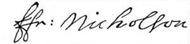
Lieutenant-General Francis Nicholson (12 November 1655 – 16 March 1728 [O.S. 5 March 1727]) was a British Army officer and colonial administrator who served as the governor of South Carolina from 1721 to 1725. He also served as the governor of Nova Scotia from 1712 to 1715, the governor of Virginia from 1698 to 1705, the governor of Maryland from 1694 to 1698, the lieutenant-governor of Virginia from 1690 to 1692 and the lieutenant-governor of the Dominion of New England from 1688 to 1689.
Nicholson's military service included time in Africa and Europe, after which he was sent to North America as leader of the troops supporting Governor Sir Edmund Andros in the Dominion of New England. There Nicholson distinguished himself, and was appointed lieutenant governor of the Dominion in 1688. After news of the Glorious Revolution and the overthrow of King James II reached the colonies in 1689, Andros was himself overthrown in the Boston Revolt. Nicholson himself was soon caught up in the civil unrest from Leisler's Rebellion in New York Town, and afterwards fled to England. (Full article...)
Selected image
 The Lunenburg Academy in 2008
 Children tobogganing in Halifax during the reconstruction (1917 or 1918)
 The Order of Nova Scotia is the highest honour amongst all those conferred by the Nova Scotia Crown
 Guardhouse at the Fortress of Louisbourg

 Welcome sign visible when entering Nova Scotia from New Brunswick by road
 North Sydney, Nova Scotia circa 1900
 Winter on Hollis Street, Halifax (1947)
 Université Sainte-Anne is a French-language university in Pointe-de-l'Église, Nova Scotia
 Halifax from Citadel Hill in 1901
 The Bluenose II is a replica of the fishing and racing schooner Bluenose
 The Halifax–Dartmouth Ferry Service is the oldest saltwater ferry in North America
 The Pride of Baltimore II off the coast of Lunenburg in 2008
 Wrecked homes on Campbell Road following the Halifax Explosion
 Women walking from Africville towards Halifax
 Wreckage of Fairey Swordfish aircraft HS404 at the Naval Air Gunnery School, Yarmouth, Nova Scotia, 1943
Selected panorama -

Topics

Categories

Things you can do
- Help expand stub articles: There are many short articles (stubs) relating to Nova Scotia. You can help by expanding them. See Nova Scotia stubs for a list.
- Add images: There are a number of articles relating to Nova Scotia which would be better with a photograph. You can help by finding an appropriately licensed image or creating your own. See requested photographs in Nova Scotia for a list.
Associated Wikimedia
The following Wikimedia Foundation sister projects provide more on this subject:
-
 Commons
Free media repository -
 Wikidata
Free knowledge base -
 Wikiquote
Collection of quotations -
 Wikisource
Free-content library -
 Wikiversity
Free learning tools -
 Wikivoyage
Free travel guide -
 Wiktionary
Dictionary and thesaurus
Related portals and WikiProject

More portals
-
 List of all portals
-

-

-

-

-

-

-

-

-

-
 Random portal
-
 WikiProject Portals
