This is a Featured article, which represents some of the best content on English Wikipedia.
Romance is the eighth studio album by Mexican singer Luis Miguel. It was released by WEA Latina on 19 November 1991. Although the production was originally intended as another collaboration with Juan Carlos Calderón, that plan was scrapped when Calderón was unable to compose songs for the album. Facing a new material deadline in his recording contract, at his manager's suggestion, Miguel chose bolero music for his next project. Mexican singer-songwriter Armando Manzanero was hired by WEA Latina to co-produce the album with Miguel. Recording began in August 1991 at Ocean Way Recording in Hollywood, California, with Bebu Silvetti as the arranger.
On the album, Miguel covers twelve boleros, originally recorded from 1944 to 1986. The first two singles, "Inolvidable" and "No Sé Tú", reached number one on the Billboard Hot Latin Songs chart in the United States and spent six months atop the Mexican charts. "Mucho Corazón" and "Cómo" were in the top five of the Hot Latin Songs chart, and "Usted" and "La Barca" received airplay throughout Latin America. Miguel promoted the record with a tour of the United States and Latin America. The album was generally well received by music critics, who praised Miguel's singing and the record's production. The singer received several accolades, including Luis Miguel's fourth Grammy nomination for Best Latin Pop Album. (Full article...)
Mexico is the world's largest producer of avocados, making avocado cultivation a major part of the country's economy, agriculture, and history. As of 2023, Mexico produced approximately 3 million tons of avocados, accounting for 29% of global output. The crop is most heavily grown in the 'Avocado Belt', primarily Michoacán and the State of Mexico. The major cultivars in Mexico are Fuerte, Hass, Bacon, Reed, Criollo, and Zutano.
Avocado farming is very important to local economies and has deep historical roots. Demand for Mexican avocados has driven growth in employment, supply chain complexity, and exports. However, growth has led to environmental consequences such as deforestation and water scarcity. There are also social challenges, including organized crime and cartel involvement, which affects locals and local communities. (Full article...)
This is a Good article, an article that meets a core set of high editorial standards.
Estrada in 2018, applying a hold on El Felino (masked)
Jerry Estrada (full name, Gerardo Hernández Estrada; born January 10, 1958) is a semi-retired Mexicanprofessional wrestler. For most of his career, he has portrayed a rudo (heel, those that portray the "bad guys") character, nicknamed "El Puma". His rudo persona was pattered on various glam rock bands, complete with colorful spandex and what was described as a "rock and roll" attitude in the ring. He was originally active from 1978 until 2003, when he was forced to retire due to chronic injures caused by his signature bumps outside the ring. Estrada began working select matches again in 2018.
Carlos Slim Helú (Spanish:[ˈkaɾlosesˈlineˈlu,-esˈlim-]; born 28 January 1940) is a Mexican business oligarch, investor and philanthropist. From 2010 to 2013, Slim was ranked as the richest person in the world by Forbes business magazine. He derived his fortune from his extensive holdings in a considerable number of Mexican companies through his conglomerate, Grupo Carso. As of July2025, the Bloomberg Billionaires Index ranked him as the 18th-richest person in the world, with a net worth of US$99.1 billion, making him the richest person in Latin America.
Slim's corporate conglomerate spans numerous industries across the Mexican economy, including education, health care, industrial manufacturing, transportation, real estate, mass media, mining, energy, entertainment, technology, retail, sports and financial services. However, the core of his fortune derives from telecommunications, where he owns América Móvil (with operations throughout Latin America) and the Mexican carrier Telcel and Internet service providerTelmex, a state-run-gone-private company which maintained a virtual monopoly for many years after Slim's acquisition. He accounts for 40 per cent of the listings on the Mexican Stock Exchange. As of 2016, he was the largest single shareholder of non-voting shares of the New York Times Company. In 2017, he sold half of his shares. (Full article...)
Pan dulce (Latin American Spanish pronunciation:[ˌpanˈdulse]; lit.'sweet bread') is the general name for a variety of Mexican baked goods. They are inexpensive treats and are consumed at breakfast, merienda, or dinner. These baked goods oftentimes are created with intent to derive meaning from people, animals, and objects. The baked goods originated in Mexico following the introduction of wheat during the Spanish conquest of the Americas and developed into many varieties thanks to French influences in the 19th century. (Full article...)
Image 2Chacmool, Maya, from the Platform of the Eagles, Chichen Itza, Mexico, ca. 800–90 CE (from History of Mexico)
Image 3A unit of Cristeros preparing for battle. (from History of Mexico)
Image 4Battle of Centla, the first time a horse was used in battle in a war in the Americas. Mural in the Palacio Municipal of Paraíso, Tabasco (from History of Mexico)
Image 5Colossal atlantids, pyramid B, Toltec, Tula, Mexico, ca. 900–1180 AD (from History of Mexico)
Image 13The Volkswagen Beetle, known in Mexico as the "Vocho," is perhaps the most iconic classic car in the country. Its production in Mexico began in 1967, and it continued until 2003, making it a symbol of Mexican automotive culture. (from Culture of Mexico)
Image 15Plutarco Elías Calles politician and revolutionary general who served as President of Mexico from 1924 to 1928, known for his role in shaping modern Mexico through reforms and the consolidation of state power. (from History of Mexico)
Image 16Porfirio Díaz dominant Mexican political and military figure who served as president for much of the late 19th and early 20th centuries, characterized by his long rule and the modernization efforts known as the Porfiriato. (from History of Mexico)
Image 17General Santa Anna known for his leadership during the Texas Revolution, Mexican-American War, and turbulent periods of Mexican history marked by political instability and territorial losses. (from History of Mexico)
Image 18Panel 3 from Cancuen, Guatemala, representing king T'ah 'ak' Cha'an (from History of Mexico)
Image 26Mexican Central Railway train at station, Mexico (from History of Mexico)
Image 27Goddess, mural painting from the Tetitla apartment complex at Teotihuacan, Mexico, 650–750 CE (from History of Mexico)
Image 28David Huerta is a contemporary philosopher and poet who examines human existence, freedom, and meaning in Mexican society, blending philosophy with art and literature. (from Culture of Mexico)
Image 33Battle of Miahuatlán took place on 3 October 1866. The liberal victory at Miahuatlán was significant because it allowed them to consolidate their control over southern Mexico. (from History of Mexico)
Image 35President Obregón. Note that he lost his right arm in the Battle of Celaya (1915), earning him the nickname of Manco de Celaya ("the one-armed man of Celaya"). (from History of Mexico)
Image 36The Castillo, Chichen Itza, Mexico, ca. 800–900 CE (from History of Mexico)





 President Felipe Calderón with President of Brazil Luiz Inácio Lula da Silva. (from History of Mexico)
 Chacmool, Maya, from the Platform of the Eagles, Chichen Itza, Mexico, ca. 800–90 CE (from History of Mexico)
 A unit of Cristeros preparing for battle. (from History of Mexico)
 Battle of Centla, the first time a horse was used in battle in a war in the Americas. Mural in the Palacio Municipal of Paraíso, Tabasco (from History of Mexico)
 Colossal atlantids, pyramid B, Toltec, Tula, Mexico, ca. 900–1180 AD (from History of Mexico)
 Buffalo Soldiers of the American 10th Cavalry Regiment taken prisoner during the Battle of Carrizal, Mexico in 1916. (from History of Mexico)
 Murals of Bonampak (between 580 and 800 AD) (from Culture of Mexico)
 Comanchería, territory controlled by the Comanches, prior to 1850 (from History of Mexico)
 Portrait and book by Sor Juana Inés de la Cruz, Baroque poet and writer. (from Culture of Mexico)

 La huida a Egipto (The Flight into Egypt). Miguel Cabrera, around 1700. (from Culture of Mexico)
 Pear, Quince and Psidium cajeta. In 2010 declared the Bicentennial Dessert of Mexico. (from Culture of Mexico)
 The Volkswagen Beetle, known in Mexico as the "Vocho," is perhaps the most iconic classic car in the country. Its production in Mexico began in 1967, and it continued until 2003, making it a symbol of Mexican automotive culture. (from Culture of Mexico)
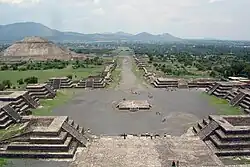 Teotihuacan view of the Avenue of the Dead and the Pyramid of the Sun, from the Pyramid of the Moon (from History of Mexico)
 Plutarco Elías Calles politician and revolutionary general who served as President of Mexico from 1924 to 1928, known for his role in shaping modern Mexico through reforms and the consolidation of state power. (from History of Mexico)
 Porfirio Díaz dominant Mexican political and military figure who served as president for much of the late 19th and early 20th centuries, characterized by his long rule and the modernization efforts known as the Porfiriato. (from History of Mexico)
 General Santa Anna known for his leadership during the Texas Revolution, Mexican-American War, and turbulent periods of Mexican history marked by political instability and territorial losses. (from History of Mexico)
 Panel 3 from Cancuen, Guatemala, representing king T'ah 'ak' Cha'an (from History of Mexico)

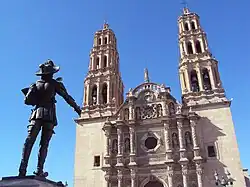 Chihuahua Cathedral and a monument to the city's founder, Antonio Deza y Ulloa (from History of Mexico)
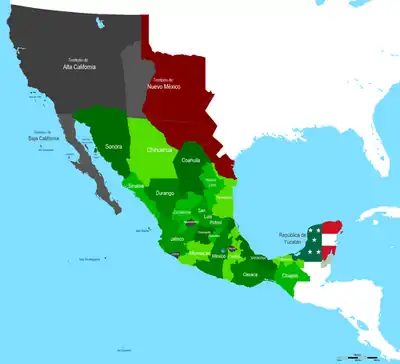 A map of Mexico 1845 after Texas annexation by the U.S. (from History of Mexico)
 Entry into Mexico City by the Mexican army (from History of Mexico)
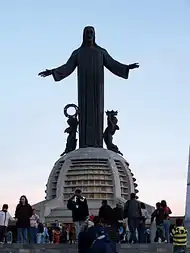 Cerro del Cubilete ("Dice Cup Hill"). At the top of the hill is the Cristo Rey (Christ the King) statue. (from Culture of Mexico)
 U.S. President Barack Obama and Mexican President-Elect Enrique Peña Nieto during their meet at the White House following Peña Nieto's election victory. (from History of Mexico)
 Toltec carving representing the Aztec Eagle, found in Veracruz, 10th–13th century. Metropolitan Museum of Art. (from History of Mexico)
 Mexican Central Railway train at station, Mexico (from History of Mexico)
 Goddess, mural painting from the Tetitla apartment complex at Teotihuacan, Mexico, 650–750 CE (from History of Mexico)
 David Huerta is a contemporary philosopher and poet who examines human existence, freedom, and meaning in Mexican society, blending philosophy with art and literature. (from Culture of Mexico)
 Liberación (Liberation). Jorge González Camarena. 1908. (from Culture of Mexico)
 Father Miguel Hidalgo y Costilla, Statue at the Sanctuary of Atotonilco (from History of Mexico)
 The 1985 Mexico City earthquake (from History of Mexico)
 Chapultepec, more commonly called the "Bosque de Chapultepec" (Chapultepec Forest) (from Culture of Mexico)
 Battle of Miahuatlán took place on 3 October 1866. The liberal victory at Miahuatlán was significant because it allowed them to consolidate their control over southern Mexico. (from History of Mexico)
 Singer and actor Pedro Infante, one of the leading figures of the Golden Age of Mexican Cinema. (from Culture of Mexico)
 President Obregón. Note that he lost his right arm in the Battle of Celaya (1915), earning him the nickname of Manco de Celaya ("the one-armed man of Celaya"). (from History of Mexico)
 The Castillo, Chichen Itza, Mexico, ca. 800–900 CE (from History of Mexico)
 Viceroy José de Iturrigaray (from History of Mexico)
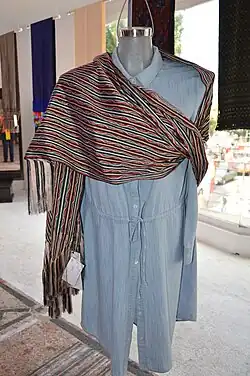 Silk rebozo from Santa María del Río, SLP on a mannequin at the Feria de Rebozo in Tenancingo, State of Mexico. (from Culture of Mexico)

 Dining table, painted between 1857 y 1859, oleo sobre tela (oil on canvas) by Agustín Arrieta (from Culture of Mexico)

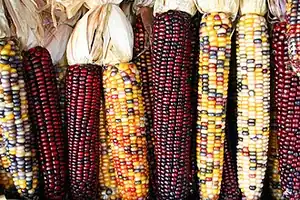 Variegated maize ears (from History of Mexico)
 Spanish and Portuguese empires in 1790 (from History of Mexico)
 Gilberto Bosques Saldívar took the initiative to rescue tens of thousands of Jews and Spanish Republican exiles from being deported to Nazi Germany or Spain. (from History of Mexico)
 Three world leaders: (background, left to right) Mexican President Carlos Salinas de Gortari, U.S. President George H. W. Bush, and Canadian Prime Minister Brian Mulroney, observe the signing of the North American Free Trade Agreement. (from History of Mexico)

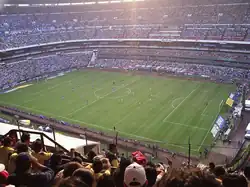 Matches between Club América and Cruz Azul at the Estadio Azteca, known as the "Clásico Joven." (from Culture of Mexico)
 Fireworks in Mexico City for New Year's Day. (from Culture of Mexico)
 Distribution of linguistic groups around 1500. (from Culture of Mexico)


 List of all portals






 Random portal
 WikiProject Portals