Portal:Mauritania

The Mauritania Portal - بوابة موريتانيا
Mauritania, officially and also known as the Islamic Republic of Mauritania, is a country in the Maghreb region of West Africa. It is bordered by the Atlantic Ocean to the west, Western Sahara to the north and northwest, Algeria to the northeast, Mali to the east and southeast, and Senegal to the southwest. By land area Mauritania is the 11th-largest country in Africa and the 28th-largest in the world; 90% of its territory is in the Sahara desert. Most of its population of 4.3 million live in the temperate south of the country; roughly a third of the population is concentrated in the capital and largest city, Nouakchott, on the Atlantic coast. The country's name derives from Mauretania, the Latin name for a region, to the north, in the ancient Mediterranean Maghreb. Mauretania extended from central present-day northern Algeria to the Atlantic, in Morocco. Berbers occupied what is now Mauritania by the beginning of the 3rd century CE. Groups of Arab tribes migrated to this area in the late 7th century, bringing with them Islam, Arab culture, and the Arabic language. In the early 20th century, Mauritania was colonized by France as part of French West Africa. It achieved independence in 1960. The country has since experienced recurrent coups and periods of military dictatorship. The 2008 Mauritanian coup d'état was led by General Mohamed Ould Abdel Aziz, who won subsequent presidential elections in 2009 and 2014. He was succeeded by General Mohamed Ould Ghazouani following the 2019 elections, in what was considered the country's first peaceful transition of power since independence. Mauritania has a poor human rights record, particularly because of its perpetuation of slavery; the 2018 Global Slavery Index estimates there are about 90,000 slaves in the country (or 2.1% of the population). Despite an abundance of natural resources, Mauritania remains poor; its economy is based primarily on agriculture and fishing. Mauritania is culturally and politically part of the Arab world as a member of the Arab League. Arabic is the official language, while Pulaar, Soninke and Wolof are recognized as national languages. The state religion is Islam, and almost all inhabitants are Sunni Muslims. Despite its prevailing Arab identity, Mauritanian society is multiethnic. The Haratin, comprise 40% of the population while the Bidhan make up 30% of the population. The remaining 30% of Mauritania’s population comprises various sub-Saharan ethnic groups. (Full article...) Selected article -Amar Godomat (né. Ama Kodu Juuf in Serer, also known as Xamakodu Fa Maak (meaning Hamacodou The Elder, in Serer), or Amar Gôdômat, Ama Kodu Joof in Gambian English, or Ama Codou Diouf in Senegalese French)) is the name given in oral tradition to an 11th-century Serer archer. Serer oral tradition relays that, a Serer bowman named Amar Godomat killed the 11th century Almoravid leader Abu Bakr ibn Umar in battle, with his bow near lake Rzik (just north of the Senegal) (Godomat's name apparently originates with this death). The battle is reported to have taken place near Khoo Maak in Serer country, commonly known as Lake Cayor. One source discussing this oral tradition says that "almoravid Abu Bakar Ben Umar was killed by the arrow of serer warrior Amar Godomat, in the month of shaa'ban 480 (November 1087). This regicide potentially signals his exodus after taking the name "Amar god o maat", "Amar (which) killed (the) king"." Mauritanian oral tradition claims Abu Bakr was killed in a clash with the "Gangara" (Soninke Wangara) of the Tagant Region of southern Mauritania, relating that he was struck down by an arrow from an old, blind Gangara chieftain in the pass of Khma (between the Tagant and Assab mountains, en route to Ghana). Another source for Abu Bakr's death says "In the region of Tagant on his way to Djabal al-Dbahab, the Mountain of Gold, he was wounded, according to the chronicles, by a poisoned arrow, shot by an old black bowman who could not see unless his eye-lids were raised up to uncover his eyeballs. The black bowman asked his daughter to hold open his eyes so that he could aim his arrow. It struck the Amir in the knee. Abu Bakr turned his horse around and rode off..." dying when he arrived in Tagant. (Full article...)
| ||||||||||||||||||||||||||||||||||||||||||||||||||||||||||||||||||||||||||||||||||||||||||||||||||||||||||||||||||||





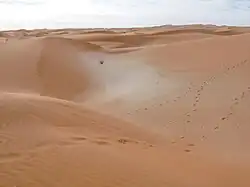


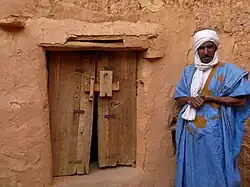
 |
You are invited to participate in WikiProject Mauritania, a WikiProject dedicated to developing and improving articles about Mauritania. |
 WikiProject Africa
Topics in Mauritania
| Current | | |
|---|---|---|
| Former | ||
| Years in Mauritania (1960–present) | |
|---|---|
Cities and towns
Largest cities or towns in Mauritania | |||||||||
|---|---|---|---|---|---|---|---|---|---|
| Rank | Name | Region | Pop. | Rank | Name | Region | Pop. | ||
| 1 | Nouakchott | Nouakchott | 1,446,761 | 11 | Adel Bagrou | Hodh Ech Chargui | 37,048 | ||
| 2 | Nouadhibou | Dakhlet Nouadhibou | 173,525 | 12 | Aïoun el Atrous | Hodh El Gharbi | 36,517 | ||
| 3 | Kiffa | Assaba | 84,101 | 13 | Hamed | Assaba | 36,448 | ||
| 4 | Vassala | Hodh Ech Chargui | 79,508 | 14 | Tintane | Hodh El Gharbi | 35,995 | ||
| 5 | Kaédi | Gorgol | 62,790 | 15 | Atar | Adrar | 35,171 | ||
| 6 | Zouérat | Tiris Zemmour | 62,380 | 16 | Néma | Hodh Ech Chargui | 35,042 | ||
| 7 | Rosso | Trarza | 61,156 | 17 | Gouraye | Guidimagha | 35,021 | ||
| 8 | Boghé | Brakna | 50,205 | 18 | Timbédra | Hodh Ech Chargui | 34,244 | ||
| 9 | Sélibaby | Guidimagha | 44,966 | 19 | Voum Legleita | Gorgol | 33,314 | ||
| 10 | Guerou | Assaba | 40,315 | 20 | Boutilimit | Trarza | 32,347 | ||
Communes
Associated Wikimedia
The following Wikimedia Foundation sister projects provide more on this subject:
-
 Commons
Free media repository -
 Wikidata
Free knowledge base -
 Wikiquote
Collection of quotations -
 Wikisource
Free-content library -
 Wikiversity
Free learning tools -
 Wikivoyage
Free travel guide -
 Wiktionary
Dictionary and thesaurus
-
 List of all portals
-

-

-

-

-

-

-

-

-

-
 Random portal
-
 WikiProject Portals