Portal:Martial arts

The Martial Arts Portal
Martial arts are codified systems and traditions of combat. They are practiced for a number of reasons ranging from self-defense, street fighting, military, and law enforcement to non-violent exercising, ceremonial, competition; physical, mental, and spiritual development; entertainment; and to preserve the intangible cultural heritage of a nation. The term "martial arts" was originally used to refer to the traditions of East Asia, but has subsequently been applied to other practices which originated outside that region. (Full article...)
Although the earliest evidence of martial arts goes back millennia, the true roots are difficult to reconstruct. Inherent patterns of human aggression which inspire practice of mock combat, combat sports, and optimization of serious close combat as cultural universals are doubtlessly inherited from the pre-human stage and were made into an "art" from the earliest emergence of that concept. Indeed, many universals of martial art are fixed by the specifics of human physiology and not dependent on a specific tradition or era.
Specific martial traditions become identifiable in Classical Antiquity, with disciplines such as shuai jiao, Greek wrestling or those described in the Indian epics or the Spring and Autumn Annals of China. (Full article...)
Selected articles
 Iaidō (居合道), abbreviated iai (居合), is a Japanese martial art that emphasizes being aware and capable of quickly drawing the sword and responding to sudden attacks.
Iaido consists of four main components: the smooth, controlled movements of drawing the sword from its scabbard (or saya), striking or cutting an opponent, shaking blood from the blade, and replacing the sword in the scabbard. While beginning practitioners of iaido may start learning with a wooden sword (bokutō 木刀) depending on the teaching style of a particular instructor, most of the practitioners use a blunt-edged sword called an iaitō or mogitō. Few, more experienced, iaido practitioners use a sharp-edged sword (shinken). (Full article...)
Japanese swords. Two tachi with full mountings (middle and bottom right), a sword with a Shirasaya-style tsuka (top right), a wakizashi (top left), and various tsuba (bottom left).
A Japanese sword (Japanese: 日本刀, Hepburn: nihontō) is one of several types of traditionally made swords from Japan. Bronze swords were made as early as the Yayoi period (1,000 BC – 300 AD), though most people generally refer to the curved blades made from the Heian period (794–1185) to the present day when speaking of "Japanese swords". There are many types of Japanese swords that differ by size, shape, field of application, and method of manufacture. Some of the more commonly known types of Japanese swords are the katana, tachi, ōdachi, wakizashi, and tantō. (Full article...)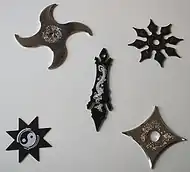
Five types of shuriken
A shuriken (Japanese: 手裏剣; lit. 'hand-hidden blade') is a Japanese concealed weapon used by samurai or ninja or in martial arts as a hidden dagger or metsubushi to distract or misdirect. (Full article...)
Aikido (Shinjitai: 合気道, Kyūjitai: 合氣道, aikidō, Japanese pronunciation: [aikiꜜdoː]) is a modern Japanese martial art which is split into many different styles including Aikikai, Shodokan Aikido, Yoshinkan, Renshinkai, Iwama Ryu, Iwama Shin Shin Aiki Shuren Kai, and Ki Aikido. Aikido is now practiced in around 140 countries.
It was originally developed by Morihei Ueshiba, as a synthesis of his martial studies, philosophy and religious beliefs. Ueshiba's goal was to create an art which practitioners could use to defend themselves against attacks, while also protecting the attackers from injury. Aikido is often translated as "the way of unifying (with) life energy" or as "the way of harmonious spirit". According to the founder's philosophy, the primary goal in the practice of aikido is to overcome oneself instead of cultivating violence or aggressiveness. Morihei Ueshiba used the phrase "masakatsu agatsu katsuhayabi" (正勝吾勝勝速日, "true victory, final victory over oneself, here and now") to refer to this principle. (Full article...)
Angampora is a Sinhalese martial art that combines combat techniques, self-defense, sport, exercise, and meditation. A key component of angampora is the namesake angam, which incorporates hand-to-hand fighting, and illangam, involving the use of indigenous weapons such as the ethunu kaduwa, staves, knives and swords. Another component known as maya angam, which uses spells and incantations for combat, is also said to have existed. Angampora's distinct feature lies in the use of pressure point attacks to inflict pain or permanently paralyze the opponent. Fighters usually make use of both striking and grappling techniques, and fight until the opponent is caught in a submission lock that they cannot escape. Usage of weapons is discretionary. Perimeters of fighting are defined in advance, and in some of the cases is a pit.
A number of paintings related to angampora are found at Buddhist temples in Sri Lanka. These include Embekka Devalaya, Gadaladeniya Rajamaha Viharaya, Temple of the Tooth, Saman Devalaya (Ratnapura) and Lankathilaka Rajamaha Viharaya. (Full article...)
A retiarius stabs at a secutor with his trident in this mosaic from the villa at Nennig, c. 2nd–3rd century CE.
A retiarius (plural retiarii; literally, "net-man" in Latin) was a Roman gladiator who fought with equipment styled on that of a fisherman: a weighted net (rete (3rd decl.), hence the name), a three-pointed trident (fuscina or tridens), and a dagger (pugio). The retiarius was lightly armoured, wearing an arm guard (manica) and a shoulder guard (galerus). Typically, his clothing consisted only of a loincloth (subligaculum) held in place by a wide belt, or of a short tunic with light padding. He wore no head protection or footwear.
The retiarius was routinely pitted against a heavily armed secutor. The net-fighter made up for his lack of protective gear by using his speed and agility to avoid his opponent's attacks and waiting for the opportunity to strike. He first tried to throw his net over his rival. If this succeeded, he attacked with his trident while his adversary was entangled. Another tactic was to ensnare his enemy's weapon in the net and pull it out of his grasp, leaving the opponent defenceless. Should the net miss or the secutor grab hold of it, the retiarius likely discarded the weapon, although he might try to collect it back for a second cast. Usually, the retiarius had to rely on his trident and dagger to finish the fight. The trident, as tall as a human being, permitted the gladiator to jab quickly, keep his distance, and easily cause bleeding. It was not a strong weapon, usually inflicting non-fatal wounds so that the fight could be prolonged for the sake of entertainment. The dagger was the retiarius's final backup should the trident be lost. It was reserved for when close combat or a straight wrestling match had to settle the bout. In some battles, a single retiarius faced two secutores simultaneously. For these situations, the lightly armoured gladiator was placed on a raised platform and given a supply of stones with which to repel his pursuers. (Full article...)
Catch wrestling (also known as catch-as-catch-can) is an English wrestling style with fewer restrictions than other wrestling styles. It allows techniques using or targeting the legs (unlike Greco-Roman wrestling), it allows joint locks (unlike freestyle wrestling and Greco-Roman wrestling), and does not require a prescribed starting grip. Rules varied by period, promoter, and competition. It was spread by wrestlers of travelling funfairs who developed their own submission holds, referred to as "hooks" and "stretches", into their wrestling to increase their effectiveness against their opponents, as well as immigrants through Europe and the Anglosphere.
Catch-as-catch-can was included in the 1904 Olympic Games and continued through the 1936 Games; it had new rules and weight categories introduced similar to other amateur wrestling styles, and dangerous moves – including all submission holds – were banned. International and national amateur wrestling organizations increasingly standardized catch-as-catch-can rules, eliminating submissions and other dangerous techniques. The International Amateur Wrestling Federation (IAWF), founded in 1921, adopted a modified ruleset that became known as freestyle wrestling. Thus, catch declined as a distinct competitive style, while aspects of its techniques and traditions were preserved in professional wrestling, particularly in Japan, where it became associated with the development of strong-style and Shoot-style Puroresu. After a revival effort starting in the 1980s, competitive catch wrestling gradually made a return, leading to The Snake Pit's Catch Wrestling World Championships and notable competitions such as the Snake Pit British Championships and ACWA US Open. (Full article...)- Jujutsu (柔術, jūjutsu; Japanese pronunciation: [dʑɯːʑɯtsɯ] or [dʑɯꜜːʑɯtsɯ] ⓘ), also known as jiu-jitsu or ju-jitsu (both /dʒuːˈdʒɪtsuː/ joo-JITS-oo), is a Japanese martial art and a system of close combat that can be used in a defensive or offensive manner. A subset of techniques from certain styles of Japanese jujutsu either directly or indirectly influenced the development of many martial arts and combat sports, such as judo, aikido, hapkido, sambo, Brazilian jiu-jitsu, ARB, mixed martial arts, etc. (Full article...)

A woman's boxing match in Uruguay in 2008
Boxing is a combat sport and martial art. Taking place in a boxing ring, it involves two opponents throwing punches at each other for a predetermined amount of time. It is usually done wearing protective equipment, such as protective gloves, hand wraps, and mouthguards.
Although the term 'boxing' commonly refers to the Western style, where only the fists are used, it has evolved differently in various regions and cultures across the world. Today the term, "boxing" is also used to refer to any combat sport focused on striking, where two opponents fight each other using their fists, and could possibly involve kicks, elbow strikes, knee strikes, and headbutts, depending on the rules. These include bare-knuckle boxing, kickboxing, Muay Thai, Lethwei, savate, and sanda. Boxing techniques have been incorporated into many martial arts, military systems, as well as other combat sports. (Full article...)- As of 2026, there have been twenty recorded deaths resulting from sanctioned mixed martial arts contests and nine from unregulated bouts, none however in the largest MMA promotion Ultimate Fighting Championship. A 2006 study suggests that the risk of injury in general in MMA is comparable to that in professional boxing. For professional boxing matches, the Manuel Velazquez Boxing Fatality Collection lists 923 deaths during the 118-year period of 1890–2008. (Full article...)


Selected biography

The son of a landowner from Tanabe, Ueshiba studied a number of martial arts in his youth, and served in the Japanese Army during the Russo-Japanese War. After being discharged in 1907, he moved to Hokkaido as the head of a pioneer settlement; here he met and studied with Takeda Sōkaku, the headmaster of Daitō-ryū Aiki-jūjutsu. On leaving Hokkaido in 1919, Ueshiba joined the Ōmoto-kyō movement, a Shinto sect, in Ayabe, where he served as a martial arts instructor and opened his first dojo. He accompanied the head of the Ōmoto-kyō group, Onisaburo Deguchi, on an expedition to Mongolia in 1924, where they were captured by Chinese troops and returned to Japan. The following year, he had a profound spiritual experience, stating that, "a golden spirit sprang up from the ground, veiled my body, and changed my body into a golden one." After this experience, his martial arts technique became gentler, with a greater emphasis on the control of ki.
Ueshiba moved to Tokyo in 1926, where he set up what would become the Aikikai Hombu Dojo. By this point he was comparatively famous in martial arts circles, and taught at this dojo and others around Japan, including in several military academies. In the aftermath of World War II the Hombu dojo was temporarily closed, but Ueshiba had by this point left Tokyo and retired to Iwama, and he continued training at the dojo he had set up there. From the end of the war until the 1960s, he worked to promote aikido throughout Japan and abroad. He died from liver cancer in 1969.
After Ueshiba's death, aikido continued to be promulgated by his students (many of whom became noted martial artists in their own right). It is now practiced around the world. (Full article...)
Selected entertainment
Rocky Balboa is a 2006 American sports drama film starring, written and directed by Sylvester Stallone. It is the sequel to Rocky V (1990) and the sixth installment in the Rocky franchise. The film co-stars Burt Young and Antonio Tarver in his only acting role. In the film, Rocky Balboa (Stallone), now an aging small restaurant owner, is challenged to an exhibition fight by hothead young boxer Mason Dixon (Tarver).
Development for a sixth Rocky film began after Stallone expressed regret over the outcome of Rocky V, which was viewed as a disappointing conclusion to the series. Rocky Balboa includes references to characters and objects from previous installments, and Stallone was inspired by recent personal struggles and triumphs when writing the film. It is Stallone's first directorial effort since Rocky IV (1985). Principal photography began in December 2005 and lasted until January 2006, with filming locations including Las Vegas, Los Angeles, and Philadelphia. In contrast to previous entries in the franchise, the fight choreography in Rocky Balboa was less scripted, featuring real punches thrown by Stallone and Tarver. It is also the latest film overall for composer Bill Conti, the composer of the first three and fifth films in the series.
It was produced by Metro-Goldwyn-Mayer, Columbia Pictures, Revolution Studios, Chartoff Productions and Winkler Films, and theatrically released by MGM Distribution Co. on December 20, 2006, sixteen years after the release of Rocky V and thirty years after the release of the first film. It is the first Rocky film not to be released under the United Artists banner, the franchise's original owner and distributor, and the last to be written or directed solely by Stallone, though he would remain a producer to the Creed films, the second of which he co-wrote. It received generally positive reviews from critics, with praise for its screenplay, Stallone's performance, and heartfelt exploration of Balboa's character, with many critics calling it a significant improvement over its predecessor, and many labelling the film one of the best entries in the franchise. It was also a commercial success, grossing $156 million dollars worldwide. A spin-off, Creed, was released in 2015 and started its own series.
Sports portals
Selected image
 |
Randai (Jawi: رنداي) is a folk theater tradition of the Minangkabau ethnic group in West Sumatra, Indonesia, which incorporates music, singing, dance, drama and the martial art of silat. Randai is usually performed for traditional ceremonies and festivals, and complex stories may span a number of nights. It is performed as a theatre-in-the-round to achieve an equality and unity between audience members and the performers. Randai performances are a synthesis of alternating martial arts dances, songs, and acted-out scenes. Stories are delivered by both the acting and the singing and are mostly based upon Minangkabau legends and folktales. Randai originated early in the 20th century out of a fusion of local martial arts, story-telling, and other performance traditions. Men originally played both the male and female characters in the story, but since the 1960s, women have also participated. (Full article...)
General images -

 Panel by Alfredo Storni featuring capoeirista Ciríaco defeating jujitsu fighter Sada Miyako with a rabo de arraia kick, O Malho, 1909. (from Mixed martial arts)
 Depiction of fighting monks demonstrating their skills to visiting dignitaries (early 19th-century mural in the Shaolin Monastery). (from Chinese martial arts)
 Yoshihiko Yoshimatsu attempting to throw Toshiro Daigo with an uchi mata in the final of the 1951 All-Japan Judo Championships (from Judo)
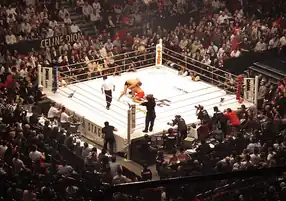 A ring used by PRIDE (from Mixed martial arts)
 Throw during competition, leads to an ippon (from Judo)


 Bruce Lee is known for practicing many martial arts styles, including Karate, having trained with Chuck Norris for many years. (from Karate)
 King Shō Shin (from Karate)


 Eisho-ji temple, Tokyo (from Judo)
 Japanese judoka Takamasa Anai Vs French judoka Thierry Fabre during the 2010 World Judo Championships held in Tokyo (from Judo)

 Masahiko Kimura vs. Hélio Gracie, a 1951 bout between Japanese judo fighter Masahiko Kimura and Brazilian jiu jitsu founder Hélio Gracie in Brazil, was an early high-profile mixed martial arts bout. (from Mixed martial arts)
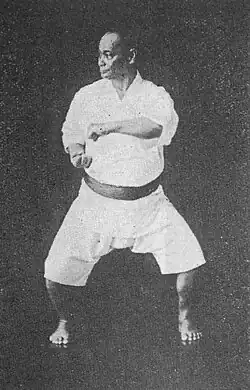 Chōki Motobu in Naihanchi-dachi, one of the basic karate stances (from Karate)
 Kung Fu in Iran (from Chinese martial arts)
 A ring-side doctor attends to a fighter following a loss. (from Mixed martial arts)
 Mural at Shaolin temple from 1830's depicting forearm strikes and reverse kicks (from Chinese martial arts)
 Megumi Fujii (left) facing Cody Welchlin (right) (from Mixed martial arts)

 Cosplayers of Karateka characters from Street Fighter (from Karate)
 Olympic Judo pictogram (from Judo)

 Gina Carano applying a ground-and-pound on her opponent (from Mixed martial arts)
- Bruce Lee popularized the concept of mixed martial arts via his hybrid philosophy of Jeet Kune Do during the late 1960s to early 1970s. (from Mixed martial arts)


 Karate movements in Lappeenranta (from Karate)
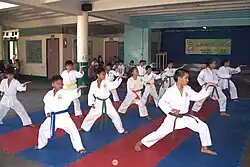 Karatekas wearing different colored belts (from Karate)
 All-Japan Judo Championships, 2007 men's final (from Judo)
 GAMMA medallists on the podium at the 2023 African Games (from Mixed martial arts)
 Judo (1935) (from Judo)
 Groundfighting in MMA. Differently from other grappling-based martial arts, you are allowed to strike your opponent when fighting on the ground. (from Mixed martial arts)
 An octagon cage used by the UFC (from Mixed martial arts)
 Fol. 4v of the I.33 (from History of martial arts)

 Two judoka wearing judogi (from Judo)
 Pankratiast in fighting stance, Ancient Greek red-figure amphora, 440 BC. (from History of martial arts)
 The Pancrastinae: a statue portraying the pancratium, an event which took place in the Roman Colosseum. Even as late as the Early Middle Ages, statues were put up in Rome and other cities to honor remarkable pankratiasts. This statue, now part of the Uffizi collection, is a Roman copy of a lost Greek original, circa 3rd century BC. (from Mixed martial arts)
 A "soccer kick", movement where the fighter kicks the head of a downed opponent. While common in vale tudo, early MMA and Japanese promotions, the soccer kick has been banned from the Unified Rules of Mixed Martial Arts. (from Mixed martial arts)
 Kung fu sword (from Chinese martial arts)
 Masters of karate in Tokyo (c. 1930s), from left to right, Kanken Toyama, Hironori Otsuka, Takeshi Shimoda, Gichin Funakoshi, Chōki Motobu, Kenwa Mabuni, Genwa Nakasone, and Shinken Taira (from Karate)
 Gichin Funakoshi (from Karate)
 Fighter performs a takedown on his opponent. (from Mixed martial arts)
 The judogi is made from a heavy weave to withstand the stress of throwing and grappling. (from Judo)
 Jigoro Kano, founder of judo (from Judo)
 Two children training in judo techniques (from Judo)
 MMA gloves. They are fingerless gloves which allow both striking and grappling to occur. (from Mixed martial arts)
Selected quote
Topics
- Regional origin - China - Europe - India - Indonesia - Japan - Korea - Philippines
- Unarmed techniques - Chokehold - Clinch - Footwork - Elbow strike - Headbutt - Hold - Kick - Knee strike - Joint lock - Punch - Sweep - Takedown - Throw
- Weapons - Archery - Duel - Knife fighting - Shooting - Stick-fighting - Swordsmanship - Nunchaku
- Training - Kata - Practice weapon - Punching bag - Pushing hands - Randori - Sparring
- Striking - Boxing - Capoeira - Karate - Kickboxing - Muay Thai - Lethwei - Sanshou - Savate - Taekwondo - Vovinam
- Internal - Aikido - Aikijutsu - Baguazhang - Tai chi - Xing Yi Quan
- Full contact / Combat sports - Professional boxing - Professional kickboxing - Knockdown karate - Mixed martial arts - Pankration - Submission wrestling - Armored combat (sport)
- Self-defense / Combatives - Arnis - Bartitsu - Hapkido - Kajukenbo - Krav Maga - MCMAP - Pencak Silat - Systema - Wing Chun - Legal aspects
- Eclectic / Hybrids - American Kenpo - Chun Kuk Do - Jeet Kune Do - Shooto - Shorinji Kempo - Unifight
- Entertainment - Fighting game - Martial arts film (Chanbara) - Professional wrestling - Stage combat - Wuxia
| |||||||||||||||||||||||||||||
| |||||||||||||||||||||||||||||


Categories

Things you can do
See the list on the right of Martial art related projects who organise work on these articles. You can also add your self to the list of Wikipedians by martial art
Talk page tagging
If you come across a martial arts related article, adding the project template {{WikiProject Martial arts}} to the talk page will help identify them for improvement and linking to related articles. For Boxing, Fencing, Mixed martial arts and Sumo. Use {{WikiProject Boxing}}, {{WikiProject Fencing}}, {{WikiProject Mixed martial arts}} and {{WikiProject Sumo}} respectively.
- Assessment
- If possible please assess articles you tag using guidelines (Boxing, Mixed martial arts and Sumo).
Deletions
Monitor and contribute to deletion debates (Boxing).
Find images
Wikipedia requested images of martial artists, mixed martial artists and boxers.
WikiProjects

- WikiProject Martial arts
- WikiProject Boxing
- WikiProject Fencing
- WikiProject Kickboxing
- WikiProject Mixed martial arts
- WikiProject Sports
- WikiProject Sumo
- WikiProject Women's sport
Associated Wikimedia
The following Wikimedia Foundation sister projects provide more on this subject:
-
 Commons
Free media repository -
 Wikidata
Free knowledge base -
 Wikiquote
Collection of quotations -
 Wikisource
Free-content library -
 Wikiversity
Free learning tools -
 Wikivoyage
Free travel guide -
 Wiktionary
Dictionary and thesaurus
-
 List of all portals
-

-

-

-

-

-

-

-

-

-
 Random portal
-
 WikiProject Portals