Map of Malaysia
Malaysia Southeast Asia . A federal constitutional monarchy , it consists of 13 states and three federal territories , separated by the South China Sea into two regions: Peninsular Malaysia on Mainland Southeast Asia and East Malaysia on the island of Borneo . Peninsular Malaysia shares land and maritime borders with Thailand , as well as maritime borders with Singapore , Vietnam , and Indonesia ; East Malaysia shares land borders with Brunei and Indonesia, and maritime borders with the Philippines and Vietnam. Kuala Lumpur is the country's national capital, largest city , and the seat of the legislative branch of the federal government , while Putrajaya is the federal administrative capital, representing the seat of both the executive branch and the judicial branch of the federal government. With a population of over 34 million, it is the world's 43rd-most populous country .
The country has its origins in the Malay kingdoms , which, from the 18th century on, became subject to the British Empire , along with the British Straits Settlements protectorate. During World War II , British Malaya , along with other nearby British and American colonies, was occupied by the Empire of Japan . Following three years of occupation, Malaya was briefly unified as the Malayan Union in 1946 until 1948 when it was restructured as the Federation of Malaya . The country achieved independence on 31 August 1957 . On 16 September 1963 , independent Malaya united with the then British crown colonies of North Borneo , Sarawak , and Singapore to become Malaysia. In August 1965, Singapore was separated from the federation and became an independent country .
Malaysia is tropical and is one of 17 megadiverse countries ; it is home to numerous endemic species . The country is multiethnic and multicultural , which has a significant effect on its politics. About half the population is ethnically Malay , with minorities of Chinese , Indians , and indigenous peoples . The Bumiputra policy grants the Malay majority a constitutionally enshrined privileged status over Malaysian citizens who are Chinese or Indians via affirmative action measures. The official language is Malaysian Malay , a standard form of the Malay language . English remains an active second language. While recognising Islam as the official religion , the constitution grants freedom of religion to non-Muslims though conversion out of Islam is forbidden while conversion to it is allowed. The government is modelled on the Westminster parliamentary system , and the legal system is based on common law . The head of state is an elected monarch , chosen among the nine state rulers every five years. The head of government is the prime minister .
The country's economy was once heavily reliant on agriculture and primary commodities but is now driven by the services and manufacturing sectors. Malaysia ranks highly in peacefulness and passport strength and has a newly industrialised economy that is relatively open and state-oriented. The country is a founding member of the Organisation of Islamic Cooperation (OIC), the East Asia Summit (EAS), and the Association of Southeast Asian Nations (ASEAN), as well as a member of the Non-Aligned Movement (NAM), the Commonwealth of Nations , and the Asia-Pacific Economic Cooperation (APEC). (Full article...
Selected article - Kota Bharu Kelantanese : Koto Baghu ), colloquially referred to as KB , is a town in Malaysia that serves as the state capital and royal seat of Kelantan . It is situated in the northeastern part of Peninsular Malaysia and lies near the mouth of the Kelantan River .
The town is home to many religious buildings , various museums, the unique architecture of the old royal palaces (still occupied by the Sultan and Sultanah and off-limits to visitors but viewable from outside) and former royal buildings (which can be visited). It is served by Keretapi Tanah Melayu 's East Coast Line at the nearby Wakaf Bharu Terminal Station, in the town of Wakaf Bharu across the Kelantan River and Sultan Ismail Petra Airport , located in Pengkalan Chepa . (Full article...
Goh V Shem AMN 吴蔚昇 ; born Goh Wei Shem ; 20 May 1989) is a Malaysian badminton player in the doubles event. He was partnered with Tan Wee Kiong after their outstanding performance at the 2014 Thomas Cup . Together, Goh and Tan won the gold medal for the men's doubles event at the 2014 Commonwealth Games as well as all their matches in the mixed team event, helping Malaysia retain the gold medal for the third consecutive time. They also won the bronze medal at the 2014 Asian Games and the silver medal at the 2016 Rio Olympics , thus making them the second ever Malaysian men's doubles pair to win the silver medal at the Olympic Games 20 years after the feat was achieved by Cheah Soon Kit and Yap Kim Hock in 1996 Atlanta . Goh and Tan are also the fifth Malaysian men's doubles pair to hold the world number 1 ranking after Razif Sidek and Jalani Sidek , followed by Cheah and Yap, Chan Chong Ming and Chew Choon Eng , and later on by Koo Kien Keat and Tan Boon Heong ever since official rankings were kept in the 80s. Goh is presently partnered with Boon Xin Yuan and South Korean Choi Sol-gyu . (Full article...
Gunung Lang Recreational Park in Ipoh Gunung Lang Recreational Park in
Ipoh
The following are images from various Malaysia-related articles on Wikipedia.
Image 1 Sea grapes, known as latok by the Bajau people. (from
Malaysian cuisine )
Image 2 The
Klang Bell , dated 200 BC–200 AD (from
History of Malaysia )
Image 3 The usually crowded
Lim Chong Eu Expressway and its surroundings in Penang were deserted on 22 March 2020 during the
Malaysian Movement Control Order to combat the
COVID-19 pandemic . (from
History of Malaysia )
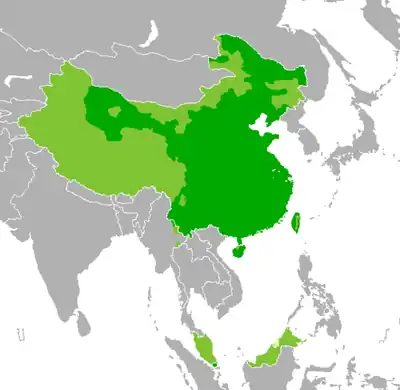
Image 5 Map of the
Mandarin Sinophone world, where
Mandarin and other
Chinese languages are spoken as a
first language among ethnic Chinese in countries where their population is significant:
Mandarin Chinese-speaking majority (Coastal and central areas of China,
Taiwan and
Singapore )
Large Mandarin Chinese-speaking minority (Highland China,
Malaysia and inner
Myanmar )
Small Mandarin Chinese-speaking minority (
Brunei )
(from
Malaysian Chinese )
Image 6 Heads from old
headhunting practices in a
Kadazan house in Sabah (from
Culture of Malaysia )
Image 7 Map of the geographic origin of the present-day ethnic Chinese Malaysians since their early migrations from China to
Nanyang region more than a hundred years ago. (from
Malaysian Chinese )
Image 9 Comparison of Malay language, Jawi writing, and Khat calligraphy with other languages. (from
Culture of Malaysia )
Image 10 An 1880 painting of southern Chinese merchant from
Fujian (left) and Chinese official in
Penang Island . (from
Malaysian Chinese )
Image 11 A
Chinatown and "Malaytown" in
Kedah . (from
Malaysian Chinese )
Image 13 SMJK Confucian in Kuala Lumpur, an example of converted Chinese independent school to government-funded "SMJK" (
National-type Chinese secondary school ). (from
Malaysian Chinese )
Image 14 Ayam percik (from
Malaysian cuisine )
Image 17 Mount Kinabalu , the highest point of Malaysia, is located in
Sabah . (from
Geography of Malaysia )
Image 18 A
wau workshop (from
Culture of Malaysia )
Image 19 Malaysian Chinese
Catholics during
Palm Sunday at St Ignatius Church in
Selangor . (from
Malaysian Chinese )
Image 20 Chinese women working in a British
mobile canteen during the
Malayan Campaign ,
c. January 1942 (from
Malaysian Chinese )
Image 21 Roti telur and teh tarik (from
Malaysian cuisine )
Image 24 The Dutch fleet battling with the Portuguese armada as part of the
Dutch–Portuguese War in 1606 to gain control of
Malacca (from
History of Malaysia )
Image 25 An ethnic Chinese woman in Malaysia grinds and cuts up dried
herbs to make
traditional Chinese medicine . (from
Malaysian Chinese )
Image 26 Joint Chinese-Malay anticommunist demonstration in
Semenyih , Selangor during the 1950s (from
Malaysian Chinese )
Image 27 Tugu Negara , the Malaysian national monument, is dedicated to those who fell during World War II and the Malayan Emergency. (from
History of Malaysia )
Image 28 The extent of the
Malaccan Empire in the 15th century became the main point for the spreading of
Islam in the
Malay Archipelago . (from
History of Malaysia )
Image 29 The topography of Malaysian Borneo. (from
Geography of Malaysia )
Image 30 Bubur pulut hitam, without coconut milk. (from
Malaysian cuisine )
Image 32 2007 Bersih rally that was held in Kuala Lumpur (from
History of Malaysia )
Image 33 Some of the examples of ethnic Chinese influenced Malaysian cuisine, clockwise from top-right:
grass jelly with
Bandung ,
yong tau foo ,
Nyonya steamed layer cake and
laksa noodle. (from
Malaysian Chinese )
Image 34 Yusheng (from
Malaysian cuisine )
Image 35 Japanese troops moving through Kuala Lumpur during their advance through Malaya (from
History of Malaysia )
Image 36 A selection of Nyonya kuih (from
Malaysian cuisine )
Image 39 Bak Kut Teh (from
Malaysian cuisine )
Image 40 A Malaysian
nasi lemak traditionally wrapped in
banana leaves (from
Malaysian cuisine )
Image 41 Replica of the palace of the
Malacca Sultanate , built from information in the
Malay Annals . (from
Culture of Malaysia )
Image 42 Lion dance in Malaysia's capital during the Chinese main festivity. (from
Malaysian Chinese )
Image 43 Evolution of Malaysia (from
History of Malaysia )
Image 44 Air bandung (from
Malaysian cuisine )
Image 45 Joget Melayu , a Malay dance (from
Culture of Malaysia )
Image 46 Former mine which has been converted into a
lake garden in
Perak . (from
Mining in Malaysia )
Image 48 Wonton Mee (from
Malaysian cuisine )
Image 49 A bowl of
curry mee , with fried beancurd skins and fish cake on the side (from
Malaysian cuisine )
Image 50 Idli served with typical accompaniments. (from
Malaysian cuisine )
For more images from Malaysia, see the following categories at Wikimedia Commons:
Category puzzle Select [►] to view subcategories
WikiProject Malaysia
Malaysia Topics Notice Board • Malaysian Wikipedians • Wikipedians in Malaysia • WikiProject Malaysia Facebook Page • Malay Language Wikipedia
Battle of Labuan ... that the aircraft disaster Double Six Crash Sabah in 1976?
1 September 1956: City Stadium in George Town , Penang was opened.
1 September 1994: 1994 IBF World Junior Championships was held in Kuala Lumpur .
2 September 1994: 1994 IBF World Junior Championships was held in Kuala Lumpur .
3 September 1991: Mini ASEAN Cultural Park in Ayer Keroh , Malacca was opened.
3 September 1994: 1994 IBF World Junior Championships was held in Kuala Lumpur .
5 September 2001: MyKad was introduced.
6 September 2016: Penang Front Party was founded.
7 September 1996: 1995 Malaysian state elections .
7 September 2003: The opening of Sitiawan Settlement Museum in Sitiawan , Perak .
8 September 1996: 1995 Malaysian state elections .
8 September 2001: 2001 Southeast Asian Games was held in Kuala Lumpur .
8 September 2018:
9 September 1971: The Star was founded.
9 September 2001: 2001 Southeast Asian Games was held in Kuala Lumpur .
10 September 2001: 2001 Southeast Asian Games was held in Kuala Lumpur .
11 September 1998: 1998 Commonwealth Games was held in Kuala Lumpur .
11 September 2001: 2001 Southeast Asian Games was held in Kuala Lumpur .
11 September 2008: 2018 Sukma Games was held in Perak .
12 September 1998: 1998 Commonwealth Games was held in Kuala Lumpur .
12 September 2001: 2001 Southeast Asian Games was held in Kuala Lumpur .
12 September 2008: 2018 Sukma Games was held in Perak .
12 September 2020: Gabungan Rakyat Sabah was established in Sabah .
13 September 1998: 1998 Commonwealth Games was held in Kuala Lumpur .
13 September 2001: 2001 Southeast Asian Games was held in Kuala Lumpur .
13 September 2008: 2018 Sukma Games was held in Perak .
13 September 2013: The International Conference on the Malaysia Agreement was held in Kota Kinabalu , Sabah .
13 September 2014: Shila Amzah Love Live in Malaysia Concert was held in Kuala Lumpur .
14 September 1974: 1974 Malaysian general election .
14 September 1998: 1998 Commonwealth Games was held in Kuala Lumpur .
14 September 2001: 2001 Southeast Asian Games was held in Kuala Lumpur .
14 September 2008: 2018 Sukma Games was held in Perak .
14 September 2019: Muafakat Nasional was founded.
15 September 1995: Malaysia Airlines Flight 2133 crashed in Tawau , Sabah .
15 September 1998: 1998 Commonwealth Games was held in Kuala Lumpur .
15 September 2001: 2001 Southeast Asian Games was held in Kuala Lumpur .
15 September 2008: 2018 Sukma Games was held in Perak .
15 September 2012: Legoland Malaysia Resort in Nusajaya , Johor was officially opened.
16 September 1963: Formation of Malaysia by the merging of Federation of Malaya , Singapore , Crown Colony of North Borneo and Crown Colony of Sarawak .
16 September 1985: University of Technology, Malaysia new campus in Skudai , Johor was opened.
16 September 1998: 1998 Commonwealth Games was held in Kuala Lumpur .
16 September 2001: 2001 Southeast Asian Games was held in Kuala Lumpur .
16 September 2008: 2018 Sukma Games was held in Perak .
16 September 2015: 2015 Malay Dignity rally in Kuala Lumpur .
16 September 2019: Seberang Perai was upgraded from town to a city .
17 September 1998: 1998 Commonwealth Games was held in Kuala Lumpur .
17 September 2001: 2001 Southeast Asian Games was held in Kuala Lumpur .
17 September 2008: 2018 Sukma Games was held in Perak .
17 September 2020: Malaysian United Democratic Alliance was founded.
18 September 1998: 1998 Commonwealth Games was held in Kuala Lumpur .
18 September 2004: 2004 Ba'kelalan by-election .
18 September 2008: 2018 Sukma Games was held in Perak .
19 September 1998: 1998 Commonwealth Games was held in Kuala Lumpur .
19 September 2008: 2018 Sukma Games was held in Perak .
20 September 1998: 1998 Commonwealth Games was held in Kuala Lumpur .
20 September 2007: Pavilion Kuala Lumpur in Bukit Bintang , Kuala Lumpur was opened.
20 September 2008: 2018 Sukma Games was held in Perak .
21 September 1963: 1963 Singaporean general election .
21 September 1998: 1998 Commonwealth Games was held in Kuala Lumpur .
21 September 2008: 2018 Sukma Games was held in Perak .
22 September 2008: 2018 Sukma Games was held in Perak .
23 September 2013: 2013 Proton Malaysian Open was held in Kuala Lumpur .
24 September 2012: 2012 Proton Malaysian Open was held in Kuala Lumpur .
24 September 2013: 2013 Proton Malaysian Open was held in Kuala Lumpur .
25 September 2006: Dataran Pahlawan Melaka Megamall in Malacca City , Malacca was opened.
25 September 2012: 2012 Proton Malaysian Open was held in Kuala Lumpur .
25 September 2013: 2013 Proton Malaysian Open was held in Kuala Lumpur .
25 September 2014: 2014 Pengkalan Kubor by-election .
26 September 2012: 2012 Proton Malaysian Open was held in Kuala Lumpur .
26 September 2013: 2013 Proton Malaysian Open was held in Kuala Lumpur .
26 September 2020: 2020 Sabah state election .
27 September 1991: 1991 Sarawak state election .
27 September 2001: 2001 Sarawak state election .
27 September 2010: 2010 Proton Malaysian Open was held in Kuala Lumpur .
27 September 2012: 2012 Proton Malaysian Open was held in Kuala Lumpur .
27 September 2013: 2013 Proton Malaysian Open was held in Kuala Lumpur .
28 September 1991: 1991 Sarawak state election .
28 September 2010: 2010 Proton Malaysian Open was held in Kuala Lumpur .
28 September 2012: 2012 Proton Malaysian Open was held in Kuala Lumpur .
28 September 2013: 2013 Proton Malaysian Open was held in Kuala Lumpur .
29 September 2010: 2010 Proton Malaysian Open was held in Kuala Lumpur .
29 September 2012: 2012 Proton Malaysian Open was held in Kuala Lumpur .
29 September 2013: 2013 Proton Malaysian Open was held in Kuala Lumpur .
30 September 1972: Malaysia–Singapore Airlines was disbanded.
30 September 2010: 2010 Proton Malaysian Open was held in Kuala Lumpur .
30 September 2012: 2012 Proton Malaysian Open was held in Kuala Lumpur .
30 September 2013: 2013 Proton Malaysian Open was held in Kuala Lumpur .
Here are some things you can help with Malaysia articles:
Start one of the requested articles at the WikiProject Malaysia To do page
Contribute to the Malaysia articles
Assess or add WP:MY template at Malaysia articles talk pages
Improve this portal
Join WikiProject Malaysia and start collaborating
See also: WikiProject Malaysia General Tasks
Pasir Gudang Municipal Field
Rank Name State Pop. Rank Name State Pop.
1 Kuala Lumpur Federal Territory 1,982,112 11 Ipoh Perak 759,952
2 Kajang Selangor 1,047,356 12 Seremban Negeri Sembilan 681,541
3 Seberang Perai Penang 946,092 13 Iskandar Puteri Johor 575,977
4 Subang Jaya Selangor 902,086 14 Kuantan Pahang 548,014
5 Klang Selangor 902,025 15 Sungai Petani Kedah 545,053
6 Johor Bahru Johor 858,118 16 Ampang Jaya Selangor 531,904
7 Shah Alam Selangor 812,327 17 Kota Kinabalu Sabah 500,425
8 George Town Penang 794,313 18 Malacca City Malacca 453,904
9 Petaling Jaya Selangor 771,687 19 Sandakan Sabah 439,050
10 Selayang Selangor 764,327 20 Alor Setar Kedah 423,868
Portal:Malaysia/Malaysia news
Religions in Malaysia
Southeast Asia
Other countries
The following Wikimedia Foundation sister projects provide more on this subject:
Discover Wikipedia using portals
List of all portals
Random portal
WikiProject Portals