This portal is not manually maintained. However, please contactNorthamerica1000when you plan to make significant changes.
This portal's subpages have been checked by an editor, and are needed.
Please take care when editing, especially if using automated editing software, and seek consensus before making major changes.Learn how to update the maintenance information here.
Liquor (/ˈlɪkər/LIK-ər, sometimes hard liquor), spirit, distilled spirit, or spirituous liquor are alcoholic drinks produced by the distillation of grains, fruits, vegetables, or sugar that have already gone through alcoholic fermentation. While the word liquor usually refers to distilled alcoholic spirits rather than drinks produced by fermentation alone, it can sometimes be used more broadly to refer to any alcoholic beverage (or even non-alcoholic ones produced by distillation or some other practices, such as the brewed liquor of a tea).
The distillation process concentrates the alcohol, so the resulting condensate has an increased alcohol by volume. As liquors contain significantly more alcohol (ethanol) than other alcoholic drinks, they are considered "harder". In North America, the term hard liquor is sometimes used to distinguish distilled alcoholic drinks from non-distilled ones, whereas the term spirits is more commonly used in the United Kingdom. Some examples of liquors are vodka, rum, gin and tequila. Liquors are often aged in barrels, such as for the production of brandy, tequila, and whiskey, or are infused with flavorings to form flavored liquors, such as absinthe. (Full article...)
Selected article -
Raksi in a bowl
Raksi (Nepali: रक्सी; Bantawa: Hengmawa/Hengma; Newar: Aila;Limbu: Sijongwaa aara) is a traditional alcoholic beverage widely consumed in Nepal. It is a distilled liquor made from fermented grains such as rice, millet, barley, or wheat, and is often prepared using homemade, traditional methods. Raksi holds a deep cultural significance and is commonly consumed by Nepalese people during festivals, rituals, and social gatherings.
Raksi is a strong drink, clear like vodka or gin, tasting somewhat like Japanese sake. It is usually made from kodo millet or rice; different grains produce different flavors. It is made by distilling a chhaang, a brewed alcoholic drink.
The Limbus and Kirati people, for whom it is a traditional beverage, drink tongba and raksi served with pieces of pork, water buffalo or goat meat sekuwa. For the Newars, aila is indispensable during festivals and various religious rituals as libation, prasad or sagan.
In CNN's list of the world's 50 most delicious drinks, raksi was ranked 41st and was described as follows: "made from millet or rice, raksi is strong on the nose and sends a burning sensation straight down your throat that resolves itself into a surprisingly smooth, velvety sensation. Nepalese drink this home brew to celebrate festivals, though some think that the prized drink itself is the reason to celebrate." (Full article...)
Eva Ekeblad (néeDe la Gardie; 10 July 1724 – 15 May 1786) was a Swedish agriculturist and salon hostess. She discovered a method to make alcohol and flour from potatoes, significantly reducing Sweden's incidence of famine. She became the first female member of the Royal Swedish Academy of Sciences.
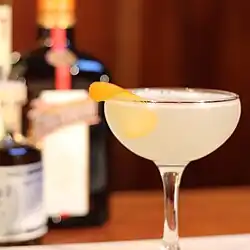
White lady (also known as a Delilah, or Chelsea sidecar) is a classic cocktail that is made with gin, Cointreau or triple sec, fresh lemon juice and an optional egg white. It belongs to the sidecar family, made with gin in place of brandy. The cocktail sometimes also includes additional ingredients, for example egg white, sugar, cream, or creme de menthe.
The classic concoction is most commonly served in a martini cocktail glass. When an egg white is added a champagne coupe is preferable; the silky foam clings more pleasingly to the curved glass. (Full article...)
Image 5
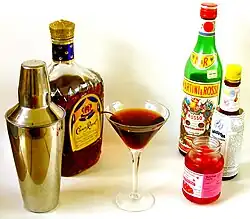
A classic 2:1 Manhattan, made with a whisky, sweet vermouth, bitters and a cherry
The whiskey-based Manhattan is one of five cocktails named for a New York City borough. It is closely related to the Brooklyn cocktail, which uses dry vermouth and Maraschino liqueur in place of the Manhattan's sweet vermouth, and Amer Picon in place of the Manhattan's angostura bitters. (Full article...)
The word horilka may also be used in a generic sense in the Ukrainian language to mean vodka or other strong spirits and etymologically is similar to the Ukrainian word for 'to burn' - hority. Home-distilled horilka, moonshine, is called samohon (Ukrainian: самогон, lit.'self-distilled' or 'self-run' - almost identical to the Russian and Polishsamogon). Horilka is usually distilled from grain (usually wheat or rye), though it can, less commonly, also be distilled from potatoes, honey, sugar beets etc. One type of horilka, called pertsivka (Ukrainian: перцівка), is horilka with chili peppers. Historically, outside Ukraine, pertsivka is generally referred to when people speak of horilka, although pertsivka itself is just one type of horilka. (Full article...)
A grasshopper is a sweet, mint-flavored, after-dinner alcoholic drink named for its green color, which comes from crème de menthe. Tujague's, a bar in the French Quarter of New Orleans, Louisiana, claims its owner Philip Guichet invented the drink in 1918. The drink gained popularity during the 1950s and 1960s throughout the American South. (Full article...)
Image 9
The paloma (Spanish for "dove") is a tequila-based cocktail. This drink is most commonly prepared by mixing tequila, lime juice, and a grapefruit-flavored soda such as Fresca, Squirt, or Jarritos and served with ice and a lime wedge. Adding salt to the rim of the glass is also an option.
The Bloody Mary was invented in the 1920s or 1930s. There are various theories as to the origin of the drink and its name. It has many variants, most notably the Red Snapper (made with gin), Bloody Maria (made with blanco tequila), and the Virgin Mary (made without alcohol). (Full article...)
Image 11
Rakı (/rɑːˈkiː/, Turkish pronunciation: [ɾaˈkɯ]ⓘ) is an alcoholic beverage made of twice-distilled grape pomace and flavored with aniseed. It is a national drink of Turkey, and it is especially popular in the coastal regions. Among drinkers of alcoholic beverages, it is popular in Turkic countries and Caucasian countries as an apéritif. It is often served with seafood or meze. It is comparable to several other anise-flavored liqueurs such as pastis, ouzo, sambuca and arak. The alcoholic content of rakı must be at least 40% according to Turkish standard. The largest producer of raki is Diageo, which operates in Turkey through its subsidiary Mey İçki (acquired in 2011); Yeni Rakı is the largest brand. Rakı has been a registered geographical indication in Turkey since 2009, granting it legal protection as a spirit produced exclusively from Turkish-grown grapes and anise.
In many East Mediterranean and Balkan countries, the term raki is widely used to describe similar distilled alcoholic beverages. This shared terminology dates back to the Ottoman Empire, where "raki" became a generic term for distilled spirits. During Ottoman rule, the word spread across the empire's territories. In many of these regions, the term raki or rakia is still used to describe grape-based pomace brandies or other spirits, often with regional variations in production methods and flavour profiles. For example, in Turkey, rakı is flavoured with anise and is distinctively served diluted with water, creating a milky-white appearance. Similarly, in the Balkans, rakija (or its linguistic variants such as ракия in Bulgarian, ракија in Serbian, and rakija in Croatian) is a general term for fruit-based brandies, with local variations like plum, pear, or apricot based liquors. (Full article...)
Image 12
Peruvian pisco sour
A pisco sour is an alcoholic cocktail of Peruvian origin, which is made from pisco, a Peruvian brandy, with sour citrus juice and sweetener components. The Peruvian pisco sour includes Peruvian pisco with freshly squeezed lime juice, simple syrup, ice, egg white, and Angostura bitters. The Chilean version is similar, but has Chilean pisco and Pica lime, and excludes the bitters and egg white. Other variants of the cocktail include with fruits like pineapple or plants such as coca leaves.
Although the preparation of pisco-based mixed beverages possibly dates back to the 1700s, historians and drink experts agree that the cocktail as it is known today was invented in the early 1920s in Lima, the capital of Peru, by the American bartenderVictor Vaughen Morris. Morris left the United States in 1903 to work in Cerro de Pasco, a city in central Peru. In 1916, he opened Morris' Bar in Lima, and his saloon quickly became a popular spot for the Peruvian upper class and English-speaking foreigners. The oldest known mentions of the pisco sour are found in newspaper and magazine advertisements, dating to the early 1920s, for Morris and his bar published in Peru and Chile. The pisco sour underwent several changes until Mario Bruiget, a Peruvian bartender working at Morris' Bar, created the modern Peruvian recipe for the cocktail in the latter part of the 1920s by adding Angostura bitters and egg whites to the mix. (Full article...)
Rakia, rakija, rakiya, rachiu or rikea (/ˈrɑːkiə,ˈræ-,rəˈkiːə/), is the collective term for fruit spirits or fruit brandy popular in Southeastern Europe. The alcohol content of rakia is normally 40% ABV, but home-produced rakia can be stronger (typically 50–80%). (Full article...)
In a broader sense, the term brandy also denotes liquors obtained from the distillation of pomace (yielding pomace brandy), or mash or wine of any other fruit (fruit brandy). These products are also called eau de vie (literally "water of life" in French). (Full article...)
Image 17
Classic daiquiri served in a cocktail glass
The daiquiri (/ˈdaɪkəri,ˈdæk-/; Spanish: daiquirí[dajkiˈɾi]) is a cocktail whose main ingredients are rum, citrus juice (typically lime juice), and sugar or other sweetener.
A liquor store is a retailbusiness that predominantly sells prepackaged alcoholic beverages, including liquors (typically in bottles), wine or beer, usually intended to be consumed off the store's premises. Depending on region and local idiom, they may be called an off-licence (in the UK and Ireland), off-sale (in parts of Canada and the US), bottle shop (in Australia, New Zealand and South Africa), bottle store (South Africa) or, colloquially, bottle-o (in Australia, New Zealand, and parts of Canada), liquor store (in Canada and the US, and less commonly, in Australia and New Zealand), party store (in parts of the US, particularly Michigan) or other similar terms. A very limited number of jurisdictions have an alcohol monopoly. In US states that are alcoholic beverage control (ABC) states, the term ABC store may be used. (Full article...)
Aguardiente (Spanish pronunciation:[ˌaɣwaɾˈðjente]; lit.'ardent water'; Portuguese: aguardente, pronounced[ˌaɣwaɾˈðẽtɨ]or[ˌaɡwaʁˈdẽtʃi]) is a type of distilled alcoholic spirit that contains between 29% and 60% alcohol by volume (ABV). It is a somewhat generic term that can refer to liquors made from various plants. It originates from and is typically consumed on the Iberian Peninsula and in Ibero-America. (Full article...)
The Vesper is a cocktail that was originally made of gin, vodka, and Kina Lillet. Since that form of Lillet is no longer produced, modern bartenders need to modify the recipe to mimic the original taste, with Lillet Blanc or Cocchi Americano as a typical substitute.
The drink was popularised by author Ian Fleming (1908–1964) in his 1953 novel Casino Royale, in which the character James Bond invents the recipe and names the cocktail after Vesper Lynd. Fleming's Bond calls it a "special martini", and though it lacks the vermouth that defined a martini in Fleming's day, it is sometimes called a Vesper martini. (Full article...)
... that instead of drinking liquor with prospective clients, Arthur Harrison Motley sent them notes written in red pencil crayon, 10,000 times a year?
... that a liquor-drinking celebrity goat named Ioiô won an election for city councilman in Fortaleza?
... that the former Natick station building became the basement of a liquor store?
The U.S. state of Oregon has an extensive history of laws regulating the sale and consumption of alcoholic beverages, dating back to 1844. It has been an alcoholic beverage control state, with the Oregon Liquor and Cannabis Commission holding a monopoly over the sale of all distilled beverages, since Prohibition. Today, there are thriving industries producing beer, wine, and liquor in the state. Alcohol may be purchased between 7a.m. and 2:30a.m for consumption at the premise it was sold at, or between 6a.m. and 2:30a.m. if it is bought and taken off premise. In 2020, Oregon began allowing the sale of alcohol via home delivery services. As of 2007, consumption of spirits was on the rise while beer consumption held steady. That same year, 11% of beer sold in Oregon was brewed in-state, the highest figure in the United States.
Oregon wine production began in the mid-19th century, before it was a state. By 1919, the industry had collapsed due to prohibition, and after prohibition ended fruit wines dominated the industry. The modern era of Oregon wine began in 1961, and the industry cemented its reputation in 1975 by winning a French award. In 2007, wine making was a $207.8 million business. Beer production began in 1852 with Henry Saxer's liberty brewing in Portland. In 1862 Henry Weinhard's bought the Liberty brewery. The company is now a part of the Miller Brewing Company, but it helped Portland to become the microbrewing capital of the world. Portland hosts North America's largest beerfest, and Oregon has produced a number of national and international award winning beers. (Full article...)
Image 10Map of Europe with individual countries grouped by preferred type of alcoholic drink, based on recorded alcohol consumption per capita (age 15+) (in liters of pure alcohol) in 2016.
Image 3A whiskey sour, served in a coupe glass, is garnished with a spiral of lemon peel and two maraschino cherries on a cocktail pick, along with drops of bitters swirled into the foam (from egg white) atop the drink. (from Cocktail garnish)






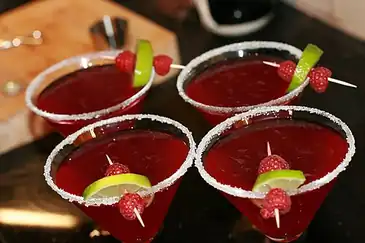


 These flaming cocktails illustrate that some liquors will readily catch fire and burn. (from Liquor)
 A martini cocktail (from List of cocktails)
 A piña colada (from List of cocktails)
 Spirits consumption per person (from Liquor)
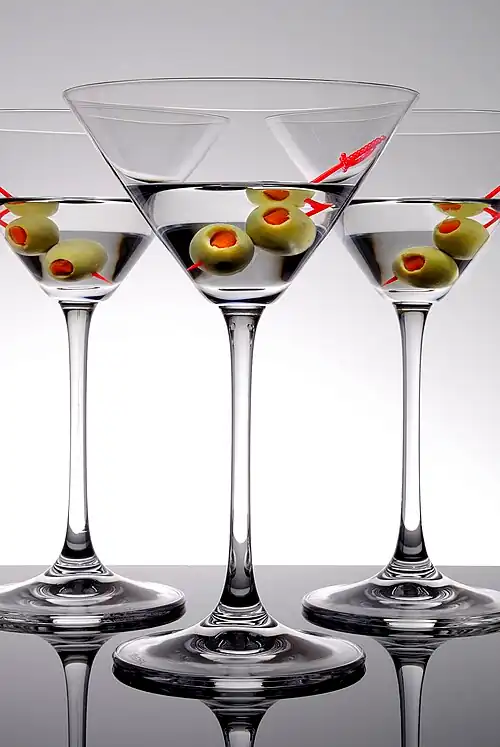 A martini is a classic gin-based cocktail. (from List of cocktails)

 Some single-drink liquor bottles available in Germany (from Liquor)
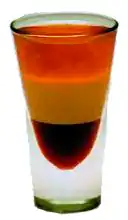 A B-52 (from List of cocktails)
 Map of Europe with individual countries grouped by preferred type of alcoholic drink, based on recorded alcohol consumption per capita (age 15+) (in liters of pure alcohol) in 2016.WineBeerSpirits(from Liquor)

 A grasshopper (from List of cocktails)
 Bee's knees (from List of cocktails)
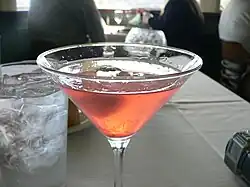 A cosmopolitan (from List of cocktails)


 Negroni (from List of cocktails)
 An illustration of brewing and distilling industry methods in England, 1858 (from Liquor)
 A Brandy Alexander being served (from List of cocktails)

 Aviation (from List of cocktails)
 Mulled wine steeping (Swedish glögg) (from List of cocktails)

 A Ramos gin fizz (from List of cocktails)
 Reservoir glass with naturally coloured verte absinthe and an absinthe spoon (from List of cocktails)
 A pisco sour (from List of cocktails)
 A Caipirinha with lime (from List of cocktails)

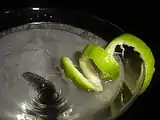 Lime twist (from Cocktail garnish)
 A whiskey sour, served in a coupe glass, is garnished with a spiral of lemon peel and two maraschino cherries on a cocktail pick, along with drops of bitters swirled into the foam (from egg white) atop the drink. (from Cocktail garnish)
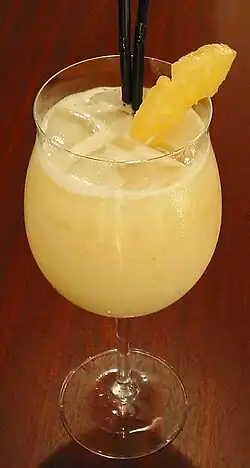 Pineapple wedge (from Cocktail garnish)
 Shrimp (from Cocktail garnish)
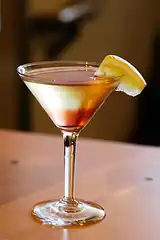 Lemon slice (from Cocktail garnish)

 Cocktail olive (from Cocktail garnish)
 Raspberry (from Cocktail garnish)


 Commons
 Wikidata
 Wikiquote
 Wikisource
 Wikiversity
 Wikivoyage
 Wiktionary
 List of all portals






 Random portal
 WikiProject Portals