Portal:Libertarianism

Introduction
Libertarianism (from French: libertaire, lit. 'libertarian'; or from Latin: libertas, lit. 'freedom') is a political philosophy that holds liberty and personal sovereignty as primary values. Many libertarians believe that the concept of freedom is in accord with the non-aggression principle, according to which each individual has the right to live as they choose, as long as they do not violate the rights of others by initiating force or fraud against them.
Libertarianism has been broadly shaped by liberal ideas. Libertarians advocate the expansion of individual autonomy and political self-determination, emphasizing the principles of equality before the law and the protection of civil rights, including the rights to freedom of association, freedom of speech, freedom of thought and freedom of choice. They generally support individual liberty and oppose authority, state power, warfare, militarism and nationalism, but some libertarians diverge on the scope and nature of their opposition to existing economic and political systems. (Full article...)
Selected article
Social anarchism, sometimes referred to as socialist anarchism, is a non-state form of socialism and is considered to be the branch of anarchism that sees individual freedom as being dependent upon mutual aid.
Social anarchist thought emphasizes community and social equality as complementary to autonomy and personal freedom. They also advocate the conversion of present-day private property into social property or the commons while retaining respect for personal property. The term is used to describe those who—contra individualist anarchism—place an emphasis on the communitarian and cooperative aspects of anarchist theory while also opposing authoritarian forms of communitarianism associated with groupthink and collective conformity, instead favouring a reconciliation between individuality and sociality.
Emerged in the late 19th century as a distinction from individualist anarchism, social anarchism is considered an umbrella term that includes—but not limited to—the post-capitalist economic models of anarcho-communism, collectivist anarchism and sometimes mutualism as well as the trade union approach of anarcho-syndicalism, the social struggle strategies of platformism and specifism and the environmental philosophy of social ecology.
The term "libertarianism" was coined and used as synonymous for anarchism and socialism, hence the terms "social anarchism" and "socialist anarchism" are often used interchangeably with libertarian socialism, left-libertarianism or left anarchism.
Selected quote
| “ | But what the Left That Was demanded was not the symbolic image of the "broken rifle" - so very much in vogue these days in pacifist boutiques - but the training and arming of the people for revolutionary ends, solely in the form of democratic militias. A resolution coauthored by Luxemburg and Lenin (a rare event) and adopted by the Second International in 1906 declared that it "sees in the democratic organization of the army, in the popular militia instead of the standing army, an essential guarantee for the prevention of aggressive wars, and for facilitating the removal of differences between nations.
This was not simply an antiwar resolution, although opposition to the war that was fast approaching was the principal focus of the statement. The arming of the people was a basic tenet of the Left That Was, and pious demands for gun control among today's leftists would have been totally alien to the thinking of the Left That Was. As recently as 1930s, the concept of "the people in arms" remained a basic tenet of independent socialist, no to speak of anarchist, movements throughout the world, including those of the United States, as I myself so well remember. The notion of schooling the masses in reliance on the police and army for public safety, much less turning the other cheek in the face of violence, would have been regarded as heinous. |
” |
| — Murray Bookchin (1921–2006) Social Anarchism or Lifestyle Anarchism (1995) |
Selected picture
 |
General images
 Gary Chartier, a left-libertarian of the free-market anti-capitalist school (from Left-libertarianism)
 John Locke, regarded as the father of liberalism (from Libertarianism)
 Murray Bookchin, American libertarian socialist theorist and proponent of libertarian municipalism and communalism (from Libertarianism)

 A diagram of the typology of beliefs in libertarianism (both left and right, respectively) (from Libertarianism)
 17 August 1860 edition of Le Libertaire, Journal du mouvement social, a libertarian communist publication in New York City (from Libertarianism)
 The Political Compass: the green quadrant represents left-libertarianism and the purple right-libertarianism (from Libertarianism)
 Tea Party movement protest in Washington, D.C., September 2009 (from Libertarianism)
 Murray Bookchin, a left-libertarian (formerly) of the social anarchist school (from Left-libertarianism)
 Sébastien Faure, prominent French theorist of libertarian communism as well as atheist and freethought militant (from Libertarianism)
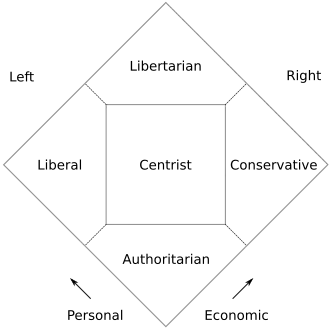 The Nolan Chart, created by American libertarian David Nolan, expands the left–right line into a two-dimensional chart classifying the political spectrum by degrees of personal and economic freedom. (from Libertarianism)
 Former congressman Ron Paul, a self-described libertarian, whose presidential campaigns in 2008 and 2012 garnered significant support from youth and libertarian Republicans (from Libertarianism)
 Members of the Spanish anarcho-syndicalist trade union Confederación Nacional del Trabajo marching in Madrid in 2010 (from Libertarianism)
 Thomas Paine, whose theory of property showed a libertarian concern with the unequal distribution of resources under statism (from Libertarianism)
Selected biography -

Hans-Hermann Hoppe (/ˈhɒpə/; German: [ˈhɔpə]; born 2 September 1949) is a German-American academic associated with Austrian School economics, anarcho-capitalism, right-wing libertarianism, paleolibertarianism, and opposition to democracy. From 1986 until 2008 he was professor of economics at the University of Nevada, Las Vegas (UNLV). He is a senior fellow of the Mises Institute think tank. In 2006 he emigrated to Turkey and founded the Property and Freedom Society.
Hoppe has written extensive criticisms of democracy, notably in his 2001 book Democracy: The God That Failed. The book favors exclusionary covenant communities that are "founded for the purpose of protecting family and kin". A section of the book favoring exclusion of democrats and homosexuals from society helped popularize Hoppe on the far-right. Some of the speakers invited at his Property and Freedom Society conferences in Turkey have been white nationalists. (Full article...)
Related portals
Parent portals
Socio-political portals
Topics
Categories

Points of interest
 | Points of interest related to Libertarianism on Wikipedia: History – Portal – Category – WikiProject – Alerts – Deletions – Assessment |
Associated Wikimedia
The following Wikimedia Foundation sister projects provide more on this subject:
-
 Commons
Free media repository -
 Wikidata
Free knowledge base -
 Wikiquote
Collection of quotations -
 Wikisource
Free-content library -
 Wikiversity
Free learning tools -
 Wiktionary
Dictionary and thesaurus
-
 List of all portals
-

-

-

-

-

-

-

-

-

-
 Random portal
-
 WikiProject Portals