Lebanon, officially the Lebanese Republic, is a country in the Levant region of West Asia. Situated at the crossroads of the Mediterranean Basin and the Arabian Peninsula, it is bordered by Syria to the north and east, Israel to the south, and the Mediterranean Sea to the west; Cyprus lies a short distance from the coastline. Lebanon has a population of more than five million and an area of 10,452 square kilometres (4,036sqmi). Beirut is the country's capital and largest city.
During the early centuries of the Roman Empire, the western provinces were Latinised, but the eastern parts kept their Hellenistic culture. ConstantineI (r.324–337) legalised Christianity and moved the capital to Constantinople. Theodosius I (r.379–395) made Christianity the state religion and Greek gradually replaced Latin for official use. The empire adopted a defensive strategy and, throughout its remaining history, experienced recurring cycles of decline and recovery.
The Byzantine Empire reached its greatest extent under the reign of Justinian I (r.527–565), who briefly reconquered much of Italy and the western Mediterranean coast. A plague began around 541, and a prolonged warfare with Persia placed fiscal and military strain on the empire, contributing to political and strategic challenges in the decades that followed. In the 630s and 640s the Arab conquests defeated Byzantine field armies in Syria and Egypt, resulting in the permanent loss of those provinces to the Rashidun Caliphate. In 698, Africa was lost to the Umayyad Caliphate, but the empire stabilised under the Isaurian dynasty. It expanded once more under the Macedonian dynasty, experiencing a two-century-long renaissance. Thereafter, periods of civil war and Seljuk incursion resulted in the loss of most of Asia Minor. The empire recovered during the Komnenian restoration, and Constantinople remained the largest and wealthiest city in Europe until the 13th century, when it was overtaken by Paris. (Full article...)
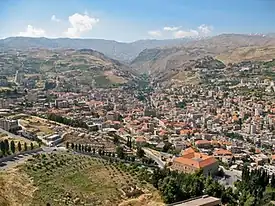
... that Gigarta, a settlement mentioned by Strabo and Pliny the Elder, is believed to have been located on the slopes of Mount Lebanon, although its exact location remains under debate?
This is a Good article, an article that meets a core set of editorial standards.
The Assaf dynasty (also called Banu Assaf) were a Sunni Muslim and ethnic Turkmen dynasty of chieftains based in the Keserwan region of Mount Lebanon in the 14th–16th centuries. They came to the area in 1306 after being assigned by the Bahri Mamluks to guard the coastal region between Beirut and Byblos and to check the power of the mostly Shia Muslim population at the time. During this period, they established their headquarters in Ghazir, which served as the Assafs' base throughout their rule.
Under the leadership of Emir Assaf, they were confirmed as the rulers of Keserwan by Sultan Selim I following the Ottoman conquest in 1516. Emir Assaf died two years later and was succeeded by his son Hasan, who was in turn killed by his brother Qa'itbay. The latter ruled Keserwan until his death without children in 1523, after which he was succeeded by Hasan's son Mansur. Mansur had a long reign and was accorded by the Ottomans numerous districts in Mount Lebanon and its environs as tax farms. He eliminated many of his Sunni rivals, and his local power relied on a Maronite Christian support base and his Maronite agents, namely members of the Hubaysh clan, who served as a check on the Shia Muslim sheikhs of Keserwan. At the peak of his power, Mansur's realm stretched from Beirut to Homs.
Mansur was dismissed in 1579 and replaced by his son Muhammad, who was imprisoned by the authorities in 1584 for alleged involvement in a looting raid against an Istanbul-bound caravan. He was restored to Keserwan in 1585 and was given tax collection authority over the rural districts of Tripoli Eyalet; this brought him into conflict with the Sayfa clan, the Assafs' erstwhile Turkmen clients, one of whose members, Yusuf Pasha Sayfa, was governor of Tripoli. The Assaf realm dissipated in 1591 when Muhammad was killed while attempting to collect taxes from the Sayfas in Akkar. Afterward, Yusuf Pasha Sayfa married Muhammad's widow and inherited the Assaf realm. (Full article...)
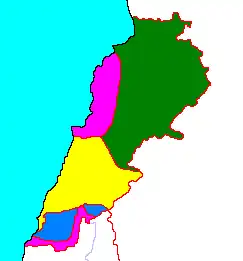
Image 10Map showing power balance in Lebanon, 1983: Green – controlled by Syria, purple – controlled by Christian groups, yellow – controlled by Israel, blue – controlled by the United Nations (from History of Lebanon)
Image 11Sidewalk Cafes are a trademark of the BCD (from Culture of Lebanon)
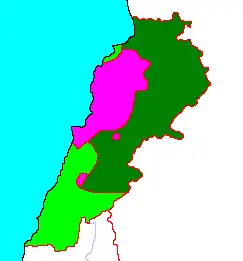
Image 18Map showing power balance in Lebanon, 1976: Dark Green – controlled by Syria; Purple – controlled by Maronite groups; Light Green – controlled by Palestinian militias (from History of Lebanon)
Image 19The funeral of the assassinated Prime Minister Rafiq Hariri (from History of Lebanon)
Image 21Portrait of Fakhreddine while he was in Tuscany, stating "Faccardino grand emir dei Drusi" translated as "Fakhreddine: great emir of the Druze" (from History of Lebanon)