Journalism is the production and distribution of reports on events, facts, ideas, and people that constitute the "news of the day" and inform society with a commitment to accuracy and verification. The word, a noun, applies to the occupation (professional or not), the methods of gathering information, and the organizing literary styles.
The role of journalism varies across countries, as do perceptions of the profession and its status. In some nations, newsmedia are controlled by the government and lack independence. In others, news media operate independently of government influence and function as private enterprises. Legal frameworks also differ, particularly regarding freedom of speech, freedom of the press, slander, and libel. Scholars have also examined journalism’s role in globalization, highlighting its contribution to increasing global interconnectedness.
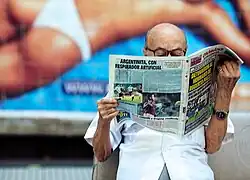
In recent years, the rise of the internet and digital media has significantly changed how people access and consume information, with a growing preference for online sources. In some regions, this shift has contributed to the decline or disappearance of traditional print newspapers. The widespread use of the internet and smartphones has transformed the media landscape since the early 21st century, with audiences increasingly accessing news through e-readers, mobile devices, and digital platforms rather than traditional formats such as newspapers, magazines, or television news. News organizations face ongoing challenges in monetizing digital content and adapting print models to evolving consumption patterns. As a result, print revenues have declined more rapidly than digital income streams have grown. (Full article...)
Selected article –
Cable-Satellite Public Affairs Network (C-SPAN/ˈsiːˌspæn/SEE-span) is an American cable and satellite television network, created in 1979 by the cable television industry as a nonprofit public service. It televises proceedings of the United States federal government and other public affairs programming. C-SPAN is a private, nonprofit organization funded by its cable and satellite affiliates. It does not have advertisements on any of its television networks or radio stations. However their official website has banner advertisements, and streamed videos also have advertisements. The network operates independently; the cable industry and the U.S. Congress have no control over its programming content.
The C-SPAN network includes the television channels C-SPAN, focusing on the U.S. House of Representatives; C-SPAN2, focusing on the U.S. Senate; and C-SPAN3, airing other government hearings and related programming; the radio station WCSP-FM; and a group of websites which provide streaming media and program archives. C-SPAN's television channels are available to approximately 100million cable and satellite households within the United States. WCSP-FM is broadcast on FM radio in Washington, D.C., and is available throughout the U.S. on SiriusXM via Internet streaming, TuneIn, and globally through iOS and Android apps. (Full article...)
Mahmūd Bēg Tarzī (1865 - 1933) was one of Afghanistan's greatest intellectuals. He is known as the father of Afghan journalism. As a great modern thinker, he became a key figure in the history of Afghanistan, leading the charge for modernization and being a strong opponent of religious obscurism.
Antoine-Roger Bolamba, later Bolamba Lokolé J'ongungu (27 July 1913 – 9 July 2002), was a Congolese journalist, writer, and politician. He edited the monthly journal La Voix du Congolais from 1945 until 1959. He also served as Secretary of State for Information and Cultural Affairs of the Republic of the Congo (now the Democratic Republic of the Congo) in 1960 and then as Minister of Information and Tourism from 1963 until 1964.
Bolamba was born to a Mongo family in 1913 in the Belgian Congo. During his education he took interest in French literature and soon thereafter began to write, publishing various works and contributing to Congolese periodicals. He gained public attention in 1939 after winning awards for his writing. In 1944 he was hired by the colonial government to manage its press division, and the following year he was made editor-in-chief of a new publication, La Voix du Congolais. Bolamba held much influence in the city of Léopoldville and frequently discussed the social implications of colonialism. He also began writing poetry, and in 1956 he released a collection entitled Esanzo: Chants pour mon pays, which articulated his Mongo and Congolese identity. (Full article...)
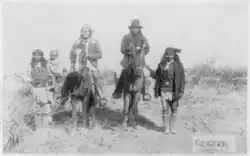
Image 17"Geronimo's camp before surrender to General Crook, 27 March 1886: Geronimo and Natches mounted; Geronimo's son (Perico) standing at his side holding baby." By C. S. Fly. (from Photojournalism)
This is a list of recognized content, updated weekly by JL-Bot (talk·contribs) (typically on Saturdays). There is no need to edit the list yourself. If an article is missing from the list, make sure it is tagged(e.g. {{WikiProject Journalism}})or categorized correctly and wait for the next update. See WP:RECOG for configuration options.
↑Canadian Library Journal, Canadian Library Association, v. 27, 1992. Digitized Dec 27, 2007 from the University of California.
↑Murphy, Lawrence William. "An Introduction to Journalism: Authoritative Views on the Profession", 1930. T. Nelson and sons Journalism. Original from the University of California. Digitized Oct 23, 2007.