Portal:Indigenous peoples of the Americas











Discover Wikipedia using portals
-
 List of all portals
-

-

-

-

-

-

-

-

-

-
 Random portal
-
 WikiProject Portals
 | Portal maintenance status: (June 2018)
|
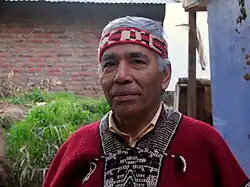
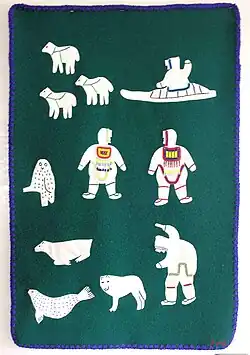
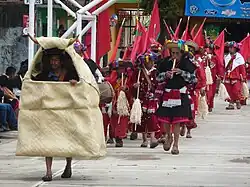
The Indigenous peoples of the Americas Portal Prominent indigenous ethnic groups in their traditional attire
 The Indigenous peoples of the Americas, also called Indians, Amerindians, or simply Natives, are the peoples who are native to the Americas or the Western Hemisphere. Their ancestors are among the pre-Columbian population of South or North America, including Central America and the Caribbean. Indigenous peoples live throughout the Americas. While often minorities in their countries, Indigenous peoples are the majority in Greenland and close to a majority in Bolivia and Guatemala. There are at least 1,000 different Indigenous languages of the Americas still in use in the 21st century. Some languages, including Quechua, Arawak, Aymara, Guaraní, Nahuatl, and some Mayan languages, have millions of speakers and are recognized as official by governments in Bolivia, Peru, Paraguay, and Greenland. (Full article...) Selected article The Maya civilization was a Mesoamerican civilization developed by the Maya peoples, and noted for its hieroglyphic script—the only known fully developed writing system of the pre-Columbian Americas—as well as for its art, architecture, mathematics, calendar, and astronomical system. The Maya civilization developed in an area that encompasses southeastern Mexico, all of Guatemala and Belize, and the western portions of Honduras and El Salvador. This region consists of the northern lowlands encompassing the Yucatán Peninsula, and the highlands of the Sierra Madre, running from the Mexican state of Chiapas, across southern Guatemala and onwards into El Salvador, and the southern lowlands of the Pacific littoral plain. The Archaic period, prior to 2000 BC, saw the first developments in agriculture and the earliest villages. The Preclassic period (c. 2000 BC to 250 AD) saw the establishment of the first complex societies in the Maya region, and the cultivation of the staple crops of the Maya diet, including maize, beans, squashes, and chili peppers. The first Maya cities developed around 750 BC, and by 500 BC these cities possessed monumental architecture, including large temples with elaborate stucco façades. Hieroglyphic writing was being used in the Maya region by the 3rd century BC. In the Late Preclassic a number of large cities developed in the Petén Basin, and Kaminaljuyu rose to prominence in the Guatemalan Highlands. Beginning around 250 AD, the Classic period is largely defined as when the Maya were raising sculpted monuments with Long Count dates. This period saw the Maya civilization develop a large number of city-states linked by a complex trade network. In the Maya Lowlands two great rivals, Tikal and Calakmul, became powerful. The Classic period also saw the intrusive intervention of the central Mexican city of Teotihuacan in Maya dynastic politics. In the 9th century, there was a widespread political collapse in the central Maya region, resulting in internecine warfare, the abandonment of cities, and a northward shift of population. The Postclassic period saw the rise of Chichen Itza in the north, and the expansion of the aggressive K'iche' kingdom in the Guatemalan Highlands. In the 16th century, the Spanish Empire colonised the Mesoamerican region, and a lengthy series of campaigns saw the fall of Nojpetén, the last Maya city in 1697. Selected imageGeneral imagesThe following are images from various Indigenous peoples of the Americas-related articles on Wikipedia.
Selected biography Sacagawea (/ˌsækədʒəˈwiːə/ see below; c. 1788 – December 20, 1812; see here for other theories about her death), also Sakakawea or Sacajawea, was a Lemhi Shoshone woman, who accompanied the Lewis and Clark Expedition, acting as an interpreter and guide, in their exploration of the Western United States. She traveled thousands of miles from North Dakota to the Pacific Ocean between 1804 and 1806. She has become an important part of the Lewis and Clark legend in the American public imagination. The National American Woman Suffrage Association of the early twentieth century adopted her as a symbol of women's worth and independence, erecting several statues and plaques in her memory, and doing much to spread the story of her accomplishments. In 2000, the United States Mint issued the Sacagawea dollar coin in her honor, depicting Sacagawea and her son, Jean Baptiste Charbonneau. The face on the coin was modeled on a modern Shoshone-Bannock woman named Randy'L He-dow Teton. No contemporary image of Sacagawea exists. In 2001, she was given the title of Honorary Sergeant, Regular Army, by then-president Bill Clinton. Did you know…
Subcategories Select [►] to view subcategories
America Indigenous peoples templates WikiProject Indigenous peoples of the Americas Related portalsThings you can do
Topics
Recognized content
Featured articlesFormer featured articlesFeatured listsGood articles
Former good articlesDid you know? articles
In the News articles
Associated WikimediaThe following Wikimedia Foundation sister projects provide more on this subject:
American indigenous language WikipediasAvañe'ẽ (Warani) · Aymar aru (Aymara) · ᏣᎳᎩ (Cherokee) · Chahta (Choctaw) · ᐃᔨᔫ (Cree) · ᐃᓄᒃ (Inuktitut) · Iñupiak · Kalaallisut (Greenlandic Inuit) · Mvskoke (Muscogee) · Nahuatlahtolli · Diné bizaad (Navajo) · Qhichwa Simi · Tsêhesenêstsestôtse (Cheyenne) Indigenous languages in Wikimedia Incubators: Alabama · Blackfoot · Chinook Jargon · Choctaw · Creek · Lakota · Micmac · Mohawk · Nheengatu · Northwestern Ojibwa · O'odham · Shoshoni · Unami-Lenape · Wüne pakina (Mapudungun) · Yucatec Maya · Central Alaskan Yup'ik · Zuni | |||||||||||||||||||||||||||||||||||||