In Hindu tradition, the city of Ayodhya is the birthplace of Rama. In the 16th century, the Mughal commander Mir Baqi built a mosque, known as the Babri Masjid, at a site identified by some Hindus as Ram Janmabhoomi, the legendary birthplace of Rama. The Archaeological Survey of India states that the mosque was built on land where a non-Islamic structure had previously existed. In the 1980s, the Vishva Hindu Parishad (VHP) began a campaign for the construction of a temple dedicated to Rama at the site, with the Bharatiya Janata Party (BJP) as its political voice. Several rallies and marches were held as a part of this movement, including the Ram Rath Yatra led by L. K. Advani. (Full article...)
Moragon is the foremost centre of worship of the Ganapatya sect, which considers Ganesha as the Supreme Being. A Hindu legend relates the temple to killing of the demon Sindhura by Ganesha. The exact date of building of the temple is unknown, though the Ganapatya saint Moraya Gosavi is known to be associated with it. The temple flourished due to the patronage of the Peshwa rulers and descendants of Moraya Gosavi. (Full article...)
Image 3
Vedic Mathematics is a book written by Indian ShankaracharyaBharati Krishna Tirtha and first published in 1965. It contains a list of mathematical techniques which were falsely claimed to contain advanced mathematical knowledge. The book was posthumously published under its deceptive title by editor V. S. Agrawala, who noted in the foreword that the claim of Vedic origin, made by the original author and implied by the title, was unsupported.
Neither Krishna Tirtha nor Agrawala were able to produce sources, and scholars unanimously note it to be a compendium of methods for increasing the speed of elementary mathematical calculations sharing no overlap with historical mathematical developments during the Vedic period. Nonetheless, there has been a proliferation of publications in this area and multiple attempts to integrate the subject into mainstream education at the state level by right-wingHindu nationalist governments. (Full article...)
Image 4
Dharma (/ˈdɑːrmə/; Sanskrit: धर्म, pronounced[dʱɐrmɐ]ⓘ) is a key concept in various Indian-origin religions. The term dharma does not have a single, clear translation and conveys a multifaceted idea. Etymologically, it comes from the Sanskrit dhr-, meaning to hold or to support, thus referring to the law that sustains things—from one's life to society, and to the universe at large. Most commonly, dharma refers to an individual's moral responsibilities or duties; the dharma of a farmer differs from the dharma of a soldier, thus making the concept a dynamic one. The antonym of dharma is adharma.
In Hinduism, dharma denotes behaviours that are considered to be in accord with Ṛta—the "order and custom" that makes life and the universe possible. This includes duties, rights, laws, conduct, virtues, and ethics, forming the "righteous way of living", which differs depending on one's identity, gender, and stage of life. The concept of dharma appears in the earliest Vedic texts, and its meaning and conceptual scope has evolved over several millennia. Dharma is believed to have a transtemporal validity, and is one of the puruṣārthas. (Full article...)
The mosque was located on a hill known as Ramkot ("Rama's fort"). According to Hindu nationalists, Baqi destroyed a pre-existing temple of Rama at the site. The existence of this temple is a matter of controversy. The Archaeological Survey of India conducted an excavation of the disputed site on the orders of the Allahabad High Court. The excavation period was short due to court time constraints, lasting only 15 days. The report of the excavation concluded that there were ruins of "a massive structure" beneath the ruins of the mosque which was "indicative of remains which are distinctive features found associated with the temples of north India", but found no evidence that the structure was specifically demolished for the construction of the Babri Masjid. The report received both praise and criticism, with some other archaeologists contesting the results of the report. (Full article...)
Modern yoga gurus are people widely acknowledged to be gurus of modern yoga in any of its forms, whether religious or not. The role implies being well-known and having a large following; in contrast to the old guru-shishya tradition, the modern guru-follower relationship is not secretive, not exclusive, and does not necessarily involve a tradition. Many such gurus, but not all, teach a form of yoga as exercise; others teach forms which are more devotional or meditational; many teach a combination. Several have been affected by scandals of various kinds. (Full article...)
The Upanishad describes four kinds of sannyasins (Hindu monks), their eating habits and lifestyle. Yoga is the path of spiritual liberation for all four. Of these, the Paramahamsa monks are discussed in this text at greater length, and described as loners who are patient with everyone, free from dualism in their thoughts, and who meditate on their soul and the Brahman. (Full article...)
General images -
The following are images from various Hinduism-related articles on Wikipedia.
Image 1Indra is a Vedic era deity, found in south and southeast Asia. Above Indra is part of the seal of a Thailand state. (from Hindu deities)
Image 3Samskaras are, in one context, the diverse rites of passage of a human being from conception to cremation, signifying milestones in an individual's journey of life in Hinduism. Above is annaprashana samskara celebrating a baby's first taste of solid food. (from Samskara (rite of passage))
Image 4The ten avatars of Vishnu, (Clockwise, from top left) Matsya, Kurma, Varaha, Vamana, Krishna, Kalki, Buddha, Parshurama, Rama and Narasimha, (in centre) Radha and Krishna. Painting currently in Victoria and Albert Museum. (from Hindu deities)
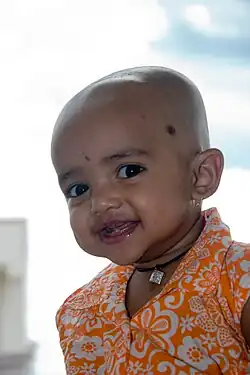
Image 5A Hindu girl after her Karnavedha rite of passage (ear piercing) (from Samskara (rite of passage))
Image 6Vaishnavism focuses on Vishnu or one of his avatars, such as his form as a human, lion, or boar. (from Hindu denominations)
Image 7Goddess Durga and a pantheon of other gods and goddesses being worshipped during Durga Puja Festival in Kolkata. (from Hindu deities)
Image 9Ishvara is, along with Shiva, Vishnu and Brahma, one of the 17 deities commonly found in Indonesian Surya Majapahit Hindu arts and records. However, Ishvara represents different concepts in various Hindu philosophies. (from Hindu deities)
Image 10Annaprashanam is the rite of passage where the baby is fed solid food for the first time. The ritual has regional names, such as Choroonu in Kerala. (from Samskara (rite of passage))
Image 11Upanayana samskara ceremony in progress. Typically, this ritual was for eight-year-olds in ancient India, but in the 1st millennium CE it became open to all ages. (from Samskara (rite of passage))
Image 13Six Hinduism deities. Surya, Parvati, Hanuman, Lakshmi, Vishnu, and Indra. All of these statues came from India, except Vishnu (from the Thai-Cambodian border). Various eras. National Museum of Scotland, Edinburgh (from Hindu deities)
Image 14A new born's Namakarana ceremony. The grandmother is whispering the name into the baby's ear, while friends and family watch. (from Samskara (rite of passage))
Image 16A Hindu cremation rite in Nepal. The samskara above shows the body wrapped in saffron on a pyre. (from Samskara (rite of passage))
Image 17A Tamil Hindu girl (center) in 1870 wearing a half-saree, flowers and jewelry from her Ritu Kala samskara rite of passage (from Samskara (rite of passage))
After gradual research; I have come to the conclusion that long before all heavenly books, God had revealed to the Hindus, through the Rishis of yore, of whom Brahma was the Chief, His four books of knowledge, the Rig Veda, the Yajur Veda, the Sama Veda and the Atharva Veda. The Quran itself made veiled references to the Upanishads as the first heavenly book and the fountainhead of the ocean of monotheism.
Jagadguru Ramanandacharya Swami Rambhadracharya (born Giridhar Mishra on 14 January 1950) is an Indian Hindu spiritual leader, educator, Sanskrit scholar, polyglot, poet, author, textual commentator, philosopher, composer, singer, playwright and Katha artist based in Chitrakoot, India. He is one of four incumbent Jagadguru Ramanandacharyas, and has held this title since 1988.
Rambhadracharya is the founder and head of Tulsi Peeth, a religious and social service institution in Chitrakoot named after Tulsidas. He is the founder and lifelong chancellor of the Jagadguru Rambhadracharya Handicapped University in Chitrakoot, which offers graduate and postgraduate courses exclusively to four types of disabled students. Rambhadracharya has been blind since the age of two months, had no formal education until the age of seventeen years, and has never used Braille or any other aid to learn or compose. (Full article...)
Image 2
Sivaya Subramuniyaswami
Sivaya Subramuniyaswami (born Robert Hansen; January 5, 1927 – November 12, 2001) was an American Hindu religious leader known as Gurudeva by his followers. Subramuniyaswami was born in Oakland, California and adopted Hinduism as a young man. He was the 162nd head of the self-claimed Nandinatha Sampradaya's Kailasa Parampara and Guru at Kauai's Hindu Monastery which is a 382-acre (155ha) temple-monastery complex on Hawaii's Garden Island.
In 1947, at the age of 20, he journeyed to India and Sri Lanka and in 1949, was initiated into sannyasa by the renowned siddha yogi and worshiper of Shiva, Jnanaguru Yogaswami of Jaffna, Sri Lanka who was regarded as one of the 20th century's remarkable mystics. In the 1970s he established a Hindu monastery in Kauai, Hawaii and founded the magazine Hinduism Today. In 1985, he created the festival of Pancha Ganapati as a Hindu alternative to December holidays like Christmas. He was one of Shaivism's Gurus, the founder and leader of the Shaiva Siddhanta Church. (Full article...)
Image 3
Studio photo of Anandamayi Ma
Anandamayi Ma (born Nirmala Sundari; 30 April 1896 – 27 August 1982) was an Indian saint, teacher, and mystic. She was revered as an incarnation of Hindu goddess Durga.
She was described by Sivananda Saraswati (of the Divine Life Society) as "la fleur la plus parfaite que le sol de l'Inde ait produite" [the most perfect flower the Indian soil has produced]. Her life was suffused in Bhakti Yoga and she was considered an epitome of "divine grace" that inspired the societal cultural milieu to lead the path of service, love and constant remembrance of the divine. Her followers experienced her spiritual attributes including precognition, faith healing and miracles. Paramahansa Yogananda translates the Sanskrit epithet Anandamayi as "Joy-permeated" in English. This name was given to her by her devotees in the 1920s to describe her perpetual state of divine joy. (Full article...)
Image 4
Adi Shankara, the most prominent exponent of Advaita Vedānta tradition. "I am other than name, form and action. My nature is ever free! I am Self, the supreme unconditioned Brahman. I am pure Awareness, always non-dual." Adi Shankara, Upadesasahasri 11.7
Advaita Vedanta (/ʌdˈvaɪtəvɛˈdɑːntə/; Sanskrit: अद्वैतवेदान्तः, IAST: Advaita Vedānta) is a Hindu tradition of Vedanta, a Brahmanical tradition of textual exegesis and philosophy; and a monastic institutional tradition nominally related to the Daśanāmi Sampradaya and propagated by the Smarta tradition. Its core tenet is that jivatman, the individual experiencing self, is ultimately pure awareness mistakenly identified with the body and its senses and with thought-constructs, and non-different from Ātman/Brahman or sat, the highest Self or Real. The term Advaita (अद्वैत) literally means "not-two" or "one without a second", which means that only Brahman, 'the one', is ultimately real while prapanca, 'the second', 'the world' or the multiplicity of thought-constructs, is not fully real. It is commonly rendered as "nonduality", and popularly interpreted as meaning that Atman is non-different from Brahman, and often equated with monism.
Advaita Vedanta is a Hindu sādhanā, a path of spiritual discipline and experience. It states that moksha ('liberation', freedom) is attained when knowledge of Brahman is attained, recognising the illusoriness of the phenomenal world and disidentifying from body-mind and the notion of 'doership', acquiring vidyā (knowledge) of one's true identity as Atman/Brahman, self-luminous (svayam prakāśa) awareness or Witness-consciousness. This knowledge is acquired through Upanishadic statements such as tat tvam asi, "that['s how] you are", which destroy the ignorance (avidyā) regarding one's true identity by revealing that (jiv)Ātman is non-different from immortal Brahman. (Full article...)
Image 5
Nome in Satsang during Sri Ramana Maharshi's Self-Realization Day (July 17, 2011) at SAT Temple
Nome (born January 23, 1955) is a spiritual teacher at Society of Abidance in Truth, known by the acronym SAT, which established and maintains a temple for nondual Self-knowledge in California. He expounds the teachings of Sri Ramana Maharshi and Advaita Vedanta. He, along with Dr. H. Ramamoorthy, translated into English the essential and classic work of Advaita Vedanta, "Ribhu Gita", which was highly recommended by Sri Ramana Maharshi. The English translation has been published by Society of Abidance in Truth and has since then been re-published by Sri Ramanasramam (Tiruvannamalai, India) and translated into Hindi, Italian, Korean and German. (Full article...)
Image 6
A.C. Bhaktivedanta Swami in Germany, 1974
Abhay Charanaravinda Bhaktivedanta Swami Prabhupada (1 September 1896 – 14 November 1977) was an Indian spiritual, philosophical, and religious teacher who spread the Hare Krishna mantra and the teachings of "Krishna consciousness" to the world. Born as Abhay Charan De and later legally named Abhay Charanaravinda Bhaktivedanta Swami, he is often referred to as "Bhaktivedanta Swami", "Srila Prabhupada", or simply "Prabhupada".
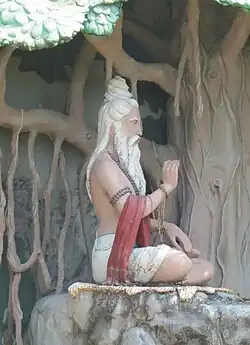
Vyasa (/ˈvjɑːsə/; Sanskrit: व्यास, lit.'compiler, arranger', IAST: Vyāsa) is a rishi (sage) with a prominent role in most Hindu traditions. He is also known as Veda Vyasa (Sanskrit: वेदव्यास, lit.'the one who classified the Vedas', IAST: Vedavyāsa) or Krishna Dvaipayana (Sanskrit: कृष्णद्वैपायन, IAST: Kṛṣṇadvaipāyana). Traditionally regarded as the author of the epic Mahābhārata, Vyasa also plays a prominent role as a character. He is also regarded by the Hindu traditions to be the compiler of the mantras of the Vedas into four texts, as well as the author of the eighteen Purāṇas and the Brahma Sutras. Vyasa is regarded by many Hindus as a partial incarnation (Sanskrit: अंशावतार, IAST: Aṃśāvatāra) of Vishnu. He is one of the immortals called the Chiranjivis, held by adherents to still be alive in the current age known as the Kali Yuga. (Full article...)