Egypt has one of the longest histories of any country, tracing its heritage along the Nile Delta back to the 6th–4th millennia BCE. Considered a cradle of civilisation, Ancient Egypt saw some of the earliest developments of writing, agriculture, urbanisation, organised religion and central government. Following nearly three millennia of pharaonic rule, Egypt came under foreign rule beginning in the 6th century BC. Egypt was an early and important centre of Christianity, later adopting Islam from the seventh century onwards. Alexandria, Egypt's former capital and currently second largest city, was a hub of global knowledge through its Library. Cairo became the capital of the Fatimid Caliphate in the tenth century and of the subsequent Mamluk Sultanate in the 13th century. Egypt then became part of the Ottoman Empire in 1517, until its local ruler Muhammad Ali established modern Egypt as an autonomous Khedivate in 1867. The country was then occupied by the British Empire along with Sudan and gained independence in 1922 as a monarchy.
El Tor (Egyptian Arabic: الطورaṭ-Ṭūr/et-ṬūrEgyptian Arabic pronunciation:[etˈtˤuːɾ]), also romanized as Al-Tur and At-Tur and known as Tur Sinai, formerly Raithu, is a city and the capital of the South Sinai Governorate of Egypt. The name of the city comes from the Arabic term for the mountain where the prophet Moses is believed to have received the Tablets of the Law from God; this mountain is designated Jabal Al Tor.
At-Tur itself appears to have been founded in the 13th century near the site of the ancient Raythou (medieval Raya). The El tor strain of cholera was discovered there in 1905. It was a quarantine camp for Muslim pilgrims returning from Hajj (the Islamic pilgrimage to Mecca). Known for its springs, the city is an important tourist destination in the South Sinai Governorate along with Sharm El Sheikh and Saint Catherine. (Full article...)
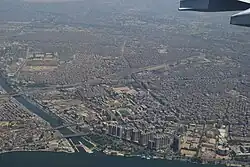
Image 16The sharp boundary between the hyper-arid desert and the irrigated Nile Valley, where most of Egypt's population and agriculture are concentrated. (from Egypt)
Image 35A tomb relief depicts workers plowing the fields, harvesting the crops, and threshing the grain under the direction of an overseer, painting in the tomb of Nakht. (from Ancient Egypt)
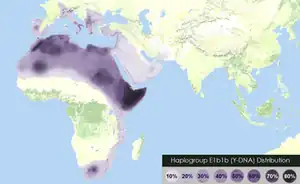
Image 36E1b1b is the most common paternal haplogroup across Africa, including Egypt, with modern genetic studies rooting the origin of the E haplogroup in East Africa. (from Ancient Egypt)
Image 44Rectangular fishpond with ducks and lotus planted round with date palms and fruit trees, Tomb of Nebamun, Thebes, 18th Dynasty (from Ancient Egypt)
Image 45The pyramids of Giza are among the most recognizable symbols of ancient Egyptian civilization. (from Ancient Egypt)
... that a wealthy councillor's house in the ancient Egyptian desert city Trimithis preserves a line from a lost tragedy by Euripides?
Selected biography -
Zewail in 2010
Ahmed Hassan Zewail (Arabic: أَحْمَد حَسَن زُوَيْل; February 26, 1946 – August 2, 2016) was an Egyptian-American chemist, known as the "father of femtochemistry". He was awarded the 1999 Nobel Prize in Chemistry for his work on femtochemistry and became the first Egyptian and Arab to win a Nobel Prize in a scientific field, and the first African to win a Nobel Prize in Chemistry. He was a professor of chemistry and physics at the California Institute of Technology (Caltech), where he was the first Caltech faculty member to be named the Linus Pauling Chair of Chemical Physics and was the director of the Physical Biology Center for Ultrafast Science and Technology. (Full article...)
Fakhfakhina (Egyptian Arabic: فخفخينا) is an Egypt fruit salad that combines a variety of fresh seasonal fruits, fruit juices, and often a scoop of ice cream, making it a popular choice for Egyptians during hot summer months. (Full article...)
This list was generated from these rules. Questions and feedback are always welcome! The search is being run daily with the most recent ~14 days of results. Note: Some articles may not be relevant to this project.
Rules | Match log | Results page (for watching) | Deleted articles| Last updated: 2026-08-29 19:44 (UTC)
Note: The list display can now be customized by each user. See List display personalization for details.