Portal:Edinburgh

The Edinburgh Portal
Welcome! — Fàilte! — Walcome!


Edinburgh is the capital city of Scotland and one of its 32 council areas. It is located in southeast Scotland and is bounded to the north by the Firth of Forth and to the south by the Pentland Hills. Edinburgh had a population of 506,520 in 2020, making it the second-most-populous city in Scotland (behind Glasgow) and the seventh-most-populous in the United Kingdom. The wider metropolitan area had a population of 912,490 in the same year.
Recognised as the capital of Scotland since at least the 15th century, Edinburgh is the seat of the Scottish Government, the Scottish Parliament, the highest courts in Scotland, and the Palace of Holyroodhouse, the official residence of the British monarch in Scotland. It is also the annual venue of the General Assembly of the Church of Scotland. The city has long been a centre of education, particularly in the fields of medicine, Scottish law, literature, philosophy, the sciences and engineering. The University of Edinburgh was founded in 1582 and is now one of four universities in the city. The financial centre of Scotland, Edinburgh was ranked as the second-largest financial centre in the United Kingdom, the fourth-largest in Europe, and the thirteenth-largest in the world in the Global Financial Centres Index in 2020.
The city is a cultural centre, and is the home of institutions including the National Museum of Scotland, the National Library of Scotland, and the Scottish National Gallery. The city is also known for the Edinburgh International Festival and the Fringe, the latter being the world's largest annual international arts festival. Historic sites in Edinburgh include Edinburgh Castle, the Palace of Holyroodhouse, St Giles' Cathedral, Greyfriars Kirk, Canongate Kirk and the extensive Georgian New Town built in the 18th and 19th centuries. The Old Town and the New Town are together listed as a World Heritage Site by UNESCO, and the site has been managed by Edinburgh World Heritage since 1999. The city's historical and cultural attractions have made it Britain's second-most-visited tourist destination, attracting 5.3 million visits, including 2.4 million from overseas, in 2023. (Full article...)
Selected location article

The Museum on the Mound (styled MUS£UM ON THE MOUND) is a museum in Edinburgh, Scotland, that focuses on money, coinage and economics. It is located in the Bank of Scotland Head Office building (latterly part of HBOS and now part of Lloyds Banking Group) on The Mound. It has more than 50,000 visitors per year. (Full article...)
Selected images
 City Observatory, the Gothic Tower

 Edinburgh (from Salisbury Crags) by William Crozier, a painter associated with The Edinburgh School
 Ratho Park Golf Club

 Scottish baronial-style turrets on Victorian tenements in St. Mary's Street
 The National Monument of Scotland (right) and Nelson Monument (left)
 The ruins of Holyrood Abbey
 The Dean Gallery, part of the Scottish National Gallery of Modern Art
 The Band of the Royal Regiment of Scotland in Edinburgh Castle
 The Princes Street Gardens, the best known park in Edinburgh
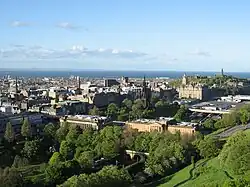 View over Edinburgh
 Architecture in Edinburgh
 Jenners Department Store, the oldest department store in Scotland
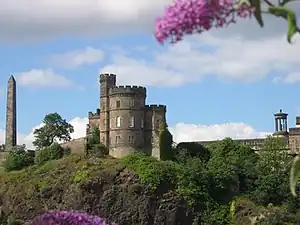
 The Governor's House
 The Castle Rock
 The BT building in Edinburgh Park
 Holyrood Palace, the official residence of the British monarch in Scotland
 View looking west along George Street
 Sir Walter Scott

 David Hume, Scottish philosopher, historian, economist, and essayist born in Edinburgh in 1711

 Two Edinburgh Trams seen at the West End - Princes Street stop
 St Giles' Cathedral, the principal place of worship of the Church of Scotland in Edinburgh
 Fountain at Holyrood Palace
 Queensferry Crossing road bridge

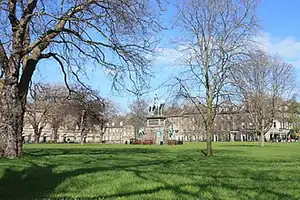 Charlotte Square, a garden square in the New Town
 The High Street, part of the Royal Mile
Selected transportation article

Edinburgh bus station is a central bus station in the city centre of Edinburgh.
The bus station is situated on Elder Street, where the buses enter & exit, with pedestrian access from there and St Andrew Square. (Full article...)
Selected area article

Davidson's Mains is a former village and now a district in the north-west of Edinburgh, Scotland. It is adjacent to the districts of Barnton, Cramond, Silverknowes, Blackhall and Corbiehill/House O'Hill. It was absorbed into Edinburgh as part of the boundary changes in 1920 and is part of the EH4 postcode area.
The name is sometimes abbreviated to D'Mains. (Full article...)
Selected environment article

Blackford Hill 164 metres (538 ft) is a hill in Edinburgh, the capital city of Scotland. It is in the area of Blackford, between Morningside, and the Braid Hills. Together with the Hermitage of Braid, it comprises the 60.3 hectares (149 acres) Hermitage of Braid and Blackford Hill Local Nature Reserve, within which lies Hermitage House. (Full article...)
Did you know?
No recent additions
Selected arts article

The Reid Concert Hall is a small music venue in the city of Edinburgh, Scotland. It is located in the south-western corner of Bristo Square about 0.53 kilometres (0.33 mi) south of the Royal Mile, and is part of the University of Edinburgh. Originally opened in 1859 as the Reid School of Music by the university's professor of music, John Donaldson (1789-1865), it was designed by the Scottish Architect David Cousin and is a Category A listed building. The hall is named after General John Reid, an army officer and musician who founded the Chair of Music (Reid Professor of Music) at the university. The Reid Concerts take place every 13 February. (Full article...)
Selected education article

Edinburgh Napier University (Scottish Gaelic: Oilthigh Napier Dhùn Èideann) is a public university in Edinburgh, Scotland. Napier Technical College, the predecessor of the university, was founded in 1964, taking its name from 16th-century Scottish mathematician and philosopher John Napier. The technical college was inaugurated as a university in 1992 by Lord Douglas-Hamilton, becoming Napier University. In 2009, the university was renamed Edinburgh Napier University.
The university is based around its three main Edinburgh campuses: Merchiston, Craiglockhart, and Sighthill. It has over 21,000 students, including those on-campus in Scotland and others studying transnational programmes abroad and online. In 2018 this included nearly 9,500 international and EU students, from more than 140 nations worldwide. (Full article...)
Selected sports article


Easter Road is a football stadium located in the Leith area of Edinburgh, Scotland, which is the home ground of Scottish Premiership club Hibernian (Hibs). The stadium currently has an all-seated capacity of 20,421, which makes it the fifth-largest football stadium in Scotland. Easter Road is also known by Hibs fans as "The Holy Ground" or "The Leith San Siro". The venue has also been used to stage international matches, Scottish League Cup semi-finals and was briefly the home ground of the Edinburgh professional rugby union team.
Hibs first played at the present site of Easter Road in 1893. The ground holds the record attendance for a Scottish match outside Glasgow, when 65,860 attended an Edinburgh derby on 2 January 1950. The size of the terracing was greatly reduced in the 1980s. After the publication of the Taylor Report, Hibs considered leaving Easter Road and moving to a different site (Straiton, near Loanhead, was mooted), but these plans were abandoned in 1994. Redevelopment of the stadium began in 1995 and was completed in 2010. The Easter Road pitch had a pronounced slope until it was removed in 2000. (Full article...)
Selected religion article

The Church of Scotland offices are located in the centre of Edinburgh, Scotland (in the New Town), at 121 George Street. These imposing buildings are popularly known in Church circles as "one-two-one". They were designed in a Scandinavian-influenced style by the architect Sydney Mitchell and built in 1909–1911 for the United Free Church of Scotland. Following the union of the Church of Scotland and the United Free Church of Scotland in 1929 the church offices were henceforth used by the newly united church.
A matching extension, incorporating a ground floor bookshop, was built in the 1930s on the east side (119 George Street). A proposed matching extension on the west side (replacing the still-existing buildings at 123 George Street) was never built. 123 George Street is, however, owned by the Church of Scotland and has been incorporated into the offices. The church offices also incorporate a chapel near the main entrance and a staff canteen in the basement. (Full article...)
Related portals
Categories

Topics


In the news
No recent news
Associated Wikimedia
The following Wikimedia Foundation sister projects provide more on this subject:
-
 Commons
Free media repository -
 Wikidata
Free knowledge base -
 Wikiquote
Collection of quotations -
 Wikisource
Free-content library -
 Wikiversity
Free learning tools -
 Wikivoyage
Free travel guide -
 Wiktionary
Dictionary and thesaurus
-
 List of all portals
-

-

-

-

-

-

-

-

-

-
 Random portal
-
 WikiProject Portals