This portal's subpages have been checked by an editor, and are needed.
Please take care when editing, especially if using automated editing software.Learn how to update the maintenance information here.
The Dogs Portal
The dog (Canis familiaris or Canis lupus familiaris) is a domesticated descendant of wolves. Also called the domestic dog, it was selectively bred during the Late Pleistocene by hunter-gatherers. Dogs and the modern gray wolf share a common ancestor. Dogs were the first species to be domesticated over 14,000 years ago, before the development of agriculture, though genetic studies suggest the domestication process may have begun over 25,000 years ago. Due to their long association with humans, dogs have gained the ability to thrive on a starch-rich diet that would be inadequate for other canids.
Dogs have been bred for desired behaviors, sensory capabilities, and physical attributes. Dog breeds vary widely in shape, size, and color. They have the same number of bones (with the exception of the tail), powerful jaws that house around 42 teeth, and well-developed senses of smell, hearing, and sight. Compared to humans, dogs possess a superior sense of smell and hearing, but inferior visual acuity. Dogs perform many roles for humans, such as hunting, herding, pulling loads, protection, companionship, therapy, aiding disabled people, and assisting police and the military.
Communication in dogs includes eye gaze, facial expression, vocalization, body posture (including movements of bodies and limbs), and chemical communication (scents, pheromones, and taste). They mark their territories by urinating on them, which is more likely when entering a new environment. Over the millennia, dogs have uniquely adapted to human behavior; this adaptation includes being able to understand and communicate with humans. As such, the human–canine bond has been a topic of frequent study, and dogs' influence on human society has given them the sobriquet of "man's best friend". (Full article...)
Selected breed -
Short-haired bitch, two years old
The Weimaraner is a German breed of hunting dog of medium to large size, with history going back at least to the nineteenth century.
It originated in the area of the city of Weimar (then in Saxe-Weimar-Eisenach, now in the state of Thuringia), for which it is named. It was recognised as a breed in 1891. It is an all-purpose gun dog, characterised by its speed and stamina, its good nose and eye, and its courage and intelligence; in Germany it is not considered suitable for keeping as a companion dog. (Full article...)
† = Descended from and closely related to livestock guardian dogs, but traditionally used in other roles
Selected article -
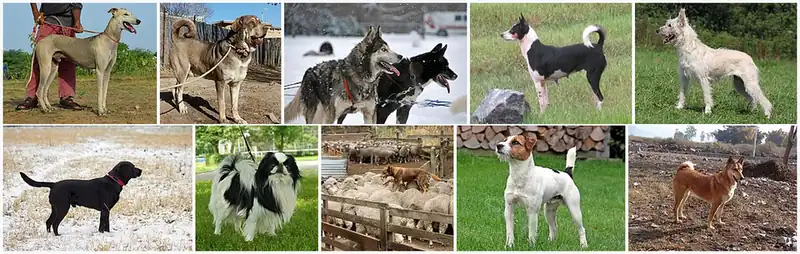
Montage showing the morphological variation of the dog.
A dog breed is a particular type of dog that was purposefully bred by humans to perform specific tasks, such as herding, hunting, and guarding. Dogs are the most variable mammal on Earth, with artificial selection producing upward of 360 globally recognized breeds. These breeds possess distinct traits related to morphology, which include body size and shape, tail phenotype, fur type, etc., but are only one species of dog. Their behavioral traits include guarding, herding, and hunting, and personality traits such as hypersocial behavior, boldness, and aggression. Most breeds were derived from small numbers of founders within the last 200 years. Because of their adaptability and usefulness to humans, dogs are the most abundant carnivore species worldwide.
A dog breed will consistently produce the physical traits, movement and temperament that were developed over decades of selective breeding. For each breed they recognize, kennel clubs and breed registries usually maintain and publish a breed standard which is a written description of the ideal specimen of the breed. Other uses of the term breed when referring to dogs include pure breeds, cross-breeds, mixed breeds and natural breeds. (Full article...)
Image 43A drawing by Konrad Lorenz showing facial expressions of a dog - a communication behavior. X-axis is aggression, y-axis is fear. (from Dog behavior)
Image 46Schematic anatomy of the ear. In dogs, the ear canal has a "L" shape, with the vertical canal (first half) and the horizontal canal (deeper half, ending with the eardrum) (from Dog anatomy)
... that when Wilson Starbuck's play Sea Dogs was staged in 1939 it "contained some of the foulest language heard on Broadway" at that point in history?
Other: Tag and assess "dog" articles with {{WikiProject Dogs}} banner. See also Dog breeds WikiProject to do list.
Recognized content
This is a list of recognized content, updated weekly by JL-Bot (talk·contribs) (typically on Saturdays). There is no need to edit the list yourself. If an article is missing from the list, make sure it is tagged(e.g. {{WikiProject Dogs}})or categorized correctly and wait for the next update. See WP:RECOG for configuration options.