Portal:Czech Republic


Welcome to the Czech Portal!
Vítejte na Českém portálu!
 |
 |
 | |
The Czech Republic, also known as Czechia and historically known as Bohemia, is a landlocked country in Central Europe. The country is bordered by Austria to the south, Germany to the west, Poland to the northeast, and Slovakia to the southeast. The Czech Republic has a hilly landscape that covers an area of 78,871 square kilometers (30,452 sq mi) with a mostly temperate continental and oceanic climate. The capital and largest city is Prague; other major cities and urban areas include Brno, Ostrava, Plzeň and Liberec.
The Duchy of Bohemia was founded in the late 9th century under Great Moravia. It was formally recognized as an Imperial Estate of the Holy Roman Empire in 1002 and became a kingdom in 1198. Following the Battle of Mohács in 1526, all of the Lands of the Bohemian Crown were gradually integrated into the Habsburg monarchy. Nearly a hundred years later, the Protestant Bohemian Revolt led to the Thirty Years' War. After the Battle of White Mountain, the Habsburgs consolidated their rule. With the dissolution of the Holy Roman Empire in 1806, the Crown lands became part of the Austrian Empire.
During the 19th century, the Czech lands underwent significant industrialization. Following the collapse of Austria-Hungary after World War I, most of the region became part of the First Czechoslovak Republic in 1918. Czechoslovakia was the only country in Central and Eastern Europe to remain a parliamentary democracy during the entirety of the interwar period. After the Munich Agreement in 1938, Nazi Germany systematically took control over the Czech lands. Czechoslovakia was restored in 1945 and three years later became an Eastern Bloc communist state following a coup d'état in 1948. Attempts to liberalize the government and economy were suppressed by a Soviet-led invasion of the country during the Prague Spring in 1968. In November 1989, the Velvet Revolution ended communist rule in the country and restored democracy. On 31 December 1992, Czechoslovakia was peacefully dissolved, with its constituent states becoming the independent states of the Czech Republic and Slovakia.
The Czech Republic is a unitary parliamentary republic and developed country with an advanced, high-income social market economy. It is a welfare state with a European social model, universal health care and free-tuition university education. It ranks 32nd in the Human Development Index. The Czech Republic is a member of the United Nations, NATO, the European Union, the OECD, the OSCE, the Council of Europe and the Visegrád Group. (Full article...)
Selected article -

Bohemia Interactive a.s. is a Czech video game developer and publisher based in Prague. The company focuses on creating military simulation games such as Operation Flashpoint: Cold War Crisis and the Arma series. It is also known for having worked on a game conversion of the DayZ mod created for Arma 2.
Founded by Marek Španěl in May 1999, the studio released its first game in 2001, a military shooter titled Operation Flashpoint: Cold War Crisis, which received critical acclaim and brought recognition for the studio. Following Operation Flashpoint was a series of downturns, such as porting the game to Xbox, which led to financial losses and the development of a sequel later abandoned by the publisher Codemasters. The studio fell into financial troubles until the United States Marine Corps employed the studio to create simulation games to train soldiers. A new division called Bohemia Interactive Simulations was created, and later spun off and became a standalone business entity. Following Codemasters' decision of not supporting the studio, Bohemia Interactive decided to develop a spiritual successor to Cold War Crisis titled Arma: Armed Assault. It was both a critical and financial success, spawning a number of sequels. Smaller projects such as Take On Helicopters were also released. (Full article...)
Selected picture

Photographer: Karelj; License: Dual (GNU Free Documentation License and Creative Commons CC-BY-SA)
In this month

- 2 September 1347 – Charles IV is crowned King of Bohemia
- 11 September 1951 – Opponents of Czechoslovakia's communist regime escape into West Germany on the Freedom Train
- 23 September 1875 – The first of the trams in Prague (Tatra T3 pictured) gets underway, under the power of horse
- 28 September 935 – Death of St Wenceslaus, marked in the Czech Republic by a national holiday since 2000
- 30 September 1938 – Leaders of Nazi Germany, France, the United Kingdom and Italy sign the Munich Agreement, permitting Germany to annex portions of Czechoslovakia
Categories

Selected biography -
Martin Miller (born Johann Rudolph Müller; 2 September 1899 – 26 August 1969), was a Czech-Austrian character actor. He played many small roles in British films and television series from the early 1940s until his death. He was best known for playing eccentric doctors, scientists and professors, although he played a wide range of small, obscure roles—including photographers, waiters, a pet store dealer, rabbis, a Dutch sailor and a Swiss tailor. On stage he was noted in particular for his parodies of Adolf Hitler and roles as Dr. Einstein in Arsenic and Old Lace and Mr. Paravicini in The Mousetrap.
Miller appeared in several notable films, including Squadron Leader X (1943), English Without Tears (1944), The Third Man (1949), The Gamma People (1956), Peeping Tom (1960), Exodus, 55 Days at Peking (1963), The V.I.P.s (1963), The Pink Panther (1963), and The Yellow Rolls-Royce (1964). His most substantial roles include George II of Great Britain in Bonnie Prince Charlie (1948) and Kublai Khan in the Doctor Who serial Marco Polo. In the 1960s, he appeared in several ITC Entertainment cult television programmes, including Ghost Squad, Danger Man, The Saint, The Avengers, Department S and The Prisoner. (Full article...)
Did you know?

- ...that the Sedlec Ossuary is a chapel decorated with the bones of 40,000 people?
- ... that the leftist Czechoslovak Chemical Workers' Union was expelled from the OSČ trade union centre in 1922?
- ... that Czech international footballer Patrik Gedeon went to play club football in Liechtenstein in the middle of his career?
- ... that a 1926 voyage to Java inspired Czech poet Konstantin Biebl for the remainder of his life?
General images
 Czech kings Ottokar II, Wenceslas II and Wenceslas III from the Přemyslid dynasty (from History of the Czech lands)

 Metro dessert (from Czech cuisine)
 Baroque St. Nicholas Church in Malá Strana, built between 1704 and 1755 (from History of the Czech lands)
 Empress Maria Theresa (reignet 1740–1780) (from History of the Czech lands)
 Church of Saint Agnes of Bohemia (Spořilov) (from Czech architecture)
 Svíčková na smetaně (marinated tenderloin), served here with dumplings and cream (from Czech cuisine)
 Pilsner Urquell in a branded mug (from Czech cuisine)
 Semi-detached villa in Brno by Otto Eisler, according to MoMA's Henry-Russell Hitchcock and Philip Johnson, is a defining building of the International style. (from Czech architecture)
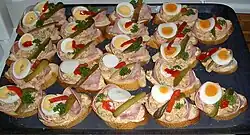 Obložené chlebíčky, a type of snack or appetizer (from Czech cuisine)
 Tomas Garrigue Masaryk, philosopher, Czechoslovak president in the years 1918–1935 (from History of the Czech lands)
 Fried hermelín (Smažený hermelín) with tartar sauce (from Czech cuisine)
 Great Moravia during the reign of Svatopluk I (from History of the Czech lands)

 Territories ruled by Ottokar II of Bohemia in 1273 (from History of the Czech lands)
 The coat of arms of the Přemyslid dynasty (until 1253–1262) (from Bohemia)
 Bronze sword, Urnfield culture, c. 1200 BC (from History of the Czech lands)

 The extent of the Protestant Reformation (1545–1620) (from History of the Czech lands)
 Detailed map of Bohemia, 1742 (from Bohemia)
 Duchy of Bohemia, around 1029 (from History of the Czech lands)
 Rotunda of St. George from the beginning of the 12th century on Mount Říp (from History of the Czech lands)
 An 1892 map showing Bohemia proper outlined in pink, Moravia in yellow, and Austrian Silesia in orange (from Bohemia)
 Dacian Influence over Bohemia (from History of the Czech lands)
 Adria Palace (Prague) (from Czech architecture)
 Linguistic map of interwar Czechoslovakia (c. 1930) (from Bohemia)
 Writer Božena Němcová (from History of the Czech lands)
 Vladislaus Hall at the Prague Castle, built from 1490 to 1502 by Benedikt Rejt (from History of the Czech lands)
 Bohemian city Karlovy Vary (from Bohemia)

 A "traditional Bohemian platter" at a restaurant in central Prague, consisting of roast duck, roast pork, beer sausage, smoked meat, red and white cabbage, bread, bacon and potato dumplings (from Czech cuisine)
 Large-scale protected areas of the Czech Republic: national parks (brown) and protected landscape areas (green) (from Protected areas of the Czech Republic)
 Prague-style beef goulash (from Czech cuisine)
 The Kingdom of Bohemia in 1618 with other Bohemian Crown lands within the Holy Roman Empire (1618) (from Bohemia)
 The National Theater from 1881 (from History of the Czech lands)
 Kačina Castle in Chotkov (from Czech architecture)
 Václav Havel, playwright, dissident and president from 1989 to 2003 (from History of the Czech lands)
 Territory under the control of the Přemyslids, c. 1301 (from History of the Czech lands)
 Emperor Francis Joseph I. (reigned 1848–1916) (from History of the Czech lands)
 St. Vitus Cathedral in Prague Castle, John of Luxembourg laid the foundation stone in 1344 (from History of the Czech lands)

 Emperor and King Charles IV. Luxembourg (from History of the Czech lands)
 Korozluky Castle (from Czech architecture)
 Entrance to Moravian Karst PLA (from Protected areas of the Czech Republic)
 Christmas cookies (vánoční cukroví) (from Czech cuisine)
 Buděticko Nature Park with Rabí Castle (from Protected areas of the Czech Republic)
 Fried bramboráky (potato pancakes) (from Czech cuisine)
 Fried Edam cheese (Smažený sýr) with potatoes and tartar sauce (from Czech cuisine)
 Monument to the village of Lidice murdered by the Nazis (from History of the Czech lands)
 King George of Podebrady, one of the first promoters of united Europe (from History of the Czech lands)
Related portals
Topics

Czech lands: Bohemia • Moravia • Czech Silesia
History: Únětice culture • Boii • Marcomanni • Samo • Great Moravia • Přemyslid dynasty • Lands of the Bohemian Crown • Czech lands (1526–1648) • 1648–1867 • 1867–1918) • Czechoslovakia • Czech Republic
Geography: Lakes • Protected areas • Regions • Rivers
Law: Judiciary • Law enforcement • Supreme Court of the Czech Republic
Politics: Administrative divisions • Government • Constitution • Elections • Foreign relations • Army • Parliament • Political parties • President • Prime Minister
Economy: Banks • Czech koruna • Energy • Oil and gas deposits • Stock Exchange • Tourism • Transport
Culture: Architecture • Art • Cinema • Cuisine • Demographics • Education • Language • Literature • Media • Music • Philosophy • Prostitution • Public holidays • Religion • Sport • Television • Video games
Symbols: Flag • Coat of arms • National anthem (Kde domov můj)
Lists: Outline of the Czech Republic • List of Czech Republic–related topics
WikiProjects
|
|
|


Featured and good content


Things to do

Wikimedia
The following Wikimedia Foundation sister projects provide more on this subject:
-
 Commons
Free media repository -
 Wikidata
Free knowledge base -
 Wikiquote
Collection of quotations -
 Wikisource
Free-content library -
 Wikiversity
Free learning tools -
 Wikivoyage
Free travel guide -
 Wiktionary
Dictionary and thesaurus
-
 List of all portals
-

-

-

-

-

-

-

-

-

-
 Random portal
-
 WikiProject Portals