Portal:Croatia


Dobro došli na hrvatski portal!

ShowcaseContentContributing

Welcome to the Croatia Portal!
Dobro došli na hrvatski portal!

Flag of Croatia
Flag of Croatia
Coat of Arms of Croatia

Croatia, officially the Republic of Croatia, is a country in Central and Southeastern Europe, on the coast of the Adriatic Sea. It borders Slovenia to the northwest, Hungary to the northeast, Serbia to the east, Bosnia and Herzegovina and Montenegro to the southeast, and shares a maritime border with Italy to the west. The Croatian archipelago contains over 1,000 islands and islets, the largest overseas territory on the Adriatic Sea. Its capital, largest city and main cultural and economic centre is Zagreb. Major urban centers include Split, Rijeka, and Osijek. The country is composed of twenty counties spanning 56,594 square kilometres (21,851 square miles) within four administrative regions. Croatia has a population of nearly 3.9 million as of 2026.

Croatian history began with the 6th century arrival of the Croats to Roman Illyria. Settled as two duchies a century later, Croatia was granted independence in 878 under Duke Branimir and elevated into a kingdom under King Tomislav in 925. The Trpimirović dynastic succession crisis placed Croatia into a personal union with Hungary in 1102. In 1527, amid Ottoman conflict, Croatia aligned with the Habsburg monarchy. It reorganized into the State of Slovenes, Croats, and Serbs before merging into the Kingdom of Yugoslavia in 1918. During World War II, most of Croatia was invaded by the Axis powers who installed a puppet state known as the Independent State of Croatia. A resistance movement restored sovereignty, emerging as the Socialist Republic of Croatia within the Socialist Federal Republic of Yugoslavia in 1943. Croatia declared independence from Yugoslavia in 1991, successfully fighting the War of Independence until 1995.

Modern Croatia is a representative democracy with a prime minister, president, and unicameral parliament. Its constitution ensures separation of powers between the executive, legislative, and judicial branches. Croatian politics reflect a multi-party system. Croatia is part of many international organizations and forums including the European Union, United Nations, WTO, and NATO, among others. It exerts regional influence as a small power in Europe, particularly within neighboring Southeast Europe. Since 1999, the Croatian Armed Forces have deployed internationally for a variety of peacekeeping missions and military interventions. Croatia was elected to serve on the non-permanent seat of the UN Security Council from 2008 to 2009.

A developed country, Croatia has an advanced economy considered high-income and dominated by its service, industrial, and agricultural sectors. Its tourism sector is prominent, generating significant economic activity across the country. Croatia has heavily invested in infrastructure, especially in transport routes and facilities along European corridors. An emerging energy power in Europe, it has strategic investments in liquefied natural gas, geothermal networks, and electric transport. It has extensive biodiversity, wildlife, and natural resources across its geography. Croatia provides social security, universal health care, and subsidized primary and secondary education while supporting culture through media and publishing. (Full article...)

Recognized content -

Entries here consist of Good and Featured articles, which meet a core set of high editorial standards.

Entrance to the Croatian Natural History Museum

The Croatian Natural History Museum (Croatian: Hrvatski prirodoslovni muzej) is the oldest and biggest natural history museum and the main body for natural history research, preservation and collection in Croatia. Located on Dimitrije Demeter Street in Gornji Grad, one of the oldest neighbourhoods of the Croatian capital Zagreb, it owns one of the biggest museum collections in Croatia, with over 2 million artefacts, including over 1.1 million animal specimens. It was founded in 1846 as the "National Museum". The National Museum was later split up into five museums, three of which were in 1986 merged as departments of the newly named Croatian Natural History Museum. The museum contains a large scientific library open to the public, and publishes the first Croatian natural history scientific journal, Natura Croatica.

The permanent display of the Croatian Natural History Museum consists of mineralogical, petrographical and zoological collections, as well as two permanent exhibits in the atrium: the Rock Map of Croatia and the Geological Pole. It is home to the remains of the Neanderthal from Krapina. In 2021, the museum was closed pending the completion of reconstruction following the 2020 Zagreb earthquake, and then reopened in 2024. (Full article...)

Did you know (auto-generated)

General images

The following are images from various Croatia-related articles on Wikipedia.

Selected biography -

Official portrait, 2015

Kolinda Grabar-Kitarović (pronounced [ɡrǎbar kitǎːroʋitɕ] ⓘ; née Grabar; born 29 April 1968) is a Croatian politician and diplomat who served as the president of Croatia from 2015 to 2020. She was the first woman to be elected to the office since the first multi-party elections in 1990 and independence from Yugoslavia in 1991. At 46 years of age, she was the youngest person to assume the presidency.

Before her election as President of Croatia, Grabar-Kitarović held a number of governmental and diplomatic posts. She was minister of European Affairs from 2003 to 2005, the first female minister of Foreign Affairs and European Integration from 2005 to 2008, Croatian ambassador to the United States from 2008 to 2011 and assistant secretary general for public diplomacy at NATO under Secretaries General Anders Fogh Rasmussen and Jens Stoltenberg from 2011 to 2014. She is a recipient of the Fulbright Lifetime Achievement Award and a number of national and international awards, decorations, honorary doctorates and honorary citizenships. (Full article...)

Selected geography article -

The Sava in Belgrade, Serbia

The Sava is a river in Central and Southeast Europe, a right-bank and the longest tributary of the Danube. From its source in Slovenia, it flows through Croatia and along its border with Bosnia and Herzegovina, and finally reaches Serbia, feeding into the Danube in its capital, Belgrade.

The Sava is 990 kilometres (615 miles) long, including the 45-kilometre (28 mi) Sava Dolinka headwater rising in Zelenci, Slovenia. It is the largest tributary of the Danube by volume of water, and the second-largest after the Tisza in terms of catchment area (97713km²) and length. It drains a significant portion of the Dinaric Alps region, through the major tributaries of Drina, Bosna, Kupa, Una, Vrbas, Lonja, Kolubara, Bosut and Krka. The Sava is one of the longest rivers in Europe and among the longest tributaries of another river. (Full article...)

Categories

Category puzzle
Category puzzle
Select [►] to view subcategories

More did you know -

  • ... that Croatian theater director Saša Broz trademarked the name and signatures of her grandfather, Yugoslav president Josip Broz Tito?

Topics


Religions in Croatia


Ex-Yugoslav countries


Other countries

Associated Wikimedia

The following Wikimedia Foundation sister projects provide more on this subject:

Things you can do


Here are some tasks awaiting attention:

Selected monthly picture

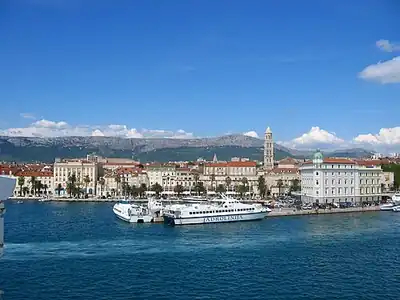
Split (Greek: Ασπάλαθος, Aspálathos; Latin: Spalatum; Italian: Spalato) is the largest and most important city in Dalmatia, the administrative center of Croatia's Split-Dalmatia County, and the country's second-largest city. It is a Mediterranean city, situated on a small peninsula on the eastern shores of the Adriatic Sea.
Discover Wikipedia using portals