Portal:Computer programming

The Computer Programming Portal
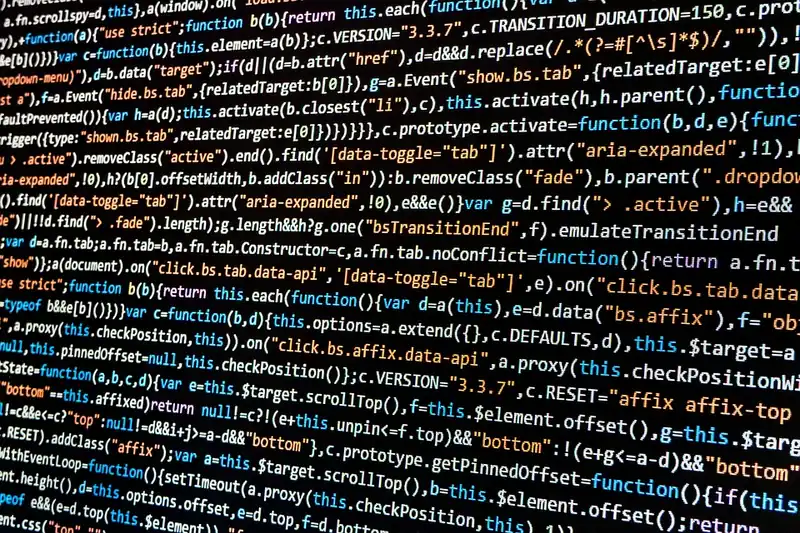
Computer programming or coding is the composition of sequences of instructions, called programs, that computers can follow to perform tasks. It involves designing and implementing algorithms, step-by-step specifications of procedures, by writing code in one or more programming languages. Programmers typically use high-level programming languages that are more easily intelligible to humans than machine code, which is directly executed by the central processing unit. Proficient programming usually requires expertise in several different subjects, including knowledge of the application domain, details of programming languages and generic code libraries, specialized algorithms, and formal logic.
Auxiliary tasks accompanying and related to programming include analyzing requirements, testing, debugging (investigating and fixing problems), implementation of build systems, and management of derived artifacts, such as programs' machine code. While these are sometimes considered programming, often the term software development is used for this larger overall process – with the terms programming, implementation, and coding reserved for the writing and editing of code per se. Sometimes software development is known as software engineering, especially when it employs formal methods or follows an engineering design process. (Full article...)
Selected articles -

Stephen Gary Wozniak (/ˈwɒzniæk/; born August 11, 1950), also known by his nickname Woz, is an American technology entrepreneur, electrical engineer, computer programmer, and inventor. In 1976, he co-founded Apple Inc. (originally called Apple Computer) with his early business partner Steve Jobs. Through his work at Apple in the 1970s and 1980s, he is widely recognized as one of the most prominent pioneers of the personal computer revolution.
In 1975, Wozniak started developing the Apple I into the computer that launched Apple when he and Jobs first began marketing it the following year. He was the primary designer of the Apple II, introduced in 1977, known as one of the first highly successful mass-produced microcomputers, while Jobs oversaw the development of its foam-molded plastic case and early Apple employee Rod Holt developed its switching power supply.
With human–computer interface expert Jef Raskin, Wozniak had a major influence over the initial development of the original Macintosh concepts from 1979 to 1981, when Jobs took over the project following Wozniak's brief departure from the company due to a traumatic airplane accident. After permanently leaving Apple in 1985, Wozniak founded CL 9 and created the first programmable universal remote, released in 1987. He then pursued several other business and philanthropic ventures throughout his career, focusing largely on technology in K–12 schools, which involved a 1990 initiative to place computers in schools in the former Soviet Union. (Full article...)- Computer programming or coding is the composition of sequences of instructions, called programs, that computers can follow to perform tasks. It involves designing and implementing algorithms, step-by-step specifications of procedures, by writing code in one or more programming languages. Programmers typically use high-level programming languages that are more easily intelligible to humans than machine code, which is directly executed by the central processing unit. Proficient programming usually requires expertise in several different subjects, including knowledge of the application domain, details of programming languages and generic code libraries, specialized algorithms, and formal logic.
Auxiliary tasks accompanying and related to programming include analyzing requirements, testing, debugging (investigating and fixing problems), implementation of build systems, and management of derived artifacts, such as programs' machine code. While these are sometimes considered programming, often the term software development is used for this larger overall process – with the terms programming, implementation, and coding reserved for the writing and editing of code per se. Sometimes software development is known as software engineering, especially when it employs formal methods or follows an engineering design process. (Full article...) - Lisp (historically LISP, an abbreviation of "list processing") is a family of programming languages with a long history and a distinctive, fully parenthesized prefix notation.
Originally specified in the late 1950s, it is the second-oldest high-level programming language still in common use, after Fortran. Lisp has changed since its early days, and many dialects have existed over its history. Today, the best-known general-purpose Lisp dialects are Common Lisp, Scheme, Racket, and Clojure.
Lisp was originally created as a practical mathematical notation for computer programs, influenced by (though not originally derived from) the notation of Alonzo Church's lambda calculus. It quickly became a favored programming language for artificial intelligence (AI) research. As one of the earliest programming languages, Lisp pioneered many ideas in computer science, including tree data structures, automatic storage management, dynamic typing, conditionals, higher-order functions, recursion, the self-hosting compiler, and the read–eval–print loop.
The name LISP derives from "List Processor". Linked lists are one of Lisp's major data structures, and Lisp source code is made of lists. Thus, Lisp programs can manipulate source code as a data structure, giving rise to the macro systems that allow programmers to create new syntax or new domain-specific languages embedded in Lisp. (Full article...) - The history of artificial intelligence (AI) began in antiquity, with myths, stories, and rumors of artificial beings endowed with intelligence by master craftsmen.
The field of AI research was founded at a workshop held on the campus of Dartmouth College in 1956. At the workshop, a concept of the first AI program, Logic Theorist, was presented by future Turing Awardee Allen Newell and future Nobel Laureate Herbert A. Simon, with help from J. C. Shaw. The software architecture of this program differed from modern AI systems in that it was a hand-written fixed script. Attendees of the workshop became the leaders of AI research for decades. Many of them predicted that machines as intelligent as humans would exist within a generation. Despite the eventual success of its attendees and the field as a whole, the workshop was considered a failure. "When the workshop failed to deliver, AI was dismissed as a pipe dream and research funding dried up".
It became apparent that researchers had underestimated the complexity of this objective. In 1974, criticism from James Lighthill and pressure from the U.S. Congress led the U.S. and British Governments to stop funding undirected research into artificial intelligence. Seven years later, a visionary initiative by the Japanese Government and the success of expert systems reinvigorated investment in AI, and by the late 1980s, the industry had grown into a billion-dollar enterprise. However, investors' enthusiasm waned in the 1990s, and the field was criticized in the press and avoided by industry (a period known as an "AI winter"). Nevertheless, research and funding continued to grow under other names. (Full article...) - Information privacy, also known as data privacy or data protection, is the relationship between the collection and dissemination of data, technology, the public expectation of privacy, contextual information norms, and the legal and political issues surrounding them.
Various types of personal information often come under privacy concerns. Privacy concerns exist wherever personally identifiable information or other sensitive information is collected, stored, used, and finally destroyed or deleted – in digital form or otherwise. Improper or non-existent disclosure control can be the root cause for privacy issues. Informed consent mechanisms including privacy policies and dynamic consent are important in communicating to data subjects the different uses of their personally identifiable information. (Full article...)
C is a general-purpose programming language created in 1972 by Dennis Ritchie. By design, C gives programmers relatively direct access to the features of typical CPU architectures, customized for the target instruction set. It has been and continues to be used to implement operating systems (especially kernels), device drivers, and protocol stacks, though its use in application software is decreasing. C is used on computers ranging from supercomputers to microcontrollers and embedded systems.
C was initially developed as a successor to the B programming language at Bell Labs by Ritchie between 1972 and 1973. Its initial purpose was to construct utilities running on Unix, and was later applied to re-implementing the kernel of the Unix operating system. During the 1980s, C gradually gained popularity, leading to it becoming one of the most widely used programming languages, with C compilers available for practically all modern computer architectures and operating systems. The book The C Programming Language, co-authored by the original language designer, served for many years as the de facto standard for the language. C has been standardized since 1989 by the American National Standards Institute (ANSI) and, subsequently, jointly by the International Organization for Standardization (ISO) and the International Electrotechnical Commission (IEC).
C is an imperative procedural language, supporting structured programming, lexical variable scope, and recursion, with a static type system. It was designed to be compiled to provide low-level access to memory and language constructs that map efficiently to machine instructions, all with minimal runtime support. Despite its low-level capabilities, the language was designed to encourage cross-platform programming. A standards-compliant C program written with portability in mind can be compiled for a wide variety of computer platforms and operating systems with few changes to its source code. (Full article...)
A Blender screenshot displaying Suzanne, a 3D test model
Computer graphics (CG) deals with generating images and art with the aid of computers. Computer graphics is a core technology in digital photography, film, video games, digital art, cell phone and computer displays, and many specialized applications. A great deal of specialized hardware and software has been developed, with the displays of most devices being driven by computer graphics hardware. It is a vast and recently developed area of computer science. The phrase was coined in 1960 by computer graphics researchers Verne Hudson and William Fetter of Boeing. It is often abbreviated as CG, or typically in the context of film as computer generated imagery (CGI). The non-artistic aspects of computer graphics are the subject of computer science research.
Computer graphics is responsible for displaying art and image data effectively and meaningfully to the consumer. It is also used for processing image data received from the physical world, such as photo and video content. Computer graphics development has had a significant impact on many types of media and has revolutionized animation, movies, advertising, and video games in general. (Full article...)- Java is a high-level, general-purpose, memory-safe, object-oriented programming language. It is intended to let programmers write once, run anywhere (WORA), meaning that compiled Java code can run on all platforms that support Java without the need to recompile. Java applications are usually compiled to bytecode that can run on any Java virtual machine (JVM) regardless of the underlying computer architecture. The syntax of Java is similar to C and C++, but has fewer low-level facilities than either of them. The Java runtime provides dynamic abilities (such as reflective programming (reflection) and runtime code modification) usually unavailable in traditional compiled languages.
Java gained popularity shortly after its release, and has been a popular programming language since then. Java was the third most popular programming language in 2022 according to GitHub. Although still widely popular, there has been a gradual decline in use of Java in recent years with other languages using JVM gaining popularity.
Java was designed by James Gosling at Sun Microsystems. It was released in May 1995 as a core component of Sun's Java platform. The original and reference implementation Java compilers, virtual machines (VMs), and class libraries were released by Sun under proprietary licenses. As of May 2007, in compliance with the specifications of the Java Community Process, Sun had relicensed most of its Java technologies under the GPL-2.0-only license. Oracle, which bought Sun in 2010, offers its own HotSpot Java virtual machine. However, the official reference implementation is the OpenJDK JVM, which is open-source software used by most developers and is the default JVM for almost all Linux distributions. (Full article...) - Mya was an intelligent personal assistant under development by Motorola in the year 2000. Proposed features for the program included the ability to read emails and answer questions 24 hours a day. Mya was intended to work with an internet service Motorola was developing called Myosphere, and was planned to be a paid service that would eventually be used by other mobile carriers. A female computer-generated character was created to represent Mya in advertising. While the quality of the character's animation was praised, it received criticism for being over sexualised.
Both the character and the program were announced to the public via an advertisement in March 2000, though the program was not ready for use at that time. Despite the announcement generating a considerable amount of attention, little was heard regarding the project in subsequent months. The program was never officially released nor cancelled, though the trademarks for both Myosphere and Mya were abandoned by Motorola in 2002. The name Mya was believed to be a play on the words 'My assistant'. (Full article...) 
Ada is a structured, statically typed, imperative, and object-oriented high-level programming language, inspired by Pascal and other languages. It has built-in language support for design by contract (DbC), extremely strong typing, explicit concurrency, tasks, synchronous message passing, protected objects, and non-determinism. Ada improves code safety and maintainability by using the compiler to find errors in favor of runtime errors. Ada is an international technical standard, jointly defined by the International Organization for Standardization (ISO), and the International Electrotechnical Commission (IEC). As of May 2023, the standard, ISO/IEC 8652:2023, is called Ada 2022 informally.
Ada was originally designed by a team led by French computer scientist Jean Ichbiah of Honeywell under contract to the United States Department of Defense (DoD) from 1977 to 1983 to supersede over 450 programming languages then used by the DoD. Ada was named after Ada Lovelace (1815–1852), who has been credited as the first computer programmer. (Full article...)
Steven Paul Jobs (February 24, 1955 – October 5, 2011) was an American businessman, inventor, and investor. A pioneer of the personal computer revolution of the 1970s and 1980s, Jobs co-founded Apple Inc. with his early business partner Steve Wozniak as Apple Computer Company in 1976. After the company's board of directors fired him in 1985, he founded NeXT the same year and purchased Pixar in 1986, becoming its chairman and majority shareholder until 2007. Jobs returned to Apple in 1997 as CEO, where he was closely involved with the creation and promotion of many of the company's most influential products until his resignation in 2011.
Jobs was born in San Francisco in 1955 and adopted shortly afterward. He attended Reed College in 1972 before withdrawing that same year. In 1974, he traveled through India, seeking enlightenment before later studying Zen Buddhism. He and Wozniak co-founded Apple in 1976 to further develop and sell Wozniak's Apple I personal computer. Together, the duo gained fame and wealth a year later with the production and sale of the Apple II, one of the first highly successful mass-produced microcomputers.
Jobs saw the commercial potential of the Xerox Alto in 1979, which was mouse-driven and had a graphical user interface (GUI). This led to the development of the largely unsuccessful Apple Lisa in 1983, followed by the breakthrough Macintosh 128K in 1984, the first mass-produced computer with a GUI. The Macintosh launched the desktop publishing industry in 1985 (for example, the Aldus PageMaker) with the addition of the Apple LaserWriter, the first laser printer to feature vector graphics and PostScript. (Full article...)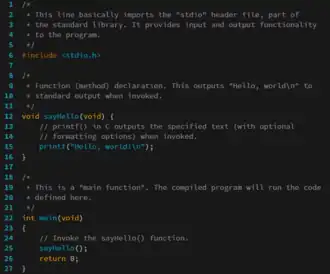
The source code for a computer program in C. The gray lines are comments that explain the program to humans. When compiled and run, it will give the output "Hello, world!".
A programming language is an engineered language for expressing computer programs, typically allowing software to be written in a human readable manner.
Execution of a program requires an implementation. There are two main approaches for implementing a programming language – compilation, where programs are translated ahead-of-time to machine code, and interpretation, where programs are directly executed. In addition to these two extremes, some implementations use hybrid approaches such as just-in-time compilation and bytecode interpreters.
The design of programming languages has been strongly influenced by computer architecture, with most imperative languages designed around the ubiquitous von Neumann architecture. While early programming languages were closely tied to the hardware, modern languages often hide hardware details via abstraction in an effort to enable better software with less effort. These languages are known as high-level languages. (Full article...)
Yoshua Bengio OC OQ OBE FRS FRSC (born March 5, 1964) is a Canadian computer scientist, and a pioneer of artificial neural networks and deep learning.
Bengio received the 2018 ACM A.M. Turing Award, often referred to as the "Nobel Prize of Computing", with Geoffrey Hinton and Yann LeCun for their foundational work on deep learning. Bengio, Hinton, and LeCun are sometimes referred to as the "Godfathers of AI".
Bengio is the most-cited computer scientist globally (by both total citations and by h-index), and the most-cited living scientist across all fields (by total citations). In November 2025, Bengio became the first AI researcher with more than a million Google Scholar citations. In 2024, Time magazine included Bengio in its yearly list of the world's 100 most influential people. (Full article...)- COBOL (Common Business-Oriented Language; /ˈkoʊbɒl, -bɔːl/) is a compiled English-like computer programming language designed for business use. It is an imperative, procedural, and, since 2002, object-oriented language. COBOL is primarily used in business, finance, and administrative systems for companies and governments. COBOL is still widely used in applications deployed on mainframe computers, such as large-scale batch and transaction processing jobs. Many large financial institutions were developing new systems in the language as late as 2006, but most programming in COBOL today is purely to maintain existing applications. Programs are being moved to new platforms, rewritten in modern languages, or replaced with other software.
COBOL's design was started in 1959 by CODASYL and was partly based on the programming language FLOW-MATIC, designed by Grace Hopper. It was created as part of a US Department of Defense effort to create a portable programming language for data processing. It was originally seen as a stopgap, but the Defense Department promptly pressured computer manufacturers to provide it, resulting in its widespread adoption. It was standardized in 1968 and has been revised five times. Expansions include support for structured and object-oriented programming. The current standard is ISO/IEC 1989:2023.
COBOL statements have prose syntax such asMOVE x TO y, which was designed to be self-documenting and highly readable. However, it is verbose and uses over 300 reserved words compared to the succinct and mathematically inspired syntax of other languages. Lacking a large standard library, the standard specifies 43 statements, 87 functions, and just one class. COBOL code is split into four divisions (identification, environment, data, and procedure), containing a rigid hierarchy of sections, paragraphs, and sentences. (Full article...) - Laboratory Virtual Instrument Engineering Workbench (LabVIEW) is a graphical system design and development platform produced and distributed by National Instruments, based on a programming environment that uses a visual programming language. It is widely used for data acquisition, instrument control, and industrial automation. It provides tools for designing and deploying complex test and measurement systems.
The visual (aka graphical) programming language is called "G" (not to be confused with G-code). It is a dataflow language originally developed by National Instruments. LabVIEW is supported on a variety of operating systems (OSs), including macOS and other versions of Unix and Linux, as well as Microsoft Windows.
The latest versions of LabVIEW are LabVIEW 2024 Q3 (released in July 2024) and LabVIEW NXG 5.1 (released in January 2021). National Instruments released the free for non-commercial use LabVIEW and LabVIEW NXG Community editions on April 28, 2020. (Full article...)


Selected images
 Output from a (linearised) shallow water equation model of water in a bathtub. The water experiences 5 splashes which generate surface gravity waves that propagate away from the splash locations and reflect off of the bathtub walls.
 Bill Gosper's Glider Gun in action
 Grace Hopper at the UNIVAC keyboard, c. 1960. Grace Brewster Murray: American mathematician and rear admiral in the U.S. Navy who was a pioneer in developing computer technology, helping to devise UNIVAC I. the first commercial electronic computer, and naval applications for COBOL (common-business-oriented language).
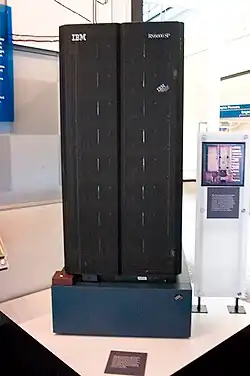 Deep Blue was a chess-playing expert system run on a unique purpose-built IBM supercomputer. It was the first computer to win a game, and the first to win a match, against a reigning world champion under regular time controls. Photo taken at the Computer History Museum.
 A head crash on a modern hard disk drive
 GNOME Shell, GNOME Clocks, Evince, gThumb and GNOME Files at version 3.30, in a dark theme
 An IBM Port-A-Punch punched card
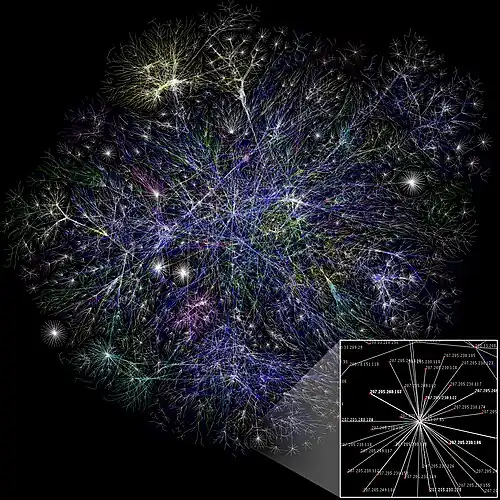 Partial map of the Internet based on the January 15, 2005 data found on opte.org. Each line is drawn between two nodes, representing two IP addresses. The length of the lines are indicative of the delay between those two nodes. This graph represents less than 30% of the Class C networks reachable by the data collection program in early 2005.
 A lone house. An image made using Blender 3D.
 Ada Lovelace was an English mathematician and writer, chiefly known for her work on Charles Babbage's proposed mechanical general-purpose computer, the Analytical Engine. She was the first to recognize that the machine had applications beyond pure calculation, and to have published the first algorithm intended to be carried out by such a machine. As a result, she is often regarded as the first computer programmer.

 A view of the GNU nano Text editor version 6.0
 Partial view of the Mandelbrot set. Step 1 of a zoom sequence: Gap between the "head" and the "body" also called the "seahorse valley".
 Margaret Hamilton standing next to the navigation software that she and her MIT team produced for the Apollo Project.
 Animation of a Non-uniform rational B-spline surface. Modeled and rendered in Cobalt.
 Stephen Wolfram is a British-American computer scientist, physicist, and businessman. He is known for his work in computer science, mathematics, and in theoretical physics.

 This image (when viewed in full size, 1000 pixels wide) contains 1 million pixels, each of a different color.
Did you know? -

- ... that police investigating rapist Zhenhao Zou had to develop custom computer code to examine more than 9 million WeChat messages on his electronic devices?
- ... that Tennyson once quoted Catullus 96 to Thackeray while they dined?
- ... that a 2021 investigation found that algorithmic amplification on TikTok could steer users towards self-harm content within hours?
- ... that both Thackeray and Longfellow bought paintings by Fanny Steers?
- ... that Perfectly Imperfect's social media platform has a main feed that is presented in reverse chronological order and is not algorithmically curated?
- ... that the Gale–Shapley algorithm was used to assign medical students to residencies long before its publication by Gale and Shapley?
Subcategories

WikiProjects

- There are many users interested in computer programming, join them.
- WikiProject Computing
- WikiProject Computer science
- WikiProject C/C++
- WikiProject Java
- WikiProject Cryptography
- WikiProject Software
Computer programming news
- 28 July 2026 –
- Taiwanese prosecutors detain an Nvidia employee in an investigation into alleged smuggling of advanced artificial intelligence chips to China through falsified transport documents. Authorities hold seven people over shipments of about 50 Supermicro servers that may violate U.S. export controls. (AFP via France 24)
Topics
This template follows roughly the 2012 ACM Computing Classification System | |||||
| Hardware | |||||
| Systems organization | |||||
| Networks | |||||
| Software organization | |||||
| Software notations, tools | |||||
| Software development | |||||
| Theory of computing | |||||
| Algorithms | |||||
| Mathematics of computing | |||||
| Information systems | |||||
| Security | |||||
| Human- centered computing | |||||
| Concurrency | |||||
| Artificial intelligence |
| ||||
| Graphics | |||||
| Applied computing |
| ||||


Related portals
Associated Wikimedia
The following Wikimedia Foundation sister projects provide more on this subject:
-
 Commons
Free media repository -
 Wikidata
Free knowledge base -
 Wikiquote
Collection of quotations -
 Wikisource
Free-content library -
 Wikiversity
Free learning tools -
 Wiktionary
Dictionary and thesaurus
-
 List of all portals
-

-

-

-

-

-

-

-

-

-
 Random portal
-
 WikiProject Portals