Portal:Coffee

The Coffee Portal
Coffee | Drinks | Coffeehouses | Companies | Culture | Preparation | Production
Introduction

Coffee is a beverage brewed from roasted ground coffee beans. Dark-colored and bitter, coffee has a stimulating effect on humans due to its caffeine content; however decaffeinated coffee is also commercially available. There are also various coffee substitutes.
Coffee production begins when the seeds from coffee cherries, the Coffea plant's fruits, are separated to produce unroasted green coffee beans. The "beans" are roasted and then ground into fine particles. Coffee is brewed from the ground roasted beans, which are typically steeped in hot water before being filtered out. It is usually served hot, although chilled or iced coffee is common. Coffee can be prepared and presented in a variety of ways, e.g., espresso, French press, caffè latte, or already-brewed canned coffee. Sugar, sugar substitutes, milk, and cream are often added and change the flavor.
Though coffee has become a global commodity, it has a history tied to food traditions around the Red Sea. The earliest reports of coffee drinking pertain to the plant's use among the Sufis of Yemen in southern Arabia in the middle of the 15th century. Up to the end of the 17th century, most of the world's coffee was imported from Yemen. As it gained in popularity, coffee started to be cultivated in Java in the 17th century and the Americas from the 18th century. (Full article...)
Selected article -

A variant of the category of French drip coffee pots is the group of so-called Bohemian coffee pots, manual zero-bypass flat bottom coffee makers made out of porcelain only, including Karlsbad coffee makers (1878), Bayreuth coffee makers (2007), the Walküre cup filter (2010) and the Walküre aroma-pot (2015). In contrast to French drip coffee pots, they all use a special double-layered conically cross-slit strainer made from through-glazed porcelain as well as a water spreader with six (or, in the larger models, more) large round holes to ensure an even water distribution and reduce the agitation of the coffee bed, a method sometimes also called cake filtration. In particular before World War I, but still up to the advent of the Espresso machine in the 1950s, they were very popular in the Viennese coffee house culture. The special kind of drip coffee they produce is called a Karlsbader ('Karlsbad coffee'). In Vienna, the Kleiner Schwarzer (confusingly also called Mokka or Piccolo), a black coffee without milk or sugar, was often prepared in Karlsbad coffee makers as well, hence they were sometimes incorrectly also called Vienna coffee-making machines. Once manufactured by many porcelain manufacturers, demand gradually dropped and eventually production stopped when electrical coffee makers became more and more common, so that Karlsbad coffee makers were only available on the used market for a couple of decades. However, experiencing a renaissance since about the millennium as part of the so-called third-wave of coffee one manufacturer restarted production of them. They are also used in restaurants and by connoisseurs, coffee sommeliers, coffee roasters and in coffee tasting laboratories. (Full article...)
General images -
 A traditional aluminium pod (left) and a paper pod (right) compared (from Nespresso)
 Dutch coffee-roasting machine, c. 1920 (from Coffee preparation)

 The word for coffee in various European languages (from Coffeehouse)
 A North American enjoying his coffee to go, even though he's in Europe (from Coffee culture)
 Single serve Vietnamese drip filter (from Coffee preparation)
 Coffee house culture between Vienna and Trieste: the coffee, the newspaper, the glass of water and the marble tabletop (from History of coffee)
- Central European Habsburg coffee house culture: news, coffee, the glass of water and the marble table top (2004) (from Coffee culture)
 Pope Clement VIII, who popularised coffee in Europe among Christians (from History of coffee)
 Centre Place, Melbourne. Australia and New Zealand have competing claims to being the birthplace of the "flat white". (from Coffeehouse)
 The port city Mocha in Yemen 1692. (from History of coffee)
 Monsooned Malabar arabica, compared with green Yirgachefe beans from Ethiopia (from History of coffee)
 A pair of Nespresso Magimix M100 machines (from Nespresso)
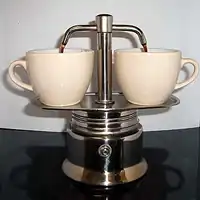
 Home espresso machine without pump (only with steam pressure) (from Coffee preparation)

 A Viennese café (from Coffeehouse)
 Interior of an espresso bar in Baliwag, Philippines (from Coffeehouse)


 Various grinders for coffee and spices (from Coffee preparation)
 Evening Café Culture in Aix-en-Provence (from Coffee culture)
 Freshly harvested coffee cherries (from Coffea)
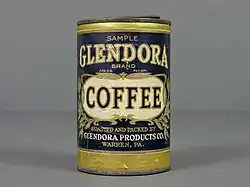 A coffee can from the first half of the 20th century. From the Museo del Objeto del Objeto collection. (from History of coffee)
 Palestinian women grinding coffee beans (from Coffeehouse)
 A Nespresso store in Lugano, Switzerland (from Nespresso)
 An English café at the close of the 17th century: men hang their hats on pegs and sit at long communal tables strewn with papers and writing implements. Coffee pots are ranged at an open fire, with a hanging cauldron of boiling water. The only woman present is separated in a canopied booth, from which she serves coffee in tall cups. (from Coffeehouse)
 The Café de Flore on the Rive Gauche in Paris is one of the oldest coffeehouses in the city. Its famous clientele included writers and philosophers. (from Coffeehouse)
 Café Tortoni is a café in Buenos Aires frequented by Jorge Luis Borges among other public figures. (from Coffeehouse)
- The Coffee Bearer by John Frederick Lewis (1857) (from History of coffee)
 Drip coffee maker (from Coffee preparation)
 Coffeehouses often sell pastries or other food items. (from Coffeehouse)
 Coffee plantation (from History of coffee)

 A coffee shop at a library in Melbourne (2006) (from Coffee culture)
 Nespresso paper pods (from Nespresso)
 Coffeepot (cafetière "campanienne"), part of a service, 1836, hard-paste porcelain, Metropolitan Museum of Art (from History of coffee)

 Nespresso machine containing professional-grade Nespresso pods, incompatible with the regular capsules (from Nespresso)

 In a pour-over, the water passes through the coffee grounds, gaining soluble compounds to form coffee. Insoluble compounds remain within the coffee filter. (from Coffee preparation)


 A Starbucks coffee shop in Knoxville, Tennessee with a drive-through (from Coffeehouse)
 Syrian Bedouin from a beehive village near Aleppo, Syria, sipping the traditional murra (bitter) coffee, 1930 (from History of coffee)
 Statue of Fernando Pessoa by Lagoa Henriques, next to the A Brasileira café, in Chiado, Lisbon (from Coffeehouse)
 Coffeepot, by French silversmith François-Thomas Germain, 1757, silver with ebony handle, Metropolitan Museum of Art (from History of coffee)
 A VertuoLine machine and capsules (from Nespresso)
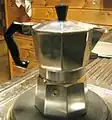 Moka pot (from Coffee preparation)
 Home espresso machine with pump (from Coffee preparation)
More did you know? -
Selected drink -

Espresso and tonic or espresso tonic is a non-alcoholic mixed drink made by mixing espresso and tonic water. First recorded in 2007, the drink became popular in Scandinavia before spreading to North America, Japan, and around the world. The key ingredients are espresso and tonic water, but other flavourings may be added. (Full article...)
Selected image -

Did you know (auto-generated)

- ... that Steem peanut butter contained as much caffeine per serving as two cups of coffee?
- ... that Jim Coffeen was the one of the first two quarterbacks for the Green Bay Packers, then served as the team's first public address announcer?
- ... that Indonesian mystic Mbah Suro reportedly consumed only coffee and cigarettes for two years?
- ... that Indonesia's current state apparatus minister, Rini Widyantini, was appointed as spokesperson in a coffee morning event?
- ... that the anti-Francoist guerrilla Marcelino Massana pranked the Civil Guard captain who was trying to kill him by paying for his coffee?
- ... that a Vancouver TV station was intended to stop the "$1,500 cup of coffee"?
- ... that Mammillaria luethyi was not seen for 44 years after being discovered growing in a coffee can on the windowsill of Mrs Crosby's?
- ... that in a copyright infringement case over a coffee-table history of the Grateful Dead, the Second Circuit held that a reuser can still claim fair use despite negotiating with the rights holder?
Topics
| Topics | |||||||
|---|---|---|---|---|---|---|---|
| Production | |||||||
| Species and varieties | |||||||
| Components | |||||||
| Preparation |
| ||||||
| Coffee drinks |
| ||||||
| List of sellers | |||||||
| Lifestyle | |||||||
| Substitutes | |||||||
| Serving cups | |||||||
| Competitions | |||||||
| Related | |||||||


Categories

Related portals
Related WikiProjects

- WikiProject Agriculture
- WikiProject Beer
- WikiProject Food and Drink
- WikiProject Spirits (semi-active)
- Wikiproject Wine (semi-active)
- WikiProject Bartending (Inactive)
- WikiProject Breakfast (inactive)
- Wikiproject Bacon (inactive)
Associated Wikimedia
The following Wikimedia Foundation sister projects provide more on this subject:
-
 Commons
Free media repository -
 Wikidata
Free knowledge base -
 Wikiquote
Collection of quotations -
 Wikisource
Free-content library -
 Wikispecies
Directory of species -
 Wikiversity
Free learning tools -
 Wiktionary
Dictionary and thesaurus
Web resources

- World Coffee Research – a 501 (c)(5) nonprofit program of the international coffee industry. (Wikipedia article: World Coffee Research)
- Coffee Research Foundation – based in Kenya, and founded in 1908
- Central Coffee Research Institute – based in Chickmagalur District, India, and founded in 1915
Wikipedia's portals
-
 List of all portals
-

-

-

-

-

-

-

-

-

-
 Random portal
-
 WikiProject Portals