Portal:Clothing

The Clothing Portal

Clothing (also known as clothes, garments, dress, apparel, or attire) consists of items worn on the body. Clothing is typically made from textiles but may also be made from animal skins, furs, and other natural materials and synthetic fibres. Clothing is a feature of every known human society, and its form and use vary according to climate, culture, available materials, technology, social norms, and individual preference.
Humans likely began wearing clothing at least tens of thousands of years ago, and early clothing was made from animal skins and plant fibres before the widespread use of woven textiles. (Full article...)
Textile is an umbrella term that includes various fibre-based materials, including fibres, yarns, filaments, threads, and different types of fabric. However, weaving is not the only manufacturing method, and many other methods were later developed to form textile structures based on their intended use. Knitting and non-woven are other popular types of fabric manufacturing. In the contemporary world, textiles satisfy the material needs for versatile applications, from simple daily clothing to bulletproof jackets, spacesuits, doctor's gowns and technical applications like geotextiles. (Full article...)
Textile art is art created from natural or synthetic fibers or from fabric or textile. Textile art is synonymous with fiber art. The art could be wall-hung, sculptural, installation, or have a functional decorative arts purpose. (Full article...)
Selected articles -


Gunta Stölzl (5 March 1897 – 22 April 1983) was a German textile artist who played a fundamental role in the development of the Bauhaus school's weaving workshop, where she created enormous change as it transitioned from individual pictorial works to modern industrial designs. She was one of a small number of female teachers on the Bauhaus' staff and the first to hold the title of "Master".
Her textile work is thought to typify the distinctive style of Bauhaus textiles. She joined the Bauhaus as a student in 1919, became a junior master in 1927. She was dismissed for political reasons in 1931, two years before the Bauhaus closed under pressure from the Nazis. (Full article...)
Bronwyn Bancroft AM (born 1958) is an Aboriginal Australian artist, administrator, book illustrator, and among the first three Australian fashion designers to show their work in Paris. She was born in Tenterfield, New South Wales, and trained in Canberra and Sydney.
In 1985, Bancroft established a shop called Designer Aboriginals, selling fabrics made by Aboriginal artists, including herself. She was a founding member of Boomalli Aboriginal Artists Co-operative. Her artwork is held by the National Gallery of Australia, the Art Gallery of New South Wales and the Art Gallery of Western Australia. She illustrated and written 47; children's books, including Stradbroke Dreamtime by activist Oodgeroo Noonuccal, and books by artist Sally Morgan. Her design commissions include one for the exterior of a Sydney sports centre. (Full article...)
Smocking on the collar of a sixteenth-century garment
Smocking is an embroidery technique used to gather fabric so that it can stretch. Before elastic, smocking was commonly used in cuffs, bodices, and necklines in garments where buttons were undesirable. Smocking developed in England and has been practised since the Middle Ages and is unusual among embroidery methods in that it was often worn by labourers. Other major embroidery styles are purely decorative and represented status symbols. Smocking was practical for garments to be both form fitting and flexible, hence its name derives from smock — an agricultural labourer's work shirt. Smocking was used most extensively in the eighteenth and nineteenth centuries. (Full article...)- Joan Schulze (born October 13, 1936) is an American artist, lecturer, and poet. Schulze's career spans over five decades. She is best known for her career in contemporary quilting and collage. Schulze was named a “pioneer of the art quilt movement” by Constance Howard. Her work is in galleries and private collections worldwide, including the Renwick Gallery/Smithsonian Institution in Washington DC, the Museum of Arts and Design in New York, & the Oakland Museum of California. (Full article...)

The Harris tweed Orb Mark
The Harris Tweed Authority (HTA) is an independent statutory public body created by the Harris Tweed Act 1993, replacing the Harris Tweed Association, which was formed in 1910. The Harris Tweed Authority is charged with the general duty of furthering the Harris Tweed industry as a means of livelihood for those who live in the Outer Hebrides of Scotland.
The Harris Tweed Authority is responsible for safeguarding the standard and reputation of Harris Tweed, promoting awareness of the cloth internationally, and disseminating information about material falling within the definition of Harris tweed and articles made from it. (Full article...)
Court Ladies Preparing Newly Woven Silk, a Chinese silk painting by Emperor Huizong of Song, early 12th century.
The production of silk originated in Neolithic China within the Yangshao culture (4th millennium BCE). Though it would later reach other places in the world, the art of silk production remained confined to China until the Silk Road opened at 114 BC. Even after trade opened, China maintained a virtual monopoly over silk production for another thousand years. The use of silk within China was not confined to clothing alone, and silk was used for a number of applications, such as writing. Within clothing, the color of silk worn also held social importance, and formed an important guide of social class during the Tang dynasty of China.
Silk cultivation had reached Japan by 300 AD, and by 552 AD the Byzantine Empire managed to obtain silkworm eggs and were able to begin silkworm cultivation while the Arabs also started to manufacture silk at around the same time. As a result of the spread of sericulture, Chinese silk exports became less important, although they still maintained dominance over the luxury silk market. The Crusades brought silk production to Western Europe, in particular to many Italian states, which saw an economic boom exporting silk to the rest of Europe. Developments in the manufacturing technique also started to take place during the Middle Ages (5th to 15th centuries) in Europe, with devices such as the spinning wheel first appearing at this time. During the 16th century, France joined Italy in developing a successful silk trade, although the efforts of most other nations to develop a silk industry of their own were unsuccessful. (Full article...)
The cochineal (/ˌkɒtʃɪˈniːl, ˈkɒtʃɪniːl/ KOTCH-in-EEL, -eel, US also /ˌkoʊtʃɪˈniːl, ˈkoʊtʃɪniːl/ KOH-chin-EEL, -eel; Dactylopius coccus) is a scale insect in the suborder Sternorrhyncha, from which the natural dye carmine is derived. A primarily sessile parasite native to tropical and subtropical South America through North America (Mexico and the Southwest United States), this insect lives on cacti in the genus Opuntia, feeding on plant moisture and nutrients. The insects are found on the pads of prickly pear cacti, collected by brushing them off the plants, and dried.
The insect produces carminic acid that deters predation by other insects. Carminic acid, typically 17–24% of dried insects' weight, can be extracted from the body and eggs, then mixed with aluminium or calcium salts to make carmine dye, also known as cochineal. Today, carmine is primarily used as a colorant in food and in lipstick (E120 or Natural Red 4). (Full article...)
A man wearing a knitted sweater
The "sweater curse" or "curse of the love sweater" is a term used by knitters and crocheters to describe the belief that if a knitter or crocheter gives a hand-knit sweater to a significant other, it will lead to the recipient breaking up with the knitter. In an alternative formulation, the relationship will end before the sweater is even completed. The belief is widely discussed in knitting publications, and some knitters reported having experienced it. In a 2005 poll, 15% of active knitters reported having experienced the sweater curse firsthand, and 41% considered it a possibility that should be taken seriously.
Despite its name, the "sweater curse" is treated in knitting literature not as a superstition governed by paranormal forces, but rather as a real-world pitfall of knitting that has rational explanations. Several plausible mechanisms for the sweater curse have been proposed, but it has not been studied systematically. (Full article...)
Weaving at Finlayson factory in Tampere, Finland (1951)
Textile manufacturing or textile engineering is a major industry. It is largely based on the conversion of fibre into yarn, then yarn into fabric. These are then dyed or printed, fabricated into cloth which is then converted into useful goods such as clothing, household items, upholstery and various industrial products.
Different types of fibres are used to produce yarn. Cotton remains the most widely used and common natural fiber making up 90% of all-natural fibers used in the textile industry. People often use cotton clothing and accessories because of comfort, not limited to different weathers. There are many variable processes available at the spinning and fabric-forming stages coupled with the complexities of the finishing and colouration processes to the production of a wide range of products. (Full article...)
Eli Whitney Jr. (December 8, 1765 – January 8, 1825) was an American inventor, widely known for inventing the cotton gin in 1793, one of the key inventions of the Industrial Revolution that shaped the economy of the Antebellum South. Whitney's invention made upland short cotton into a profitable crop, which strengthened the economic foundation of slavery in the United States and prolonged the institution. Despite the social and economic impact of his invention, Whitney lost much of his profits in legal battles over patent infringement for the cotton gin. Thereafter, he turned his attention to securing contracts with the government in the manufacture of muskets for the newly formed United States Army. He continued making arms and inventing until his death in 1825. (Full article...)
Lady Jane Allgood displays her embroidery of an anemone and tulips worked in long-and-short stitch, part of a set of 18th century chair covers and screens which survive at Nunwick Hall, although now much faded.
English embroidery includes embroidery worked in England or by English people abroad from Anglo-Saxon times to the present day. The oldest surviving English embroideries include items from the early 10th century preserved in Durham Cathedral and the 11th century Bayeux Tapestry, if it was worked in England. The professional workshops of Medieval England created rich embroidery in metal thread and silk for ecclesiastical and secular uses. This style was called Opus Anglicanum or "English work", and was famous throughout Europe.
With the Protestant Reformation of the 16th century, the focus of English embroidery increasingly turned to clothing and household furnishings, leading to another great flowering of English domestic embroidery in the Elizabethan and Jacobean eras. The end of this period saw the rise of the formal sampler as a record of the amateur stitcher's skills. Curious fashions of the mid-17th century were raised work or stumpwork, a pictorial style featuring detached and padded elements, and crewel work, featuring exotic leaf motifs worked in wool yarn. (Full article...)
Ainu ceremonial dress on display under glass in the British Museum
The conservation and restoration of textiles refers to the processes by which textiles are cared for and maintained to be preserved from future damage. The field falls under the category of art conservation, heritage conservation as well as library preservation, depending on the type of collection. The concept of textile preservation applies to a wide range of artifacts, including tapestries, carpets, quilts, clothing, flags and curtains, as well as objects which "contain" textiles, such as upholstered furniture, dolls, and accessories such as fans, parasols, gloves and hats or bonnets. Many of these artifacts require specialized care, often by a professional conservator. (Full article...)
Sprang Headdress from the Head of a Mummy of a Child (MET, 90.5.33)
Sprang is an ancient method of constructing fabric that has a natural elasticity. Its appearance is similar to netting, but unlike netting, sprang is constructed entirely from warp threads. Archaeological evidence indicates that sprang predates knitting; the two needlework forms bear a visible resemblance and serve similar functions but require different production techniques.
Although examples of sprang have been unearthed from as early as the Bronze Age, sprang was almost entirely undocumented in written records until the late nineteenth century when archaeological finds generated interest in Europe. Museum examples of sprang had been misidentified as knitting or lace until discoveries of ancient examples prompted reexamination of newer pieces. Subsequently, sprang has been identified in a variety of cultures and traditions across several continents. Its practice as a folk art waned during the twentieth century and sprang traditions have disappeared in most locales. Knitting has largely supplanted sprang. (Full article...)
The Great Silk Road was a network of Asian trade routes active from the second century BCE until the mid-15th century. Spanning over 6,400 km (4,000 mi) on land, it played a central role in facilitating economic, cultural, political, and religious interactions between the Eastern and Western worlds. The name "Silk Road" was coined in the late 19th century, but some 20th- and 21st-century historians instead prefer the term Silk Routes, on the grounds that it more accurately describes the intricate web of land and sea routes connecting Central, East, South, Southeast, and West Asia as well as East Africa and Southern Europe. In fact, some scholars criticise or even dismiss the idea of silk roads and call for a new definition or alternate term. According to them, the literature using this term has "privileged the sedentary and literate empires at either end of Eurasia" thereby ignoring the contributions of steppe nomads. In addition, the classic definition sidelines prominent civilisations such as India and Iran.
The Silk Road derives its name from the highly lucrative trade of silk textiles that were primarily produced in China. The network began with the expansion of the Han dynasty (202 BCE – 220 CE) into Central Asia around 114 BCE, through the missions and explorations of the Chinese imperial envoy Zhang Qian, which brought the region under unified control. The Chinese took great interest in the security of their trade products, and extended the Great Wall of China to ensure the protection of the trade route. The Parthian Empire provided a vital bridge connecting the network to the Mediterranean. Meanwhile, the rise of the Roman Empire in the west further established the western terminus of the interconnected trade system. By the first century CE, Chinese silk was widely sought after in Rome, Egypt, and Greece. Other lucrative commodities from the East included tea, dyes, perfumes, and porcelain; among Western exports were horses, camels, honey, wine, and gold. Aside from generating substantial wealth for emerging mercantile classes, the proliferation of goods such as paper and gunpowder greatly affected the trajectory of political history in several theatres in Eurasia and beyond. (Full article...)
"Summer", detail from a tapestry called The Seasons or Orchard, woven by Morris & Co. in wool, silk, and mohair on a cotton ground at Merton Abbey in 1890, designed by William Morris and John Henry Dearle.
John Henry Dearle (22 August 1859 – 15 January 1932) was a British textile and stained-glass designer trained by the artist and craftsman William Morris who was much influenced by the Pre-Raphaelite Brotherhood. Dearle designed many of the later wallpapers and textiles released by Morris & Co., and contributed background and foliage patterns to tapestry designs featuring figures by Edward Burne-Jones and others. Beginning in his teens as a shop assistant and then design apprentice, Dearle rose to become Morris & Co.'s chief designer by 1890, creating designs for tapestries, embroidery, wallpapers, woven and printed textiles, stained glass, and carpets. Following Morris's death in 1896, Dearle was appointed Art Director of the firm, and became its principal stained glass designer on the death of Burne-Jones in 1898.
Morris's reputation overshadowed Dearle's work throughout Dearle's career: Dearle exhibited early patterns under Morris's name and Dearle designs continue to be sold as Morris patterns. Critical assessment of Dearle's work then underwent a significant change during the final decades of the twentieth century, recognizing Dearle's mature work as having a unique artistic vision of its own. Dearle always remained close to Morris's aesthetic, but from the 1890s onward he incorporated a distinctive set of Persian and Turkish influences. (Full article...)


Did you know (auto generated)

- ... that Armand Avril travelled in 1960 for a year in Africa, where he was inspired to assemble "bottle caps, clothespins, glue, nails and empty tin cans"?
- ... that Sandra Ng wore her own clothes while filming Love Lies to help the production crew save on the budget?
- ... that Oduwa's reign saw cowries becoming so widespread as currency that nobles stitched them into their clothes, causing runaway inflation?
- ... that Swertia japonica was used as an insecticide for clothes during the Edo period?
- ... that Olympic cyclist Clyde Rimple was fined £60 for pouring bleach and urinating on his wife's clothes?
- ... that Caroline Jones wore different charity clothes every day in 2015 after her mother died?
More Did you know

- ... that grosgrain ribbons or textiles finished by calendering become the thin, glossy and papery fabric known as moire (pictured)?
- ... that shed is a weaving term for the temporary separation in warp threads so the shuttle with the weft can go through?
- ...that a selvage is the edge of a piece of woven or knitted fabric that won't fray or come unraveled?
Related portals
Selected image

Jacobean embroidery refers to embroidery styles that flourished beginning in the reign of King James I of England in first quarter of the seventeenth century. The term is usually used today to describe a form of crewel embroidery used for furnishing characterized by fanciful plant and animal shapes worked in a variety of stitches with two-ply wool yarn on linen.
General images -
 Hindu lady wearing sari, one of the most ancient and popular pieces of clothing in the Indian subcontinent. (from Fashion)
 Warp-weighted loom configured for twill weave fabric. (from History of clothing and textiles)

 Textile machinery at the Cambrian Factory, Llanwrtyd, Wales in the 1940s (from History of clothing and textiles)
 Model with a modern dress reflecting the current fashion trend, 2011 (from Fashion)
 Latin dancers in their costumes. The woman is wearing backless dress with deep slits on its lower portion, while the man is wearing a shirt with top buttons open. (from Fashion)
 Marie Antoinette, wife of Louis XVI, was a leader of fashion. Her choices, such as this 1783 white muslin dress called a chemise a la Reine, were highly influential and widely worn. (from Fashion)
 A Concert in an Interior by Jan Josef Horemans the Younger of Antwerp, 1764. The women's sack-back gowns and the men's coats over long waistcoats are characteristic of this period. (from History of clothing and textiles)

 Celebrities such as Britney Spears have popularized the concept of wearing underwear as outerwear. (from Fashion)

 A multigenerational banquet depicted on a wall-painting from Pompeii, 1st century AD (from History of clothing and textiles)
 Kiko Mizuhara is a designer known for blending traditional Japanese elements with modern fashion, challenging stereotypes of Japanese style as static or outdated. (from Fashion)
 Indigenous Americas Map Tunic designed in 2018 by Carla Fernández and Pedro Reyes for Taller Flora. (from Fashion)

 A French reinterpretation of Spanish fashion, with elaborate reticella ruff, 1609 (from History of clothing and textiles)
 A silk chiffon dress identical to that worn by Jennifer Lopez to the 42nd Annual Grammys in 2000, this version exhibited at the Fashion Museum, Bath, as part of their Dress of the Year Collection. (from History of clothing and textiles)
 A woman in Bengal region in the eastern part of the Indian subcontinent, clad in fine Bengali muslin, 18th century. (from History of clothing and textiles)
 Edgar I of England in short tunic, hose, and cloak, 966 (from History of clothing and textiles)

 Bold floral patterned silks, 15th century (from History of clothing and textiles)
 A see-through top worn along with pasties at a fashion show in 2017. Such fashion trends get popularised through media. (from Fashion)
 Reconstruction of people of the Mierzanowice culture from present-day Poland, c. 2100–1650 BC. (from History of clothing and textiles)

 Tie dye vendor, July 2013 (from Fashion)

 Cover of Marcus Clarks' spring and summer catalogue 1926–27 (from Fashion)
 Diana: A Celebration, an exhibition of Princess Diana's outfits at the Frazier History Museum. Diana's fashion significantly impacted style trends. (from Fashion)
 Gross sales of goods vs IP laws (US 2007) (from Fashion)
 Albrecht Dürer's drawing contrasts a well-turned out bourgeoise from Nuremberg (left) with her counterpart from Venice. The Venetian lady's high chopines make her look taller. (from Fashion)
 Estonian national clothes are a fine example of change in clothing after the Industrial Revolution. They changed considerably during 18th and 19th century with the addition of new types of colors (like aniline dyes), placement of colors (like lengthwise stripes) and with the addition of new elements (like waistcoats). By the end of the 19th century they went out of use in most of the country (except more remote places as in Kihnu island) and it was only in mid 20th century when they once again gained popularity and now as a formal clothing. Members of University of Tartu Folk Art Ensemble wearing clothes specific to Kihnu island, Tori Parish (women in red skirts) and Tõstamaa area (men in brown clothing). (from History of clothing and textiles)
 This 1921 clipping from the St. Louis Post-Dispatch, with story and drawings by Marguerite Martyn, represents the saturation newspaper coverage given to society women at a fashionable dance. (from Fashion)
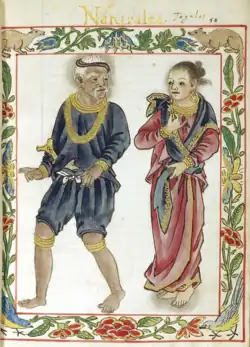 A 16th-century Boxer Codex image showing the attire of a Classical period Filipino, made of silk and cotton (from History of clothing and textiles)
 Kaia Gerber at the 2019 Max Mara Fashion Week in Milan (from Fashion)
 Liu Wen, supermodel, walks the runway modeling fashions by designer Diane von Fürstenberg at New York Fashion Week 2013. (from Fashion)
 14th-century Italian silk damasks (from History of clothing and textiles)
 Sungir boy clothes reconstruction, about 30,000 years ago. (from History of clothing and textiles)
 Gensei Kajin Shu by Yoshu Chikanobu, 1890. Various styles of traditional Japanese clothing and Western styles. (from Fashion)
 1895 Punch cartoon.Gertrude: "My dear Jessie, what on earth is that Bicycle Suit for?"
Jessie: "Why, to wear, of course."
Gertrude: "But you haven't got a Bicycle!"
Jessie: "No; but I've got a Sewing Machine!" (from History of clothing and textiles)
Selected quote
Main topics
| Headwear |
| ||||||||
|---|---|---|---|---|---|---|---|---|---|
| Neckwear | |||||||||
| Underwear and lingerie |
| ||||||||
| Tops | |||||||||
| Bottoms |
| ||||||||
| Full-body wear |
| ||||||||
| Coats and outerwear |
| ||||||||
| Armwear | |||||||||
| Legwear | |||||||||
| Footwear | |||||||||
| Accessories |
| ||||||||
| Specialized |
| ||||||||
| Dress codes |
| ||||||||
| Related | |||||||||

| Fundamentals |  | |
|---|---|---|
| History of ... | ||
| Regional and ethnic | ||
| Related | ||
| Glossaries | ||
Recognized content
Extended content | ||
|---|---|---|

Featured articlesGood articlesFeatured pictures
Featured portals |




Subcategories

WikiProjects
- Parent project
Wikipedia:WikiProject Arts

- Main project
Textile Arts WikiProject
- Participants
- Related projects
WikiProject Fashion • WikiProject Knots • WikiProject Sculpture • WikiProject Visual arts
What are WikiProjects?
Things you can do
 |
Here are some tasks awaiting attention:
|
Associated Wikimedia
The following Wikimedia Foundation sister projects provide more on this subject:
-
 Commons
Free media repository -
 Wikidata
Free knowledge base -
 Wikiquote
Collection of quotations -
 Wikisource
Free-content library -
 Wikiversity
Free learning tools -
 Wiktionary
Dictionary and thesaurus
-
 List of all portals
-

-

-

-

-

-

-

-

-

-
 Random portal
-
 WikiProject Portals