Welcome To The Christianity Portal
Christianity Abrahamic monotheistic religion based on the Bible and the teachings of Jesus . The Gospels state that Jesus is the Son of God and rose from the dead after his crucifixion , whose coming as the messiah (Christ ) was prophesied in the Old Testament and chronicled in the New Testament . It is the world's largest and most widespread religion with over 2.3 billion followers, comprising around 28.8% of the world population . Its adherents, known as Christians , are estimated to make up a majority of the population in 120 countries and territories .
Christianity remains culturally diverse in its Western and Eastern branches , and doctrinally diverse concerning justification and the nature of salvation , ecclesiology , ordination , and Christology . Most Christian denominations , however, generally hold in common the belief that Jesus is God the Son —the Logos incarnated —who ministered , suffered , and died on a cross , but rose from the dead for the salvation of humankind; this message is called the gospel , meaning the "good news". The four canonical gospels of Matthew , Mark , Luke and John describe the life of Jesus and teachings as preserved in the early Christian tradition , with the Old Testament as the gospels' respected background.
The three main branches of Christianity are Catholicism (1.3 billion people), Protestantism (800 million), and Eastern Orthodoxy (300 million), while other prominent branches include Oriental Orthodoxy (60 million) and Restorationism (35 million). Smaller church communities number in the thousands. In Christianity, efforts toward unity (ecumenism ) are underway. In the West , Christianity remains the dominant religion even with a decline in adherence , with about 70% of that population identifying as Christian. Christianity is growing in Africa and Asia , the world's most populous continents. Many Christians are still persecuted in some regions of the world, particularly where they are a minority, such as in the Middle East , North Africa , East Asia , and South Asia . (Full article...
This is a Featured article, which represents some of the best content on English Wikipedia.
Prosperity theology prosperity gospel , the health and wealth gospel , the gospel of success , seed-faith gospel , Faith movement , or Word of Faith movement) is a belief among some Charismatic Protestant Christians , originating in the United States , that financial blessing and physical well-being are always the will of God for them, and that faith , positive scriptural confession, and giving to charitable and religious causes will increase one's material wealth . Material and especially financial success is seen as evidence of divine grace or favor and blessings, while the opposite (poverty) is seen as divine judgment .
Prosperity theology is considered heretical by almost all other Christian denominations; it has been criticized by leaders from various Christian denominations , who maintain that it is irresponsible, promotes idolatry , and is contrary to the Bible . Secular as well as Christian observers have also criticized some versions of the prosperity theology as exploitative of the poor. The practices of some preachers have attracted scandal, and some have been charged with financial fraud . (Full article...
Ælfheah of Canterbury Æthelberht of Kent Almost There (album) Alodia Amazing Grace Grand Duchess Anastasia Nikolaevna of Russia St Helen's Church, Ashby-de-la-Zouch Asser Augustine of Canterbury Augustinian theodicy Alexis Bachelot Badnjak (Serbian) Baldwin of Forde George Calvert, 1st Baron Baltimore John W. Beschter Book of Kells William M. Branham Martin Bucer David Hillhouse Buel (priest) Robert Burnell Josephine Butler Byzantine Empire Cædwalla of Wessex William de St-Calais John Calvin Capon Chapel Cardinal-nephew Charles Carroll the Settler Robert Catesby Cathedral of the Immaculate Conception (Moscow) Catherine de' Medici Ten Commandments in Catholic theology Cento Vergilianus de laudibus Christi Christ lag in Todes Banden, BWV 4 A Christmas Carol Clement of Dunblane Cologne War Henry Conwell William de Corbeil Walter de Coventre Thomas Cranmer Crucifixion and Last Judgement diptych Damien (South Park) David I of Scotland Harold Davidson Randall Davidson John Day (printer) Deusdedit of Canterbury Die Hard Diocletianic Persecution Drapier's Letters Bob Dylan Ealdred (archbishop of York) Michael Francis Egan Elgin Cathedral English Benedictine Reform Leonhard Euler Guy Fawkes Gilbert Foliot George Fox Ursula Franklin Geoffrey (archbishop of York) Georgetown University Gerard (archbishop of York) Gospel of the Ebionites Gothic boxwood miniature El Greco Gregorian mission Gunpowder Plot Reginald Heber Hebron Church (Intermont, West Virginia) Henry (bishop of Finland) George Went Hensley Hilary of Chichester Huguenot-Walloon half dollar Anne Hutchinson Illinois (Sufjan Stevens album) Intelligent design Into Temptation (film) JC's Girls James II of England James VI and I Frank Jenner Jesus Joan of Arc Jocelin of Glasgow Joseph Johnson (publisher) Samuel Johnson Peter Jones (missionary) Josquin des Prez Jovan Vladimir Justus Johannes Kepler Knights Templar John Knox Manuel I Komnenos Cosmo Gordon Lang Laurence of Canterbury Lisa the Skeptic Old Church of St Nidan, Llanidan Kellie Loder William de Longchamp Madonna in the Church Mary, Queen of Scots Maximus the Confessor Mellitus Felix Mendelssohn Mormon handcart pioneers Mr. Hankey, the Christmas Poo Nativity (Christus) Nefarious: Merchant of Souls Netley Abbey Nigel (bishop of Ely) Ninety-five Theses Norton Priory Old Pine Church Grand Duchess Olga Nikolaevna of Russia Operation Auca Ormulum Paulinus of York Peasants' Revolt Joseph Priestley House Joseph Priestley Priestley Riots St Botolph's Church, Quarrington Ion Heliade Rădulescu Rastafari Religious debates over the Harry Potter series Robert of Jumièges Ambrose Rookwood Royal Maundy William S. Sadler Saint Fin Barre's Cathedral St James' Church, Sydney St Nicholas, Blakeney Second Crusade Elliott Fitch Shepard St Denys' Church, Sleaford Albertus Soegijapranata A Song for Simeon St. Michael's Cathedral, Qingdao Jo Stafford Myles Standish Stanford Memorial Church Stephen I of Hungary Stigand Arthur Sullivan Swedish emigration to the United States Paul Palaiologos Tagaris Paul Nobuo Tatsuguchi Theobald of Bec Thomas of Bayeux Joseph W. Tkach Trading Places Francis Tresham Harriet Tubman Vampire Ralph Vaughan Williams Peter Martyr Vermigli Vespro della Beata Vergine Hubert Walter Wells Cathedral Westminster Assembly William Wilberforce Wilfrid Samuel Merrill Woodbridge Huldrych Zwingli
The following are images from various Christianity-related articles on Wikipedia.
Image 1 Depiction of Trinity from
Saint Denis Basilica in Paris (12th century) (from
Trinity )
Image 2 13th-century depiction of the Trinity from a
Roman de la Rose manuscript (from
Trinity )
Image 3 The
Communion of the Apostles , by
Luca Signorelli , 1512 (from
Jesus in Christianity )
Image 4 The Father, The Holy Spirit, and Christ crucified, depicted in a
Welsh manuscript
c. 1390–1400 (from
Trinity )
Image 5 The Trinity by Russian icon painter
Andrei Rublev , early 15th century (from
Trinity )
Image 6 The "Heavenly Trinity" joined to the "
Earthly Trinity " through the
Incarnation of the
Son –
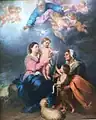
The Heavenly and Earthly Trinities by
Murillo (c.
1677) (from
Trinity )
Image 7 God the Father (top), the Holy Spirit (a dove), and the child Jesus, painting by
Bartolomé Esteban Murillo (d. 1682) (from
Trinity )
Image 8 Pope
Clement I prays to the Trinity, in a typical post-Renaissance depiction by
Gianbattista Tiepolo (d. 1770). (from
Trinity )
Image 9 The
Church of the Holy Sepulchre is a
holy site in
Jerusalem believed by most
Christians to encompass the
tomb of Jesus and the site of his crucifixion and resurrection. (from
Jesus in Christianity )
Image 10 An artistic depiction of the Trinity, with the
hand representing the
Father , the
Chi Rho and
ichthys representing the
Son , and the
dove representing the
Holy Spirit (from
Trinity )
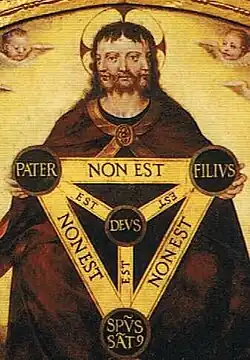
Image 12 A
Shield of the Trinity diagram, illustrating relationships between the Father, the Son, and the Holy Spirit (from
Trinity )
Image 13 A depiction of the
Council of Nicaea in AD
325, at which the Deity of Christ was declared orthodox and
Arianism condemned (from
Trinity )
Image 14 God, in the person of the Son, confronts
Adam and Eve , by
Master Bertram (d.
c. 1415). (from
Trinity )
Image 15 God the Father (top), and the Holy Spirit (represented by a dove) depicted above Jesus Painting by
Francesco Albani (d. 1660) (from
Trinity )
Image 16 A representation of the
Trifacial Trinity , as a three faced head, sometimes used in Renaissance iconography (but disavowed by the Catholic Church). (from
Trinity )
Image 18 Detail of the
earliest known artwork of the Trinity, the
Dogmatic or Trinity Sarcophagus ,
c. 350 (
Vatican Museums ).
Three similar figures, representing the Trinity, are involved in the creation of
Eve , whose much smaller figure is cut off at lower right; to her right,
Adam lies on the ground. (from
Trinity )
Image 19 First page of
Mark , by
Sargis Pitsak (14th century): "The beginning of the gospel of Jesus Christ, the Son of God". (from
Jesus in Christianity )
Image 20 The Glory of Saint Nicholas , by
António Manuel da Fonseca ;
Nicholas of Myra , a participant in the First Council of Nicaea, achieves the
beatific vision in the shape of the Holy Trinity. (from
Trinity )
Image 21 The Holy Trinity on the stained glass windows of the Church of Saint Peter and Saint Paul in
Brockdish (from
Trinity )
Image 24 Many Christians use the
crucifix to symbolise Jesus' sacrificial death and as a focus for
devotion . (from
Jesus in Christianity )
Image 25 Three doors representing the trinity at
a cathedral in Cleveland, Ohio (from
Trinity )
Image 26 Jesus'
Farewell Discourse to his eleven remaining disciples after the
Last Supper , from the
Maestà by
Duccio (from
Jesus in Christianity )
Image 27 The Holy Trinity in an angelic glory over a landscape, by
Lucas Cranach the Elder (d. 1553) (from
Trinity )
Image 29 Attributed to the circle of Pieter Claeissins II,
A Christian Allegory of the Salvation of a Christian Soul (
c. 1570–1600) depicts the triumph of virtue over death and
Satan . The Bowes Museum. (from
Salvation in Christianity )
Image 30 Representation of the Trinity in the form of the
mercy seat (epitaph from 1549) (from
Trinity )
Image 31 Atypical depiction of the Trinity where the Son is identified by a lamb, the Father an
Eye of Providence , and the Spirit a dove (from
Trinity )
Image 32 Depictions of the Resurrection of Jesus are
central to Christian art (
Resurrection of Christ by
Raphael , 1499–1502). (from
Jesus in Christianity )
Image 33 A Greek
fresco of Athanasius of Alexandria, the chief architect of the Nicene Creed, formulated at Nicaea (from
Trinity )
Image 34 The Trinity by Russian icon painter
Andrei Rublev , early 15th century: this portrayal of the three
angels who visited
Abraham at the
Oak of Mamre (Genesis 18:1-8) (from
Trinity )
Image 35 A painting depicting the
Trifacial Trinity by an anonymous author from the Peruvian
Cuzco School (but disavowed by the Catholic Church). (from
Trinity )
Image 36 The Good Samaritan by
James Tissot . The
Parable of the Good Samaritan is one of the parables of Jesus. (from
Jesus in Christianity )
Image 37 A 'Jesus Saves'
neon cross sign outside of a Protestant church in
New York City (from
Salvation in Christianity )
Image 38 The
Adoration of the Trinity by
Albrecht Dürer (1511).
From top to bottom: Holy Spirit (dove), God the Father and Christ on the cross. (from
Trinity )
This is a Good article, an article that meets a core set of high editorial standards.
Joseph Pomeroy Widney LL.D (December 26, 1841 – July 4, 1938), was an American doctor, educator, historian, and religious leader.
After the American Civil War led him to medicine, he followed his brothers to California where he received his medical degree. He saw southern California as a "Garden of Eden". In Los Angeles he was a founder of the Los Angeles Medical Society. He was a strong proponent of the new University of Southern California , and became its second president and the founding dean of its school of medicine. The Los Angeles Public Library was one of his major interests. (Full article...
10 (MercyMe album) 1292–1294 papal election March–April 1605 papal conclave Æthelwig St Beuno's Church, Aberffraw Ralph Abernathy St Mary's Church, Acton Æthelbert of York Æthelnoth (archbishop of Canterbury) Æthelred (archbishop) Gregorio Pietro Agagianian Agapemonites Ion Agârbiceanu Jane Aitken Albigensian Crusade Albin of Brechin Codex Alexandrinus Aliqoli Jadid-ol-Eslam All Saints Church, Patcham All Saints' Church, Runcorn All Saints' Church, Shuart All Saints' Episcopal Church (Briarcliff Manor, New York) All That Is Within Me All of Creation (song) Allah Ethan Allen Patrick Allen (governor-general) The Altar and the Door American Dream (Casting Crowns song) St Eleth's Church, Amlwch Gene Amondson Apostolic Faith Mission of South Africa Arab Christians Archbishopric of Moravia Architecture of the medieval cathedrals of England Argument from morality Asia Bibi blasphemy case Assemblies of God USA St Mary's Church, Astbury 2008 attacks on Christians in southern Karnataka Ave Maria (Beyoncé song) Ave Maryam Azusa Street Revival BYU Jerusalem Center Baby Jesus theft Emilia Baeyertz Jim Bakker Baldwin (abbot of Bury St Edmunds) Baptism with the Holy Spirit Cicely Mary Barker Basehead Bath Abbey Beautiful (MercyMe song) Bebenhausen Abbey Bede Henry Ward Beecher Ben-Hur (1959 film) Benjaminville Friends Meeting House and Burial Ground Berenice (daughter of Herod Agrippa) Berhtwald Bethlehem Between You and Me (DC Talk song) Biblical criticism Big Gay Al's Big Gay Boat Ride Black Christmas (2006 film) Bless Me Indeed (Jabez's Song) St Edern's Church, Bodedern St Mary's Church, Bodewryd St Twrog's Church, Bodwrog Anne Boleyn Boniface of Savoy (bishop) Born Again (Third Day song) Bosa of York Robert Jefferson Breckinridge Bregowine Brigham Young University Bristol Cathedral Britney (song) Needham B. Broughton Brown Memorial Presbyterian Church Buhl Altarpiece Smedley Butler Byzantine Greeks Byzantine Empire under the Komnenos dynasty Robert Cade Caffo Call My Name (Third Day song) Kirk Cameron Ernest T. Campbell Captivity of Mangalorean Catholics at Seringapatam Codex Carolinus Bartolomé de las Casas Casting Crowns (album) Cathedral of St. John the Divine Cathedral of the Immaculate Conception (Hong Kong) Catholic Church Catholic Church in Afghanistan Catholic Church in Nepal A Catholic Statement on Pluralism and Abortion Ceolnoth Henry Chadwick (theologian) Chalke The Chariot (band) Chester Cathedral St Andrew's Church, Chew Stoke Chilembwe uprising Chinese Rites controversy Christ Church, Newton Church of Christ Pantocrator, Nesebar Christ the Lord Is Risen Today History of Christian thought on persecution and tolerance The Christian Manifesto Christian metal Christian Science Christian views on alcohol Christian ethics Christian interpretations of Virgil's Eclogue 4 Christian meditation Christianisation of Scotland Christianity in Medieval Scotland Christianization of Poland Christmas Party (The Office) The Christmas Sessions Christmas truce Church Administration Building Church Missions House The Church of Jesus Christ of Latter-day Saints Church of the Holy Mother of God, Donja Kamenica Churches of Christ Civilian Public Service John Clarke (Baptist minister) Claudius of Turin William C. Clayton Cleeve Abbey Clement of Alexandria Closed on Sunday John B. Cobb Codex Vaticanus John Alan Coey Codex Coislinianus Come to the Well Coming Up to Breathe Commonitorium (Orientius) Via della Conciliazione Conservapedia Constantine the Great Contra Celsum Controversy over the use of Manchester Cathedral in Resistance: Fall of Man Sierk Coolsma John Cotton (minister) Council of Reims (1148) Courageous (song) John Collins Covell Ion Creangă Crucifixion darkness Crusades Heidi Cruz Cullen Old Church Cuthbert of Canterbury Cynfarwy Dalby Church Kim Davis Lynn de Silva Death (South Park) Death in 19th-century Mormonism DecembeRadio Dejan (despot) Delilah Church of St Demetrius, Patalenitsa Devotions upon Emergent Occasions The Dictator Pope Everard Digby Does Anybody Hear Her Tiffany Doggett Louis William Valentine DuBourg Dunstan Mary Dyer Earthsuit East to West (song) Edict of Torda William Edington Edmund the Martyr Edward the Martyr Edwin of Northumbria Eliot Indian Bible Elizabethan settlement English Reformation English Standard Version Ralph d'Escures Anthony Esolen Etchmiadzin Cathedral Euthymius I of Constantinople Evangelical Missionary Church of Besançon Fallen angel Ioan C. Filitti First Crusade First Presbyterian Church of Marcellus First Presbyterian Church of Newtown Reginald Fitz Jocelin Ranulf Flambard Ned Flanders Samuel Lightfoot Flournoy (lawyer) Samuel Lightfoot Flournoy (politician) Robert Foliot Follow God Fordham University Richard Gagnon Galileo Galilei Garde Church Henry Garnet Murder of Irene Garza Antoni Gaudí The Generous Mr. Lovewell Church of St George, Kyustendil Larry Geraty Germanus of Winchester Ghazanchetsots Cathedral Henry Bell Gilkeson Give Me Your Eyes Glastonbury Abbey Glycerius God's Choice God with Us (song) Goin' Home (Archie Shepp and Horace Parlan album) Gospel of Jesus' Wife Gospel of John Gospel of the Hebrews Grammy Award for Best Soul Gospel Performance, Male or Female Gravity (Lecrae album) John Gregorson Campbell Gregory of Nyssa Haapsalu Castle Half-Way Covenant Lyman Hall (academic) Bethesda Methodist Chapel, Hanley R. A. Hardie Stephen Harper Johann Peter Hebel Henry VIII Hensley Henson Here with Me (MercyMe song) Octavia Hill Sidney Hill Thomas S. Hinde Historiography of the Crusades History of Gaza The History of the Fairchild Family Holly & Ivy Holy Leaven Home Alone Homesick (MercyMe song) Honorius of Canterbury Hospitaller colonization of the Americas Hymns for the Amusement of Children I Can Only Imagine (MercyMe song) I Made It (Fantasia song) Ich hatte viel Bekümmernis, BWV 21 Unionskirche, Idstein If We Are the Body St Margaret's Church, Ifield William Blake's illustrations of On the Morning of Christ's Nativity Im Frieden dein, o Herre mein Indonesian Christian Student Movement De Iniusta Vexacione Willelmi Episcopi Primi International Pentecostal Holiness Church Isaac Ishe Komborera Africa Jænberht Herbert Armitage James Jehovah's Witnesses Jesu, meine Freude Jesuit Missions of Chiquitos Jesus Freak (song) Jesus Is King Jesus Is Lord Jesus for President Jingle All the Way Jocelin of Wells John IV of Ohrid St John's, Ashfield Gary Johnson Jonah Gabriel Jones (politician) Joyful, Joyful Judas (Lady Gaga song) Julian of Norwich Justinian I William Hoapili Kaʻauwai Katy Hudson (album) Robert Keable Mkrtich Khrimian Martin Luther King Jr. Kingdom of Fazughli Kingdom of al-Abwab Heather Knight (educator) James Sloan Kuykendall Laie Hawaii Temple Lärbro Church Walter W. Law Lazar the Serb Jelena Lazarević Lecrae Marcel Lefebvre Johannes Leimena Henry de Lichton Lifesong Lifesong (song) Lift Up Your Face Like a Prayer (song) Lima Liturgy Lindenwood University Liturgical calendar (Lutheran) Liverpool Metropolitan Cathedral St Gallgo's Church, Llanallgo St Pabo's Church, Llanbabo St Peter's Church, Llanbedrgoch St Peulan's Church, Llanbeulan Llandaff Cathedral St Tyfrydog's Church, Llandyfrydog St Eugrad's Church, Llaneugrad St Mary's Church, Llanfair-yn-y-Cwmwd St Mary's Church, Llanfair-yng-Nghornwy St Michael's Church, Llanfihangel Ysgeifiog St Cristiolus's Church, Llangristiolus St Cwyllog's Church, Llangwyllog St Iestyn's Church, Llaniestyn St Enghenedl's Church, Llanynghenedl Lord's Supper in Reformed theology Low Lights Lund Cathedral La Luz del Mundo Lye Church Karl G. Maeser Frederik Magle Magnificat (Rutter) Magnificat (Torri) Make Your Move (song) Mangalorean Catholics Agnes von Mansfeld-Eisleben Agnes Mary Mansour Francis Marbury Marcellina (gnostic) Grand Duchess Maria Nikolaevna of Russia Thomas Bryan Martin Henry Martyn Mary I Mary Magdalene St Mary's Church, Llanfair Mathafarn Eithaf Matthew, Mark, Luke and John Mauro-Roman Kingdom May God have mercy upon your soul David Meade (author) St Lawrence's Church, Mereworth Metropolitan Community Church of Washington, D.C. Pope Miltiades Codex Basilensis A. N. IV. 2 Minuscule 543 Robert Molyneux A Moral Reckoning More popular than Jesus Mormon Trail Mormon folklore The Most Famous Man in America The Most Hated Family in America Church of the Holy Mother of God, Asen's Fortress Move (MercyMe song) Move (Third Day album) Al-Mundhir III ibn al-Harith St Mary's Church, Nantwich National Christian Council of China Nativity scene St Mary's Church, Nether Alderley New Brunswick Theological Seminary Isaac Newton Nidan Nothing Fails Novum Instrumentum omne Nun bitten wir den Heiligen Geist Nun danket all und bringet Ehr Nun jauchzt dem Herren, alle Welt Nun komm, der Heiden Heiland O'er the Gloomy Hills of Darkness Omen (Antestor album) Oneness Pentecostalism Origen Orthodox Church in America Oswald of Northumbria Oswald of Worcester Church of Saint Oswald, King and Martyr, Oswaldkirk St Thomas the Martyr's Church, Oxford Papal conclave Peace Candle Peace on Earth (Casting Crowns album) John Peckham Pelagianism Herb Pennock Pennsylvania Ministerium Peter of Bruys Megan Phelps-Roper Philip the Arab and Christianity William Phips Photian schism A Plain Introduction to the Criticism of the New Testament Platon of Banja Luka Robert Plunkett Pohick Church Church of St. Polyeuctus Roger de Pont L'Évêque St Chad's Church, Poulton-le-Fylde Praise You In This Storm Pray (Justin Bieber song) Prayer of Saint Francis Presbyterian Church in the United States of America Presbyterian Ladies' College, Sydney Prester John Linvoy Primus The Prince of Egypt Project 86 Psalm 84 Public Universal Friend Hugh de Puiset Qedarites The Rage Against God Paulos Faraj Rahho Rangers F.C. signing policy Johannes Rebmann St Mary Redcliffe Reformed baptismal theology Robyn Regehr James Reimer Aurelia Henry Reinhardt Remember not, Lord, our offences Remembering You (song) Requiem (Fauré) Revelation (Third Day album) Revelations of Divine Love Charles Reynolds (cleric) St Mary's Church, Rhodogeidio St Peirio's Church, Rhosbeirio Charlene Richard Richard of Dover Leni Riefenstahl George Ripley (transcendentalist) Riverside Church Gene Robinson Romanus (bishop of Rochester) Royal touch Joseph Franklin Rutherford St Caffo's Church, Llangaffo St Ceidio's Church, Rhodogeidio St Ceinwen's Church, Cerrigceinwen St Cynfarwy's Church, Llechgynfarwy St Deiniol's Church, Llanddaniel Fab St Dona's Church, Llanddona St Edwen's Church, Llanedwen St Ffinan's Church, Llanffinan St Fflewin's Church, Llanfflewin St Gwenllwyfo's Church Old Church of St Gwenllwyfo, Llanwenllwyfo St John the Baptist Church, Reid Saint-Louis-du-Louvre St Margaret's Church, Aberlour St Mary's Church, Pentraeth St Mihangel's Church, Llanfihangel yn Nhowyn St Nidan's Church, Llanidan St. Patrick's Cathedral (New York City) Old St Paul's Cathedral St Peter's Roman Catholic Church, Buckie St Rufus Church Saint Thomas Anglicans Samson San Sebastian Church (Manila) Sanctus Real FC Santa Claus Satan Satisfied (DecembeRadio album) Savior's Shadow Say Yes (Michelle Williams song) Scottish religion in the eighteenth century Scottish religion in the seventeenth century Scrooged Seal of Zion, Illinois Selah (Kanye West song) Seneca Falls Convention Serb uprising of 1596–1597 Sermons of Jonathan Swift Session of Christ William J. Seymour Marshall L. Shepard William Henry Sheppard Silence (2016 film) Angelus Silesius Simele massacre Sixtine Vulgate Sixto-Clementine Vulgate Slow Fade Christopher Smart Joseph Smith So Long Self Son of God (TV series) Sonne der Gerechtigkeit Southern Adventist University Spoken For Joseph Sprigg St. James Church (Queens) St John's Church, Manchester St Mary's Church, Chesham Stånga Church Elizabeth Cady Stanton Star of Bethlehem Stefan Vladislav Storkyrkan William Stoughton (judge) St James' Church, Stretham St Peter's Church, Sudbury Billy Sunday Sunday football in Northern Ireland Surb Karapet Monastery Frederick Swann Sylvester (singer) Symeon the New Theologian Syracuse University St Mary's Church, Tal-y-llyn Tamar of Georgia Grand Duchess Tatiana Nikolaevna of Russia Taunton Unitarian Chapel The Church of Jesus Christ of Latter-day Saints in Tonga Pope Theodore II Theodosius I Theology of Huldrych Zwingli These Are Special Times Third Epistle of John Thirty pieces of silver Thrive (Casting Crowns album) Thurstan Tian Feng (magazine) Tiberius Harry Toulmin (Unitarian minister) Towson United Methodist Church Thomas Traherne St Beuno's Church, Trefdraeth St Caian's Church, Tregaian Ralph Waldo Trine St George's Church, Trotton George Washington Truett Desmond Tutu Typos of Constans Unbreakable (Fireflight song) Undone (MercyMe album) Unitarian Universalist Church of Arlington Until the Whole World Hears Until the Whole World Hears (song) Upper Brook Street Chapel, Manchester Uppsala Cathedral Varagavank Virgin of Vladimir Visby Cathedral Vix pervenit Vä Church Gebhard Truchsess von Waldburg Was willst du dich betrüben, BWV 107 Wash Us in the Blood Water (Kanye West song) Martha Watts Derek Webb Hugh of Wells Matthew West What's So Amazing About Grace? John Wheelwright Francis White (Virginia politician) John Whiteley (missionary) Who Am I (Casting Crowns song) Wighard William of York John Wilson (Puritan minister) Robert Winchelsey John Winthrop Witch trials in early modern Scotland Andrew Wodrow The Woman's Bible Word of God Speak The Worship Project Wright brothers Wulfhelm Wulfred Yahballaha III Yaropolk Izyaslavich Yazdegerd I Yours (Steven Curtis Chapman song) John Sigismund Zápolya Elias Zoghby Sayfo
Nero's Torches A Christian martyr Christianity , through stoning , crucifixion , burning at the stake or other forms of torture and capital punishment . The word "martyr " comes from the Greek word μάρτυς, mártys, which means "witness." At first, the term applied to Apostles . Once Christians started to undergo persecution , the term came to be applied to those who suffered hardships for their faith. Finally, it was restricted to those who had been killed for their faith. The early Christian period before Constantine I was the "Age of martyrs". A martyr's death was considered a "baptism in blood," cleansing one of sin , similar to the effect of baptism in water. Early Christians venerated martyrs as powerful intercessors , and their utterances were treasured as inspired by the Holy Spirit .
Category puzzle Select [►] to view subcategories
Discover Wikipedia using portals
List of all portals
Random portal
WikiProject Portals