Portal:Capitalism

The Capitalism PortalCapitalism is an economic system based on the private ownership of the means of production and its use for the purpose of obtaining profit. This socioeconomic system has developed historically in several stages and is defined by a number of constituent elements: private property, profit motive, capital accumulation, competitive markets, commodification, wage labor, and an emphasis on innovation and economic growth. Capitalist economies tend to experience business cycles of economic expansion followed by recessions. Economists, historians, political economists, and sociologists have adopted different perspectives in their analyses of capitalism and have recognized various forms of it in practice. These include laissez-faire capitalism, free-market capitalism, state capitalism, and welfare capitalism. Different forms of capitalism feature varying degrees of free markets, public ownership, barriers to free competition, and state-sanctioned social policies. The degree of competition in markets, the role of intervention and regulation, and the scope of state ownership vary across different models of capitalism. The extent to which markets are free and the rules defining private property are matters of politics and policy. Most of the existing economies in the world today are mixed economies that combine elements of free markets with state intervention and, in some cases, economic planning. Capitalism in its modern form emerged from agrarianism in England, as well as from mercantilist practices in European countries between the 16th and 18th centuries. The Industrial Revolution of the 18th century established capitalism as a dominant mode of production characterized by factory work and a complex division of labor. Through globalization, capitalism spread across the world in the 19th and 20th centuries, especially before World War I and again after the end of the Cold War. During the 19th century, capitalism was largely unregulated by the state but became more regulated in the post–World War II period through Keynesianism, followed by a return of more unregulated capitalism termed neoliberalism starting in the 1980s. (Full article...) Selected article Selected biography Some years into retirement Ricardo became keen to enter Parliament and in August 1818 he secured Lord Portarlington’s borough for £4,000, as part of the terms of a loan of £25,000. As a result, Ricardo entered the House of Commons, representing Portarlington, an Irish rotten borough. He was 47 years of age. His record in Parliament was that of an earnest reformer. He held the seat until his death four years later. Ricardo argued that there is mutual national benefit from trade even if one country is more competitive in every area than its trading counterpart and that a nation should concentrate resources only on industries where it had a comparative advantage, that is in those industries in which it has the greatest competitive edge. Ricardo suggested that national industries which were, in fact, profitable and internationally competitive should be jettisoned in favour of the most competitive industries. Ricardo's theory of comparative advantage assumes the existence of an industry and trade policy at a national level. Although he did not presume here that business decisions are or should be made independently by entrepreneurs on the basis of viability or profit, he knew that merchants engage only if it is profitable for them to do so. (Full article...) Selected quote
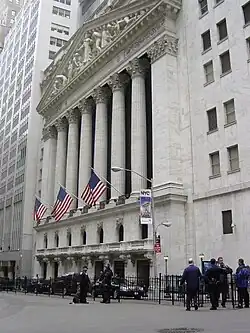
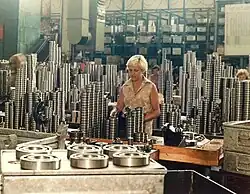
General imagesThe following are images from various capitalism-related articles on Wikipedia.
Did you know
Categories Related portalsCapitalism topicsCapitalism .. Private property .. Economic freedom .. Laissez-faire .. British Agricultural Revolution .. Industrial Revolution .. Klondike Gold Rush .. Marketplace .. Prices .. Money .. Wage .. Taxes .. Patent .. Capitalist mode of production .. Criticisms of socialism .. Adam Smith .. Milton Friedman .. Ludwig Von Mises .. Murray N. Rothbard .. The Wealth of Nations .. The Protestant Ethic and the Spirit of Capitalism .. Capital and Interest .. Capitalism and Freedom .. American capitalism .. Corporate capitalism .. Democratic capitalism .. Anarcho-capitalism .. State capitalism .. Welfare capitalism .. Ronald Reagan Related WikiProjects
Things you can do Improve this portal! Associated WikimediaThe following Wikimedia Foundation sister projects provide more on this subject:
Discover Wikipedia using portals
|