The area of today's Austria has been inhabited since at least the Paleolithic period. Around 400 BC, it was inhabited by the Celts and then annexed by the Romans in the late 1st century BC. Christianization in the region began in the 4th and 5th centuries, during the late Roman period, followed by the arrival of numerous Germanic tribes during the Migration Period.
Austria as a state emerged from the remnants of the Eastern and Hungarian March at the end of the first millennium, first as a frontier march of the Holy Roman Empire, it then developed into a Duchy in 1156, and was made an Archduchy in 1453. Being the heartland of the Habsburg monarchy since the late 13th century, Austria was a major imperial power in Central Europe for centuries and from the 16th century, Vienna also served as the Holy Roman Empire's administrative capital. The Holy Roman Empire was dissolved in 1806, two years after Austria had established its own empire, which became a great power and one of the largest states in Europe. The empire's defeat in wars and the loss of territories in the 1860s paved the way for the establishment of Austria-Hungary in 1867.
Seeking to recover royal estates lost during his minority, Henry relied on lower-ranking officials, provoking unrest in Saxony and Thuringia. He suppressed revolts there in 1069 and 1071, but his promotion of commoners alienated the nobility. Insisting on his royal prerogative to appoint bishops and abbots, he became embroiled in what would later be known as the Investiture Controversy, coming into conflict with the papacy; Pope Alexander IIexcommunicated Henry's advisers in 1073. After crushing a renewed rebellion in Saxony in 1075, Henry adopted an active policy in Italy, alarming Alexander's successor, Gregory VII, who threatened him with excommunication for simony. (Full article...)
In Vienna, the Hotel Sacher and Demel pastry shop dominate the market for Sachertorte. In the 20th century, they fought over the cake's ownership, trademark, and how many layers of sponge the original contained, with Hotel Sacher favouring two and Demel one. The cakes themselves had the same basic ingredients, but the exact recipes were kept secret. (Full article...)
Image 3
Marshal Mortier at the battle of Durenstein in 1805, by Auguste Sandoz
The Battle of Dürenstein (German: Schlacht bei Dürnstein; also known as Dürrenstein, Dürnstein and Diernstein) or the Battle of Krems (Russian: Сражение при Кремсе), on 11 November 1805, was an engagement in the Napoleonic Wars during the War of the Third Coalition. Dürenstein (modern Dürnstein), Austria, is located in the Wachau valley, on the river Danube, 73 kilometers (45mi) upstream from Vienna, Austria. The river makes a crescent-shaped curve between Dürnstein and nearby Krems an der Donau, and the battle was fought in the flood plain between the river and the mountains.
At Dürenstein, a combined force of Russian and Austrian troops trapped a French division commanded by Théodore Maxime Gazan. The French division was part of the newly created VIII Corps, the so-called Corps Mortier, under command of Édouard Mortier. In pursuing the Austrian retreat from Bavaria, Mortier had over-extended his three divisions along the north bank of the Danube. Mikhail Kutuzov, commander of the Coalition force, enticed Mortier to send Gazan's division into a trap and French troops were caught in a valley between two Russian columns. They were rescued by the timely arrival of a second division, under command of Pierre Dupont de l'Étang. The battle extended well into the night, after which both sides claimed victory. The French lost more than a third of their participants, and Gazan's division experienced over 40percent losses. The Austrians and Russians also had heavy losses—close to 16percent—but perhaps the most significant was the death in action of Johann Heinrich von Schmitt, one of Austria's most capable chiefs of staff. (Full article...)
No particular triggering event started the war. Prussia cited its centuries-old dynastic claims on parts of Silesia as a casus belli, but Realpolitik and geostrategic factors also played a role in provoking the conflict. Maria Theresa's contested succession to the Habsburg monarchy provided an opportunity for Prussia to strengthen itself relative to regional rivals such as Saxony and Bavaria. (Full article...)
Image 5
Bird's-eye view of Athens and its suburbs during the Noemvriana clashes, published by The Sphere in December 1916
The Noemvriana (Greek: Νοεμβριανά, "November Events") was an armed confrontation in Athens in December[O.S. November]1916 between the Kingdom of Greece and the Allied Powers, arising from a dispute over Greece's neutrality in World WarI, followed by reprisals and riots against Greek supporters of the Allies.
The immediate crisis began in May1916, when the Greek fortress of Roupel was surrendered to the Central Powers, mainly Bulgarian forces, raising concerns among the Allies of a secret alliance between the Greek government and the Central Powers. The Allies feared that the Central Powers, with Greek support, might launch an attack against the Franco-British army that had been invited to Thessaloniki by former Prime Minister Eleftherios Venizelos to assist Serbia and had been bivouacked there since late 1915. Diplomatic negotiations between King ConstantineI and the Allies took place in mid-1916, with the King advocating for Greek neutrality, which would favor the Central Powers. The Allies demanded the demobilization of the Greek army to ensure Greece's neutrality after the surrender of Fort Roupel. However, the failure of negotiations, combined with the Bulgarian Army's advance in Macedonia, led to a military coup by officers supporting Venizelos in Thessaloniki. Supported by the Allies, in October1916, Venizelos established a provisional government in northern Greece to form an army to reclaim territories lost to Bulgaria, thus splitting Greece into two factions. (Full article...)
The battle was fought in and around the town of Leuthen (now Lutynia, Poland), 10km (6mi) northwest of Breslau, (now Wrocław, Poland), in Prussian (formerly Austrian) Silesia. By exploiting the training of his troops and his superior knowledge of the terrain, Frederick created a diversion at one end of the battlefield and moved most of his smaller army behind a series of low hillocks. The surprise attack in oblique order on the unsuspecting Austrian flank baffled Prince Charles, who took several hours to realize that the main action was to his left, not his right. Within seven hours, the Prussians had destroyed the Austrians and erased any advantage that the Austrians had gained throughout the campaigning in the preceding summer and autumn. Within 48 hours, Frederick had laid siege to Breslau, which resulted in the city's surrender on 19–20 December. (Full article...)
The "vertical/horizontal" (VH) platform, which the Rapide uses, extensively incorporates aluminium throughout the body, reducing weight. In 2012, Aston Martin ended its partnership with Magna Steyr and shifted production to Gaydon, a Warwickshire village where the other VH-platform cars—including the DB9, the DBS, the Vantage and the second-generation Vanquish—were produced. The car was praised by automotive critics for its appealing exterior and interior design. In 2015, Aston Martin debuted an electric concept version, the RapideE. The production-ready model debuted in 2019 but was never series-produced. (Full article...)
Image 8
Topographic map of Switzerland highlighting the location of the battle
The Battle of Winterthur (27 May 1799) was an important action between elements of the Army of the Danube and elements of the Habsburg army, commanded by Friedrich Freiherr von Hotze, during the War of the Second Coalition, part of the French Revolutionary Wars. The small town of Winterthur lies 18 kilometers (11mi) northeast of Zürich, in Switzerland. Because of its position at the junction of seven roads, the army that held the town controlled access to most of Switzerland and points crossing the Rhine into southern Germany. Although the forces involved were small, the ability of the Austrians to sustain their 11-hour assault on the French line resulted in the consolidation of three Austrian forces on the plateau north of Zürich, leading to the French defeat a few days later.
Archduke Charles carried out major reforms to the Imperial Austrian Army, but the quality of it was diminished to some extent by the incompleteness of training and the Army's multinational nature. The French military relied on their talented emperor, veterans, whose numbers had dwindled over the course of recent wars, as well as the effective Napoleonic la maraude tactics. Napoleon, like the Austrians, had to cope with a multinational army, which included many foreign allies. On 10 April 1809, Austrian forces under Archduke Charles crossed the border of Bavaria, a French client state. The French response, under Louis-Alexandre Berthier, was disorganised but order was imposed with the arrival of Napoleon on 17 April. Napoleon led an advance to Landshut, hoping to cut off the Austrian line of retreat and sweep into their rear. Charles crossed the Danube at Regensburg, which allowed him to retreat eastwards, although he failed to reach the Austrian capital, Vienna, before the French. A French assault across the Danube was repulsed on 21–22 May at the Battle of Aspern-Essling but a repeat attack was successful in July. Napoleon won a close battle at the 5–6 July Battle of Wagram, but the Austrian’s stiff resistance throughout the campaign and withdrawal in good order frustrated France’s efforts to score a decisive victory. When the retreating Austrian army turned to face the French at the Battle of Znaim, negotiations mid-battle led to reaching an eponymous armistice on 12 July. Austria’s invasion of the Duchy of Warsaw was repulsed and they were driven out of their territories in Italy. They enjoyed more success in other theatres, seizing areas in Dalmatia and overrunning Saxony (where they fought alongside the Black Brunswickers), though news of the armistice reaching local commanders compelled them to halt their operations. British forces landed in Walcheren, in the French client state of Holland, but were unable to seize their objective of capturing Antwerp and later withdrew. (Full article...)
The terrain complicated battle tactics for both sides, but the Russians and the Austrians, having arrived in the area first, were able to overcome many of its difficulties by strengthening a causeway between two small ponds. They had also devised a solution to Frederick's deadly modus operandi, the oblique order. Although Frederick's troops initially gained the upper hand in the battle, his limited scouting, combined with the strong defensive preparations of the Allied troops, gave the Russians and Austrians an advantage. By afternoon, when the combatants were exhausted, fresh Austrian troops thrown into the fray secured the Allied victory. (Full article...)
Image 11
The Battle of Rossbach took place on 5November 1757 during the Third Silesian War (1756–1763, part of the Seven Years' War) near the village of Rossbach (Roßbach), in the Electorate of Saxony. It is sometimes called the Battle of, or at, Reichardtswerben, after a different nearby town. In this 90-minute battle, Frederick the Great, king of Prussia, defeated an Allied army composed of French forces augmented by a contingent of the Reichsarmee (Imperial Army) of the Holy Roman Empire. The French and Imperial army included 41,110 men, opposing a considerably smaller Prussian force of 22,000. Despite overwhelming odds, Frederick managed to defeat the Imperials and the French.
The Battle of Rossbach marked a turning point in the Seven Years' War, not only for its stunning Prussian victory, but because France refused to send troops against Prussia again and Britain, noting Prussia's military success, increased its financial support for Frederick. Following the battle, Frederick immediately left Rossbach and marched for 13 days to the outskirts of Breslau. There he met the Austrian army at the Battle of Leuthen; he employed similar tactics to again defeat an army considerably larger than his own. (Full article...)
After completing her doctoral research in 1906, Meitner became the second woman to earn a doctorate in physics from the University of Vienna. She spent much of her scientific career in Berlin, where she was a physics professor and a department head at the Kaiser Wilhelm Institute for Chemistry. She was the first woman to become a full professor of physics in Germany. She lost her positions in 1935 because of the anti-JewishNuremberg Laws of Nazi Germany, as well as her citizenship after the 1938 annexation of Austria by Germany. On 13–14 July 1938, she fled to the Netherlands with the help of Dirk Coster. She lived in Stockholm for many years, ultimately becoming a Swedish citizen in 1949, while insisting on keeping her Austrian citizenship, but relocated to Britain in the 1950s to be with family members. (Full article...)
On 20 October Moreau retreated from Freiburg im Breisgau and established his army along a ridge of hills. The severe condition of the roads prevented Archduke Charles from flanking the French right wing. The French left wing lay too close to the Rhine to outflank, and the French center, positioned in a 7-mile (11km) semi-circle on heights that commanded the terrain below, was unassailable. Instead, he attacked the French flanks directly, and in force, which increased casualties for both sides. (Full article...)
Image 14
Kafka in 1923
Franz Kafka (3 July 1883– 3 June 1924) was a German-language Jewish Czech writer and novelist born in Prague, in the Austro-Hungarian Empire. Widely regarded as a major figure of 20th-century literature, his works fuse elements of realism and the fantastique, and typically feature isolated protagonists facing bizarre or surreal predicaments and incomprehensible bureaucratic powers. The term Kafkaesque has entered the lexicon to describe situations like those depicted in his writings. His best-known works include the novella The Metamorphosis (1915) and the novels The Trial (1924) and The Castle (1926). He is also celebrated for his brief fables and aphorisms, which frequently incorporated comedic elements alongside the darker themes of his longer works. His work has widely influenced artists, philosophers, composers, filmmakers, literary historians, religious scholars, and cultural theorists.
Kafka was born into a middle-class German-speaking Czech Jewish family in Prague, the capital of the Kingdom of Bohemia, which belonged to the Austro-Hungarian Empire (later the capital of Czechoslovakia and the Czech Republic). He trained as a lawyer, and after completing his legal education was employed full-time in various legal and insurance jobs. His professional obligations led to internal conflict as he felt that his true vocation was writing. Only a minority of his works were published during his life; the story collections Contemplation (1912) and A Country Doctor (1919), and individual stories, such as his novella The Metamorphosis, were published in literary magazines, but they received little attention. He wrote hundreds of letters to family and close friends, including his father, with whom he had a strained and formal relationship. He became engaged to several women but never married. He died relatively unknown in 1924 of tuberculosis, aged 40. His literary executor and friend Max Brod ignored Kafka's wishes to destroy his remaining works, publishing them to eventual acclaim. (Full article...)
Image 15
Friedrich der Grosse und der Feldscher
The War of the Bavarian Succession (German: Bayerischer Erbfolgekrieg; 3 July 1778 – 13 May 1779) was a dispute between the Austrian Habsburg monarchy and an alliance of Saxony and Prussia over succession to the Electorate of Bavaria after the extinction of the Bavarian branch of the House of Wittelsbach. The Habsburgs sought to acquire Bavaria, and the alliance opposed them, favoring another branch of the Wittelsbachs. Both sides mobilized large armies, but the only fighting in the war was a few minor battles. However, thousands of soldiers died from disease and starvation, earning the conflict the name Kartoffelkrieg (Potato War) in Prussia and Saxony; in Habsburg Austria, it was sometimes called the Zwetschgenrummel (Plum Fuss).
On 30 December 1777, Maximilian III Joseph, the last of the junior Wittelsbach line, died of smallpox, leaving no children. Charles Theodore, a scion of a senior branch of the House of Wittelsbach, held the closest claim of kinship, but he also had no legitimate children to succeed him. His cousin, Charles II August, Duke of Zweibrücken, therefore had a legitimate legal claim as Charles Theodore's heir presumptive. Across Bavaria's southern border, Emperor Joseph II coveted the Bavarian territory and had married Maximilian Joseph's sister Maria Josepha in 1765 to strengthen any claim he could extend. His agreement with the heir, Charles Theodore, to partition the territory neglected any claims of the heir presumptive, Charles August. (Full article...)
Selected article -
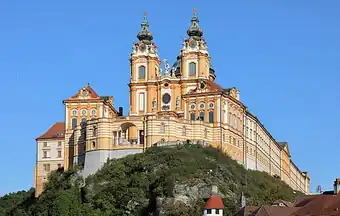
Melk Abbey in the Wachau
The Wachau (German pronunciation:[vaˈxaʊ]) is an Austrian valley with a landscape of high visibility formed by the Danube river. It is one of the most prominent tourist destinations of Lower Austria, located midway between the towns of Melk and Krems. It is 30km in length and was already settled in prehistoric times. A well-known place and tourist attraction is Dürnstein, where King Richard the Lion-Heart of England was held captive by Duke Leopold V.
The Wachau is well known for its production of apricots and grapes, both of which are used to produce specialty liquors and wines. Wachau is a source of Austria's most prized dry Rieslings and Grüner Veltliners.
The Wachau was added to the UNESCO list of World Heritage Sites in recognition of its architectural and agricultural history.
thumb|upright|Billy Wilder
Billy Wilder (22 June 1906–27 March 2002) was an Austro-Hungarian born American filmmaker, screenwriter, producer, artist, and journalist, whose career spanned more than 50 years and 60 films. He is regarded as one of the most brilliant and versatile filmmakers of Hollywood's golden age. Wilder is one of only five people who have won Academy Awards as producer, director, and writer for the same film (The Apartment).
From the mid-1950s on, Wilder made mostly comedies. Among the classics Wilder created in this period are the farces The Seven Year Itch (1955) and Some Like It Hot (1959), satires such as The Apartment (1960), and the drama comedy Sabrina (1954). He directed fourteen different actors in Oscar-nominated performances. Wilder was recognized with the American Film Institute (AFI) Life Achievement Award in 1986. In 1988, Wilder was awarded the Irving G. Thalberg Memorial Award. In 1993, he was awarded the National Medal of Arts. Wilder has attained a significant place in the history of Hollywood censorship for his role in expanding the range of acceptable subject matter.
... that a priest refused to perform the wedding ceremony for Austrian socialist Josef Peskoller and his fiancée Maria Griel on political grounds in 1928?
... that during his tenure as the manager of Austria's Burgtheater from 1971 to 1976, Gerhard Klingenberg often directed plays with analogies of a divided Europe?