Øvrebø og Hægeland Municipality
Øvrebø og Hægeland Municipality
Øvrebø og Hægeland herred | |
|---|---|
 View of one of the local churches, Hægeland Church | |
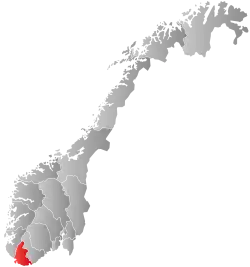 Vest-Agder within Norway | |
 Øvrebø og Hægeland within Vest-Agder | |
| Coordinates: 58°17′26″N 07°46′39″E / 58.29056°N 7.77750°E | |
| Country | Norway |
| County | Vest-Agder |
| District | Sørlandet |
| Established | 1 Jan 1861 |
| • Preceded by | Øvrebø Municipality |
| Disestablished | 1 July 1896 |
| • Succeeded by | Øvrebø Municipality and Hægeland Municipality |
| Administrative centre | Øvrebø |
| Government | |
| • Mayor (1895–1896) | Torje Horrisland |
| Area (upon dissolution) | |
• Total | 303 km2 (117 sq mi) |
| Highest elevation | 500.22 m (1,641.1 ft) |
| Population (1896) | |
• Total | 1,731 |
| • Density | 5.71/km2 (14.8/sq mi) |
| Time zone | UTC+01:00 (CET) |
| • Summer (DST) | UTC+02:00 (CEST) |
| ISO 3166 code | NO-1016[2] |
Øvrebø og Hægeland is a former municipality in the old Vest-Agder county, Norway. The 303-square-kilometre (117 sq mi) municipality existed from 1865 until its dissolution in 1896. The area is now part of Vennesla Municipality in Agder county. The administrative centre was the village of Øvrebø, where Øvrebø Church is located.[3][4]
General information
The municipality of Øvrebø og Hægeland was established on 1 January 1861[5] when the old Øvrebø Municipality was divided into two separate municipalities: the southeastern district (population: 1,103) became the new Vennesla Municipality and the rest of the old municipality (population: 1,829) became the new Øvrebø og Hægeland Municipality. The new Øvrebø og Hægeland Municipality existed for only 35 years before it was dissolved. On 1 July 1896, it was divided to create two new municipalities: the southern district (population: 888) became the new Øvrebø Municipality and the northern district (population: 843) became the new Hægeland Municipality. (Later, in 1964, both Øvrebø and Hægeland were merged into Vennesla Municipality.)[6]
Name
In 1861, the parishes of Øvrebø and Hægeland were put together to form this municipality and it was given the compound name Øvrebø og Hægeland, literally meaning "Øvrebø and Hægeland".
The parish of Øvrebø is named after the old Øvrebø farm (Old Norse: Øfribœr) since the first Øvrebø Church was built there. The first element comes from the word øfri which means "upper". The last element is bœr which means "farm" or "farmstead" (it is cognate with the Dutch language word "boer" which means "farmer"). The name therefore means "the upper farm".[7]
The parish of Hægeland is named after the old Hægeland farm (Old Norse: Helgaland) since the first Hægeland Church was built there. The first element comes from the word heilagr which means "holy", likely since this area was important to ancient Norse pagan worship. The last element is land which means "land" or "district".[3][8]
Churches
The Church of Norway had one parish (sokn) within Øvrebø og Hægeland Municipality. At the time of the municipal dissolution, it was part of the Øvrebø prestegjeld and the Torridal prosti (deanery) in the Diocese of Agder.[9]
| Parish (sokn) | Church name | Location of the church | Year built |
|---|---|---|---|
| Øvrebø | Øvrebø Church | Øvrebø | 1800 |
| Hægeland | Hægeland Church | Hægeland | 1830 |
Geography
The municipality was located in the northern part of the present-day Vennesla Municipality, to the west of the Otra river. The highest point in the municipality was the 500.22-metre (1,641.1 ft) tall mountain Oksla, located in the northern part of the municipality.[1] Hornnes Municipality (in Nedenes county) was located to the north, Iveland Municipality (also in Nedenes county) was located to the east, Vennesla Municipality and Oddernes Municipality were located to the southeast, Søgne Municipality was located to the south, Øyslebø og Laudal Municipality was located to the southwest, Finsland Municipality was located to the west, and Bjelland og Grindum Municipality was located to the northwest.
Government
While it existed, Øvrebø og Hægeland Municipality was governed by a municipal council of directly elected representatives. The mayor was indirectly elected by a vote of the municipal council.[10] The municipality was under the jurisdiction of the Torridal District Court and the Agder Court of Appeal.
Mayors
The mayor (Norwegian: ordfører) of Øvrebø og Hægeland Municipality was the political leader of the municipality and the chairperson of the municipal council. The following people have held this position:[11][5]
- 1861–1861: Alf A. Robstad
- 1862–1873: Ole A. Egeland
- 1874–1875: A. Stubstad
- 1876–1877: Osmund J. Neset
- 1878–1885: Nils O. Homme
- 1886–1889: Anders A. Robstad
- 1890–1891: Kristen Vehus
- 1892–1895: Anders A. Robstad
- 1895–1896: Torje Horrisland
See also
References
- 1 2 "Høgaste fjelltopp i kvar kommune: Vennesla" (in Norwegian). Kartverket. 16 January 2024.
- ↑ Bolstad, Erik; Thorsnæs, Geir, eds. (9 January 2024). "Kommunenummer". Store norske leksikon (in Norwegian). Foreningen Store norske leksikon.
- 1 2 Thorsnæs, Geir, ed. (30 November 2021). "Øvrebø (tidligere kommune)". Store norske leksikon (in Norwegian). Foreningen Store norske leksikon. Retrieved 11 June 2026.
- ↑ Thorsnæs, Geir; Lauritzen, Per Roger, eds. (2 March 2026). "Hægeland (tettsted)". Store norske leksikon (in Norwegian). Foreningen Store norske leksikon. Retrieved 11 June 2026.
- 1 2 Vest-Agder fylke 1837-1937 (in Norwegian). Kristiansand: Landmarks bokhandel. 1937. p. 539.
- ↑ Jukvam, Dag (1999). "Historisk oversikt over endringer i kommune- og fylkesinndelingen" (PDF) (in Norwegian). Statistisk sentralbyrå. ISBN 9788253746845.
{{cite web}}: CS1 maint: periodical has ISBN (link) - ↑ Rygh, Oluf (1912). Norske gaardnavne: Lister og Mandals amt (in Norwegian) (9 ed.). Kristiania, Norge: W. C. Fabritius & sønners bogtrikkeri. p. 36.
- ↑ Rygh, Oluf (1912). Norske gaardnavne: Lister og Mandals amt (in Norwegian) (9 ed.). Kristiania, Norge: W. C. Fabritius & sønners bogtrikkeri. p. 41 and 34.
- ↑ Statistisk sentralbyrå (1 January 1951). Norges Sivile, Geistlige, Rettslige og Militære Inndeling 1. Januar 1951 (PDF). Norges Offisielle Statistikk (in Norwegian). Oslo, Norge: H. Aschehoug & Co.
- ↑ Hansen, Tore; Vabo, Signy Irene, eds. (25 November 2024). "kommunestyre". Store norske leksikon (in Norwegian). Foreningen Store norske leksikon. Retrieved 31 December 2024.
- ↑ "Ordfører i Øvrebø". Flickr. Retrieved 7 August 2023.
Places adjacent to Øvrebø og Hægeland Municipality | ||||||||||||||||
|---|---|---|---|---|---|---|---|---|---|---|---|---|---|---|---|---|
| ||||||||||||||||


| |||||||||||
 | Towns and cities |
| |||||||||
| Municipalities |
| ||||||||||
| |||||||||||
