United 2026 FIFA World Cup bid
| United 2026 Canada–United States–Mexico 2026 | |
|---|---|
 | |
| Tournament details | |
| Host countries | Canada United States Mexico |
| Venues | 16 (selected from a proposal of 23) (in 16 host cities) |
← 2022 2030 → | |
United 2026, also known as the North American 2026 bid, was a successful joint bid led by the United States Soccer Federation, together with the Canadian Soccer Association and the Mexican Football Federation, to host the 2026 FIFA World Cup in Canada, Mexico, and the United States of America.
While the soccer federations of Canada, Mexico, and the United States had individually announced plans to field a bid for the 2026 World Cup, the concept of a joint bid among the three North American countries was first proposed in 2016. The joint bid was unveiled on April 10, 2017, under which the tournament would be held at venues in all three countries. A shortlist of 23 candidate cities were named in the official bid, with 17 in the U.S., 3 in Canada, and 3 in Mexico. The final list included eleven U.S. cities that joined two Canadian cities and three Mexican cities, to form the roster of 16 cities that hosted the matches of the World Cup. Although a joint bid, the majority of the matches were held in the United States. The initial bid recommended that the United States would host 60 of the 80 matches.[1] After the tournament format was modified in March 2023, the match allocation then stood as follows: of the 104 matches, Canada hosted 13 matches, Mexico hosted 13 matches, and the United States hosted 78 matches, including all matches from the quarterfinals onward.
On June 13, 2018, at the 68th FIFA Congress in Moscow, Russia, the United bid was selected by 134 votes to Morocco's 65.[2] Upon this selection, Canada became the fifth country to host both the men's and women's World Cup, joining Sweden, the United States, Germany, and France. Mexico became the first country to host three men's World Cups, and the United States became the first country to host both the men's and women's World Cup twice each. This was the first World Cup to be hosted in three countries, as well as the first since 2002 and the second overall to be held in multiple countries.
Background
The three soccer federations of Canada, Mexico, and the U.S. announced interest in submitting a bid for the 2026 FIFA World Cup years before the federations intended to unify their efforts.
In July 2012, Canadian Soccer Association president Victor Montagliani confirmed plans for a Canadian bid, saying: "We have verbally told FIFA that when the bid process begins for the next available World Cup, which would be the 2026 World Cup, that the CSA will be one of the countries putting in a formal proposal".[3] At the time the bid was announced, Canada had hosted the men's 1987 Under-16 World Championship and the U-20 World Cups for both men and women; the country has since hosted the 2014 FIFA U-20 Women's World Cup and the FIFA Women's World Cup in 2015. In October 2013, Montagliani confirmed Canada's intention to bid for the 2026 tournament[4] and the Canadian Soccer Association reiterated this in January 2014.[5]
In September 2012, Mexican Football Federation (FMF) President Justino Compeán confirmed plans for a Mexican bid.[6] In October 2013, Liga MX President said that Mexico was interested in joining forces with the U.S. to co-host a bid for the 2026 World Cup.[7] On December 9, 2014, FMF confirmed that it was bidding for the 2026 World Cup.[8]
On May 13, 2016, at the FIFA Congress in Mexico City, USSF board member John Motta told ESPN "whatever happens, we will bid for the 2026 World Cup -- either jointly (with Mexico or Canada) or we will do it alone."[9] The United States hosted the 1994 FIFA World Cup and unsuccessfully bid for the 2022 World Cup, which was won by Qatar in 2010. On April 18, 2015, Brazilian legend Pelé stated that the United States should host the 2026 World Cup.[10]
In December 2016, Victor Montagliani, CONCACAF president announced for the first time a possibility of a joint bid between the United States, Canada, and Mexico to host the 2026 World Cup.[11]
On April 10, 2017, the three bodies announced their intent to submit a joint bid for the 2026 World Cup.[12]
Bid process
Bidding for the 2026 FIFA World Cup was postponed due to the 2015 FIFA corruption case and the subsequent resignation of Sepp Blatter,[13] then was restarted following the FIFA Council meeting on May 10, 2016, wherein the bidding process would consist of four phases:[14]
- May 2016 – May 2017: a new strategy and consultation phase
- June 2017 – Dec 2017: enhanced phases for bid preparation
- March 2018 – June 2018: bid evaluation
- June 2018: final decision[15]
With no rival bid having emerged since April 2017 the CONCACAF member federations of Canada, Mexico, and the United States sent a joint request to FIFA to hasten the bid process. Canada, Mexico, and the United States wanted FIFA to award the bid outside the traditional bidding process at the June 2018 FIFA Congress in Moscow if the CONCACAF-bid meets FIFA requirements.[16][17]
However the FIFA Council decided on May 8, 2017, that FIFA would have a full bidding procedure. In order to ensure continental rotation of hosting duties, only the member associations of CAF, CONCACAF, CONMEBOL, and the OFC were invited, as these continental confederations had not hosted the two previous World Cups.[18] A date of August 11, 2017, was set for submission of an intention to bid.[19]
FIFA soccer tournament hosting experiences
Together, Canada, Mexico, and the United States had hosted 14 FIFA events, which was the most of any trio of geographically connected nations.[20]
 Canada
 Mexico
 United States
In addition, all three countries had hosted at least one Olympic soccer tournament: Canada played host in Montreal 1976, Mexico in Mexico City 1968, and the United States hosted thrice – in St. Louis 1904, Los Angeles 1984 and Atlanta 1996. The Atlanta Games were the first to include a women's tournament.
Bid committee
On July 6, 2017, a United Bid Committee was officially formed by the national federations of Canada, Mexico, and the United States, to kick off the bidding process to bring the 2026 World Cup to North America.[21][22][23][24][25]
Honorary chairman of the board
- Robert Kraft: National Football League and Major League Soccer executive and owner[26]
United bid committee board of directors
- Steven Reed – co-chairman, president of the Canadian Soccer Association[27][28]
- Decio de María – co-chairman, president of the Mexican Football Federation[27][28]
- Carlos Cordeiro – co-chairman, president of the United States Soccer Federation[27][28]
- Victor Montagliani – president of CONCACAF
- Sunil Gulati – FIFA Council member
- Don Garber – commissioner of Major League Soccer
- Dan Flynn – secretary general of U.S. Soccer
- Donna Shalala – trustee professor of Political Science at the University of Miami
- Guillermo Cantu – general secretary of the Mexican Football Federation
- Peter Montopoli – general secretary of the Canadian Soccer Association
- Carlos Bocanegra – technical director of Atlanta United FC
- Julie Foudy – founder of Julie Foudy Sports Leadership Academy and television analyst and reporter for ESPN/ABC
- Ed Foster-Simeon – president and CEO of U.S. Soccer Foundation
United bid committee executive team
- John Kristick – executive director for the united bid committee
- Jim Brown – managing director, technical operations
- Peter Montopoli – Canada bid director
- Yon De Luisa – Mexico bid director
Potential venues
On August 15, 2017, the United Bid Committee released a list of 49 existing, fully-functional stadiums in 44 metropolitan markets across the three nations to be considered for the official bid. Cities had to submit written proposals to the United Bid Committee by January 19, 2018, before being selected by the committee.[29] The United Bid Committee planned to include 20–25 venues in the official bid, which was sent to FIFA in March 2018. Stadiums had to have a capacity of at least 40,000 for group stage matches and at least 80,000 for the opening match and the final.[30]
On September 7, 2017, the United Bid Committee announced that a total of 41 cities (with 44 venues) had submitted bids marking their official declaration of interest to be included in the final bid.[31] Almost a month later, on October 4, 2017, the list of cities was cut down to 32 with 35 venues.[32] During U.S. Soccer's annual general meeting in Orlando in February 2018, Gulati revealed that the list of cities had been cut down to 26 with 26 venues.[33]
On March 14, 2018, Soldier Field in Chicago, U.S. Bank Stadium in Minneapolis, and BC Place in Vancouver all announced that they were dropping out as potential host cities. All three cities cited concerns over the financial transparency of being a host city and cited FIFA's unwillingness to negotiate financial details as reasons for their decisions; the bid committee announced the next day they had reduced the number of cities in the bid to 23.[34][35][36][37][38]
On July 6, 2021, Canada Soccer announced that Montreal had withdrawn its bid from the selection process, due to the Quebec provincial government withdrawing its support.[39] On April 14, 2022, more than four years after dropping out, BC Place in Vancouver was announced as a replacement for Montreal.[40] On April 21, 2022, Washington, D.C. announced that they were dropping out and merging their campaign with Baltimore's M&T Bank Stadium.[41]
The official bid proposed the main opening match to be held in either Azteca Stadium in Mexico City or at the Rose Bowl in the Los Angeles area, that all three host countries' teams host their first matches on the first day of the tournament and that the final match be held at MetLife Stadium in the New York City area. The bid also proposed the two semifinal matches to be held at AT&T Stadium in the Dallas/Fort Worth area and Mercedes-Benz Stadium in Atlanta. All of the other cities in the American portion of the bid were considered for quarterfinal matches. The bid book proposal called for Mexico and Canada to each host seven group stage matches, two matches in the round of 32, and one in the round of 16.[42]
- A † denotes stadium used for previous men's World Cup tournaments
- A ‡ denotes retractable-roof or indoor stadium
Venues excluded since start of bidding process
Venues that were contacted but did not submit a bid
| City | Stadium | Capacity | Image |
|---|---|---|---|
| Calgary, Alberta[38] |
McMahon Stadium | 35,400 (expandable to 46,020) |
 |
| Green Bay, Wisconsin[38] |
Lambeau Field | 81,441 |  |
| Montreal, Quebec[38] |
Saputo Stadium | 20,801 |  |
| San Diego, California[38] |
Qualcomm Stadium | 70,561 |  |
| Toronto, Ontario[38] |
Rogers Centre‡ | 54,000 |  |
Venues that submitted bids but were rejected (1st round)
| City | Stadium | Capacity | Image |
|---|---|---|---|
| Birmingham, Alabama[38] |
Legion Field | 71,594 |  |
| Cleveland, Ohio[38] |
Huntington Bank Field | 67,895 |  |
| Indianapolis, Indiana[38] |
Lucas Oil Stadium‡ | 62,421 (expandable to 70,000) |
 |
| Jacksonville, Florida[38] |
TIAA Bank Field | 69,132 (expandable to 82,000) |
 |
| New Orleans, Louisiana[38] |
Caesars Superdome‡ | 73,208 (expandable to 76,438) |
 |
| Ottawa, Ontario[38] |
TD Place Stadium | 24,000 |  |
| Pittsburgh, Pennsylvania[38] |
Acrisure Stadium | 69,690 |  |
| Regina, Saskatchewan[38] |
Mosaic Stadium | 33,350 (expandable to 40,000) |
 |
| San Antonio, Texas[38] |
Alamodome‡ | 64,000 | 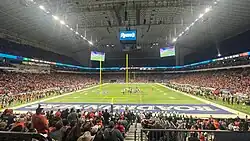 |
Venues that submitted bids but were rejected (2nd round)
During the 2018 U.S. Soccer Annual General Meeting, Sunil Gulati announced that the following cities were not selected for the final hosting bid.[33]
| City | Stadium | Capacity | Image |
|---|---|---|---|
| Charlotte, North Carolina[38] |
Bank of America Stadium | 75,525 | 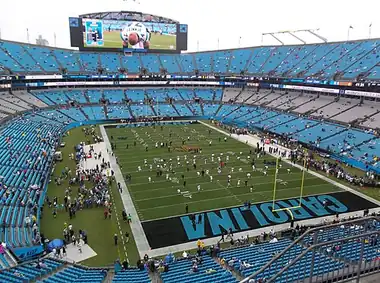 |
| Dallas, Texas[38] |
Cotton Bowl† | 92,100 |  |
| Detroit, Michigan[38] |
Ford Field‡ | 65,000 (expandable to 70,000) |
 |
| Las Vegas, Nevada[38] |
Allegiant Stadium‡ (Paradise, Nevada) |
72,000 |  |
| Los Angeles, California[38] |
Memorial Coliseum | 93,607 |  |
| Phoenix, Arizona[38] |
State Farm Stadium‡ (Glendale, Arizona) |
63,400 (expandable to 78,600) |
 |
| Salt Lake City, Utah[38] |
Rice–Eccles Stadium | 53,609 |  |
| Tampa, Florida[38] |
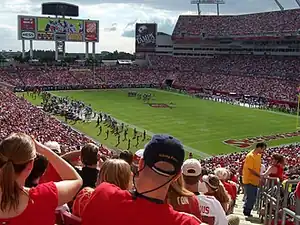
Raymond James Stadium | 65,890 (expandable to 75,000) |
 |
Venues that withdrew voluntarily
| City | Stadium | Capacity | Image |
|---|---|---|---|
| Chicago, Illinois[38] |
Soldier Field† | 61,500 |  |
| Minneapolis, Minnesota[38] |
U.S. Bank Stadium‡ | 66,655 (expandable to 73,000) |
 |
| Montreal, Quebec[39] |
Olympic Stadium‡ | 61,004 (Bid book: 55,822) (Expandable to 73,000) |
 |
| Washington, D.C.[38] |
Northwest Stadium (Landover, Maryland) |
62,000 |  |
Venues excluded from final list (June 2022)
| City | Stadium | Capacity | Image |
|---|---|---|---|
| Baltimore, Maryland[38] |
M&T Bank Stadium | 71,006 (Bid book: 70,976) |
 |
| Cincinnati, Ohio[38] |
Paycor Stadium | 65,515 (Bid book: 67,402) |
 |
| Denver, Colorado[38] |
Empower Field at Mile High | 76,125 (Bid book: 77,595) |
 |
| Edmonton, Alberta[38] |
Commonwealth Stadium | 56,302 (Bid book: 56,418) |
 |
| Los Angeles, California[38] |
Rose Bowl (Pasadena, California)† |
92,000 (Bid book: 88,432) |
 |
| Nashville, Tennessee[38] |
Nissan Stadium | 69,143 (Bid book: 69,722) (expandable to 75,000) |
 |
| Orlando, Florida[38] |
Camping World Stadium† | 60,219 (Bid book: 65,000) |
 |

 : Venue declined to participate
 : Venue withdrew voluntarily
 : Venue submitted bid but was rejected (1st round)
 : Venue submitted bid but was rejected (2nd round)
 : Venue cut after final decision (June 2022)
Venues selected to host matches
Canada
| City | Stadium | Capacity | Image |
|---|---|---|---|
| Vancouver, British Columbia[43] | BC Place‡ | 54,000 |  |
| Toronto, Ontario[38] | BMO Field | 30,000 (Expanding to 45,500 for tournament) |
 |

Mexico
| City | Stadium | Capacity | Image |
|---|---|---|---|
| Mexico City[38] | Estadio Azteca† | 87,523 | 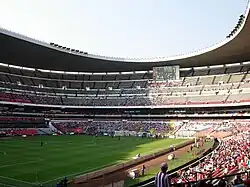 |
| Monterrey, Nuevo León[38] | Estadio BBVA | 53,500 (Bid book: 53,460) |
 |
| Guadalajara, Jalisco[38] | Estadio Akron | 46,232 (Bid book: 48,071) |
 |
Mexican cities hosting matches | |||

United States





Additional host venue information
Canada
| City | Venue | Year opened | Tenants | Major sporting events hosted |
|---|---|---|---|---|
| Toronto | BMO Field | 2007 (Expanded 2015) | Toronto FC (MLS) (2007–present) Toronto Nationals (MLL) (2009) Toronto Argonauts (CFL) (2016–present)[45] Toronto FC II (USL1) (2018) |
2007 FIFA U-20 World Cup venue 2014 FIFA U-20 Women's World Cup venue 2015 CONCACAF Gold Cup venue 2015 Pan American Games Rugby Sevens venue 104th Grey Cup venue MLS Cup 2010 venue MLS Cup 2016 venue MLS Cup 2017 venue 2018 CONCACAF Champions League Finals first leg venue |
| Vancouver | BC Place | 1983 (Renovated 2009, 2011) | BC Lions (CFL) (1983–present) Vancouver Whitecaps FC (MLS) (2011–present) Vancouver Whitecaps (NASL) (1983–1984) Vancouver Nighthawks (WBL) (1988) |
9-time Grey Cup venue 1990 Gay Games 2010 Winter Olympics host stadium 2015 FIFA Women's World Cup venue and final venue Annual Canada Sevens venue |
Mexico
| City | Venue | Year opened | Tenants | Major sporting events hosted |
|---|---|---|---|---|
| Guadalajara
(Zapopan) |
Estadio Akron | 2010 | Guadalajara (2010–present) | 2010 Copa Libertadores Finals venue 2011 FIFA U-17 World Cup venue 2011 Pan American Games host stadium |
| Mexico City | Estadio Azteca | 1966 (Renovated 1986, 1999, 2013 and 2016) | Mexico national football team (1966–present) América (1966–present) Necaxa (1966–1970, 1982–2003) Atlante (1966–1982, 1996–2001, 2004–2007) UNAM (1967–1969) Atlético Español (1970–1982) Cruz Azul (1971–1996, 2018–present) |
1970 FIFA World Cup venue and final venue (Capacity: 108,000) 1986 FIFA World Cup venue and final venue (Capacity: 114,600) 1968 Summer Olympics soccer venue 1975 Pan American Games venue 1983 FIFA World Youth Championship venue 1985 Mexico City Cup / Azteca 2000 venue 1993 CONCACAF Gold Cup venue 1999 FIFA Confederations Cup venue 2003 CONCACAF Gold Cup venue 2011 FIFA U-17 World Cup venue |
| Monterrey
(Guadalupe) |
Estadio BBVA Bancomer | 2015 | Monterrey (2015–present) | |
United States
General facilities
Support
Football confederations
FIFA members
 Afghanistan[49]
 Argentina[50]
 Bolivia[50]
 Brazil[51]
 Chile[51]
 Colombia[51]
 Costa Rica[52]
 Denmark[53]
 Ecuador[52]
 El Salvador[54]
 Finland[55]
 Germany[56]
 Grenada[57]
 Guyana[58]
 Honduras[59]
 Iraq[60]
 Jamaica[57]
 Liberia[61]
 Namibia[62]
 Nicaragua[59]
 Panama[59]
 Paraguay[59]
 Peru[59]
 Saudi Arabia[63]
 Uruguay[59]
 Venezuela[59]
 Zimbabwe[64]
Public opinion
On October 24, 2017, a survey of adults in Canada, Mexico, and the United States showed a broad support for Canada–United States–Mexico bid to host the 2026 FIFA World Cup. It found that 77% of North American residents were in favor of hosting the first-ever 48-team FIFA World Cup, and 81% of respondents across the three countries agreed that hosting the tournament would be good for their specific country. Also, nearly six in 10 (57 percent) of those surveyed said they would be interested in attending FIFA World Cup matches if the games were played near where they live or work.[65]
U.S. House of Representatives
On April 20, 2018, Representatives Darin LaHood and fellow co-chairs of the Congressional Soccer Caucus Kathy Castor (FL-14), Don Bacon (NE-02), Ruben Kihuen (NV-04) introduced a resolution to recognize and support the efforts of the United Bid Committee to host the 2026 FIFA World Cup in Canada, Mexico and the United States.[66] The U.S. House of Representatives adopted this resolution on April 25, 2018.[67]
Other government officials
Toronto city councilors Mark Grimes and Cesar Palacio supported the bid, as well as Mayor John Tory.[68] Montreal Mayor Valérie Plante also supported it.[69]
On March 13, 2018, Canadian Minister of Sport Kirsty Duncan announced in Ottawa that the Canadian federal government officially threw its support behind the North American bid for the 2026 World Cup, with the promise of up to $5 million in immediate help should the unified bid win.[70]
U.S. President Donald Trump,[71] Canadian Prime Minister Justin Trudeau,[72] and Mexican President Enrique Peña Nieto[73] all supported the bid for the World Cup. Trump designated Jared Kushner, at the time head of the Office of American Innovation and senior advisor to the president, as point man for the White House.[74]
Marketing
The bid was branded "United 2026", the logo of the bid is a ball with the number 26 representing the year "2026" with the colors of the flags of Canada, Mexico, and the United States and the slogans were: "United As One" (Spanish: "Unidos Como Uno", French: "Unis Comme Un"). and "Football For All" (Spanish: "Fútbol Para Todos", French: "Football Pour Tous").[75]
Opinions
On December 28, 2017, during a sports business conference in Dubai, United Arab Emirates, FIFA president Gianni Infantino considered the United bid to be a positive message.[76]
Controversies
U.S. President Donald Trump's executive orders regarding immigration from certain Muslim-majority countries implemented during his first term in 2017 was touted as a potential risk, with Infantino saying, "Any team, including the supporters and officials of that team, who qualify for a World Cup need to have access to the country, otherwise there is no World Cup."[77] In response, the Trump administration sent letters to FIFA that read, in part, that Trump was "confident" that "all eligible athletes, officials and fans from all countries around the world would be able to enter the United States without discrimination."[78] In 2018, Trump then warned the countries that intended to support the Morocco bid to host the 2026 World Cup, tweeting: "The US has put together a STRONG bid w/ Canada & Mexico for the 2026 World Cup. It would be a shame if countries that we always support were to lobby against the U.S. bid. Why should we be supporting these countries when they don't support us (including at the United Nations)?"[79] In January 2021, the travel ban was reversed by his successor Joe Biden.[80]
Both Trump administrations were met with a wave of concern from co-hosts Canada and Mexico, particularly about his messaging regarding tariffs on both countries as well as the sovereignty of Canada. In addition, restrictions on immigration and a reduced federal workforce created concerns that fans may not be able to get their visas in time for the event,[81][82] as the wait for a visa interview in some countries was roughly around a year on average, with one travel report from the U.S. Travel Association claiming the U.S. was not even prepared to host one.[83][84][85] In June 2025, the second Trump administration reinstated a travel ban affecting citizens from multiple countries, citing national security concerns.[86] The ban, which was later expanded in December, prohibited the issuance of new immigrant and non-immigrant visas for citizens of 39 affected countries, including those of teams that qualified for the World Cup: Haiti, Iran, Ivory Coast, and Senegal. The proclamation included an exemption for any athlete or member of an athletic team, including coaches, persons performing a necessary support role, and immediate relatives, traveling for the World Cup, Olympics, or other major sporting events as determined by the Secretary of State.[87][88]
This exemption ensured that national teams' players, coaches, and staff from those designated countries would be permitted to enter the United States for the competition, but the US State Department confirmed that ordinary citizens of the four countries were not covered by this exemption, making them ineligible for visa issuance to attend the matches. While fans were permitted to submit visa applications with the promise of priority if they provided proof of tickets, the department noted that issuance would be unlikely, barring rare "national interest" waivers. However, this restriction could be circumvented if a fan was a valid visa holder, a permanent resident, or a dual national who applied using a passport not subject to the ban. In such cases, applicants could still be eligible to enter or apply for entry, provided they satisfied all other immigration and security requirements.[89][90][91]
References
- ↑ Carlise, Jeff (April 10, 2017). "U.S., neighbors launch 2026 World Cup bid". Archived from the original on April 11, 2017.
- ↑ "World Cup 2026: Canada, US & Mexico joint bid wins right to host tournament". BBC Sport. June 13, 2018. Archived from the original on January 14, 2021. Retrieved June 13, 2018.
- ↑ Ben Rycroft (July 6, 2012). "Canadian Soccer Association to bid for 2026 World Cup". Canadian Broadcasting Corporation. Archived from the original on September 4, 2013. Retrieved February 9, 2013.
- ↑ Squizzatoa, Daniel (October 10, 2013). "The race is on: Canada continues to plan on bid for 2026 World Cup". mlssoccer.com. Archived from the original on December 16, 2013. Retrieved December 13, 2013.
- ↑ "Canada to bid for 2026 FIFA World Cup". Canadian Broadcasting Corporation. The Canadian Press. January 23, 2014. Archived from the original on January 25, 2014.
- ↑ "Mexico to bid for 2026 World Cup". ESPN. Press Association. September 21, 2012. Archived from the original on July 14, 2014. Retrieved February 9, 2013.
- ↑ "Report: Mexico would team up with USA to host 2026 World Cup tournament". Major League Soccer. October 9, 2013. Archived from the original on October 9, 2013.
- ↑ "Buscará México la sede del Mundial 2026" [Mexico seeks to host the 2026 World Cup] (in Spanish). Milenio. Archived from the original on December 15, 2014. Retrieved December 10, 2014.
- ↑ Chaudhary, Vivek (13 May 2016). "United States, Mexico in talks for joint 2026". ESPN FC. Archived from the original on 16 May 2016.
- ↑ Lewis, Brian (April 18, 2015). "Pelé: US deserves World Cup". New York Post. Archived from the original on April 20, 2015.
- ↑ "U.S., Canada, Mexico 2026 World Cup bid a possibility - CONCACAF chief". ESPN. December 28, 2016. Archived from the original on February 23, 2017.
- ↑ Carlise, Jeff (April 10, 2017). "U.S., Mexico and Canada officially launch bid to co-host 2026 World Cup". Archived from the original on April 11, 2017.
- ↑ "Scandal-plagued FIFA postpones 2026 World Cup bidding". ABC News. Archived from the original on June 11, 2015. Retrieved June 11, 2015.
- ↑ "FIFA Council agrees on four-phase bidding process for 2026 FIFA World Cup". FIFA. May 10, 2016. Archived from the original on May 10, 2016.
- ↑ Dixon Oppong (June 13, 2018). "World Cup 2026: US, Canada and Mexico to host tournament". USAHint.com. Archived from the original on June 13, 2018. Retrieved June 13, 2018.
- ↑ "CONCACAF to ask FIFA to fast-track U.S.-led 2026 World Cup bid -- sources". April 11, 2011. Archived from the original on May 23, 2017. Retrieved May 8, 2017.
- ↑ "FIFA Council set to back North American 2026 World Cup bid". Reuters. May 8, 2017. Archived from the original on June 12, 2018. Retrieved August 11, 2017.
- ↑ "FIFA Council prepares Congress, takes key decisions for the future of the FIFA World Cup". FIFA. May 9, 2017. Archived from the original on June 18, 2017.
- ↑ "FIFA Council keeps bidding window for 2026 World Cup open for further three months". Inside the Games. May 9, 2017. Archived from the original on August 11, 2017. Retrieved May 9, 2017.
- ↑ "Five Things to Know: Unified 2026 World Cup Bid". United States Soccer Federation. April 10, 2017. Archived from the original on April 18, 2017.
- ↑ "United Bid Committee for Canada, Mexico and United States Officially Formed for 2026 FIFA World Cup". US Soccer. July 6, 2018. Archived from the original on July 8, 2017. Retrieved July 6, 2017.
- ↑ "Kristick hired as United Bid Committee executive director for '26 World Cup". ESPN. Associated Press. July 6, 2017. Archived from the original on July 8, 2017. Retrieved July 6, 2017.
- ↑ Davidson, Neil (July 6, 2017). "CONCACAF finalizes committee ahead of 2026 World Cup bid". TSN. Archived from the original on July 6, 2017.
- ↑ "Canadá, México y Estados Unidos Formaron el Comité de la Candidatura Conjunta Para Competir por la Sede de la Copa Mundial de la FIFA 2026" (in Spanish). Mexican Football Federation. July 6, 2017. Archived from the original on September 2, 2011.
- ↑ "United Bid 2026". united2026.com. Archived from the original on June 12, 2018. Retrieved December 2, 2017.
- ↑ "Robert Kraft Named Honorary Chairman of the Board for United Bid Committee of Canada Mexico USA". united2026.com. Archived from the original on July 23, 2017. Retrieved July 19, 2017.
- 1 2 3 "North American 2026 World Cup bid makes leadership changes". ESPN. March 6, 2018. Archived from the original on March 8, 2018. Retrieved March 6, 2018.
- 1 2 3 "Our United Bid to Host the 2026 FIFA World Cup". United 2026 Newsletter. March 6, 2018. Archived from the original on March 9, 2018. Retrieved March 6, 2018.
- ↑ "D.C., Maryland Pitch Proposals to Be Hosts of 2026 World Cup". NBC Washington. November 20, 2018. Archived from the original on November 20, 2017. Retrieved November 20, 2017.
- ↑ "United Bid Committee Commences Outreach for Potential Host Cities in Bid for 2026 FIFA World Cup". US Soccer. Archived from the original on August 16, 2017. Retrieved August 15, 2017.
- ↑ "Forty-one Cities Across Canada, Mexico and the United States Submit Bids to Serve as Host Cities in United Bid for 2026 FIFA World Cup". Archived from the original on September 8, 2017. Retrieved September 7, 2017.
- ↑ Straus, Brian (October 4, 2017). "USA, Mexico, Canada 2026 World Cup Bid Trims Potential Host List to 32 Cities". SI. Archived from the original on August 26, 2025. Retrieved October 30, 2025.
- 1 2 US Soccer (February 10, 2018). 2018 U.S. Soccer Annual General Meeting: National Council Meeting. 54 minutes in. Archived from the original on December 21, 2019. Retrieved December 9, 2018 – via YouTube.
- ↑ "Emanuel pulls Chicago out of World Cup bid". Chicago Sun-Times. March 14, 2018. Archived from the original on March 22, 2018.
- ↑ Belz, Adam (March 16, 2018). "Minneapolis pulls out of running as host city for 2026 World Cup". Star Tribune. Archived from the original on February 12, 2026. Retrieved October 30, 2025.
- ↑ "B.C. at odds with WC bid committee". TSN. March 14, 2018. Archived from the original on March 15, 2018.
- ↑ "United States-led World Cup bid cuts list of potential host cities to 23". ESPN. March 15, 2018. Archived from the original on March 16, 2018. Retrieved March 15, 2018.
- 1 2 3 4 5 6 7 8 9 10 11 12 13 14 15 16 17 18 19 20 21 22 23 24 25 26 27 28 29 30 31 32 33 34 35 36 37 38 39 40 41 42 43 44 45 46 47 48 49 50 "United 2026 bid book" (PDF). united2026.com. Archived (PDF) from the original on September 15, 2021. Retrieved April 30, 2018.
- 1 2 "Montreal withdraws from host city selection process for 2026 World Cup". sportsnet.ca. July 6, 2021. Archived from the original on August 16, 2021. Retrieved July 6, 2021.
- ↑ "Vancouver replaces Montreal as 2026 WC site". ESPN. April 14, 2022. Archived from the original on June 16, 2026. Retrieved October 30, 2025.
- ↑ "FedEx Field in Maryland drops out as 2026 World Cup site". AP News. April 21, 2022. Archived from the original on June 16, 2026. Retrieved October 30, 2025.
- ↑ "2026 WC bid eyes 3-nation open, N.J. final". March 27, 2018. Archived from the original on March 28, 2018. Retrieved March 28, 2018.
- ↑ "Update on FIFA World Cup 2026 candidate host city process". April 14, 2022. Archived from the original on July 12, 2022. Retrieved April 14, 2022.
- 1 2 "Los Angeles 2026". Archived from the original on June 29, 2021. Retrieved April 19, 2022.
- ↑ "TSN". The Sports Network. Archived from the original on March 1, 2014. Retrieved September 20, 2013.
- ↑ Das, Andrew (April 18, 2017). "FIFA Confederation Agrees to Support U.S.-Led World Cup Bid". The New York Times.
- ↑ "CONCACAF hosts 2026 World Cup joint-bid press conference". CONCACAF. Archived from the original on February 5, 2018. Retrieved March 4, 2018.
- ↑ "CONMEBOL endorses North American joint bid to host 2026 World Cup". CONMEBOL. April 13, 2018. Archived from the original on April 14, 2018. Retrieved April 13, 2018.
- ↑ "MEDIA RELEASE". Afghanistan Football Federation. June 6, 2018. Archived from the original on December 6, 2018. Retrieved June 6, 2018.
- 1 2 "South American nations to vote for 2026 N America World Cup". Archived from the original on June 16, 2018. Retrieved April 14, 2018.
- 1 2 3 "CONMEBOL endorses North America WC bid". April 13, 2018. Archived from the original on April 14, 2018. Retrieved April 14, 2018.
- 1 2 "CONMEBOL releases statement backing 2026 North American World Cup bid". April 13, 2018. Archived from the original on April 14, 2018. Retrieved April 14, 2018.
- ↑ Jesper Møller [@jespermollerdbu] (June 13, 2018). "Danmarks stemme går til United Bid (USA, Canada, Mexico) som VM-vært 2026" (Tweet) (in Danish) – via Twitter.
- ↑ "CONMEBOL releases statement backing 2026 North American World Cup bid". April 13, 2018. Archived from the original on April 14, 2018. Retrieved April 14, 2018.
- ↑ "Suomi Kanadan, Meksikon ja Yhdysvaltojen MM2026-hankkeen takana" (in Finnish). Suomen Palloliitto. June 12, 2018.
- ↑ "World Cup 2026: DFB Support USA, Canada and Mexico Bid". DFB - Deutscher Fußball-Bund E.V. Retrieved June 12, 2018.
- 1 2 @united2026 (May 10, 2018). "Deep appreciation for the support shown by Jamaica and Grenada Football Associations for a North American FIFA World Cup in 2026. #Opportunity2026 will extend to all nations as we promote #FootballForAll across the world. #Unity2026 #Certainty2026" (Tweet). Retrieved May 10, 2018 – via Twitter.
- ↑ "Guyana backs joint North American bid for 2026 FIFA World Cup". Guyana Chronicle. June 7, 2018.
- 1 2 3 4 5 6 7 "North America 2026 World Cup bid receives CONMEBOL endorsement - Goal.com". Archived from the original on April 14, 2018. Retrieved April 14, 2018.
- ↑ IQ-PRO [@IraqiProPlayers] (June 12, 2018). "#Iraq to vote for @united2026" (Tweet) – via Twitter.
- ↑ "Liberia to vote against Morocco's 2026 World Cup bid". BBC Sport. May 24, 2018. Archived from the original on May 25, 2018. Retrieved May 24, 2018.
- ↑ "Namibia Shuns Morocco's 2026 World Cup Bid ... Over Western Sahara Issue". New Era. June 5, 2018.
- ↑ "Saudi Arabia to support US bid to host 2026 FIFA World Cup". ArabianBusiness.com. June 6, 2018.
- ↑ "Zim Settle for Americans in 2026 World Cup Battle . . . Blow for Morocco as ZIFA sing in the United States corner". The Herald. June 6, 2018. Archived from the original on September 19, 2018. Retrieved June 6, 2018.
- ↑ "New North American Survey Shows Broad Support for United Bid to Host 2026 FIFA World Cup". US Soccer. October 24, 2017. Archived from the original on October 28, 2017. Retrieved October 27, 2017.
- ↑ H.Con.Res. 111 (Recognizing and supporting the efforts of the United Bid Committee to bring the 2026 Fédération Internationale de Football Association [FIFA] World Cup competition to Canada, Mexico, and the United States)
- ↑ "LaHood World Cup Resolution Overwhelmingly Passes House". Darin LaHood. April 25, 2018.
- ↑ Grimes, Councillor [@Mark_Grimes] (February 1, 2018). "Toronto's joint @united2026 bid just passed in City Council 29-1 ! Thanks to my Task Force co-chairs Councillor Palacio & Mayor @JohnTory for their hard work in helping bring this forward ! #TOpolipic.twitter.com/Dwske92kaM" (Tweet). Retrieved March 4, 2018 – via Twitter.
- ↑ Plante [@Val_Plante] (March 17, 2018). "Un réel plaisir de rencontrer @JoeySaputo tout juste avant le match! @impactmontreal #polmtl" [A real pleasure to meet @JoeySaputo just before the match! @impactmontreal #polmtl] (Tweet). Retrieved March 22, 2018 – via Twitter.
- ↑ "Canadian government backs FIFA 2026 World Cup bid". Canadian Broadcasting Corporation. March 13, 2018. Archived from the original on March 14, 2018. Retrieved March 14, 2018.
- ↑ "Donald Trump 'fully supports' a World Cup with Mexico and Canada". The Independent. April 11, 2017. Archived from the original on March 27, 2018. Retrieved March 22, 2018.
- ↑ Trudeau, Justin [@JustinTrudeau] (April 27, 2018). "Canada is fully behind the North American bid for the 2026 FIFA World Cup – and we're ready to welcome the world for an amazing tournament. Great to be partnered with @EPN and @RealDonaldTrump for this one" (Tweet) – via Twitter.
- ↑ "Enrique Pena Nieto President of Mexico Welcomes FIFA Trophy". Getty Images. Archived from the original on April 29, 2018. Retrieved April 29, 2018.
- ↑ Adam Crafton (November 4, 2024). "Donald Trump, Jared Kushner and the race to host the 2026 World Cup". New York Times. Retrieved June 16, 2026.
Jared Kushner, Trump's son-in-law, became the key contact in the White House for the United bid and, even as recently as this year, he remained key in securing the World Cup final for MetLife Stadium in New Jersey [...] Kushner, the husband of Trump's daughter Ivanka and a senior advisor to the president. Kushner ran a White House department named the Office of American Innovation and this was the connecting point for the bid
- ↑ "Gathering in Houston - United, as One". united2026.com. November 17, 2017. Archived from the original on February 28, 2018. Retrieved January 21, 2018.
- ↑ "USA, Mexico, Canada World Cup bid is "positive message": Infantino". Yahoo Sports. December 28, 2017. Archived from the original on March 31, 2019. Retrieved December 28, 2017.
- ↑ Hill, Tim (March 9, 2017). "Trump travel ban could prevent United States hosting World Cup". The Guardian. Archived from the original on November 14, 2021. Retrieved June 2, 2018.
- ↑ Das, Andrew (June 12, 2018). "How 3 Letters From Trump Might Help Bring the 2026 World Cup to the U.S." The New York Times. Archived from the original on October 2, 2025. Retrieved September 28, 2020.
- ↑ "Donald Trump issues warning to other countries over voting against US 2026 World Cup bid". The Independent. April 27, 2018. Archived from the original on December 4, 2025. Retrieved March 28, 2020.
- ↑ Lanard, Noah (January 20, 2021). "Biden Just Ended Trump's Muslim Ban". Archived from the original on May 14, 2026. Retrieved January 20, 2021.
- ↑ "Tariffs will add excitement to 2026 World Cup, Trump says". Politico. March 8, 2025. Retrieved March 27, 2025.
- ↑ "FIFA World Cup 2026: Donald Trump says co-host tensions will make tournament 'more exciting'". BBC Sport. March 8, 2025. Archived from the original on March 27, 2025. Retrieved March 27, 2025.
- ↑ Timms, Aaron (March 5, 2025). "The 2026 Trade War World Cup captures our new nativist world order". The Guardian.
- ↑ "Doubts raised over US travel system during 2026 World Cup and 2028 Olympics". The Guardian. February 19, 2025. ISSN 0261-3077. Retrieved March 27, 2025.
- ↑ Surendran, Shwetha (February 19, 2025). "U.S. travel system 'not ready' for WC, Olympics". ESPN. Archived from the original on March 27, 2025. Retrieved March 27, 2025.
- ↑ Abnos, Alexander (June 5, 2025). "Trump travel ban includes exemption for World Cup and Olympic athletes". The Guardian. Archived from the original on June 5, 2025. Retrieved June 5, 2025.
- ↑ Abnos, Alexander (December 17, 2025). "World Cup countries Senegal and Côte d'Ivoire among additions to Trump travel ban". The Guardian. Retrieved December 17, 2025.
- ↑ "Fact Sheet: President Donald J. Trump Further Restricts and Limits the Entry of Foreign Nationals to Protect the Security of the United States". The White House. December 16, 2025. Archived from the original on December 17, 2025. Retrieved December 18, 2025.
- ↑ Crafton, Adam (November 20, 2025). "U.S. Government's travel bans mean many Haitian fans will not be able to go to World Cup". The New York Times. ISSN 0362-4331. Archived from the original on November 19, 2025. Retrieved November 25, 2025.
- ↑ "Travel Ban and its impact for the nationals of Cuba, Haiti and Venezuela. What you need to know". WOLA. Archived from the original on September 20, 2025. Retrieved November 25, 2025.
- ↑ Miceli, Cristina (November 20, 2025). "U.S. Travel Ban Could Block Thousands Of Fans From The 2026 FIFA World Cup". The Travel. Archived from the original on November 26, 2025. Retrieved November 25, 2025.
External links
- 2026 FIFA World Cup bids
- Canada at the FIFA World Cup
- Mexico at the FIFA World Cup
- United States at the FIFA World Cup
- Canada at the 2026 FIFA World Cup
- Mexico at the 2026 FIFA World Cup
- United States at the 2026 FIFA World Cup
- Canada–Mexico–United States relations
- Canada–United States sports relations
- Mexico–United States sports relations
- Canadian Soccer Association
- United States Soccer Federation