Triangular orthobicupola
| Triangular orthobicupola | |
|---|---|
 | |
| Type | Johnson J26 – J27 – J28 |
| Faces | 8 triangles 6 squares |
| Edges | 24 |
| Vertices | 12 |
| Vertex configuration | 6(32.42) 6(3.4.3.4) |
| Symmetry group | D3h |
| Dihedral angle (degrees) | triangle-to-triangle:141.1° triangle-to-square:125.3° square-to-square:109.5° |
| Dual polyhedron | trapezo-rhombic dodecahedron |
| Properties | convex, composite |
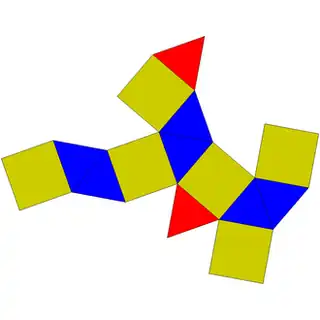
| Net | |
 | |
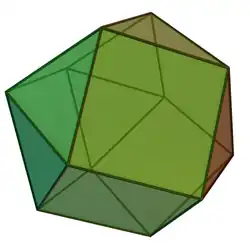
In geometry, the triangular orthobicupola is the 27th Johnson solid. As the name suggests, it can be constructed by attaching two triangular cupolae along their bases. It has an equal number of squares and triangles at each vertex; however, it is not vertex-transitive. It is also called the anticuboctahedron, twisted cuboctahedron,[1] or disheptahedron.[2][3] In chemistry, the triangular orthobicupola can be found in the coordination structure of crystals with hexagonal closed-packed spheres. The dual polyhedron of the triangular orthobicupola is the trapezo-rhombic dodecahedron. It is a plesiohedron, a space-filling polyhedron defined by Voronoi diagram.
Construction and naming
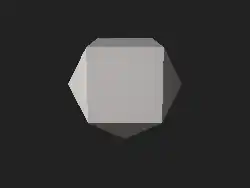
The triangular orthobicupola is constructed by attaching two triangular cupolae at their bases. This construction also applies to the cuboctahedron, which could also be called the triangular gyrobicupola; the difference is that the two triangular cupolas that make up the triangular orthobicupola are joined so that the triangular bases have the same orientation (hence, "ortho"); the cuboctahedron is joined so that the triangular bases have opposite orientations. Given a triangular orthobicupola, a 60° rotation of one cupola before the joining yields a cuboctahedron.[4] Hence, another name for the triangular orthobicupola is the anticuboctahedron.[5]
The triangular orthobicupola is a convex polyhedron with regular polygonal faces (eight equilateral triangles and six squares) and is therefore a Johnson solid, named after American mathematician Norman W. Johnson, who enumerated the 92 such polyhedra (excluding the uniform polyhedra). It is enumerated as the twenty-seventh Johnson solid, .[6][7] It is a composite polyhedron, because it can be sliced into two triangular cupolae.[8]

Properties
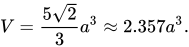
The surface area and the volume of a triangular orthobicupola are the same as those of a cuboctahedron. The surface is the sum of all of its polygonal faces: six squares and eight equilateral triangles. For edge length , the areas of these of polygons are given by and , respectively. Therefore,[6] Its volume is twice the volume of a triangular cupola:[6]



A triangular orthobicupola has the same symmetry as a triangular prism, the dihedral group of order six, which contains one three-fold axis and three two-fold axes.[1]

A triangular orthobicupola has three different dihedral angles (angles between two polygonal faces):[9]
- An angle between two adjacent triangles is around 141°. This is obtained by adding the two triangular cupolae's triangle-to-hexagon angles.
- An angle between two adjacent squares is around 109.4°. This is obtained by adding the two triangular cupolae's square-to-hexagon angles.
- A square-to-triangle angle is the same angle as in the triangular cupola, around 125.3°.
Sphere packing
The packing of congruent spheres can be arranged densely into a triangular orthobicupola.[2] The twelve vertices represent the spheres, or ligancy. Such an arrangement is called the hexagonal close-packing, and is found in crystal coordination.[3] Magnesium and helium are chemical elements with such a structure.[2]
Dual polyhedron

The dual polyhedron of a triangular orthobicupola is the trapezo-rhombic dodecahedron[5] or trapezoidal dodecahedron,[10] a twelve-faced solid whose faces are six rhombi and six trapezoids. It is obtained by cutting a rhombic dodecahedron in half through the hexagonal cross-section and rotating the halves 60° with respect to each other.[11] It is a plesiohedron, a special kind of polyhedron that can tile a space with its copy, defined as the Voronoi cell of a symmetric Delone set, generated by the hexagonal close-packing.[10][1]
References
- 1 2 3 Pearce, Peter (1978). Structure in Nature Is a Strategy for Design. MIT Press. p. 48. ISBN 978-0-262-66045-7.
- 1 2 3 Borchardt-Ott, Walter (1993). Crystallography. Springer. p. 214.
- 1 2 "Crystal co-ordination of the barium ion". Proceedings of the Indian Academy of Sciences - Section A. 60: 317–351. November 1964. doi:10.1007/BF03047061.
- ↑ Ogievetsky, O.; Shlosman, S. (2021). "Platonic compounds and cylinders". In Novikov, S.; Krichever, I.; Ogievetsky, O.; Shlosman, S. (eds.). Integrability, Quantization, and Geometry: II. Quantum Theories and Algebraic Geometry. American Mathematical Society. p. 477. ISBN 978-1-4704-5592-7.
- 1 2 Becker, David A. (2012). "A Peculiarly Cerebroid Convex Zygo-Dodecahedron is an Axiomatically Balanced "House of Blues": The Circle of Fifths to the Circle of Willis to Cadherin Cadenzas". Symmetry. 4 (4): 644–666. Bibcode:2012Symm....4..644B. doi:10.3390/sym4040644.
- 1 2 3 Berman, M. (1971). "Regular-faced convex polyhedra". Journal of the Franklin Institute. 291 (5): 329–352. doi:10.1016/0016-0032(71)90071-8. MR 0290245.
- ↑ Francis, D. (2013). "Johnson solids & their acronyms". Word Ways. 46 (3): 177.
- ↑ Timofeenko, A. V. (2009). "Convex Polyhedra with Parquet Faces" (PDF). Doklady Mathematics. 80 (2): 720–723. doi:10.1134/S1064562409050238.
- ↑ Johnson, Norman W. (1966). "Convex polyhedra with regular faces". Canadian Journal of Mathematics. 18: 169–200. doi:10.4153/cjm-1966-021-8. MR 0185507. S2CID 122006114. Zbl 0132.14603.
- 1 2 Lagarias, Jeffrey C. (2011). "The Kepler conjecture and its proof". The Kepler Conjecture: The Hales–Ferguson proof. Springer, New York. pp. 3–26. doi:10.1007/978-1-4614-1129-1_1. ISBN 978-1-4614-1128-4. MR 3050907.; see especially p. 11
- ↑ Williams, Robert (1979). The Geometrical Foundation of Natural Structure: A Source Book of Design. Dover Publications, Inc. p. 170.