Trapezo-rhombic dodecahedron
| Trapezo-rhombic dodecahedron | |
|---|---|
 | |
| Type | Plesiohedron |
| Faces | 6 rhombi 6 trapezoids |
| Edges | 24 |
| Vertices | 14 |
| Vertex configuration | (2) 4.4.4 (6) 4.4.4.4 (6) 4.4.4 |
| Symmetry group | D3h, [3,2], (*322), order 12 |
| Rotation group | D3, [3,2]+, (322), order 6 |
| Dual polyhedron | Triangular orthobicupola |
| Properties | convex |
| Net | |
 | |

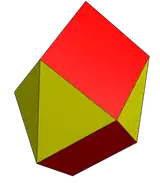
In geometry, the trapezo-rhombic dodecahedron or rhombo-trapezoidal dodecahedron is a convex dodecahedron with 6 rhombic and 6 trapezoidal faces. It has D3h symmetry. A concave form can be constructed with an identical net, seen as excavating trigonal trapezohedra from the top and bottom. It is also called the trapezoidal dodecahedron.[1]
Description
The trapezo-rhombic dodecahedron is a polyhedron with six trapezoidal and six rhombic faces. This polyhedron can be obtained from a rhombic dodecahedron by cutting it in half through the hexagonal cross-section and rotating the halves 60° with respect to each other.[2] It is the dual polyhedron of a triangular orthobicupola, a Johnson solid whose faces are squares and equilateral triangles.[3]
The trapezo-rhombic dodecahedron is a plesiohedron, a special kind of polyhedron that can tile a space with its copy, representing the three-dimensional Voronoi cell of a sphere in a hexagonal close packing; this and the face-centered cubic packing are the densest ways to pack spheres.[1][4] It is therefore related to the rhombic dodecahedron, as suggested from the construction, which is a Voronoi cell of the other optimal way to pack spheres. The two shapes differ in their combinatorial structure as well as in their geometry: in the rhombic dodecahedron, every edge connects a degree-three vertex to a degree-four vertex, whereas the trapezo-rhombic dodecahedron has six edges that connect vertices of equal degrees.[5]

A trapezo-rhombic dodecahedron has two different edges lengths, and . Its surface area and volume are given by[6]



Variations
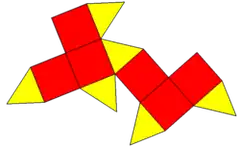
The trapezo-rhombic dodecahedron can be seen as an elongation of another dodecahedron, which can be called a rhombo-triangular dodecahedron, with 6 rhombi (or squares) and 6 triangles. It also has D3h symmetry and is space-filling. It has 21 edges and 11 vertices. With square faces, it can be seen as a cube split across the 3-fold axis, separated with the two halves rotated 180°, and filling the gaps with triangles. When used as a space-filler, connecting dodecahedra on their triangles leaves two cubical step surfaces on the top and bottom, which can connect with complementary steps.
 |
 |
 |
See also
References
- 1 2 Lagarias, Jeffrey C. (2011). "The Kepler conjecture and its proof". The Kepler Conjecture: The Hales–Ferguson proof. Springer, New York. pp. 3–26. doi:10.1007/978-1-4614-1129-1_1. ISBN 978-1-4614-1128-4. MR 3050907.; see especially p. 11
- ↑ Williams, Robert (1979). The Geometrical Foundation of Natural Structure: A Source Book of Design. Dover Publications, Inc. p. 170.
- ↑ Becker, David A. (2012). "A Peculiarly Cerebroid Convex Zygo-Dodecahedron is an Axiomatically Balanced "House of Blues": The Circle of Fifths to the Circle of Willis to Cadherin Cadenzas". Symmetry. 4 (4): 644–666. Bibcode:2012Symm....4..644B. doi:10.3390/sym4040644.
- ↑ Pearce, Peter (1978). Structure in Nature Is a Strategy for Design. MIT Press. p. 48. ISBN 978-0-262-66045-7.
- ↑ Ball, Walter William Rouse; Coxeter, Harold Scott Macdonald (1987). Mathematical Recreations and Essays. Dover Publications. p. 151.
- ↑ Kitazono, Koichi; Akimoto, Ryoga; Iguchi, Masaya (2023). "Design and Applications of Additively Manufactured Porous Aluminum Alloys". Materials Transactions. 64 (2): 334–340. doi:10.2320/matertrans.MT-LA2022051.