Timeline of extinctions in the 20th century

This timeline of extinctions is a chronological list of biological species, subspecies, and other evolutionary significant units recorded to have disappeared during the course of the 20th century.
Following the parent timeline of extinctions in the Holocene, the entries included range from 1900 to 1999, even though the 20th century is properly established to have lasted from 1 January 1901 to 31 December 2000. For extinctions in 2000, see timeline of extinctions in the Holocene#21st century.
The list is incomplete by necessity, since the majority of extinctions are thought to be undocumented, and for many others there isn't a definitive, widely accepted last, or most recent record. According to the species-area theory, the present rate of extinction may be up to 140,000 species per year.[1]
Timeline
1900s
| Last record | Common name | Binomial name | Former range | Declared extinct | Causes | Picture |
|---|---|---|---|---|---|---|
| c. 1900 | Caucasian moose | Alces alces caucasicus | Northern Caucasus and Transcaucasian shore of the Black Sea[2] | Hunting. The subspecies' validity is questioned because moose from Russia recolonized the Caucasian moose's former range naturally over the 20th century.[3] | 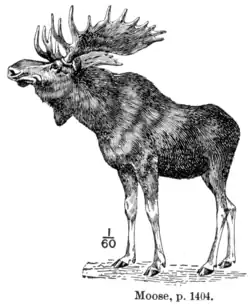 | |
| Saint Croix racer | Borikenophis sanctaecrucis | Saint Croix, United States Virgin Islands | Undetermined.[4] | |||
| Gravenche | Coregonus hiemalis | Lake Geneva, Swiss-French border | 2008 (IUCN) | Eutrophication and overfishing.[5] |  | |
| Northeastern black rhinoceros | Diceros bicornis brucii | Horn of Africa to eastern Sudan and Bahr el Ghazal | Hunting and habitat loss.[6] |  | ||
| Genophantis leahi | Maui, Oahu, Molokai and Hawaii (island), Hawaii, United States | 1994 (IUCN) | Undetermined.[7] | |||
| c. 1900-1950 | Lord Howe long-eared bat | Nyctophilus howensis | Lord Howe Island, Australia | 2020 (IUCN) | Possibly predation by introduced owls and rats.[8] | |
| 1900 | ||||||
| Light-loving noctuid moth | Agrotis photophila | Oahu, Hawaii, United States | 1986 (IUCN) | Undetermined.[9] | ||
| Koʻolau spurwing long-legged fly[10] | Campsicnemus mirabilis | Mount Tantalus, Hawaii, United States | 1986 (IUCN) | Predation by the introduced ant Pheidole megacephala.[11] |  | |
| Coloceras hemiphagae | Norfolk Island, Australia | Extinction of their host, the Norfolk pigeon.[12] | ||||
| Coloceras restinctus | ||||||
| Leafshell | Epioblasma flexuosa | Tennessee, Cumberland, and Ohio River systems, United States | 1983 (IUCN) | Undetermined.[13] |  | |
| Eugenia scheffleri | Usambara Mountains, Tanzania | Possibly deforestation for agriculture.[14] | ||||
| Norfolk pigeon | Hemiphaga novaeseelandiae spadicea | Norfolk Island, Australia | Hunting.[15] |  | ||
| Oʻahu ʻākepa | Loxops wolstenholmei | Oahu mountains, Hawaii, United States | Probably habitat destruction, introduced predators and avian diseases.[16] |  | ||
| 1900-1905 | Oahu treesnails | Achatinella buddii | Koolau Mountains and Niu Valley, Hawaii, United States[17] | 1990 (IUCN) | Undetermined.[18][19][20] |  |
| Achatinella caesia | Palolo, Hawaii, United States[21] | |||||
| Achatinella decora | Koolau Mountains, Hawaii[22] |  | ||||
| Kona giant looper moth | Scotorythra megalophylla | Hawaii, United States | 1996 (IUCN) | Undetermined.[23][24] |  | |
| Koʻolau giant looper moth | Scotorythra nesiotes | |||||
| 1900–1909 | Oahu treesnail | Achatinella thaanumi | Waiʻanae, Hawaii, United States[25] | 1990 (IUCN) | Undetermined.[26] | |
| Skadar nase | Chondrostoma scodrense | Lake Skadar, Albania-Montenegro border | Undetermined.[27] | |||
| Leucocharis loyaltiensis | New Caledonia | 1994 (IUCN) | Undetermined.[28][29] | |||
| Leucocharis porphyrocheila |  | |||||
| 1901 | Car Nicobar sparrowhawk[A] | Accipiter butleri butleri | Car Nicobar, Nicobar Islands, India | 1995 | Habitat destruction.[16] | |
| Pig-footed bandicoot[B] | Chaeropus ecaudatus or C. yirratji[30] | Interior Australia | 1982 (IUCN) | Predation by feral cats and red foxes.[31] |  | |
| Delonix tomentosa | Ankara plateau, western Madagascar | Habitat fragmentation and slash and burn agriculture.[32] | ||||
| Tennessee riffleshell | Epioblasma propinqua | Tennessee, Cumberland, Wabash, and Ohio River systems, United States | 1983 (IUCN) | Undetermined.[33] |  | |
| Eulophia grandidieri | Mahatsara, Toamasina, Madagascar | Undetermined.[34] | ||||
| Esperance dog weed | Opercularia acolytantha | North of Esperance, Western Australia | Undetermined.[35] | |||
| Greater ʻamakihi | Viridonia sagittirostris | Wailuku river, Hawaiʻi Island, United States | 1988 (IUCN) | Habitat destruction for sugarcane agriculture.[36] |  | |
| 1901-1902 | Long-tailed hopping mouse | Notomys longicaudatus | Northwestern New South Wales, Australia | 2016 (IUCN) | Predation by cats, foxes, hawks, and owls.[37][38] |  |
| 1902 | Pied raven | Corvus corax varius morpha leucophaeus | Faroe Islands, Denmark | Hunting.[39] |  | |
| Hunteria hexaloba | Libreville, Gabon | Habitat destruction.[40] | ||||
| Rocky Mountain locust | Melanoplus spretus | Rocky Mountains and North American Prairie | 2014 (IUCN)[41] | Breeding habitat loss due to irrigation and cattle ranching. |  | |
| Auckland merganser | Mergus australis | South, Stewart, and Auckland Island, New Zealand | 1910 1988 (IUCN) |
Hunting and predation by introduced animals.[42] |  | |
| Oeceoclades seychellarum | Cascade Estate, Mahé, Seychelles | 1997 (IUCN) | Habitat degradation caused by human settlement and invasive plants.[43] | |||
| North Island piopio[C] | Turnagra tanagra | North Island, New Zealand | 1988 (IUCN) | Possibly habitat destruction, hunting, and predation by introduced cats and rats.[44] |  | |
| 1903 | Agelanthus rondensis | Eastern Rondo Plateau, Tanzania | Undetermined.[45] | |||
| Guadalupe caracara | Caracara lutosa | Guadalupe Island, Mexico | 1988 (IUCN) | Extermination campaign.[46] |  | |
| Cynorkis rolfei | Vatomandry, Toamasina, Madagascar | Undetermined.[47] | ||||
| Stumptooth minnow | Stypodon signifer | Southern Coahuila, Mexico | 1983 (IUCN) | Habitat degradation and pollution.[48] | ||
| 1903–1906 | Maiden's bush-pea | Pultenaea maidenii | South-western side of the Victoria Range in the Grampians, Victoria, Australia | 2000[49] | Undetermined.[50][51] | |
| 1904 | Madeiran wood pigeon | Columba palumbus maderensis | Madeira, Portugal | 1924 | Undetermined.[16] |  |
| Choiseul pigeon | Microgoura meeki | Choiseul, Solomon Islands | 1994 (IUCN) | Predation by feral dogs and cats.[52] |  | |
| Ixodes nitens | Christmas Island, Australia | Extinction of its host, the Maclear's rat.[53] | ||||
| Maclear's rat | Rattus macleari | 2016 (IUCN) | Possibly disease spread by introduced black rats.[54] | 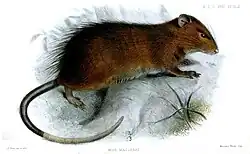 | ||
| Neuchâtel charr | Salvelinus neocomensis | Lake Neuchâtel, Switzerland | 2008 (IUCN) | Eutrophication caused by pollution and agriculture.[55] | ||
| Xenopsylla nesiotes | Christmas Island, Australia | Extinction of its host, the Maclear's rat.[53] | ||||
| 1905 | Japanese wolf[D][57][58] | Canis lupus hodophilax | Honshū, Shikoku and Kyūshū, Japan | Hunting and a rabies-like epidemic.[59] |  | |
| Gibbus lyonetianus | Mauritius | 1994 (IUCN) | Undetermined.[60] | |||
| South Island piopio[E] | Turnagra capensis capensis | South Island, New Zealand | 1988 (IUCN) | Possibly habitat destruction and predation by introduced rats.[61] |  | |
| 1906 | Chatham bellbird | Anthornis melanocephala | Chatham Islands, New Zealand | 1938 1988 (IUCN) |
Possibly habitat destruction, predation by rats and cats, and overhunting by collectionists.[62] |  |
| Guadalupe flicker | Colaptes auratus rufipileus | Guadalupe Island, Mexico | 1922 | Habitat destruction and predation by introduced goats and cats.[16] |  | |
| Cebu blackish cuckooshrike[F] | Coracina coerulescens altera | Cebu, Philippines | Deforestation.[16] |  | ||
| Cebu bar-bellied cuckooshrike[G] | Coracina striata cebuensis | |||||
| Cebu dark-throated oriole | Oriolus steerii assimilis |  | ||||
| South-western barred bandicoot | Perameles myosuros | Southern Western Australia, Australia | 2022 (IUCN) | Predation by introduced cats and foxes.[63] |  | |
| 1907 | Argocoffeopsis lemblinii | Agnieby Valley, Ivory Coast | Undetermined.[64][65] | |||
| Black mamo | Drepanis funerea | Molokai and Maui, Hawaii, United States | 1988 (IUCN) | Habitat destruction by introduced cattle and deer, and predation by introduced rats and mongooses.[66] |  | |
| Huia[H] | Heteralocha acutirostris | North Island, New Zealand | Hunting and deforestation of old growth forests to make pastures for livestock.[68] |  | ||
| Poecilobothrus majesticus | Walton-on-the-Naze, Essex, England | 2022 (IUCN) | Undetermined.[69] | |||
| Huia louse | Rallicola extinctus | North Island, New Zealand | 1990 | Extinction of its host.[70] |  | |
| 1908 | Assumption rail | Dryolimnas cuvieri abbotti | Assumption Island, Seychelles | 1937 | Hunting, habitat destruction, and predation by introduced rats.[16] |  |
| Siquijor hanging parrot | Loriculus philippensis siquijorensis | Siquijor, Philippines | Possibly deforestation and capture for the pet trade.[16] | |||
| Persoonia laxa | Sydney's Northern Beaches, Australia | 2020 (IUCN) | Probably habitat destruction.[71] | |||
| Dawson's caribou | Rangifer tarandus dawsoni | Graham Island, British Columbia, Canada | 2016 (IUCN) | Hunting, habitat loss via clearcutting, and competition with black-tailed deer.[72] mtDNA studies suggest it is not different enough to warrant separate subspecies status.[73] |  | |
| Rhynchosia ledermannii | Bamenda Highlands, Babju, Cameroon | Deforestation caused by agriculture and firewood collection.[74] | ||||
| Alejandro Selkirk firecrown | Sephanoides fernandensis leyboldi | Alejandro Selkirk Island?, Juan Fernández Archipelago, Chile | Probably deforestation, predation and erosion caused by introduced cats, rats, goats, and rabbits, and competition of introduced plants with the nesting tree Luma apiculata.[16][75] |  | ||
| Sloane's urania[76] | Urania sloanus | Jamaica | 1908 | Habitat loss and natural disasters.[77] |  | |
| Robust white-eye | Zosterops strenuus | Lord Howe Island, Australia | 1928 1988 (IUCN)[78] |
 | ||
| 1909 | Cumberland leafshell | Epioblasma stewardsonii | Tennessee and Coosa River systems, United States | 1983 (IUCN) | Undetermined.[79] |  |
| Bogotá sunangel | Heliantelus zusii | Northern Andes? | Possibly deforestation.[16] |
1910s
| Last record | Common name | Binomial name | Former range | Declared extinct | Causes | Picture |
|---|---|---|---|---|---|---|
| c. 1910 | Oʻahu deceptor bush cricket | Leptogryllus deceptor | Oahu, Hawaii, United States[80][81] | Undetermined.[82] | ||
| Yellowfin cutthroat trout | Oncorhynchus clarki macdonaldi | Twin Lakes, Colorado, United States | Hybridization with rainbow trout and competition with lake trout, both introduced.[48] |  | ||
| 1910 | Southwestern thick-billed grasswren | Amytornis textilis macrourus | Southwest Australia | Drought and overgrazing by livestock and introduced mammals.[16] |  | |
| Roper River scrub robin | Drymodes superciliaris colcloughi | Northern Territory, Australia | Undetermined.[83] | |||
| Slender-billed grackle | Quiscalus palustris | Lerma River and Xochimilco, Mexico | 1986 (IUCN) | Draining of marshlands.[84] |  | |
| after 1910 | Maui hau kuahiwi[85] | Hibiscadelphus wilderianus | Maui, Hawaii, United States | 1978 (IUCN) | Undetermined.[86] |  |
| 1911 | Laysan noctuid moth | Agrotis laysanensis | Laysan, Hawaii, United States | Undetermined.[87] |  | |
| Iwo Jima rail[I] | Amaurornis cinerea brevipes | Naka Iwo Jima and Minami Iwo Jima, Bonin Islands, Japan | Habitat clearance for agriculture and predation by introduced cats and rats.[16] | |||
| Minute noctuid moth | Helicoverpa minuta | Hawaii, United States | 1986 (IUCN) | Undetermined.[88] | ||
| Shing-keng | Hopea shingkeng | Arbor Hills, Arunachal Pradesh, India[J] | 1998 (IUCN) | Possibly deforestation.[89] |  | |
| Laysan dropseed noctuid moth | Hypena laysanensis | Laysan, Hawaii, United States | 1986 (IUCN) | Undetermined.[90] | ||
| Rhyncogonus bryani | Laysan, Hawaii, United States | 1994 (IUCN) | Habitat destruction caused by introduced rabbits grazing.[91] | |||
| New Caledonian buttonquail | Turnix novaecaledoniae | New Caledonia | Hunting, habitat degradation and predation by introduced animals.[92] | |||
| 1912 | Maui agrotis noctuid moth | Agrotis cremata | Oahu and Maui, Hawaii, United States | Undetermined.[93][94] | ||
| Procellaris agrotis noctuid moth | Agrotis procellaris | Laysan, Hawaii, United States | ||||
| Namoi Valley thick-billed grasswren | Amytornis textilis inexpectatus | Central New South Wales, Australia | Undetermined.[16] | | ||
| Waiautoa forget-me-not | Myosotis laingii | South Marlborough, New Zealand | Undetermined.[95] |  | ||
| Guadalupe storm petrel | Oceanodroma macrodactyla | Guadalupe Island, Mexico | Predation by feral cats, and habitat degradation by goat grazing.[96] |  | ||
| Bornean Baillon's crake | Porzana pusilla mira | Borneo | Deforestation?[16] | |||
| Orkney charr | Salvelinus inframundus | Heldale Water and possibly Hoglinns Water, Hoy, Orkney | 2024 (IUCN) | Possibly habitat degradation due to construction, predation or competition with introduced brown trout.[97] | ||
| 1913 | Laysan millerbird | Acrocephalus familiaris familiaris | Laysan, Hawaii, United States | 1923 | Habitat destruction by introduced rabbits.[16] | 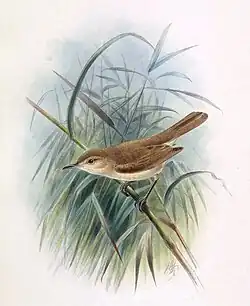 |
| Angraecum sterrophyllum | Antananarivo, Madagascar | Undetermined.[98] | ||||
| New Caledonian lorikeet[K] | Charmosyna diadema | New Caledonia | 1998 | Undetermined.[99] |  | |
| Panicum pearsonii | Great Karasberg, Namibia | Undetermined.[100] | ||||
| Achatinellid land snail | Partulina montagui | Hawaii, United States | 1986 (IUCN) | Undetermined.[101] | ||
| 1914 | Passenger pigeon[L] | Ectopistes migratorius | Eastern North America | 1986 (IUCN) | Hunting and habitat loss. |  |
| Laughing owl[M] | Ninox albifacies | New Zealand | Competition or predation by introduced stoats and cats.[105] |  | ||
| Achatinellid land snail | Partulina crassa | Lanai, Hawaii, United States[106] | 1986 (IUCN) | Undetermined.[107] |  | |
| Guadeloupe ameiva | Pholidoscelis cineraceus | Guadeloupe and nearby islands | 2015 (IUCN) | Predation by introduced mammals like mongooses.[108] |  | |
| 1914-1929 | Bering cackling goose | Branta hutchinsii asiatica | Commander and Kuril Islands, Russia; possibly migratory to Japan | Hunting and predation by introduced Arctic foxes.[16] | ||
| c. 1915[109] | Kenai Peninsula wolf | Canis lupus alces | Kenai Peninsula, Alaska, United States | Extermination campaign. |  | |
| 1916 | Tau bei qi mu | Alnus henryi | Tanshui, Taiwan | Undetermined.[110] | ||
| Risiocnemis laguna | Paete, Luzon, Philippines | Urbanization.[111] | ||||
| 1917 | Cayenne nightjar | Antrostomus maculosus | Northwestern French Guiana | Undetermined.[16] | ||
| Waitakere scurvy grass | Lepidium amissum | Coastal Waitākere Ranges, New Zealand[112] | Possibly artificial habitat alteration.[113] |  | ||
| Maui upland damselfly | Megalagrion jugorum | Maui, Hawaii, United States | 2020 (IUCN) | Undetermined.[114] | ||
| Rodrigues day gecko | Phelsuma edwardnewtonii | Rodrigues | 2015 (IUCN) | Possibly deforestation and predation by introduced rats and cats.[115] |  | |
| 1918 | Dirk Hartog thick-billed grasswren | Amytornis textilis carteri | Dirk Hartog Island, Western Australia | Predation by introduced rats.[16] | | |
| Lord Howe starling[16] | Aplonis fusca hulliana | Lord Howe Island, Australia | 1928 1988 (IUCN) |
Predation by introduced black rats.[116] |  | |
| Carolina parakeet[N] | Conuropsis carolinensis | Eastern and central United States | 1940 (IUCN) | Hunting, habitat loss, and competition with introduced bees.[117] |  | |
| Rück's blue flycatcher | Cyornis ruckii | Medan?, Indonesia | Possibly deforestation.[16] |  | ||
| Lānaʻi hookbill | Dysmorodrepanis munroi | Lana'i, Hawaii, United States | 1940 (IUCN) | Habitat destruction for pineapple agriculture, and predation by introduced cats and rats.[118] |  | |
| Tarpan[O] | Equus ferus ferus | Europe | Hunting and hybridization with domestic horses.[120] |  | ||
| 1918–1952[121] | Bernard's wolf | Canis lupus bernardi | Banks Island, Canada | 1993 (IUCN) | Undetermined.[P] |  |
| 1919 | Bulbophyllum minax | Fianarantsoa, Madagascar | Undetermined.[123] | |||
| Appalachian Barbara's buttons | Marshallia grandiflora | Henderson and Polk counties, North Carolina, United States | 2020 | Undetermined.[124] |  |
1920s
| Last record | Common name | Binomial name | Former range | Declared extinct | Causes | Picture |
|---|---|---|---|---|---|---|
| c. 1920 | Florida black wolf | Canis rufus floridanus | Southeastern United States | Hunting and habitat loss.[125] |  | |
| 1920 | True fera | Coregonus fera | Lake Geneva | 2008 (IUCN) | Eutrophication and overfishing.[126] |  |
| Euphorbia boinensis | Ankarafantsika and Mount Tsitondroina, Boeny, Madagascar | Habitat degradation by fire.[127] | ||||
| 1920-1929 | Assumption Island coucal | Centropus toulou assumptionis | Assumption Island, Seychelles | Guano mining.[16] | ||
| 1921 | Euphorbia pirahazo | Ambongo and Bemarivo, Madagascar | Collection for rubber.[128] | |||
| Astley's leiothrix | Leiothrix astleyi | China | Undetermined.[16] | |||
| Myoporum rimatarense | Rimatara, Austral Islands, French Polynesia | Logging.[129] | ||||
| Before 1922 | Mangareva kingfisher | Todiramphus gambieri gambieri | Mangareva, Gambier Islands, French Polynesia[16] | Undetermined.[130] | ||
| 1922 | Oahu treesnail | Achatinella lehuiensis | Lehui, Hawaii, United States[131] | 1996 (IUCN) | Undetermined.[132] | |
| Lilac leek-orchid | Prasophyllum colemaniarum | Bayswater, Victoria, Australia | Undetermined.[133] | |||
| Red-moustached fruit dove | Ptilinopus mercierii | Marquesas Islands, French Polynesia | 1994 (IUCN) | Predation by introduced great horned owls, rats, and cats.[134] |  | |
| 1923 | Acacia kingiana | Wagin, Western Australia | Undetermined.[135] | |||
| Kerr's noctuid moth | Agrotis kerri | French Frigate Shoals, Hawaii, United States | 1996 (IUCN) | Likely habitat loss and predation by introduced ants.[136] | ||
| Norfolk Island starling | Aplonis fusca fusca | Norfolk Island, Australia | 1968 1988 (IUCN) |
Undetermined.[116] |  | |
| Bulbophyllum tampoketsense | Antananarivo, Madagascar | Overcollection and deforestation.[137] | ||||
| Laysan honeycreeper | Himatione fraithii | Laysan, Hawaii, United States | 2016 (IUCN) | Habitat destruction by introduced rabbits.[138] | 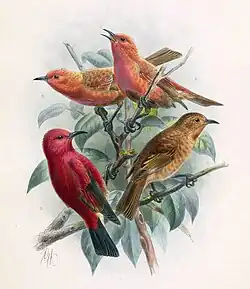 | |
| Nazareno | Monteverdia lineata | Western Cuba | 2010 2020 (IUCN) |
Possibly habitat degradation.[139] | ||
| 1924 | Sicilian wolf[Q] | Canis lupus cristaldii | Sicily, Italy | Hunting.[140] |  | |
| Round combshell | Epioblasma personata | Tennessee, Wabash, and Ohio River systems, United States | Undetermined.[141] | |||
| Lord Howe fantail | Rhipidura fuliginosa cervina | Lord Howe Island, Australia | 1928 | Probably predation by introduced rats.[16] |  | |
| Lord Howe thrush | Turdus poliocephalus vinitinctus | 1999 | Introduction of black rats.[142] |  | ||
| California grizzly bear | Ursus arctos californicus | California, United States | Hunting.[143] DNA evidence does not support its status as a separate subspecies.[144] |  | ||
| 1925 | Microreas agrotis noctuid moth | Agrotis microreas | Hawaii Island, Hawaii, United States | Undetermined.[145] |  | |
| Bubal hartebeest | Alcelaphus buselaphus buselaphus | North Africa and Southern Levant | Hunting.[146] |  | ||
| Angraecum muscicolum | Tsinjoarivo, Bongolava, Madagascar | Undetermined.[147][148][149] | ||||
| Angraecum perhumile | ||||||
| Angraecum rigidifolium | Mandraka, Antananarivo, Madagascar | |||||
| Bulbophyllum sanguineum | Toamasina, Madagascar | Undetermined.[150] | ||||
| Macledium pretoriense | Pretoria, South Africa | Urbanization.[151] | ||||
| 1926 | Poko noctuid moth | Agrotis crinigera | Hawaii, United States | 1996 (IUCN) | Undetermined.[152] | |
| Benthamia nigro-vaginata | Fianarantsoa, Madagascar | Undetermined.[153] | ||||
| Anthony's woodrat | Neotoma bryanti anthonyi | Isla Todos Santos, Mexico | 2008 (IUCN) | Predation by feral cats.[154] | ||
| 1927 | Thick-billed ground dove | Alopecoenas salamonis | Solomon Islands | 2005 (IUCN) | Probably habitat destruction, hunting, and predation by introduced cats and rats.[155] | |
| Caucasian wisent[156] | Bison bonasus caucasicus | Caucasus Mountains | 1988 (IUCN) | Hunting. Hybrid descendants exist in captivity, and have been reintroduced to the wild.[157] |  | |
| Snake River sucker | Chasmistes muriei | Snake River, United States | Hybridization with the Utah sucker after dams changed the river's flow.[48] | |||
| Syrian wild ass | Equus hemionus hemippus | Near East | Hunting.[158] |  | ||
| Bia | Exyrias volcanus | Taal Lake, Philippines | Overfishing, pollution, habitat degradation, and invasive species among others.[159] | |||
| Confused moth | Helicoverpa confusa | Hawaii, United States | 1986 (IUCN) | Undetermined.[160] | ||
| Ethiopian amphibious rat | Nilopegamys plumbeus | Northwestern Ethiopia | Habitat destruction.[161][162] |  | ||
| Hawaii yellowwood | Ochrosia kilaueaensis | Hawaiʻi, Hawaii, United States | 2020 (IUCN) | Habitat degradation by introduced plants, goats, and fires.[163] |  | |
| Samar Bay owl | Phodilus badius riverae | Samar Island, Philippines | Undetermined.[164] | |||
| Pseudophilautus malcolmsmithi | Sri Lanka | 2004 (IUCN) | Habitat loss.[165] | |||
| Pseudophilautus rugatus | Taralanda, Sri Lanka | Possibly habitat loss due to agriculture.[166] | ||||
| Pseudophilautus zimmeri | Point de Galle, Sri Lanka | Urbanization.[167] | ||||
| Yellow-bellied goby | Silhouettea flavoventris | Taal Lake, Philippines | Overfishing, pollution, habitat degradation, and invasive species among others.[168] | |||
| Cry pansy | Viola cryana | Cry, Yonne, France | 2011 (IUCN) | Overcollection by botanists and limestone quarrying.[169] | ||
| 1927-1928 | Paradise parrot | Psephotellus pulcherrimus | Eastern Australia | 1994 (IUCN) | Probably habitat degradation.[170] |  |
| 1928 | Bulbophyllum hirsutiusculum | Fianarantsoa, Madagascar | Undetermined.[171] | |||
| Utah Lake sculpin | Cottus echinatus | Utah Lake, Utah, United States | Increased water pollution and salinity caused by agriculture, and introduced fishes. The last individuals may have been killed by drought in the 1930s.[48] | |||
| Lord Howe gerygone | Gerygone insularis | Lord Howe Island, Australia | 1936 1988 (IUCN) |
Predation by introduced rats.[172] |  | |
| Eastwood's long-tailed seps | Tetradactylus eastwoodae | Limpopo, South Africa | 1996 (IUCN) | Habitat loss.[173] | ||
| Nullarbor barred bandicoot | Perameles papillon | Nullarbor Plain, Australia | 2025 (IUCN) | Predation by feral cats and red foxes, habitat degradation, and changes in the fire regime.[174] |  | |
| 1929 | Acalypha wilderi | Northwestern Rarotonga, Cook Islands | 2014 (IUCN) | Deforestation for agriculture and housing development. Doubts exist about it being distinct from still living A. raivavensis and A. tubuaiensis; if indeed the same, the older name A. wilderi prevails.[175] | ||
| St. Kitts bullfinch | Melopyrrha grandis | Saint Kitts | 1972 | Deforestation?[16] |  | |
| Makira woodhen[R] | Pareudiastes silvestris | Makira, Solomon Islands | Probably predation by introduced cats and rats.[16] | |||
| Scleria chevalieri | Western Senegal | 2020 (IUCN) | Draining of wetland habitat.[176] | |||
| Mount Holland thomasia | Thomasia gardneri | Near Mount Holland, Western Australia | Undetermined.[177] |
1930s
| Last record | Common name | Binomial name | Former range | Declared extinct | Causes | Picture |
|---|---|---|---|---|---|---|
| c. 1930 | Western rufous bristlebird | Dasyornis broadbenti littoralis | Southwestern Australia | Burning of shrublands for pasture and predation by introduced cats.[16] |  | |
| New Zealand grayling | Prototroctes oxyrhynchus | New Zealand | 1986 (IUCN) | Possibly over-exploitation, deterioration of the freshwater habitat through clearance of forest cover resulting in increased light penetration, raised water temperature, and invasive salmonids.[178] |  | |
| 1930–1939 | Centaurea pseudoleucolepis | Kammenye Mogily, Donetsk, Ukraine | 2011 (IUCN) | Undetermined. Possibly a hybrid rather than a valid species.[179] | ||
| Tahiti rail | Hypotaenidia pacifica | Tahiti and Mehetia?, French Polynesia[16] | 1988 (IUCN) | Probably predation by introduced cats and rats.[180] |  | |
| Nuku Hiva monarch[S] | Pomarea nukuhivae | Nuku Hiva, Marquesas Islands, French Polynesia | 1974 2004 (IUCN) |
Probably habitat destruction and predation by introduced species.[181] | ||
| 1930 | Carelia anceophila | Hawaii, United States | 1990 (IUCN) | Undetermined.[182][183] | ||
| Carelia cumingiana | ||||||
| St Kilda house mouse | Mus musculus muralis | St Kilda, Scotland | Complete evacuation of St Kilda's human population, which it depended on.[184] | 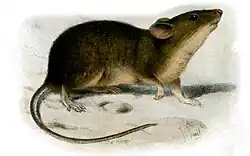 | ||
| Darwin's Galápagos mouse | Nesoryzomys darwini | Santa Cruz, Galápagos Islands, Ecuador | 1994 (IUCN) | Competition, predation, and exotic pathogens from introduced black rats.[185] | ||
| Silver trout | Salvelinus agassizi | Dublin Pond and Christine Lake, New Hampshire, United States | 1986 (IUCN) | Overfishing and introduction of exotic fish.[48] |  | |
| 1931 | Roque Chico de Salmor giant lizard | Gallotia simonyi simonyi | Roque Chico de Salmor, off El Hierro, Canary Islands | Hunting and capture for the exotic pet trade.[186] | 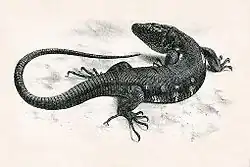 | |
| Lesser bilby[T] | Macrotis leucura | Deserts of Australia | 1982 (IUCN) | Probably predation by introduced cats and red foxes, and changes to the fire regime.[187] | 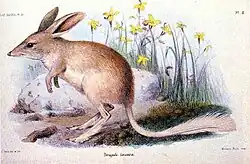 | |
| Stephens Island ground beettle | Mecodema punctellum | Stephens Island, New Zealand | 1994 (IUCN) | Possibly forest clearance.[188] | ||
| Bunker's woodrat | Neotoma bryanti bunkeri | Coronados Islands, Mexico | 2008 (IUCN) | Depletion of food resources and predation by feral cats.[189] | ||
| 1932 | Angraecum mahavense | Ambohipiraka, Antsiranana, Madagascar | Undetermined.[190] | |||
| Roosevelt's giant anole | Anolis roosevelti | Virgin Islands | Possibly deforestation.[191] | |||
| Euphrasia mendoncae | Bragança, Portugal | 2011 (IUCN) | Undetermined. Could be synonimous with E. minima.[192] | |||
| Lake Mackay hare-wallaby | Lagorchestes asomatus | Between Mount Farewell and Lake Mackay, Northern Territory; possibly Great Sandy, Gibson, and Tanami Deserts | 1982 (IUCN) | Predation by introduced cats and red foxes, possibly also changes to the fire regime after the removal of the Australian aboriginal population.[193] | ||
| Western Lewin's rail | Lewinia pectoralis clelandii | Southwest Australia | 1980s | Drainage and burning of wetlands for agriculture and settlement.[16] | ||
| Natuna Bay owl | Phodilus badius arixuthus | Bunguran Island, Indonesia | Undetermined.[164] | |||
| Heath hen | Tympanuchus cupido cupido | East Coast of the United States | Hunting, predation by feral cats, wildfires, and histomoniasis transmitted by domestic poultry.[194][195] |  | ||
| before 1933 | Zonites siphnicus | Sifnos, Sikinos, and Folegandros, Greece | 2017 (IUCN) | Undetermined.[196] | ||
| 1933 | Desert bettong | Bettongia anhydra | Tanami Desert and Nullarbor Plain, Australia | 2016 (IUCN) | Probably predation by feral cats and foxes, and changes to the fire regime.[197] | |
| Wolseley conebush | Leucadendron spirale | Breede River Valley, South Africa | 2020 (IUCN) | Habitat destruction for timber plantations and agriculture, competition with invasive plants.[198] | ||
| Lesser stick-nest rat[U] | Leporillus apicalis | Central Australia | 2016 (IUCN) | Predation by introduced species and habitat destruction for agriculture.[199] |  | |
| Pseudophilautus eximius | Dimbula, Sri Lanka | 2004 (IUCN) | Possibly habitat loss.[200] | |||
| Rhipidoglossum orientalis | Nguru Mountains, Tanzania | Undetermined.[201] | ||||
| Tridactyle sarcodantha | Uluguru Mountains, Tanzania | Deforestation for agriculture.[202] | ||||
| 1934 | Lost shark | Carcharhinus obsoletus | Southern South China Sea | Fishing.[203] | ||
| Hawaiʻi ʻōʻō | Moho nobilis | Hawaiʻi Island, Hawaii, United States | 1988 (IUCN) | Possibly habitat loss and disease.[204] |  | |
| Indefatigable Galápagos mouse | Nesoryzomys indefessus | Santa Cruz and Baltra, Galápagos Islands, Ecuador | 2002 (IUCN) | Introduction of black rats.[205] | ||
| Aguelmame Sidi Ali trout[206] | Salmo pallaryi | Lake Aguelmame Sidi Ali, Morocco | 2006 (IUCN) | Introduction of the common carp.[207] | ||
| 1935 | Desert rat-kangaroo[V] | Caloprymnus campestris | Central Australia | 1994 (IUCN) | Predation by introduced red foxes and cats.[208] |  |
| Mogollon mountain wolf[209] | Canis lupus mogollonensis | Arizona, United States | Hunting.[W] |  | ||
| Southern Rocky Mountain wolf[209] | Canis lupus youngi | Southern Rocky Mountains |  | |||
| Lepisanthes unilocularis | Seashore of Foluo, southwest Hainan, China | 1998 (IUCN) | Undetermined.[210] | |||
| Ratas Island lizard[211] | Podarcis lilfordi rodriquezi | Ratas Island off Mahón, Gymensian Islands, Spain | Explosion of Ratas Island during the rebuilding of Port Mahon.[212] |  | ||
| Senecio navugabensis | Lake Navugabo, southwestern Uganda | Undetermined.[213] | ||||
| Triaspis schliebeni | Lake Lutamba, Lindi District, Tanzania | Possibly habitat loss caused by agriculture.[214] | ||||
| Uvaria decidua | Mlinguru, south of Lindi, Tanzania | Undetermined.[215] | ||||
| 1936 | Ryukyu wood pigeon | Columba jouyi | Ryukyu, Japan | 1988 (IUCN)[216] | Possibly deforestation.[16] | |
| Virgin Islands screech owl[X] | Megascops nudipes newtoni | Virgin Islands | Deforestation for agriculture.[16] |  | ||
| Thylacine[Y] | Thylacinus cynocephalus | Australia and New Guinea | 1983 (IUCN)[221] | Competition with humans and dingos, extermination campaign (in Tasmania). |  | |
| Raiatean banded tree snail | Partula cuneata | Raiatea, Society Islands, French Polynesia | 1994 (IUCN) | Predation by introduced rosy wolfsnails.[222] | ||
| Pohnpei ground partula snail | Partula guamensis | Pohnpei, Micronesia | 2024 (IUCN) | Predation by the introduced flatworm Platydemus manokwari, brown rats, black rats, Polynesian rats, and rosy wolfsnails.[223] |  | |
| 1937 | Delissea sinuata | Oʻahu, Hawaii, United States | 2025 (IUCN) | Invasive species.[224] | ||
| Neostethus ctenophorus | Laguna de Bay, Luzon, Philippines | Likely pollution.[225] | ||||
| Bali tiger[Z] | Panthera tigris balica | Bali, Indonesia | Hunting and habitat loss.[AA] |  | ||
| Lānaʻi ʻalauahio | Paroreomyza montana montana | Lana'i, Hawaii, United States | 1937 | Habitat degradation.[227] |  | |
| Marquesas swamphen | Porphyrio paepae | Hiva Oa and Tahuata, Marquesas, French Polynesia | 2014 (IUCN) | Probably hunting and predation by rats and cats.[228] |  | |
| c. 1937 | Barbus microbarbis | Lake Luhondo, Rwanda | 2006 (IUCN) | Possibly predation by introduced Tilapia and Haplochromis in the 1950s.[229] | ||
| 1938 | Oahu treesnail | Achatinella spaldingi | Waianae Mountains, Hawaii, United States[230] | 1990 (IUCN) | Undetermined.[231] | |
| Acianthus ledwardii | Burleigh Heads, Queensland, Australia | Undetermined.[232] | ||||
| Banara wilsonii | Puerto Padre, Cuba | 2020 (IUCN) | Habitat destruction for sugarcane cultivation.[233] | |||
| McGregor's house finch | Carpodacus mexicanus mcgregori | San Benito Island, Mexico | Undetermined.[16] | |||
| Colparion madgei | Mauritius | 1994 (IUCN) | Undetermined.[234] | |||
| Tobias' caddisfly | Hydropsyche tobiasi | Main River and the Rhine up to Cologne, Germany | 1983 (IUCN) | Pollution.[235] | ||
| Grand Cayman oriole[AB] | Icterus leucopteryx bairdi | Grand Cayman, Cayman Islands | Deforestation.[16] | |||
| Pahranagat spinedace | Lepidomeda altivelis | Pahranagat Valley, Nevada, United States | 1986 (IUCN) | Competition and predation by introduced common carps, mosquitofish, and American bullfrogs.[48] | ||
| Bougainville black-faced pitta | Pitta anerythra pallida | Bougainville Island, Papua-New Guinea | Undetermined.[16] | |||
| Eastern cougar[AC] | Puma concolor couguar | Eastern North America | 2011[236] | Hunting.[AD] |  | |
| Little spotted kiwi louse | Rallicola pilgrimi | New Zealand | Parasite of the little spotted kiwi, extinct when the last birds were relocated to predator-free islands as part of conservation efforts.[12] | |||
| Grass Valley speckled dace | Rhynichthys osculus reliquus | Lander County, Nevada, United States | Introduction of the rainbow trout.[48] | |||
| Daito varied tit | Sittiparus varius orii | Kitadaitōjima, Okinawa, Japan | 1984–1986 | Habitat destruction for agriculture and military infrastructure.[16] | ||
| Schomburgk's deer[AE] | Rucervus schomburgki | Central Thailand | 1994 (IUCN) | Hunting.[237] |  | |
| Grand Cayman thrush | Turdus ravidus | Grand Cayman, Cayman Islands | 1965 1988 (IUCN) |
Probably habitat loss.[238] | ||
| Mount Kenya potto | Perodicticus ibeanus stockleyi | Mount Kenya, Kenya | Most likely habitat loss for agriculture.[239] | |||
| 1939 | Cyperus chionocephalus | Ethiopia | Livestock grazing, firewood collection, and agriculture.[240] | |||
| New Caledonian nightjar | Eurostopodus exul | Northwestern New Caledonia | Undetermined.[16] | |||
| Toolache wallaby[AF] | Notamacropus greyi | Southeastern Australia | 1983 (IUCN) | Habitat loss to agriculture, hunting, and predation by introduced red fox.[241] |  | |
| Roystonea stellata | Baracoa, eastern Cuba | 2020 (IUCN) | Habitat destruction for coffee cultivation.[242] |
1940s
| Last record | Common name | Binomial name | Former range | Declared extinct | Causes | Picture |
|---|---|---|---|---|---|---|
| c. 1940 | Sugarspoon | Epioblasma arcaeformis | Cumberland and Tennessee river systems, United States | 1983 (IUCN) | Damming.[243] |  |
| 1940 | Lesser ʻakialoa | Akialoa obscura | Hawaiʻi Island, Hawaii, United States | 1994 (IUCN) | Possibly deforestation and introduced disease-carrying mosquitos.[244] |  |
| Cascade mountain wolf[209] | Canis lupus fuscus | Continental Cascadia[122] | Hunting. |  | ||
| Cape Verde giant skink[AG] | Chioninia coctei | Western Barlavento Islands, Cape Verde | 1996 (IUCN) | Hunting, capture for the exotic pet trade, predation by feral dogs[186] and cats.[245] |  | |
| Pseudophilautus dimbullae | Dimbula, Sri Lanka | 2004 (IUCN) | Possibly habitat loss.[246] | |||
| Las Vegas dace | Rhinichthys deaconi | Las Vegas Valley, Nevada, United States | 1965 1986 (IUCN) |
Habitat destruction.[48] | ||
| Javan lapwing[AH] | Vanellus macropterus | Java, Indonesia | Hunting and habitat loss to agriculture.[247] |  | ||
| 1940-1949 | Cebu white-bellied woodpecker | Dryocopus javensis cebuensis | Cebu, Philippines | Deforestation.[16] | ||
| Lord Howe boobook | Ninox novaeseelandiae albaria | Lord Howe Island, Australia | Deforestation, predation by introduced black rats, and predation or competition with southern boobooks, barn owls, and masked owls (all introduced to control the invasive rat population).[16] | 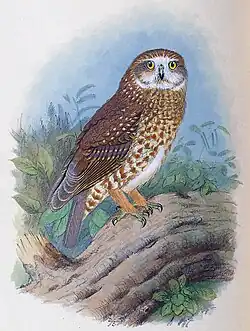 | ||
| Stellaria elatinoides | New Zealand | Habitat destruction and possibly invasive weeds.[248] | ||||
| c. 1941 | Arabian ostrich[AI] | Struthio camelus syriacus | Arabian Peninsula and the Near East | Hunting.[249] |  | |
| 1941 | Mukojima white-eye | Apalopteron familiare familiare | Mukojima, Nakodo-jima, and probably Chichi-jima, Bonin Islands | Deforestation.[16] |  | |
| Xerces blue | Glaucopsyche xerces | San Francisco Peninsula, California, United States | 1996 (IUCN) | The absence of Lotus and Lupinus plants in the area due to human development.[250] |  | |
| 1942 | Angraecum serpens | Toamasina, Madagascar | Undetermined.[251] | |||
| Texas gray wolf[209] | Canis lupus monstrabilis | Texas, United States | Hunting.[AJ] | 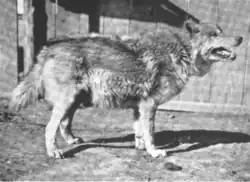 | ||
| Hymenodictyon seyrigii | Toliara, Madagascar | Habitat destruction caused by graphite mining and wildfires.[252] | ||||
| Moss-land silver-studded blue | Plebejus argus masseyi | Lancashire and Cumbria, England | Undetermined.[253] | |||
| Polystachya rugosilabia | Nguru Mountains, Tanzania | Habitat loss to cardamom cultivation.[254] | ||||
| Chapin's crombec | Sylvietta leucophrys chapini | Lendu Plateau, Democratic Republic of the Congo | Deforestation.[16] | |||
| Norfolk triller | Lalage leucopyga leucopyga | Norfolk Island, Australia | 1999 | Habitat loss and predation by introduced black rats.[255] |  | |
| 1943 | Eriocaulon inundatum | Senegal coast | 2020 (IUCN) | Habitat destruction for salt mining.[256] | ||
| Cebu hanging parrot[AK] | Loriculus philippensis chrysonotus | Cebu, Philippines | Deforestation.[16] |  | ||
| Barbary lion[AL] | Panthera leo leo | North Africa | Habitat loss from desertification and human activities, followed by extermination campaign.[AM] |  | ||
| Desert bandicoot[AN] | Perameles eremiana | Central Australia | 1982 (IUCN) | Predation by cats and foxes, competition with European rabbits, and changes to the fire regime after the British colonization of Australia.[258] |  | |
| Polystachya acuminata | Usambara Mountains, Tanzania | Deforestation for logging and agriculture.[259] | ||||
| 1943–1962 | Polystachya canaliculata | Nguru Mountains, Tanzania | Deforestation.[260] | |||
| 1944 | American ivory-billed woodpecker[AO] | Campephilus principalis principalis | Southern United States | Logging and hunting.[263] |  | |
| Disperis egregia | East Usambara Mountains, Tanzania | Habitat degradation caused by logging and the invasive umbrella tree (Maesopsis eminii).[264] | ||||
| Bismarck red-necked crake | Rallina tricolor convicta | New Ireland and New Hannover islands, Bismarck Archipelago, Papua New Guinea | Undetermined.[16] | |||
| 1944–1945[16] | Laysan rail | Zapornia palmeri | Laysan, Hawaii, United States | 1988 (IUCN) | Habitat destruction by introduced rabbits and guinea pigs, and predation by introduced rats.[265] |  |
| 1944-1947 | Aruba amazon | Amazona barbadensis canifrons | Aruba | Persecution by farmers and exotic pet trade.[16] |  | |
| Before 1945 | Achatinellid land snails | Perdicella fulgurans | East Maui, Hawaii, United States | Undetermined.[266][267][268][269] | ||
| Perdicella maniensis | West Maui, Hawaii, United States | |||||
| Perdicella zebra | East Maui, Hawaii, United States | |||||
| Perdicella zebrina | ||||||
| 1945 | Oahu treesnail | Achatinella papyracea | Oahu, Hawaii, United States[270] | 1990 (IUCN) | Undetermined.[271] | |
| Cyprus dipper | Cinclus cinclus olympicus | Cyprus | Undetermined.[272] | |||
| Wake Island rail | Hypotaenidia wakensis | Wake Island, United States | 1988 (IUCN) | Hunting and destruction caused by fighting in World War II.[273] |  | |
| After 1945 | Oahu treesnail | Achatinella juncea | Koolau Mountains, Hawaii, United States | Undetermined.[274] | ||
| 1946 | Amastrid land snail | Amastra subsoror | West Maui, Hawaii, United States | Undetermined.[275] |  | |
| Achatinellid land snail | Auriculella uniplicata | Undetermined.[276] | ||||
| Mount Alifana partula[AP] | Partula salifana | Guam, United States | 1994 (IUCN) | Predation by introduced rosy wolfsnails and New Guinea flatworms.[277] |  | |
| Pallid beach mouse | Peromyscus polionotus decoloratus | Volusia and Flagler Counties, Florida, United States | Habitat loss.[278] | |||
| Emma's giant rat | Uromys emmae | Owi Island, Indonesia | Undetermined.[279] | |||
| 1947 | Mimosa kitrokala | Taolagnaro, southeastern Madagascar | Undetermined.[280] | |||
| Pseudophilautus zal | Sri Lanka | 2004 (IUCN) | Possibly habitat loss due to agriculture.[281] | |||
| 1948 | Ash Meadows killifish | Empetrichthys merriami | Ash Meadows, Nevada, United States | 1986 (IUCN) | Predation by introduced American Bullfrogs and red swamp crayfish.[48] |  |
| 1948–1949 | Pink-headed duck[AQ] | Rhodonessa caryophyllacea | Northeast India, Bangladesh, and northern Myanmar | Trophy hunting and habitat loss to agriculture.[16][282] |  | |
| 1949 | Sinú parakeet | Pyrrhura subandina | Sinú Valley, Córdoba, Colombia | Possibly hunting and habitat loss.[16] |
1950s
| Last record | Common name | Binomial name | Former range | Declared extinct | Causes | Picture |
|---|---|---|---|---|---|---|
| c. 1950 | Little Swan Island hutia | Geocapromys thoracatus | Little Swan Island, Honduras | 1996 (IUCN) | Introduced rats.[283] |  |
| 1950 | Dorstenia bicaudata | East Usambara and Uluguru Mountains, Tanzania | Undetermined.[284] | |||
| Lepidium obtusatum | Coastal Waitākere Ranges and Wellington, New Zealand[285][286] | Habitat destruction as a consequence of gravel extraction, weed invasion, and overcollection by botanists.[285][286] | ||||
| Hokkaidō otter | Lutra lutra whiteleyi | Hokkaidō and southern Kuril Islands[287] | Hunting.[288] | |||
| Stereospermum zenkeri | Yaounde, Cameroon | Urbanization.[289] | ||||
| 1950–1959 | Negros spotted imperial pigeon | Ducula carola nigrorum | Negros and Siquijor, Philippines | Undetermined.[16] | ||
| Eriocaulon jordanii | Sierra Leone coast | 2020 (IUCN) | Possibly habitat destruction for rice cultivation.[290] | |||
| White-headed Polynesian ground dove | Pampusana erythroptera albicollis | Hao, Hiti, and possibly Tahanea, French Polynesia | Predation by introduced cats and rats.[16] |  | ||
| San Martín Island woodrat | Neotoma bryanti martinensis | Isla San Martín, Mexico | 2008 (IUCN) | Predation by feral cats.[291] | ||
| Amirante turtle dove | Nesoenas picturata aldabrana | Amirante Islands, Seychelles | Hybridization with the Malagasy turtle dove.[16] | |||
| Moroccan guineafowl | Numida meleagris sabyi | Between the Oum er Rbia and Sebou rivers of Morocco | Habitat destruction and hunting.[16] |  | ||
| Tristramella magdelainae | Damascus, Syria | 2006 (IUCN) | Possibly drought, pollution, and water extraction.[292] | |||
| Tawi-tawi buttonquail | Turnix sylvaticus suluensis | Jolo and Tawi-tawi, Sulu, Philippines | Possibly deforestation and predation by introduced animals.[16] | |||
| 1951 | Oahu treesnail | Achatinella valida | Koolau Mountains, Hawaii, United States[293] | 1990 (IUCN) | Undetermined.[294] |  |
| Afrocyclops pauliani | Antananarivo, Madagascar | 1996 (IUCN) | Undetermined.[295] |  | ||
| Amastrid land snail | Amastra crassilabrum | Oahu, Hawaii, United States | 1994 (IUCN) | Undetermined.[296] |  | |
| Cynorkis sylvatica | Marivorahona, Antsiranana, Madagascar | Undetermined.[297] | ||||
| Queen of Sheba's gazelle | Gazella bilkis | Taiz, Yemen | Hunting.[298] |  | ||
| Podocarpus perrieri | Eastern coast of Madagascar | Deforestation.[299] | ||||
| Japanese sea lion[AR] | Zalophus japonicus | Japanese Islands and Korea | 1994 (IUCN) | Hunting for blubber and oil, and commercial fishing.[300] |  | |
| 1952 | Oahu treesnail | Achatinella elegans | Koolau Mountains, Hawaii, United States[301] | 1996 (IUCN) | Undetermined.[302] | |
| Niceforo's pintail | Anas georgica niceforoi | Central Colombia | Possibly hunting and habitat degradation.[16] | |||
| Deepwater cisco | Coregonus johannae | Lakes Michigan and Huron | 1986 (IUCN) | Overfishing, predation by introduced lampreys, and hybridization with more common ciscoes.[48] |  | |
| Caribbean monk seal[AS] | Neomonachus tropicalis | Caribbean Sea, Bahamas, and Gulf of Mexico | 1994 (IUCN) 2005[304] |
Hunting for meat, blubber and oil, and habitat destruction from commercial fishing.[305] |  | |
| San Benedicto rock wren | Salpinctes obsoletus exsul | San Benedicto, Revillagigedo Islands, Mexico | Eruption of the El Boquerón vent.[16] | |||
| New Mexico sharp-tailed grouse | Tympanuchus phasianellus hueyi | New Mexico (and Colorado?), United States | Aridification and habitat destruction.[16] | |||
| 1953 | Ilin Island cloudrunner[AT] | Crateromys paulus | Mindoro and Ilin Islands, Philippines | Deforestation?[306] |  | |
| Raycraft Ranch killifish | Empetrichthys latos concavus | Pahrump Valley, Nevada, United States | Predation by introduced carps and bullfrogs.[48] | |||
| Faramea chiapensis | Selva Negra, Chiapas, Mexico | 2020 (IUCN) | Deforestation for agriculture.[307] | |||
| Plectranthus scopulicola | West Usambara, Tanzania | Possibly habitat loss caused by agriculture.[308] | ||||
| Negros fruit dove | Ptilinopus arcanus | Negros Island, Philippines | Deforestation?[16] |  | ||
| Schizothorax saltans | Talas River basin, Kazakhstan | 2020 (IUCN) | Water extraction, pollution, and fisheries.[309] | |||
| 1954 | Maravillas red shiner | Cyprinella lutrensis blairi | Maravillas Creek, Texas, United States | 1987 | Introduction of plains killifish.[48] | |
| Plateau chub | Evarra eigenmanni | Chalco and Xochimilco-Tlahuac channels, Valley of Mexico | 1986 (IUCN) | Habitat destruction and pollution.[310] |  | |
| Adams mistletoe | Trilepidea adamsii | From the Waipoua River to the Waikato and Coromandel Peninsula in the North Island; Great Barrier Island, and Waiheke Island, New Zealand[311] | Possibly habitat loss, over-collecting, loss of pollinators and dispersers, and predation by introduced common brushtail possums.[311] |  | ||
| 1955 | Beyşehir bleak | Alburnus akili | Lake Beyşehir, Turkey | 2006 (IUCN) | Predation by introduced zanders and possibly hybridization with the Sakarya bleak.[312] | |
| Aspidostemon inconspicuus | Menagisy forest, Toamasina, Madagascar | Deforestation caused by slash-and-burn agriculture.[313] | ||||
| Itombwe nightjar[AU] | Caprimulgus prigoginei | Central Africa? | Deforestation?[16] | |||
| Goff's pocket gopher | Geomys pinetis goffi | Eastern Florida, United States | Habitat destruction.[314] | |||
| 1956 | Coosa elktoe | Alasmidonta mccordi | Coosa River, Alabama, United States | 2000 (IUCN) | Impoundment of the Coosa River.[315] | |
| Gong shan hua | Betula gynoterminalis | Drungzu Nusu Zizhixian, near Gongshan, China | Possibly forest clearing and habitat loss.[316] | |||
| Imperial woodpecker | Campephilus imperialis | North-Central Mexico | Hunting and habitat loss.[317] |  | ||
| Levuana moth[318] | Levuana iridescens | Viti Levu, Fiji | 1994 (IUCN)[319] | Introduction of the parasitic fly Bessa remota by coconut farmers, as a form of biological pest control.[AV] |  | |
| Crescent nail-tail wallaby[320] | Onychogalea lunata | Western and central Australia | 1982 (IUCN) | Predation by introduced foxes and feral cats, human-induced habitat degradation.[321] |  | |
| 1957 | Disperis bosseri | Ankaratra, Antananarivo, Madagascar | Undetermined.[322] | |||
| Thicktail chub | Gila crassicauda | California Central Valley and San Francisco Bay, United States | 1986 (IUCN) | Habitat destruction for agriculture and introduced fish.[48] | 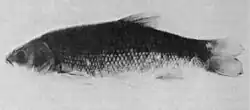 | |
| Diels' currant bush | Leptomeria dielsiana | Scott River, Western Australia | Undetermined.[323] | |||
| Scioto madtom | Noturus trautmani | Big Darby Creek, Ohio, United States | 2013 (IUCN) | Undetermined.[324] | ||
| Hainan ormosia[325] | Ormosia howii | Hainan and Guangdong, China | 1998 (IUCN) | Possibly deforestation for agriculture.[326] | ||
| Puebla deer mouse | Peromyscus mekisturus | Puebla, Mexico | Habitat destruction due to agriculture or climate change.[327] | |||
| 1958 | Oahu treesnail | Achatinella juddii | Koolau Mountains, Hawaii, United States[328] | 1996 (IUCN) | Undetermined.[329] | |
| New Britain thicketbird | Cincloramphus grosvenori | New Britain, Papua New Guinea | Undetermined.[16] | |||
| Pahrump Ranch poolfish | Empetrichthys latos pahrump | Nye County, Nevada, United States | Habitat destruction by excessive water pumping.[48] | |||
| Blue walleye | Sander vitreus glaucus | Lake Erie, Ontario, and Niagara River | 1983 | Overfishing and hybridization with walleye.[330] |  | |
| 1959 | Acalypha dikuluwensis | Katanga Copperbelt, Democratic Republic of the Congo | 2012 (IUCN) | Habitat destruction caused by surface mining.[331] | ||
| Aeranthes albidiflora | Fianarantsoa, Madagascar | Undetermined.[332] | ||||
| Rennell Island teal | Anas gibberifrons remissa | Rennell Island, Solomon Islands | Competition with introduced Tilapia.[16] |
1960s
| Last record | Common name | Binomial name | Former range | Declared extinct | Causes | Picture |
|---|---|---|---|---|---|---|
| 1960 | New Caledonian owlet-nightjar[AW] | Aegotheles savesi | Southwestern New Caledonia | Undetermined.[16] |  | |
| Achatinellid land snail | Auriculella expansa | West Maui, Hawaii, United States | Undetermined.[333] | |||
| Candango mouse | Juscelinomys candango | Brasília, Brazil | 2008 (IUCN) | Urban sprawl.[334] |  | |
| 1960-1969 | Savoy whitefish | Coregonus bezola | Lac du Bourget, France | Eutrophication of the lake caused by pollution.[335] | ||
| Techirghiol stickleback | Gasterosteus crenobiontus | Lake Techirghiol, Romania | Hybridization with the three-spined stickleback; the springs it inhabited were separated from the latter's habitat by a hypersaline lake acting as barrier between the species, until irrigation works transformed the lake into a brackish one that was invaded by migratory three-spined sticklebacks.[336] | |||
| Pantanodon madagascariensis | Mahambo, Madagascar | 2004 (IUCN) | Introduced Gambusia.[337] | |||
| Syr Darya sturgeon | Pseudoscaphirhynchus fedtschenkoi | Syr Darya river | Draining of the Aral Sea.[338] |  | ||
| 1961 | Northern white-winged apalis | Apalis chariessa chariessa | Lower Tana river, Kenya | Deforestation.[16] | ||
| Cynorkis bimaculata | Manjakatompo, Antananarivo, Madagascar | Undetermined.[339] | ||||
| Dryophthorus distinguendus | Hawaii, United States | 1986 (IUCN) | Possibly habitat loss and invasive species.[340] | |||
| Viesca mud turtle | Kinosternon hirtipes megacephalum | Southwestern Coahuila, Mexico | Drainage of habitat.[341] | |||
| Semper's warbler[AX] | Leucopeza semperi | St Lucia mountains | Predation by introduced Javan mongooses.[342] |  | ||
| Lijndenia brenanii | Usambara Mountains, Tanzania | Habitat degradation caused by overcollection, logging, gold mining, and introduced Maesopsis.[343] | ||||
| Durango shiner | Notropis aulidion | Tunal river, Durango, Mexico | 1990 (IUCN) | Pollution and introduced species.[48] |  | |
| Zacatecas Worthen's sparrow | Spizella wortheni browni | Northwest Zacatecas, Mexico | 1991 | Habitat destruction caused by agriculture, overgrazing, cattle-induced erosion, and decline of native herbivores.[16] | ||
| 1961–1963 | Kākāwahie | Paroreomyza flammea | Molokai, Hawaii, United States | 1979 1994 (IUCN) |
Probably habitat destruction and introduced disease.[344] |  |
| 1962 | Du Toit's torrent frog | Arthroleptides dutoiti | Kenya-Uganda border | Assessed as extinct in 1994, but upgraded to Critically Endangered in 2004.[345] | Possibly habitat degradation and chytridiomycosis.[345] |  |
| Red-bellied gracile opossum | Cryptonanus ignitus | Jujuy, Argentina | 2008 (IUCN) | Habitat loss to agriculture and industry development.[346] | ||
| Gloomy tube-nosed bat | Murina tenebrosa | Tsushima Island and possibly Yakushima, Japan | Undetermined.[347] | |||
| Ptychochromis onilahy | Onilahy River, Madagascar | 2004 (IUCN) | Overfishing, deforestation leading to increased sedimentation, and competition with introduced tilapias.[348] | |||
| Tacoma pocket gopher | Thomomys mazama tacomensis | Puget Sound and Olympic Peninsula, Washington, United States | 2000 (IUCN) | Habitat destruction due to residential development and gravel mining.[349] | ||
| 1963 | Oahu treesnail | Achatinella abbreviata | Koolau Mountains, Hawaii, United States[350] | 1990 (IUCN) | Undetermined.[351] |  |
| Angraecum rubellum | Moramanga, Toamasina, Madagascar | Undetermined.[352] | ||||
| Campo Grande tree frog | Boana cymbalum | São Paulo, Brazil | 2023 (IUCN) | The only two known locations have been completely lost to urban development. If it survived in the nearby Serra da Paranapiacaba it may have been lost to pollution and chytridiomycosis during the 1970s or 1980s.[353] | ||
| Saint Helena darter | Sympetrum dilatatum | Saint Helena | 1996-2021 (IUCN) | Probably deforestation and predation by extinct aquatic carnivores including the African clawed frog.[354] | ||
| 1964 | Hawaii chaff flower | Achyranthes atollensis | The atolls Kure, Midway, Pearl and Hermes, and Laysan of the Northwestern Hawaiian Islands, United States | 2003 (IUCN) | Habitat loss due to the construction of military installations.[355] | |
| Barbodes disa | Lake Lanao, Mindanao, Philippines | 2020 (IUCN) | Overfishing and predation by introduced tank goby and ornate sleeper.[356][357][358][359][360][361] | |||
| Katapa-tapa | Barbodes flavifuscus | |||||
| Kandar | Barbodes lanaoensis | |||||
| Bitungu | Barbodes pachycheilus | |||||
| Barbodes palata | ||||||
| Bagangan | Barbodes resimus | |||||
| Bulbophyllum erythroglossum | Toamasina, Madasgacar | Undetermined.[362] | ||||
| South Island snipe | Coenocorypha iredalei | South and Stewart islands, New Zealand | 2014 (IUCN) | Predation by introduced animals.[363] |  | |
| Lake Ontario kiyi | Coregonus kiyi orientalis | Lake Ontario | Overfishing, introduction of exotic species, eutrophication, and water pollution.[48] | |||
| Goldman's yellow rail | Coturnicops noveboracensis goldmani | Lerma River, Mexico | Undetermined.[16] | |||
| Achatinellid land snail | Newcombia philippiana | Hawaii, United States | Undetermined.[364] | |||
| Rio Grande bluntnose shiner | Notropis simus simus | Upper Rio Grande | Possibly habitat degradation and introduced species.[48] | |||
| Laysan weevil | Oodemas laysanensis | Laysan, Hawaii, United States | 1986 (IUCN) | Possibly habitat degradation caused by introduced rabbits and plants.[365] | ||
| Crested shelduck[AY] | Tadorna cristata | Primorye, Hokkaido, and Korea; Northeastern China? |
Undetermined.[366] |  | ||
| 1965 | Euphorbia neospinescens | Chunya District, Tanzania | Agricultural expansion and charcoal burning.[367] | |||
| Santo Stefano lizard | Podarcis siculus sanctistephani | Santo Stefano Island, Italy | Introduced epidemic and predation by introduced snakes and feral cats.[368] | |||
| 1966–1967 | Aplothorax burchelli | Saint Helena | Undetermined. |  | ||
| 1967 | Oahu treesnail | Achatinella dimorpha | Koʻolau Range, Hawaii, United States | Undetermined.[369] |  | |
| Anisopappus burundiense | Central Burundi | Habitat destruction caused by agriculture.[370] | ||||
| Narrow catspaw | Epioblasma lenior | Tennessee River system, United States | 1983–2000 (IUCN) | Damming.[371] | ||
| Saint Helena earwig | Labidura herculeana | Saint Helena | 2014 (IUCN) | Predation by introduced animals.[372] |  | |
| New Zealand greater short-tailed bat | Mystacina robusta | New Zealand | 1988 (IUCN) | Predation by introduced Polynesian and black rats.[373] |  | |
| 1968 | Belgrandiella boetersi | Tiefsteinschlucht, Austria | Likely groundwater abstraction and habitat degradation.[374] | |||
| San Clemente wren | Thryomanes bewickii leucophrys | San Clemente, Channel Islands of California, United States | Vegetation destruction by introduced goats and sheep.[16] | |||
| Guam flying fox | Pteropus tokudae | Guam | 2004 (IUCN) | Hunting and predation by the introduced brown tree snake.[375][376] | ||
| 1969 | Nightingale reed warbler | Acrocephalus luscinius | 2023 (IUCN) | Habitat loss from drainage and burning of wetlands, pesticide use, and predation by introduced cats and rats.[16] |  | |
| Kauaʻi ʻakialoa | Akialoa stejnegeri | Kauaʻi, Hawaii, United States | 2016 (IUCN) | Possibly habitat destruction and introduced disease.[377] |  | |
| Kouprey[AZ] | Bos sauveli | Southern Vietnam to Yunnan, China[379] | Hunting.[380] | 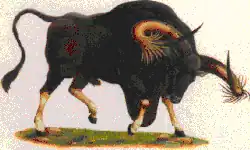 | ||
| Blackfin cisco | Coregonus nigripinnis | Lakes Michigan and Huron | 1996 (IUCN) | Overfishing, predation by introduced sea lampreys, and hybridization with other ciscoes.[48] |  | |
| Tubercled blossom | Epioblasma torulosa torulosa | Tennessee and Ohio River systems, United States | Impoundment, siltation, and pollution.[381] |
1970s
| Last record | Common name | Binomial name | Former range | Declared extinct | Causes | Picture |
|---|---|---|---|---|---|---|
| c. 1970 | Socorro elf owl | Micrathene whitneyi graysoni | Socorro, Revillagigedo Islands, Mexico | Likely predation by introduced domestic cats.[16] | ||
| 1970 | Diplazium ulugurense | Bondwa, Uluguru Mountains, Tanzania | Deforestation for agriculture.[382] | |||
| Acornshell | Epioblasma haysiana | Tennessee and Cumberland River systems, United States | 1994 (IUCN) | Exposure to domestic sewage,[383] habitat degradatation and fragmentation.[384] |  | |
| Mexican dace | Evarra bustamantei | Xochimilco-Tlahuac channels, Mexico | 1983 (IUCN) | Habitat destruction and pollution.[385][386] | ||
| Endorheic chub | Evarra tlahuacensis | Lake Chalco, Valley of Mexico | ||||
| Saudi gazelle | Gazella saudiya | Arabian Peninsula | 2006 (IUCN) | Hunting.[387] | _(cropped)).jpg) | |
| Llanfairfechan hawkweed | Hieracium cambricogothicum[388] | Gwynedd, Wales | Herbicides and road construction.[389] | |||
| Clear Lake splittail | Pogonichthys ciscoides | Clear Lake and its tributaries, California, United States | 1986 (IUCN) | Habitat destruction and pollution from agriculture.[48] | ||
| 1970–1979 | Pagan reed warbler | Acrocephalus yamashinae | Pagan, Northern Mariana Islands | 1981 2016 (IUCN) |
Habitat destruction and predation by introduced rats and cats.[16] | |
| Lake Constance whitefish | Coregonus gutturosus | Lake Constance, Germany-Austria-Switzerland triple border | 2008 (IUCN) | Eutrophication.[390] | 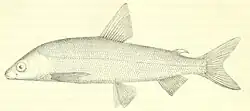 | |
| Tien Shan dhole | Cuon alpinus hesperius | Pamir to Altai Mountains | Undetermined.[391][BA] |  | ||
| Western Turner's eremomela | Eremomela turneri kalindei | Southeast D. R. Congo and southwest Uganda | Possibly deforestation.[16] | |||
| Nubian wild ass | Equus africanus africanus | Nubian Desert | Hunting for food and traditional medicine, competition with livestock for vegetation and water, possibly interbreeding with domestic donkeys.[393] |  | ||
| Madeiran large white | Pieris brassicae wollastoni | Madeira, Portugal | Possibly introduced diseases and the parasitoid wasp Cotesia glomerata.[394] |  | ||
| Tristramella intermedia | Lake Hula, Israel | 2006 (IUCN) | Draining of the lake and adjacent marshes.[395] | |||
| 1970-1982 | Polystachya porphyrochila | Uluguru Mountains, Tanzania | Deforestation for agriculture.[396] | |||
| 1970–1989 | Aplocheilichthys sp. nov. 'Naivasha' | Lake Naivasha, Kenya | 2004 (IUCN) | Competition and predation by introduced fish.[397] | ||
| 1971 | Blotiella coriacea | South Uluguru Mountains, Tanzania | Deforestation for agriculture.[398] |  | ||
| Cotula myriophylloides | Cape Peninsula, South Africa | Wetland draining and competition with introduced plants.[399] | ||||
| Santa Cruz pupfish | Cyprinodon arcuatus | Santa Cruz River, Arizona, United States | 2011 (IUCN) | Predation by introduced largemouth bass.[48][400] | ||
| Ticao Tarictic hornbill | Penelopidis panini ticaensis | Ticao Island, Philippines | Habitat destruction. Sometimes not considered a subspecies but a color morph.[16] |  | ||
| Lake Pedder earthworm | Hypolimnus pedderensis | Lake Pedder, Tasmania, Australia | 2003 (IUCN) | Flooding of Lake Pedder for a hydroelectric power scheme.[401] |  | |
| before 1972 | Tecopa pupfish | Cyprinodon nevadensis calidae | Tecopa Hot Springs, California, United States | 1994 | Habitat degradation and introduced bluegill sunfish and mosquito fish.[330] | 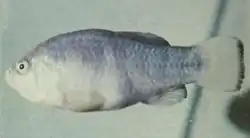 |
| 1972 | Tropical acidweed | Desmarestia tropica | Galápagos Islands, Ecuador | Undetermined.[402] |  | |
| Turgid blossom | Epioblasma turgidula | Southern Appalachians and Cumberland Plateau, United States | Damming and water pollution.[403] |  | ||
| Mason River myrtle | Myrcia skeldingii | Mason River, Jamaica | 1998 (IUCN) | Undetermined.[404] | ||
| Bushwren louse | Philopteroides xenicus | New Zealand | Parasite of the bushwren, extinct with its host.[12] | |||
| Grey groundsel | Senecio georgianus | Western, eastern, and southern Australia, including Tasmania | Undetermined.[405] | |||
| Bushwren | Xenicus longipes | New Zealand | 1994 (IUCN) | Predation by introduced cats, rats, weasels, and stoats.[16] |  | |
| 1973 | Barbodes cataractae | Misamis Occidental and Lake Lanao, Philippines | Overfishing and predation by introduced fish. Possibly also pollution caused by mining.[406] | |||
| Bitungu | Barbodes truncatulus | Lake Lanao, Mindanao, Philippines | 2020 (IUCN) | Predation by introduced tank goby and ornate sleeper.[407] | ||
| Peppered tree frog | Dryopsophus piperatus | Northern Tablelands, New South Wales, Australia | Undetermined.[408] | |||
| Guadeloupe house wren | Troglodytes aedon guadeloupensis | Guadeloupe | Deforestation.[16] | |||
| 1974 | Barbodes herrei | Lake Lanao, Mindanao, Philippines | 2020 (IUCN) | Predation by introduced tank goby and ornate sleeper.[409] | ||
| Vanua Levu long-legged thicketbird[BB] | Cincloramphus rufus cluniei | Vanua Levu, Fiji | Undetermined.[16] | |||
| Amistad gambusia[410] | Gambusia amistadensis | Goodenough Spring, Texas, United States | 1986 (IUCN) 1987 |
Disappeared from the wild when the spring was flooded by the Amistad Reservoir in 1969. All captive individuals later hybridized with mosquitofish accidentally.[330][48] | ||
| Flores rail | Lewinia pectoralis exsul | South and west Flores, Indonesia | Undetermined.[16] | |||
| Aragua robber frog | Pristimantis anotis | Henri Pittier National Park, Aragua, Venezuela | Chytridiomycosis?[411] | |||
| 1975 | Bagangan | Barbodes clemensi | Lake Lanao, Mindanao, Philippines | 2020 (IUCN) | Predation by introduced tank goby and ornate sleeper.[412][413] | |
| Bitungu | Barbodes palaemophagus | |||||
| Round Island burrowing boa | Bolyeria multocarinata | Round Island, Mauritius? | 1996 (IUCN) | Habitat degradation by introduced goats and rabbits.[414] |  | |
| Longjaw cisco | Coregonus alpenae | Lakes Michigan, Huron, and Erie | 1986 (IUCN) | Overfishing, predation by introduced sea lampreys, and hybridization with introduced ciscoes.[48] | ||
| Hula bream | Mirogrex hulensis | Lake Hula, Israel | 1996 (IUCN) | Draining of the lake to turn the bottom into farmland.[415] | ||
| Phantom shiner | Notropis orca | Rio Grande | 1986 (IUCN) | Possibly habitat loss, hybridization with the bluntnose shiner, and introduction of exotic fishes.[48] | ||
| Norfolk thrush | Turdus poliocephalus poliocephalus | Norfolk Island, Australia | Clearing of vegetation, predation by rats and feral cats, competition and interbreeding with introduced song thrushes and common blackbirds. |  | ||
| 1975–1977 | Siamese flat-barbelled catfish | Platytropius siamensis | Chao Phraya and Bang Pakong River basins, Thailand | 2011 (IUCN) | Damming and canalization of rivers, pollution, and reclamation of wetlands. | |
| 1976 | Barbodes tras | Lake Lanao, Mindanao, Philippines | 2020 (IUCN) | Predation by introduced tank goby and ornate sleeper.[416] | ||
| Jalpa false brook salamander | Pseudoeurycea exspectata | Cerro Miramundo, Jalapa, Guatemala | Possibly logging and cattle grazing.[417] | |||
| Mexican grizzly bear | Ursus arctos nelsoni | Aridoamerica | Hunting.[418] DNA evidence does not support its status as a separate subspecies.[144] | 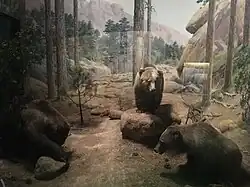 | ||
| 1977 | Barbodes katolo | Lake Lanao, Mindanao, Philippines | 2020 (IUCN) | Predation by introduced tank goby and ornate sleeper.[419][420] | ||
| Barbodes manalak | ||||||
| Gonâve eastern chat-tanager | Calyptophilus frugivorus abbotti | Gonâve Island, Haiti | Deforestation.[16] | |||
| Golden partula | Partula aurantia | Moorea, Society Islands, French Polynesia | 1988 (IUCN) | Predation by introduced rosy wolfsnails.[421][422][423] | ||
| Burch's partula | Partula jackieburchi | Tahiti, Society Islands, French Polynesia | 1996 (IUCN) | |||
| Tahitian banded tree snail | Partula producta | Faurahi Valley, Tahiti, French Polynesia | 1994 (IUCN) |  | ||
| Colombian grebe | Podiceps andinus | Bogotá wetlands, Colombia | 1994 (IUCN) | Habitat loss, pollution, hunting, and predation of chicks by introduced rainbow trout.[424] | ||
| Eiao monarch | Pomarea fluxa | Eiao, Marquesas Islands, French Polynesia | 2006 (IUCN) | Possibly predation by introduced cats, black rats, and Polynesian rats; disease transmitted by introduced chestnut-breasted mannikin, and habitat loss due to grazing by sheep.[425] | ||
| 1978 | Albizia lankaensis | Ramboda, Sri Lanka | Deforestation.[426] | |||
| Craugastor myllomyllon | Finca Volcán, Alta Verapaz, Guatemala | 2020 (IUCN) | Habitat destruction for agriculture.[427] | |||
| White-eyed river martin[BC] | Eurochelidon sirintarae | Central Thailand | Hunting and habitat loss.[428] |  | ||
| Little earth hutia | Mesocapromys sanfelipensis | Key Juan García, Cuba | Hunting, man-made fires, and competition with black rats.[429] |  | ||
| Miss Waldron's red colobus[BD] | Piliocolobus waldronae | Rainforests of Ghana and Ivory Coast | 2000[430] | Hunting and deforestation.[431] | ||
| 1979 | Short Spider-orchid | Caladenia brachyscapa | Warrnambool, Victoria and Clarke Island, Tasmania, Australia | Undetermined.[432][433] | ||
| Magnificent spider-orchid | Caladenia magnifica | Central Victoria, Australia | ||||
| Yunnan lake newt | Hypselotriton wolterstorffi | Kunming Lake, Yunnan, China | 2005 (IUCN) | Pollution, habitat destruction, and introduced fish and frog species.[434] | 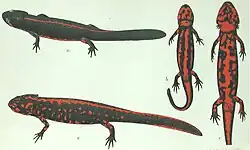 | |
| Japanese otter | Lutra nippon[435] | Honshu, Kyushu, and Shikoku, Japan | 2012 | Hunting and habitat loss.[436] |  | |
| British large blue | Phengaris arion eutyphron | Southern Britain | Undetermined.[437] |  | ||
| Mount Glorious day frog | Taudactylus diurnus | Southeast Queensland, Australia | 2008 (IUCN) | Undetermined.[438] | ||
| Caspian tiger[BE] | Panthera tigris virgata | Central and Western Asia | 2007 (IUCN) | Hunting and habitat destruction.[439][BF] |  |
1980s
| Last record | Common name | Binomial name | Former range | Declared extinct | Causes | Picture |
|---|---|---|---|---|---|---|
| 1980 | Basananthe cupricola | Mine de l'Etoile, Katanga Copperbelt, Democratic Republic of the Congo | Habitat destruction caused by surface mining.[440] | |||
| Olomaʻo[BG] | Myadestes lanaiensis | Maui, Lana'i, and Molokai, Hawaii | Disease and habitat degradation caused by introduced pigs, axis deer, and mosquitos.[441] |  | ||
| Dutch alcon blue | Phengaris alcon arenaria | Utrecht and Holland, Netherlands | Undetermined.[442] | |||
| 1980–1985 | Roberts's lechwe | Kobus leche robertsi | Luongo and Kalungwishi drainage systems, Luapula, Zambia | 1994 (IUCN) | Undetermined.[443] | |
| 1980-1989 | Taha'a banded tree snail | Partula bilineata | Taha'a, Society Islands, French Polynesia | 1996 (IUCN) | Predation by introduced rosy wolfsnails.[444][445][446] |  |
| Raiatean streaked tree snail | Partula dolichostoma | Raiatea, Society Islands, French Polynesia | 1994 (IUCN) | |||
| Taha'a hermit tree snail | Partula eremita | Taha'a, Society Islands, French Polynesia | 1996 (IUCN) | |||
| 1981 | Anabarilius macrolepis | Yilong Lake, Yunnan, China | 2011 (IUCN) | Drying of the lake for 20 days, after excessive water abstraction for agriculture.[447] | ||
| Mariana mallard[BH] | Anas platyrhynchos oustaleti | Mariana Islands | 2005 (IUCN) | Hunting and habitat loss to agriculture.[449] |  | |
| Yilong carp | Cyprinus yilongensis | Yilong Lake, Yunnan, China | 1996 (IUCN) | Drying of the lake after excessive water abstraction for agriculture.[450] | ||
| Canary Islands oystercatcher | Haematopus meadewaldoi | Lanzarote and Fuerteventura, Spain; Senegal | 1994 (IUCN) | Overharvesting of intertidal invertebrates.[451] |  | |
| Hernandia drakeana | Moorea, Society Islands, French Polynesia | 1998 (IUCN) | Undetermined.[452] | |||
| Puhielelu hibiscadelphus | Hibiscadelphus crucibracteatus | Lana'i, Hawaii, United States | 1998 (IUCN) | Predation by introduced axis deer.[85] | ||
| Bishop's ʻōʻō | Moho bishopi | Molokai, Hawaii, United States | 2000 (IUCN) | Habitat loss to agriculture and livestock grazing, followed by the introduction of black rats and disease-carrying mosquitos.[453] |  | |
| Chile Darwin's frog | Rhinoderma rufum | Valparaíso and Biobío, Chile | Chytridiomycosis?[454] | |||
| 1982 | Pait | Barbodes amarus | Lake Lanao, Mindanao, Philippines | 2020 (IUCN) | Predation by introduced fishes.[455] | |
| Samaná eastern chat-tanager | Calyptophilus frugivorus frugivorus | Samaná Peninsula, Dominican Republic | Deforestation.[16] | |||
| 1982–1983 | Galápagos damsel | Azurina eupalama | Galápagos Islands, Ecuador | 1982-83 El Niño event.[456][457] |  | |
| 24-rayed sunstar | Heliaster solaris | 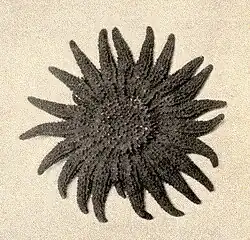 | ||||
| before 1983 | Ohridohauffenia drimica | Upper Drin River, North Macedonia | 1994 (IUCN) | Draining of the river.[458] | ||
| 1983 | Ivell's sea anemone | Edwardsia ivelli | Widewater Lagoon, West Sussex, England | Possibly water pollution.[459] |  | |
| San Marcos gambusia | Gambusia georgei | San Marcos spring and river, Texas, United States | 2021 (IUCN) | Reduced flow and pollution from agriculture, introduced fishes and plants (Colocasia esculenta), and hybridization with Gambusia affinis.[460] | ||
| Formosan clouded leopard[BI] | Neofelis nebulosa brachyura | Taiwan | 2013 | Hunting.[BJ] |  | |
| Aldabra brush-warbler | Nesillas aldabrana | Malabar Island, Seychelles | 1994 (IUCN) | Possibly predation by introduced cats and rats, and habitat degradation by goats and tortoises.[462] | ||
| Southern gastric-brooding frog[BK] | Rheobatrachus silus | Southeast Queensland, Australia | 2006 (IUCN) | Undetermined, possibly chytridiomycosis.[463] |  | |
| Escobilla de masca | Thesium psilotocladum | Barranco de Masca, Tenerife, Spain | Predation by introduced goats and rabbits.[464] | |||
| Guam bridled white-eye | Zosterops conspicillatus conspicillatus | Guam | Predation by introduced brown tree snakes.[16] |  | ||
| 1983–1986 | Atitlán grebe | Podilymbus gigas | Lake Atitlán, Guatemala | 1990 (IUCN) | Predation and competition with introduced largemouth bass, water level fall after the 1976 Guatemala earthquake, and degradation of breeding sites due to reed-cutting and tourism development.[465] |  |
| 1984 | Green blossom | Epioblasma torulosa gubernaculum | Tennessee River system, United States | Impoundment, siltation, and pollution.[381] |  | |
| Guam flycatcher[BL] | Myiagra freycineti | Guam | 2004 (IUCN) 2005[449] |
Predation by the introduced brown tree snake, possibly also introduced diseases.[16] |  | |
| Javan tiger | Panthera tigris sondaica | Java, Indonesia | 2010 (IUCN) | Hunting and habitat loss.[439][BM] |  | |
| 1984–1985 | Guam rufous fantail | Rhipidura rufifrons uraniae | Guam | Predation by introduced brown tree snakes.[16] |  | |
| c. 1985 | California condor louse | Colpocephalum californici | North America | Delousing of all surviving California condors before beginning their captive breeding program.[384] | ||
| 1985 | Kauai agrotis noctuid moth | Agrotis tephrias | Kauai, Maui, and possibly Hawaii (island), Hawaii, United States | Undetermined.[466] | ||
| Timucua heart lichen | Cora timucua | Florida, United States | Habitat destruction for urban development.[467] | |||
| Christmas Island shrew | Crocidura trichura | Christmas Island, Australia | Undetermined.[468] | |||
| Kāmaʻo[BN] | Myadestes myadestinus | Kauaʻi, Hawaii, United States | 2004 (IUCN) | Habitat loss and disease spread by introduced mosquitos.[469] |  | |
| Oldenlandia adscensionis | Green Mountain, Ascension Island | 1998 (IUCN) | Predation by introduced goats, sheep, rabbits, and rats; or competition with introduced plants.[470] |  | ||
| Oʻahu ʻalauahio | Paroreomyza maculata | Oahu, Hawaii, United States | Possibly disease spread by introduced mosquitos.[471] |  | ||
| Northern gastric-brooding frog | Rheobatrachus vitellinus | Mid-eastern Queensland, Australia | 2015 (IUCN) | Undetermined, possibly chytridiomycosis.[472] | ||
| Alaotra grebe[BO] | Tachybaptus rufolavatus | Lake Alaotra, Madagascar | 2010 (IUCN) | Hunting, accidental capture in nylon gillnets, predation and competition with introduced largemouth bass, striped snakehead, and Tilapia; habitat degradation from agriculture, and hybridization with the little grebe.[473] |  | |
| 1985-1989 | Taha'a large tree snail | Partula planilabrum | Taha'a, Society Islands, French Polynesia | 1996 (IUCN) | Predation by introduced rosy wolfsnails.[474][475][476] |  |
| Arrow-head tree snail | Partula sagitta | |||||
| Taha'a squat tree snail | Partula umbilicata |  | ||||
| 1986 | Pass stubfoot toad | Atelopus senex | Central Costa Rica | 2020 (IUCN) | Possibly chytridiomycosis or climate change.[477] | |
| Zanzibar leopard[BP] | Panthera pardus adersi | Unguja Island, Tanzania | Extermination campaign.[439][BQ] | 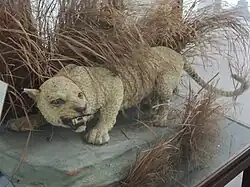 | ||
| Bora Bora tree snail | Partula lutea | Bora Bora, Society Islands, French Polynesia | 1994 (IUCN) | Predation by introduced rosy wolfsnails.[479] |  | |
| Eastern Canary Islands chiffchaff | Phylloscopus canariensis exsul | Lanzarote and Fuerteventura?, Canary Islands | Habitat loss?[16] | |||
| Banff longnose dace[480] | Rhinichthys cataractae smithi | Banff National Park, Alberta, Canada | 1987 | Habitat degradation, competition and hybridization with introduced fishes.[480] |  | |
| after 1986 | Coast dandelion | Taraxacum cygnorum | Australia | Undetermined.[481] | ||
| 1987 | Dusky seaside sparrow[BR] | Ammospiza maritima nigrescens | Merritt Island and the St. Johns River, Florida, United States | 1990 | Flooding and draining of marshes to reduce mosquito population.[482] |  |
| Cuban ivory-billed woodpecker[BS] | Campephilus principalis bairdii | Cuba | Habitat loss.[263] |  | ||
| Kauaʻi ʻōʻō | Moho braccatus | Kauaʻi, Hawaii, United States | 2021 (IUCN) | Habitat loss and introduced black rats, pigs, and disease-carrying mosquitos. The last female was killed by Hurricane Iwa during the 1982–1983 El Niño event.[483] |  | |
| Namibcypris costata | Southern Kaokoveld, Namibia | 1996 (IUCN) | Habitat destruction.[484] |  | ||
| Eskimo curlew[BT] | Numenius borealis | Northwestern Canada and Alaska, and Southern Cone | Hunting and habitat destruction.[485][486] |  | ||
| 1987–1993 | Moroccan bustard | Ardeotis arabs lynesi | Western Morocco | Undetermined.[16] |  | |
| before 1988 | Graecoanatolica macedonica | Doiran Lake, Greece-North Macedonia border | 2002 (IUCN) | Water substraction.[487] |  | |
| 1988 | Caladenia thysanochila | Mount Eliza, Victoria, Australia | Undetermined.[488] | |||
| Maui ʻakepa | Loxops ochraceus | Maui, Hawaii, United States | Undetermined.[489] |  | ||
| Bachman's warbler[490] | Vermivora bachmanii | Southeastern United States and Cuba | Habitat destruction from swampland draining and sugarcane agriculture.[491] |  | ||
| 1989 | Tunisian barb | Luciobarbus antinorii | Chott el Djerid, Tunisia | 2022 (IUCN) | Water substraction.[492] | |
| Golden toad | Incilius periglenes | Monteverde Cloud Forest Reserve, Costa Rica | 2005 (IUCN) | Anthropogenic global warming, chytridiomycosis, and airborne pollution.[493] |  | |
| ʻŌʻū[BU] | Psittirostra psittacea | Hawaii, United States | 2024 (IUCN) | Possibly habitat loss, predation by introduced rats, and malaria spread by exotic mosquitos.[494] |  | |
| Jamaican golden swallow | Tachycineta euchrysea euchrysea | Jamaica | Deforestation?[16] |  | ||
| Malabar large-spotted civet | Viverra civettina | Western Ghats, India | Possibly deforestation, hunting, and predation by domestic dogs.[495] |  | ||
| 1989-1990 | Long jaw tristramella | Tristramella sacra | Sea of Galilee | 2014 (IUCN) | Possibly destruction of its breeding habitat in the marshes of the northern shore of the lake.[496] |  |
1990s
| Last record | Common name | Binomial name | Former range | Declared extinct | Causes | Picture |
|---|---|---|---|---|---|---|
| c. 1990 | Zonites embolium | Islets of Dyo Adelfoi, Megali Zafrano, Karavonisi, and Divounia, inbetween Astypalaia and Karpathos, Greece | Possibly habitat degradation caused by military use, introduced rats and rabbits.[497] | |||
| 1990 | Canavalia veillonii | Bourail, New Caledonia | Deforestation caused by uncontrolled fires, clearing for agriculture, and predation by introduced rusa deer.[498] | |||
| Barbados scaly-breasted thrasher | Margarops fuscus atlantica | Barbados | Deforestation.[16] | |||
| Mountain mist frog | Mosleyia nyakalensis | Queensland, Australia | 2020 (IUCN) | Habitat loss and chytridiomycosis.[499] | ||
| 1990–1999 | Negros celestial monarch | Hypothymis coelestis rabori | Negros and possibly Sibuyan Island, Philippines | Deforestation.[16] | ||
| before 1991 | Garrett's rustic tree snail | Partula garrettii rustica | Raiatea, Society Islands, French Polynesia | 2022 (IUCN) | Predation by introduced rosy wolfsnails.[500] |  |
| 1991 | Baolan | Barbodes baoulan | Lake Lanao, Mindanao, Philippines | 2020 (IUCN) | Predation by introduced fishes.[501] | |
| Cambarellus alvarezi | Potosí Spring, Nuevo León, Mexico | 2010 (IUCN) | Water abstraction[502] | |||
| Thalia's tree snail | Partula garrettii thalia | Raiatea, Society Islands, French Polynesia | 2022 (IUCN) | Predation by introduced rosy wolfsnails.[503] |  | |
| Montane monkey-faced bat | Pteralopex pulchra | Mount Makarakomburu, Guadalcanal, Solomon Islands | Undetermined.[504] | |||
| 1991-1992 | Thick-lipped tree snail | Partula crassilabris | Raiatea, Society Islands, French Polynesia | 1994 (IUCN) | Predation by introduced rosy wolfsnails.[505][506][507] |  |
| Raiatean banded partula | Partula protracta | |||||
| Remote tree snail | Partula remota | |||||
| 1992 | Callerya neocaledonica | Nakutakoin, Dumbea, New Caledonia | Habitat degradation caused by uncontrolled fires and introduced cattle, pigs, and rusa deer.[508] | |||
| Tiwi Islands hooded robin | Melanodryas cucullata melvillensis | Melville and Bathurst Islands, Northern Territory, Australia | Possibly changes in the fire regime.[16] | |||
| Splendid poison frog | Oophaga speciosa | Western Panama | Chytridiomycosis.[509] |  | ||
| Raiatean ground partula | Partula atilis | Raiatea, Society Islands, French Polynesia | 1994 (IUCN) | Predation by introduced rosy wolfsnails.[510][511][512][513][514] | ||
| Auriculate tree snail | Partula auriculata |  | ||||
| Slender mountain tree snail | Partula dolorosa | 1996 (IUCN) | ||||
| Thin-lipped tree snail | Partula leptochila | 1994 (IUCN) | ||||
| Raiatean ground partula | Partula levistriata | |||||
| Aru flying fox | Pteropus aruensis | Aru Islands, Indonesia | Possibly hunting and deforestation caused by sugarcane plantation.[515] |  | ||
| 1993 | Angel Island mouse | Peromyscus guardia | Isla Ángel de la Guarda, Baja California, Mexico | Competition with introduced rodents and predation by cats.[516] | ||
| before 1994 | Pachnodus velutinus | Mahé, Seychelles | 2000 (IUCN) | Hybridization with Pachnodus niger.[517] |  | |
| 1994 | Huahine tiny tree snail | Partula arguta | Huahine, Society Islands, French Polynesia | 1996 (IUCN) | Predation by introduced rosy wolfsnails.[518] |  |
| c. 1995 | Aguijan reed warbler | Acrocephalus nijoi | Aguijan, Mariana Islands | 2000–2009[16] 2016 (IUCN) |
Habitat destruction caused by goats introduced in the 1950s.[519] | |
| 1995 | Pohnpei starling | Aplonis pelzelni | Pohnpei, Micronesia | Possibly habitat loss, hunting, and predation by introduced rats. |  | |
| Maui nukupu'u | Hemignathus affinis | Maui, Hawaii, United States | Undetermined.[16] |  | ||
| 1996 | Chiriqui harlequin frog | Atelopus chiriquiensis | Talamanca-Chiriqui mountains, Costa Rica | 2020 (IUCN) | Chytridiomycosis.[520] |  |
| Norfolk Island boobook | Ninox novaeseelandiae undulata | Norfolk Island, Australia | Deforestation leading to increased competition for nest-hollows with honeybees and crimson rosellas.[BV] |  | ||
| Barbary leopard | Panthera pardus panthera | Atlas Mountains | Hunting.[BW] |  | ||
| Swollen Raiatea Tree Snail[BX] | Partula turgida | Raiatea, Society Islands, French Polynesia | 1996 (IUCN) | Predation by introduced rosy wolfsnails.[521] |  | |
| 1997 | Green and red venter harlequin toad | Atelopus pinangoi | Mérida, Venezuela | Chytridiomicosis, habitat destruction, and predation by introduced trout.[522] | ||
| Sangihe dwarf kingfisher | Ceyx fallax sangirensis | Sangihe Islands, Indonesia | Habitat destruction.[16] |  | ||
| Sakaraha pygmy kingfisher | Corythornis madagascariensis dilutus | Southwestern Madagascar | Undetermined.[16][523] | |||
| Iberian lynx louse | Felicola isidoroi | Iberian Peninsula | ||||
| Ua Pou monarch | Pomarea mira | Ua Pou, Marquesas, French Polynesia | Deforestation and predation by introduced black rats.[524] | |||
| Sharp snouted day frog | Taudactylus acutirostris | Coastal north Queensland from Mount Graham to the Big Tableland | 2022 (IUCN) | Chytridiomycosis.[525] | ||
| 1999 | Tora hartebeest | Alcelaphus buselaphus tora | Southwestern Eritrea and the Ethiopian-Sudanese border | Agro-pastoral development and hunting.[526] | 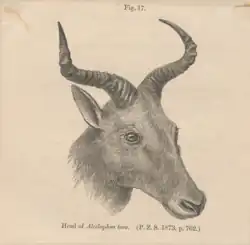 | |
| Bogardilla | Squalius palaciosi | Andújar, Spain | 2022 (IUCN) | Damming and the introduction of invasive species.[527] |
See also
Notes
- ↑ Unconfirmed report from 1977 (Hume, 2017).
- ↑ Unconfirmed reports from natives until the 1950s (IUCN).
- ↑ Unconfirmed reports until 1970 (IUCN).
- ↑ Unconfirmed reports between 1910 and 1996.[56]
- ↑ Unconfirmed reports until 1963 (IUCN).
- ↑ Unconfirmed record in 2000 (Hume).
- ↑ Unconfirmed record in 2000 (Hume).
- ↑ Unconfirmed sighting in 1963.[67]
- ↑ Unconfirmed sighting in 1925 (Hume).
- ↑ Reports from Tibet are erroneous (IUCN).
- ↑ Unconfirmed report in 1976 (IUCN).
- ↑ In captivity. Last confirmed sighting in the wild in 1901.[102] Unconfirmed sightings in the wild between 1902 and 1907.[103]
- ↑ Unidentified calls heard in 1960 could be of this species.[104]
- ↑ In captivity. Last confirmed sighting in the wild in 1910, with unconfirmed reports until the 1930s (IUCN).
- ↑ In captivity.[119] Last seen in the wild in 1879 (Jezierski and Jaworski, 2008).
- ↑ It was suggested that Bernard's wolf should be merged with the extant arctic wolf[122] or other wolves from the continent.[121]
- ↑ Last unconfirmed killing in 1938, and unconfirmed sighting in 1970 (Angelici & Rossi, 2018).
- ↑ Unconfirmed report in 2002 (Hume, 2017).
- ↑ Unconfirmed sightings in 1975 (IUCN).
- ↑ Date of last collection. Aboriginal Australians claimed it survived until around 1960, and a skull estimated to be over 15 years old was found in an owl nest in 1967 (IUCN).
- ↑ Unconfirmed sightings between 1970 and 2008 (IUCN).
- ↑ Unconfirmed sightings between 1977 and 2011 (IUCN).
- ↑ The subspecific differences between the Mogollon mountain wolf, Southern Rocky Mountain wolf, and surviving Great Plains wolf and Mexican wolf have been denied on morphological grounds.[122]
- ↑ Unconfirmed reports in 1985 (Hume, 2017).
- ↑ In captivity (IUCN). Last dated in New Guinea in 3050 BCE,[217] in mainland Australia in 1277-1229 BCE,[218] and in Tasmania in 1931.[219] Unconfirmed sightings between 1937 and 2000.[220]
- ↑ Unconfirmed sighting in 1972 (Rossi, 2020).
- ↑ Genetics do not support a subspecific differentiation with the living Sumatran tiger.[226]
- ↑ Unconfirmed sighting in 1967 (Hume, 2017).
- ↑ Unconfirmed sighting in 1992. Bolgiano, C. & Roberts, J. (2005) The Eastern Cougar: Historic Accounts, Scientific Investigations, and New Evidence. Stackpole Books, 246 pages.
- ↑ Genetics do not support subspecies differentiation between the eastern cougar and living cougars in Florida and Western North America;[226] if placed under a single subspecies, this would have the name P. c. couguar because of being older.
- ↑ In captivity. Last seen in the wild in 1932 (IUCN).
- ↑ In captivity. Last confirmed wild sighting in 1924; unconfirmed sightings between 1943 and the 1970s (IUCN).
- ↑ In captivity. Last recorded in the wild in 1915 (Mateo et al., 2020). Unconfirmed recent remains found in 2005 (IUCN).
- ↑ Unconfirmed record in 2002 (Hume).
- ↑ Unconfirmed sighting in 1966 (Boug & Islam, 2018).
- ↑ The Texas gray wolf has been at times included within either the living Great Plains wolf or the Mexican wolf on morphological grounds.[122]
- ↑ In captivity. Last confirmed sighting in the wild in 1929, a dubious one in 2004 (Hume, 2017).
- ↑ Unconfirmed sighting in 1956 (Rossi, 2020).
- ↑ Hybrid descendants are believed to exist in captivity.[257] However, genetics do not support subspecies differentiation with living wild lions in Asia, West and Central Africa,[226] which would be named P. l. leo if placed within a single subspecies.
- ↑ Unconfirmed sightings in the 1960s (IUCN).
- ↑ Unconfirmed recordings in 2008.[261][262]
- ↑ Survival to the early 1980s proposed on the basis of empty shells found in 1989 (IUCN).
- ↑ Unconfirmed sighting in 2011 (IUCN).
- ↑ Unconfirmed sightings in 1974 and 1975 (IUCN).
- ↑ Unconfirmed sighting in 1962.[303]
- ↑ In Ilin. Last dated in Mindoro in 50 BCE (Louys et al., 2021).
- ↑ Unconfirmed recording in 1997 (Hume, 2017).
- ↑ However, it's been argued that L. iridescens was not actually native to Fiji and that lack of post-1956 records is the result of diminished enthomological research after Fiji's independence.[318]
- ↑ Unconfirmed sightings and calls heard in 1998 (IUCN).
- ↑ Unconfirmed sighting in 2015 (IUCN).
- ↑ Unconfirmed sighting in 1971 (IUCN).
- ↑ Unconfirmed sightings in 1982-1983.[378]
- ↑ Scat from a dhole of unknown subspecies was found in the Bek-Tosot Conservancy of southern Kyrgyzstan in 2022.[392]
- ↑ Unconfirmed sighting in 1990 (Hume, 2017).
- ↑ Unconfirmed sighting in 1980 (Hume).
- ↑ A skin was found in possession of a hunter in 2002, and possible calls were heard in 2008 (IUCN).
- ↑ In captivity. Last individual in the wild killed in 1970 (Rossi).
- ↑ Genetics do not support subspecific differentiation with extant mainland tigers.[226]
- ↑ Unconfirmed sighting in 2005 (IUCN).
- ↑ In captivity. Last captured in the wild in 1979.[448]
- ↑ Unconfirmed sighting in 2019.[461]
- ↑ Subspecific status has been denied on morphological and genetic grounds.[226]
- ↑ In captivity. Last collected in the wild in 1981 (IUCN).
- ↑ In captivity. Last collected from the wild in 1983 (Hume).
- ↑ Genetics do not support subspecies differentiation with the extant Sumatran tiger; if placed in the same subspecies, this would have the name P. t. sondaica due to being older.[226]
- ↑ Unconfirmed reports until 1991 (IUCN).
- ↑ Unconfirmed sighting in 1988 (IUCN).
- ↑ Unconfirmed recording in 2018 (Rossi, 2020).
- ↑ This subspecies has been subsumed into the extant African leopard on morphological grounds.[478]
- ↑ In captivity. Last seen in the wild in 1980 (Walter, 1992).
- ↑ Unconfirmed sighting in 1998 (IUCN).
- ↑ Unconfirmed sighting in 2006 (Hume, 2017).
- ↑ Unconfirmed sightings after 1995 (IUCN).
- ↑ Descendants of hybrids with the New Zealand subspecies survive in the island.[16]
- ↑ The subspecies has been subsumed into the extant African leopard on morphological grounds.[478]
- ↑ In captivity. Last captured in the wild in 1992 (IUCN).
References
- ↑ S.L. Pimm, G.J. Russell, J.L. Gittleman and T.M. Brooks, The Future of Biodiversity, Science 269: 347–350 (1995)
- ↑ Boeskorov, G.G. (2003) The genetics of the modern moose and a review of its taxonomy. Cranium 20, Vol. 2: 31–45.
- ↑ Sipko, T.P. & Kholodova, M.V. (2009) Fragmentation of Eurasian moose populations during periods of population depression. Alces, Vol. 45: 25–34
- ↑ Platenberg R.; Powell R. (2017) [errata version of 2016 assessment]. "Borikenophis sanctaecrucis". IUCN Red List of Threatened Species. 2016 e.T40791A115177079. doi:10.2305/IUCN.UK.2016-3.RLTS.T40791A71740001.en.
- ↑ Freyhof, J.; Kottelat, M. (2008). "Coregonus hiemalis". IUCN Red List of Threatened Species. 2008 e.T135671A4175929. doi:10.2305/IUCN.UK.2008.RLTS.T135671A4175929.en.
- ↑ Moodley, Yoshan; Russo, Isa-Rita M.; Dalton, Desiré L.; Kotzé, Antoinette; Muya, Shadrack; Haubensak, Patricia; Bálint, Boglárka; Munimanda, Gopi K.; Deimel, Caroline; Setzer, Andrea; Dicks, Kara; Herzig-Straschil, Barbara; Kalthoff, Daniela C.; Siegismund, Hans R.; Robovský, Jan (8 February 2017). "Extinctions, genetic erosion and conservation options for the black rhinoceros (Diceros bicornis)". Scientific Reports. 7 (1) 41417. Bibcode:2017NatSR...741417M. doi:10.1038/srep41417. ISSN 2045-2322. PMC 5296875. PMID 28176810.
- ↑ World Conservation Monitoring Centre (1996). "Genophantis leahi". IUCN Red List of Threatened Species. 1996 e.T9000A12948738. doi:10.2305/IUCN.UK.1996.RLTS.T9000A12948738.en. Retrieved 16 December 2022.
- ↑ Lumsden, L.F.; Reardon, T.B. (2020). "Nyctophilus howensis". IUCN Red List of Threatened Species. 2020 e.T15006A22009211. doi:10.2305/IUCN.UK.2020-3.RLTS.T15006A22009211.en.
- ↑ Walker, A. & Medeiros, M.J. (2021). "Agrotis photophila". IUCN Red List of Threatened Species. 2021 e.T708A189703011. doi:10.2305/IUCN.UK.2021-3.RLTS.T708A189703011.en. Retrieved 16 November 2021.
- ↑ "NatureServe Explorer 2.0". explorer.natureserve.org. Retrieved 17 December 2022.
- ↑ World Conservation Monitoring Centre (1996). "Campsicnemus mirabilis". IUCN Red List of Threatened Species. 1996 e.T3719A10034887. doi:10.2305/IUCN.UK.1996.RLTS.T3719A10034887.en. Retrieved 16 December 2022.
- 1 2 3 Rózsa, L., & Vas, Z. (2015). Co-extinct and critically co-endangered species of parasitic lice, and conservation-induced extinction: should lice be reintroduced to their hosts?. Oryx, 49(1), 107–110
- ↑ NatureServe Explorer
- ↑ https://www.iucnredlist.org/species/179356/1576050
- ↑ Stephen T. Garnett & Gabriel M. Crowley (2000). "New Zealand Pigeon (Norfolk Island)" (PDF). The Action Plan for Australian Birds 2000. Environment Australia. Archived from the original (PDF) on 21 May 2011. Retrieved 8 December 2008.
- 1 2 3 4 5 6 7 8 9 10 11 12 13 14 15 16 17 18 19 20 21 22 23 24 25 26 27 28 29 30 31 32 33 34 35 36 37 38 39 40 41 42 43 44 45 46 47 48 49 50 51 52 53 54 55 56 57 58 59 60 61 62 63 64 65 66 67 68 69 70 71 72 73 74 75 76 77 78 79 80 81 82 83 84 85 86 87 Hume, J.P. (2017) Extinct Birds. Bloomsbury Publishing, 560 pages.
- ↑ https://explorer.natureserve.org/Taxon/ELEMENT_GLOBAL.2.116945/Achatinella_buddii
- ↑ Mollusc Specialist Group (1996). "Achatinella buddii". IUCN Red List of Threatened Species. 1996 e.T170A13040003. doi:10.2305/IUCN.UK.1996.RLTS.T170A13040003.en. Retrieved 15 November 2021.
- ↑ Mollusc Specialist Group (1996). "Achatinella caesia". IUCN Red List of Threatened Species. 1996 e.T173A13041958. doi:10.2305/IUCN.UK.1996.RLTS.T173A13041958.en. Retrieved 14 November 2021.
- ↑ Mollusc Specialist Group (1996). "Achatinella decora". IUCN Red List of Threatened Species. 1996 e.T179A13044905. doi:10.2305/IUCN.UK.1996.RLTS.T179A13044905.en. Retrieved 14 November 2021.
- ↑ https://explorer.natureserve.org/Taxon/ELEMENT_GLOBAL.2.110408/Achatinella_caesia
- ↑ https://explorer.natureserve.org/Taxon/ELEMENT_GLOBAL.2.121194/Achatinella_decora
- ↑ World Conservation Monitoring Centre (1996). "Scotorythra megalophylla". IUCN Red List of Threatened Species. 1996 e.T20074A9144387. doi:10.2305/IUCN.UK.1996.RLTS.T20074A9144387.en. Retrieved 16 December 2022.
- ↑ World Conservation Monitoring Centre (1996). "Scotorythra nesiotes". IUCN Red List of Threatened Species. 1996 e.T20075A9144489. doi:10.2305/IUCN.UK.1996.RLTS.T20075A9144489.en. Retrieved 16 December 2022.
- ↑ https://explorer.natureserve.org/Taxon/ELEMENT_GLOBAL.2.108066/Achatinella_thaanumi
- ↑ Mollusc Specialist Group (1996). "Achatinella thaanumi". IUCN Red List of Threatened Species. 1996 e.T202A13049902. doi:10.2305/IUCN.UK.1996.RLTS.T202A13049902.en. Retrieved 16 November 2021.
- ↑ Ford, M. (2024). "Chondrostoma scodrense". IUCN Red List of Threatened Species. 2024 e.T61345A137244103. doi:10.2305/IUCN.UK.2024-2.RLTS.T61345A137244103.en. Retrieved 30 January 2025.
- ↑ Mollusc Specialist Group (1996). "Leucocharis loyaltiensis". IUCN Red List of Threatened Species. 1996 e.T11895A3313377. doi:10.2305/IUCN.UK.1996.RLTS.T11895A3313377.en. Retrieved 20 November 2021.
- ↑ https://www.iucnredlist.org/species/11896/3313425
- ↑ "New species of extinct pig-footed bandicoot described from Australia". nhm.ac.uk. Retrieved 26 April 2022.
- ↑ Burbidge, A.A.; Woinarski, J. (2016). "Chaeropus ecaudatus". IUCN Red List of Threatened Species. 2016 e.T4322A21965168. doi:10.2305/IUCN.UK.2016-2.RLTS.T4322A21965168.en.
- ↑ https://www.iucnredlist.org/species/36270/2864543
- ↑ NatureServe
- ↑ https://www.iucnredlist.org/species/65611976/66172553
- ↑ "Opercularia acolytantha ? Esperance Dog Weed". Environment.gov.au. Retrieved 26 June 2026.
- ↑ BirdLife International (2016). "Viridonia sagittirostris". IUCN Red List of Threatened Species. 2016 e.T22720784A94682950. doi:10.2305/IUCN.UK.2016-3.RLTS.T22720784A94682950.en.
- ↑ Musser, G. G.; Carleton, M. D. (2005). "Notomys longicaudatus". In Wilson, D. E.; Reeder, D. M. (eds.). Mammal Species of the World: A Taxonomic and Geographic Reference (3rd ed.). Johns Hopkins University Press. pp. 894–1531. ISBN 978-0-8018-8221-0. OCLC 62265494.
- ↑ Burbidge, A.A.; Woinarski, J. (2016). "Notomys longicaudatus". IUCN Red List of Threatened Species. 2016 e.T14864A22401520. doi:10.2305/IUCN.UK.2016-1.RLTS.T14864A22401520.en. Retrieved 13 November 2021.
- ↑ Robischon, Marcel (February 2015). "Blue Tigers, Black Tapirs, & the Pied Raven of the Faroe Islands: Teaching Genetic Drift Using Real-Life Animal Examples". The American Biology Teacher. 77 (2): 108–112. doi:10.1525/abt.2015.77.2.5. JSTOR 10.1525/abt.2015.77.2.5. S2CID 85886338.
- ↑ https://www.iucnredlist.org/species/203776/2771321
- ↑ Hochkirch, A. (2014). "Melanoplus spretus". IUCN Red List of Threatened Species. 2014. doi:10.2305/IUCN.UK.2014-1.RLTS.T51269349A55309428.en.
- ↑ BirdLife International (2016). "Mergus australis". IUCN Red List of Threatened Species. 2016 e.T22680496A92864737. doi:10.2305/IUCN.UK.2016-3.RLTS.T22680496A92864737.en.
- ↑ https://www.iucnredlist.org/species/193438/8860728
- ↑ BirdLife International (2016). "Turnagra tanagra". IUCN Red List of Threatened Species. 2016 e.T22728820A94997902. doi:10.2305/IUCN.UK.2016-3.RLTS.T22728820A94997902.en.
- ↑ IUCN SSC East African Plants Red List Authority (2013). "Agelanthus rondensis". IUCN Red List of Threatened Species. 2013 e.T179885A1593243. doi:10.2305/IUCN.UK.2013-2.RLTS.T179885A1593243.en. Retrieved 18 November 2021.
- ↑ BirdLife International (2016). "Caracara lutosa". IUCN Red List of Threatened Species. 2016 e.T22728892A94999996. doi:10.2305/IUCN.UK.2016-3.RLTS.T22728892A94999996.en.
- ↑ https://www.iucnredlist.org/species/65611923/66173007
- 1 2 3 4 5 6 7 8 9 10 11 12 13 14 15 16 17 18 19 20 21 22 23 Miller, R.R., Williams, J.D., & Williams, J.E. (1989). Extinctions of North American fishes during the past century. Fisheries, 14(6), 22–38.
- ↑ "Pultenaea maidenii ? Maiden's Bush-pea". Environment.gov.au. Retrieved 26 June 2026.
- ↑ Corrick, Margaret G. "Pultenaea maidenii". Royal Botanic Gardens Victoria. Retrieved 28 July 2021.
- ↑ Holland, Daryl. "The Stories of Australia's Botanical Biodiversity". University of Melbourne. Retrieved 28 July 2021.
- ↑ BirdLife International (2012). "Microgoura meeki". IUCN Red List of Threatened Species. 2012 e.T22691086A39248835. doi:10.2305/IUCN.UK.2012-1.RLTS.T22691086A39248835.en.
- 1 2 Beall, L. (1 November 2023). "Unwelcome Guests – Coextinction of Parasites". TheExtinctions. Retrieved 21 August 2023.
- ↑ Lamoreux, J.; Woinarski, J.; Burbidge, A.A. (2016). "Rattus macleari". IUCN Red List of Threatened Species. 2016 e.T19344A22440729. doi:10.2305/IUCN.UK.2016-1.RLTS.T19344A22440729.en. Retrieved 12 November 2021.
- ↑ Freyhof, J. & Kottelat, M. (2008). "Salvelinus neocomensis". IUCN Red List of Threatened Species. 2008 e.T135421A4127253. doi:10.2305/IUCN.UK.2008.RLTS.T135421A4127253.en. Retrieved 13 January 2018.
- ↑ Yoshiyuki M., Imaizumi Y., Record of Canis hodophirax Temminck, 1839 captured in the garden of the Castle of Fukui, Fukui Prefecture, Japan.
- ↑ Ishiguro, Naotaka; Inoshima, Yasuo; Shigehara, Nobuo (2009). "Mitochondrial DNA Analysis of the Japanese Wolf (Canis Lupus Hodophilax Temminck, 1839) and Comparison with Representative Wolf and Domestic Dog Haplotypes". Zoological Science. 26 (11): 765–70
- ↑ Morita M., Yagi H., 2015, Size estimation of so-called "Chichibu wild dog" from photographs: comparison with known structures and application of super-impose method., ISSN 1345-1987, Animate (12), pp. 1–10 (pdf)
- ↑ Knight, J. (1997) "On the extinction of the Japanese wolf." Asian Folklore Studies, Vol. 56, Nº1.
- ↑ Griffiths, O. (1996). "Gibbus lyonetianus". IUCN Red List of Threatened Species. 1996 e.T9179A12967161. doi:10.2305/IUCN.UK.1996.RLTS.T9179A12967161.en. Retrieved 17 November 2021.
- ↑ BirdLife International (2016). "Turnagra capensis". IUCN Red List of Threatened Species. 2016 e.T22705595A94026176. doi:10.2305/IUCN.UK.2016-3.RLTS.T22705595A94026176.en.
- ↑ BirdLife International (2016). "Anthornis melanocephala". IUCN Red List of Threatened Species. 2016 e.T22728814A94997726. doi:10.2305/IUCN.UK.2016-3.RLTS.T22728814A94997726.en.
- ↑ Woinarski, J.C.Z.; Burbidge, A.A. (2025). "Perameles myosuros". IUCN Red List of Threatened Species. 2025 e.T217035435A217035444. Retrieved 10 October 2025.
- ↑ https://plants.jstor.org/stable/10.5555/al.ap.specimen.p00136957
- ↑ A. Assi (1998). "Argocoffeopsis lemblinii". The IUCN Red List of Threatened Species. 1998. IUCN: e.T18290783A9687680. doi:10.2305/IUCN.UK.1998.RLTS.T18290783A9687680.en.
- ↑ BirdLife International (2016). "Drepanis funerea". IUCN Red List of Threatened Species. 2016 e.T22720852A94686803. doi:10.2305/IUCN.UK.2016-3.RLTS.T22720852A94686803.en.
- ↑ Higgins, Peter Jeffrey; Peter, John M; Cowling, SJ, eds. (2006). Handbook of Australian, New Zealand and Antarctic Birds. Volume 7: Boatbill to Starlings, Part A: Boatbill to Larks. Melbourne: Oxford University Press.
- ↑ Barrie, Heather; Robertson, Hugh (2005). The Field Guide to the Birds of New Zealand (Revised ed.). Viking.
- ↑ Macadam, C. (2022). "Poecilobothrus majesticus". IUCN Red List of Threatened Species. 2022 e.T123671476A123674314. doi:10.2305/IUCN.UK.2022-1.RLTS.T123671476A123674314.en. Retrieved 26 April 2023.
- ↑ Mey, Eberhard (1990): Eine neue ausgestorbene Vogel-Ischnozere von Neuseeland, Huiacola extinctus (Insecta, Phthiraptera). Zoologischer Anzeiger 224(1/2): 49–73
- ↑ Auld, T.; Weston, P. (2020). "Persoonia laxa". IUCN Red List of Threatened Species. 2020 e.T113204000A113309830. doi:10.2305/IUCN.UK.2020-3.RLTS.T113204000A113309830.en.
- ↑ Day, David (1989). Vanished Animals. Gallery Books. p. 196. ISBN 978-0-8317-2782-6.
- ↑ Byun, S. A., Koop, B. F., & Reimchen, T. E. (2002). "Evolution of the Dawson caribou (Rangifer tarandus dawsoni)". Canadian Journal of Zoology, 80 (5): 956–960.
- ↑ https://www.iucnredlist.org/species/202768/2752129
- ↑ Fukui, D.; Sano, A. (2020). "Pipistrellus sturdeei". IUCN Red List of Threatened Species. 2020 e.T17365A22123157. doi:10.2305/IUCN.UK.2020-2.RLTS.T17365A22123157.en.
- ↑ Vinciguerra, R. (2009). Osservazioni su Urania sloanus (Cramer, 1779)(Lepidoptera: Uraniidae). SHILAP Revista de Lepidopterología, 37(147), 307–311.
- ↑ Lees, D.C. & Smith, N.G. (1991). "Foodplants of the Uraniinae (Uraniinae) and their Systematic, Evolutionary and Ecological Significance". Journal of the Lepidopterists' Society. 45: 297–347. Retrieved 3 August 2015.
- ↑ BirdLife International (2016). "Zosterops strenuus". IUCN Red List of Threatened Species. 2016 e.T22714223A94406811. doi:10.2305/IUCN.UK.2016-3.RLTS.T22714223A94406811.en.
- ↑ NatureServe
- ↑ "NatureServe Explorer 2.0". explorer.natureserve.org. Retrieved 17 December 2022.
- ↑ Orthopteroid Specialist Group (1996). "Leptogryllus deceptor". IUCN Red List of Threatened Species. 1996 e.T11690A3301867. doi:10.2305/IUCN.UK.1996.RLTS.T11690A3301867.en. Retrieved 10 May 2020.
- ↑ https://recentlyextinctspecies.com/orthoptera-grasshoppers-locusts-crickets-wetas-and-katydids/leptogryllus-deceptor
- ↑ Schodde R, Mason IJ (1999). The Directory of Australian Birds: Passerines. A Taxonomic and Zoogeographic Atlas of the Biodiversity of Birds in Australia and its Territories. Collingwood, Australia: CSIRO Publishing. pp. x 851 pp. ISBN 0-643-06456-7.
- ↑ BirdLife International (2016). "Quiscalus palustris". IUCN Red List of Threatened Species. 2016 e.T22724314A94859972. doi:10.2305/IUCN.UK.2016-3.RLTS.T22724314A94859972.en.
- 1 2 Champion, J.H. (2020) Biogeography and phylogenetics of the Hawaiian endemic Hibiscadelphus, Hau Kuahiwi (Malvaceae).
- ↑ "Hibiscadelphus wilderianus". IUCN Red List of Threatened Species. 1998 e.T30397A9536660. 1998. doi:10.2305/IUCN.UK.1998.RLTS.T30397A9536660.en.
- ↑ Walker, A. & Medeiros, M.J. (2021). "Agrotis laysanensis". IUCN Red List of Threatened Species. 2021 e.T707A189702983. doi:10.2305/IUCN.UK.2021-3.RLTS.T707A189702983.en. Retrieved 16 December 2022.
{{cite journal}}: CS1 maint: multiple names: authors list (link) - ↑ World Conservation Monitoring Centre (1996). "Helicoverpa minuta". IUCN Red List of Threatened Species. 1996 e.T9809A13018521. doi:10.2305/IUCN.UK.1996.RLTS.T9809A13018521.en. Retrieved 16 December 2022.
- ↑ Barstow, M. (2023). "Hopea shingkeng". IUCN Red List of Threatened Species. 2023 e.T33469A149814208. doi:10.2305/IUCN.UK.2023-1.RLTS.T33469A149814208.en. Retrieved 28 February 2024.
- ↑ World Conservation Monitoring Centre (1996). "Hypena laysanensis". IUCN Red List of Threatened Species. 1996 e.T10637A3206838. doi:10.2305/IUCN.UK.1996.RLTS.T10637A3206838.en. Retrieved 16 December 2022.
- ↑ Lyal, C. (2014). "Rhyncogonus bryani". IUCN Red List of Threatened Species. 2014 e.T19724A21424429. doi:10.2305/IUCN.UK.2014-1.RLTS.T19724A21424429.en. Retrieved 16 December 2022.
- ↑ BirdLife International (2025). "Turnix novaecaledoniae". IUCN Red List of Threatened Species. 2025 e.T22734789A250389068. doi:10.2305/IUCN.UK.2025-2.RLTS.T22734789A250389068.en.
- ↑ World Conservation Monitoring Centre (2021). "Agrotis cremata". IUCN Red List of Threatened Species. 2021 e.T188974686A189703107. doi:10.2305/IUCN.UK.2021-3.RLTS.T188974686A189703107.en. Retrieved 16 December 2022.
- ↑ Walker, A. & Medeiros, M.J. (2021). "Agrotis procellaris". IUCN Red List of Threatened Species. 2021 e.T709A189703039. doi:10.2305/IUCN.UK.2021-3.RLTS.T709A189703039.en. Retrieved 16 December 2022.
{{cite journal}}: CS1 maint: multiple names: authors list (link) - ↑ de Lange, P. (2014). "Myosotis laingii". IUCN Red List of Threatened Species. 2014 e.T62798327A62798331. doi:10.2305/IUCN.UK.2014-2.RLTS.T62798327A62798331.en. Retrieved 1 June 2024.
- ↑ BirdLife International (2018). "Hydrobates macrodactylus". IUCN Red List of Threatened Species. 2018 e.T22698530A132651919. doi:10.2305/IUCN.UK.2018-2.RLTS.T22698530A132651919.en.
- ↑ Ford, M. (2024). "Salvelinus inframundus". IUCN Red List of Threatened Species. 2024 e.T135414A137331529. doi:10.2305/IUCN.UK.2024-2.RLTS.T135414A137331529.en. Retrieved 14 February 2025.
- ↑ https://www.iucnredlist.org/species/68501557/68715503
- ↑ BirdLife International (2019). "Charmosyna diadema". IUCN Red List of Threatened Species. 2019 e.T22684689A156512185. doi:10.2305/IUCN.UK.2019-3.RLTS.T22684689A156512185.en.
- ↑ https://www.iucnredlist.org/species/44392986/44494562
- ↑ Mollusc Specialist Group (1996). "Partulina montagui". IUCN Red List of Threatened Species. 1996 e.T16353A5612122. doi:10.2305/IUCN.UK.1996.RLTS.T16353A5612122.en. Retrieved 8 January 2023.
- ↑ Greenberg, J. (2014) A Feathered River Across the Sky: The Passenger Pigeon's Flight to Extinction. New York: Bloomsbury USA. ISBN 978-1-62040-534-5.
- ↑ Fuller, E. (2014). The Passenger Pigeon. Princeton and Oxford: Princeton University Press. ISBN 978-0-691-16295-9.
- ↑ Williams, G. R. & Harrison, M. (1972): The Laughing Owl Sceloglaux albifacies (Gray. 1844): A general survey of a near-extinct species. Notornis 19(1): 4–19.
- ↑ BirdLife International (2016). "Sceloglaux albifacies". IUCN Red List of Threatened Species. 2016 e.T22689496A93232295. doi:10.2305/IUCN.UK.2016-3.RLTS.T22689496A93232295.en.
- ↑ "NatureServe Explorer 2.0". explorer.natureserve.org. Retrieved 18 December 2022.
- ↑ Mollusc Specialist Group (1996). "Partulina crassa". IUCN Red List of Threatened Species. 1996 e.T16351A5610123. doi:10.2305/IUCN.UK.1996.RLTS.T16351A5610123.en. Retrieved 17 November 2021.
- ↑ Lorvelec, Olivier; Pascal, Michel; Pavis, Claudie & Feldmann, Philippe (2007), "Amphibians and reptiles of the French West Indies: Inventory, threats and conservation", Applied Herpetology, 4 (2): 131–161, doi:10.1163/157075407780681356, S2CID 54651514
- ↑ Bangs, E.E. et al. (1982) "Effects of increased human populations on wildlife resources of the Kenai Peninsula." In Transsactions of the Forty-Seventh North American Wildlife and Natural Resources Conference, ed. Kenneth Sabol (Washington, D.C., 1982)
- ↑ https://www.iucnredlist.org/species/194641/2355096
- ↑ Dow, R.A. (2020). "Risiocnemis laguna". IUCN Red List of Threatened Species. 2020 e.T139565471A146602520. doi:10.2305/IUCN.UK.2020-1.RLTS.T139565471A146602520.en. Retrieved 2 June 2024.
- ↑ "Lepidium amissum". New Zealand Plant Conservation Network. Retrieved 26 May 2022.
- ↑ de Lange, P. (2014). "Lepidium amissum". IUCN Red List of Threatened Species. 2014 e.T62798275A62798278. doi:10.2305/IUCN.UK.2014-2.RLTS.T62798275A62798278.en. Retrieved 1 June 2024.
- ↑ Polhemus, D.A. (2020). "Megalagrion jugorum". IUCN Red List of Threatened Species. 2020 e.T12953A510761. doi:10.2305/IUCN.UK.2020-1.RLTS.T12953A510761.en.
- ↑ Cole, N. (2021). "Phelsuma edwardnewtonii". IUCN Red List of Threatened Species. 2021 e.T17432631A17432636. doi:10.2305/IUCN.UK.2021-2.RLTS.T17432631A17432636.en.
- 1 2 BirdLife International (2023). "Aplonis fusca". IUCN Red List of Threatened Species. 2023 e.T22710511A238884608. doi:10.2305/IUCN.UK.2023-1.RLTS.T22710511A238884608.en.
- ↑ BirdLife International (2016). "Conuropsis carolinensis". IUCN Red List of Threatened Species. 2016 e.T22685776A93087087. doi:10.2305/IUCN.UK.2016-3.RLTS.T22685776A93087087.en.
- ↑ BirdLife International (2017). "Dysmorodrepanis munroi". IUCN Red List of Threatened Species. 2017 e.T22720738A111776369. doi:10.2305/IUCN.UK.2017-1.RLTS.T22720738A111776369.en.
- ↑ Kaagan, L. M. (2000). The Horse in the Late Pleistocene and Holocene Britain. University of London, University College London (United Kingdom).
- ↑ Tadeusz Jezierski, Zbigniew Jaworski (2008). Das Polnische Konik. Die Neue Brehm-Bücherei Bd. 658, Westarp Wissenschaften, Hohenwarsleben.
- 1 2 Carbyn, L.N. et al. (1995) Ecology and conservation of wolves in a changing world. University of Alberta Press, 620 pages.
- 1 2 3 4 Chambers, S. M., Fain, S. R., Fazio, B., & Amaral, M. (2012). An account of the taxonomy of North American wolves from morphological and genetic analyses. North American Fauna, (77), 1–67.
- ↑ Members of the IUCN SSC Madagascar Plant Specialist Group (2015). "Bulbophyllum minax". IUCN Red List of Threatened Species. 2015 e.T68501333A68714444. doi:10.2305/IUCN.UK.2015-4.RLTS.T68501333A68714444.en. Retrieved 20 November 2021.
- ↑ Marshallia grandiflora NatureServe
- ↑ Parker, W.T. (1990) Red Wolf Recovery Plan. U.S. Fish and Wildlife Service, 110 pages.
- ↑ Freyhof, J.; Kottelat, M. (2008). "Coregonus fera". IUCN Red List of Threatened Species. 2008 e.T135627A4165119. doi:10.2305/IUCN.UK.2008.RLTS.T135627A4165119.en.
- ↑ Haevermans, T. (2019). "Euphorbia boinensis". IUCN Red List of Threatened Species. 2019 e.T44303A124142268. doi:10.2305/IUCN.UK.2019-2.RLTS.T44303A124142268.en. Retrieved 16 November 2021.
- ↑ Haevermans, T. (2004). "Euphorbia pirahazo". IUCN Red List of Threatened Species. 2004 e.T44423A10901671. doi:10.2305/IUCN.UK.2004.RLTS.T44423A10901671.en. Retrieved 17 November 2021.
- ↑ "Myoporum rimatarense". APNI. Retrieved 1 December 2015.
- ↑ BirdLife International; BirdLife International (2018) [amended version of 2016 assessment]. "Todiramphus gambieri". IUCN Red List of Threatened Species. 2018 e.T22683499A129640736. doi:10.2305/IUCN.UK.2018-2.RLTS.T22683499A129640736.en. Retrieved 9 June 2024.
- ↑ https://explorer.natureserve.org/Taxon/ELEMENT_GLOBAL.2.109765/Achatinella_lehuiensis
- ↑ Mollusc Specialist Group (1996). "Achatinella lehuiensis". IUCN Red List of Threatened Species. 1996 e.T186A13047687. doi:10.2305/IUCN.UK.1996.RLTS.T186A13047687.en. Retrieved 17 November 2021.
- ↑ "VicFlora: Prasophyllum colemaniarum". Vicflora.rbg.vic.gov.au. Retrieved 26 June 2026.
- ↑ BirdLife International (2016). "Ptilinopus mercierii". IUCN Red List of Threatened Species. 2016 e.T22691495A93314660. doi:10.2305/IUCN.UK.2016-3.RLTS.T22691495A93314660.en.
- ↑ "Acacia kingiana". Environment.gov.au. Retrieved 26 June 2026.
- ↑ Walker, A. & Medeiros, M.J. (2021). "Agrotis kerri". IUCN Red List of Threatened Species. 2021 e.T706A189702955. doi:10.2305/IUCN.UK.2021-3.RLTS.T706A189702955.en. Retrieved 16 December 2022.
{{cite journal}}: CS1 maint: multiple names: authors list (link) - ↑ Members of the IUCN SSC Madagascar Plant Specialist Group (2015). "Bulbophyllum tampoketsense". IUCN Red List of Threatened Species. 2015 e.T68501391A68700609. doi:10.2305/IUCN.UK.2015-4.RLTS.T68501391A68700609.en. Retrieved 22 October 2022.
- ↑ BirdLife International (2017). "Himatione fraithii". IUCN Red List of Threatened Species. 2017 e.T103829706A119553201. doi:10.2305/IUCN.UK.2017-3.RLTS.T103829706A119553201.en.
- ↑ Gonzalez-Oliva, L. (2020). "Monteverdia lineata". IUCN Red List of Threatened Species. 2020 e.T147088627A149821996. doi:10.2305/IUCN.UK.2020-3.RLTS.T147088627A149821996.en.
- ↑ Angelici, F. M.; Rossi, L. (2018). "A new subspecies of grey wolf (Carnivora, Canidae), recently extinct, from Sicily, Italy" (PDF). Bollettino del Museo Civico di Storia Naturale di Verona. 42: 3–15.
- ↑ NatureServe
- ↑ Turdus poliocephalus vinitinctus — Vinous-tinted Thrush, Species Profile and Threats Database, Department of the Environment and Heritage, Australia.
- ↑ Storer, T.I. & Tevis, L.P. (1996) California Grizzly. University of California Press, 335 pages.
- 1 2 Miller, C.; Waits, L.; Joyce, P. (2006). "Phylogeography and mitochondrial diversity of extirpated brown bear (Ursus arctos) populations in the contiguous United States and Mexico". Molecular Ecology. 15 (14): 4477–4485. Bibcode:2006MolEc..15.4477M. doi:10.1111/j.1365-294X.2006.03097.x. PMID 17107477. S2CID 7336900.
- ↑ Walker, A. & Medeiros, M.J. (2021). "Agrotis microreas". IUCN Red List of Threatened Species. 2021 e.T188988510A189703157. doi:10.2305/IUCN.UK.2021-3.RLTS.T188988510A189703157.en. Retrieved 16 December 2022.
{{cite journal}}: CS1 maint: multiple names: authors list (link) - ↑ Harper, F. (1945) Extinct and vanishing mammals of the Old World. American Committee for International Wild Life Protection, 850 pages.
- ↑ https://www.iucnredlist.org/species/68501446/68696538
- ↑ https://www.iucnredlist.org/species/68501442/68689893
- ↑ https://www.iucnredlist.org/species/68501420/68697920
- ↑ https://www.iucnredlist.org/species/68501327/68702167
- ↑ Pfab, M.F. (Gauteng Nature Conservation).; Victor, J.; et al. (National Botanical Institute) (2003). "Dicoma pretoriensis". IUCN Red List of Threatened Species. 2003 e.T39626A10252624. doi:10.2305/IUCN.UK.2003.RLTS.T39626A10252624.en. Retrieved 19 April 2023.
- ↑ Walker, A. & Medeiros, M.J. (2021). "Agrotis crinigera". IUCN Red List of Threatened Species. 2021 e.T704A189702899. doi:10.2305/IUCN.UK.2021-3.RLTS.T704A189702899.en. Retrieved 16 December 2022.
{{cite journal}}: CS1 maint: multiple names: authors list (link) - ↑ https://www.iucnredlist.org/species/68501358/68696790
- ↑ Álvarez-Castañeda, S.T.; Castro-Arellano, I. (2018). "Neotoma bryanti ssp. anthonyi". IUCN Red List of Threatened Species. 2018 e.T14576A124171511. doi:10.2305/IUCN.UK.2018-2.RLTS.T14576A124171511.en.
- ↑ BirdLife International (2016). "Alopecoenas salamonis". IUCN Red List of Threatened Species. 2016 e.T22691056A93301654. doi:10.2305/IUCN.UK.2016-3.RLTS.T22691056A93301654.en.
- ↑ Bashkirov, I. S. (1939). Caucasian European Bison. Moscow: Central Board for Reserves, Forest Parks and Zoological Gardens, Council of the People's Commissars of the RSFSR: 1–72. [In Russian.]
- ↑ Puzek, Z.; et al. (2002). European Bison Bison bonasus: Current State of the Species and an Action Plan for Its Conservation. Bialowieza: Mammal Research Institute, Polish Academy of Sciences.
- ↑ Peter Maas. "Equus hemionus hemippus". The Extinction Website. Archived from the original on 6 May 2010. Retrieved 20 November 2009.
- ↑ Torres, A.G.; Mutia, M.T.M.; Palla, H.P.; Muyot, M.C.; Leander, N.J.S. & Kesner-Reyes, K. (2021). "Exyrias volcanus". IUCN Red List of Threatened Species. 2021 e.T162160431A162160434. doi:10.2305/IUCN.UK.2021-1.RLTS.T162160431A162160434.en. Retrieved 2 June 2024.
- ↑ World Conservation Monitoring Centre (1996). "Helicoverpa confusa". IUCN Red List of Threatened Species. 1996 e.T9808A13018419. doi:10.2305/IUCN.UK.1996.RLTS.T9808A13018419.en. Retrieved 16 December 2022.
- ↑ "Scientific Illustration". Scientific Illustration. Retrieved 18 April 2019.
- ↑ Kerbis Peterhans, J. & Lavrenchenko, L. (2008). "Nilopegamys plumbeus". IUCN Red List of Threatened Species. 2008 e.T40766A10363474. doi:10.2305/IUCN.UK.2008.RLTS.T40766A10363474.en.
- ↑ Keir, M. (2020). "Ochrosia kilaueaensis". IUCN Red List of Threatened Species. 2020 e.T33562A83804687. doi:10.2305/IUCN.UK.2020-3.RLTS.T33562A83804687.en.
- 1 2 König, C., & Weick, F. (2008). Owls of the world. A&C Black.
- ↑ IUCN SSC Amphibian Specialist Group (2020). "Pseudophilautus malcolmsmithi". IUCN Red List of Threatened Species. 2020 e.T58869A156583167. doi:10.2305/IUCN.UK.2020-3.RLTS.T58869A156583167.en. Retrieved 18 November 2021.
- ↑ IUCN SSC Amphibian Specialist Group (2020). "Pseudophilautus rugatus". IUCN Red List of Threatened Species. 2020 e.T58895A156584657. doi:10.2305/IUCN.UK.2020-3.RLTS.T58895A156584657.en. Retrieved 18 November 2021.
- ↑ IUCN SSC Amphibian Specialist Group (2020). "Pseudophilautus zimmeri". IUCN Red List of Threatened Species. 2020 e.T58939A156586253. doi:10.2305/IUCN.UK.2020-3.RLTS.T58939A156586253.en. Retrieved 18 November 2021.
- ↑ Torres, A.G.; Kesner-Reyes, K.; Leander, N.J.S. & Capuli, E. (2021). "Silhouettea flavoventris". IUCN Red List of Threatened Species. 2021 e.T162160938A162160945. doi:10.2305/IUCN.UK.2021-1.RLTS.T162160938A162160945.en. Retrieved 2 June 2024.
- ↑ Juillet, N. (2011). "Viola cryana". IUCN Red List of Threatened Species. 2011 e.T165210A5990668. doi:10.2305/IUCN.UK.2011-1.RLTS.T165210A5990668.en.
- ↑ BirdLife International (2016). "Psephotellus pulcherrimus". IUCN Red List of Threatened Species. 2016 e.T22685156A93061054. doi:10.2305/IUCN.UK.2016-3.RLTS.T22685156A93061054.en.
- ↑ Members of the IUCN SSC Madagascar Plant Specialist Group (2015). "Bulbophyllum hirsutiusculum". IUCN Red List of Threatened Species. 2015 e.T68501540A68716388. doi:10.2305/IUCN.UK.2015-4.RLTS.T68501540A68716388.en. Retrieved 19 November 2021.
- ↑ BirdLife International (2016). "Gerygone insularis". IUCN Red List of Threatened Species. 2016 e.T22704724A93982219. doi:10.2305/IUCN.UK.2016-3.RLTS.T22704724A93982219.en.
- ↑ Bates, M.F.; Jacobsen, N. (2018). "Tetradactylus eastwoodae". IUCN Red List of Threatened Species. 2018 e.T21663A115653635. doi:10.2305/IUCN.UK.2018-2.RLTS.T21663A115653635.en.
- ↑ Threatened Species Scientific Committee (2021). Listing Advice Perameles papillon Nullarbor Barred Bandicoot. Canberra: Department of Agriculture, Water and the Environment. http://www.environment.gov.au/biodiversity/threatened/species/pubs/89865-listing-advice-03032021.pdf
- ↑ de Lange, P.; Martin, T.; McCormack, G. (2014). "Acalypha wilderi". IUCN Red List of Threatened Species. 2014 e.T199821A2612719. doi:10.2305/IUCN.UK.2014-1.RLTS.T199821A2612719.en.
- ↑ Mesterházy, A. (2020). "Scleria chevalieri". IUCN Red List of Threatened Species. 2020 e.T140414966A140414986. doi:10.2305/IUCN.UK.2020-2.RLTS.T140414966A140414986.en.
- ↑ "Thomasia gardneri ? Mt Holland Thomasia". Environment.gov.au. Retrieved 26 June 2026.
- ↑ West, D.; David, B.; Ling, N. (2014). "Prototroctes oxyrhynchus". IUCN Red List of Threatened Species. 2014 e.T18384A20887241. doi:10.2305/IUCN.UK.2014-3.RLTS.T18384A20887241.en. Retrieved 23 May 2022.
- ↑ https://www.iucnredlist.org/species/165235/5994236
- ↑ BirdLife International (2023). "Hypotaenidia pacifica". IUCN Red List of Threatened Species. 2023 e.T22692450A229345916. doi:10.2305/IUCN.UK.2023-1.RLTS.T22692450A229345916.en.
- ↑ BirdLife International (2016). "Pomarea nukuhivae". IUCN Red List of Threatened Species. 2016 e.T22732936A95052074. doi:10.2305/IUCN.UK.2016-3.RLTS.T22732936A95052074.en.
- ↑ Mollusc Specialist Group (1996). "Carelia anceophila". IUCN Red List of Threatened Species. 1996 e.T3875A10147634. doi:10.2305/IUCN.UK.1996.RLTS.T3875A10147634.en. Retrieved 16 November 2021.
- ↑ Mollusc Specialist Group (1996). "Carelia cumingiana". IUCN Red List of Threatened Species. 1996 e.T3878A10144285. doi:10.2305/IUCN.UK.1996.RLTS.T3878A10144285.en. Retrieved 17 November 2021.
- ↑ "People and nature on St Kilda". www.ihbc.org.uk. Archived from the original on 13 March 2016. Retrieved 12 January 2022.
- ↑ Tirira, D.G.; Weksler, M. (2019). "Nesoryzomys darwini". IUCN Red List of Threatened Species. 2019 e.T14706A22390382. doi:10.2305/IUCN.UK.2019-3.RLTS.T14706A22390382.en.
- 1 2 Mateo, J. A., Barone, R., Hernández-Acosta, C. N., & López-Jurado, L. F. (2020) La muerte anunciada de dos gigantes macaronésicos: el gran escinco caboverdiano, Chioninia coctei (Duméril & Bibron, 1839) y el lagarto de Salmor, Gallotia simonyi (Steindachner, 1889). Bol. Asoc. Herpetol. Esp. Vol. 31 (2), pgs. 3–30.
- ↑ Burbidge, A.A.; Woinarski, J. (2016). "Macrotis leucura". IUCN Red List of Threatened Species. 2016 e.T12651A21967376. doi:10.2305/IUCN.UK.2016-2.RLTS.T12651A21967376.en.
- ↑ World Conservation Monitoring Centre (1996). "Mecodema punctellum". IUCN Red List of Threatened Species. 1996 e.T12922A3398669. doi:10.2305/IUCN.UK.1996.RLTS.T12922A3398669.en. Retrieved 23 May 2022.
- ↑ Álvarez-Castañeda, S.T.; Castro-Arellano, I.; Lacher, T. (2018). "Neotoma bryanti ssp. bunkeri". IUCN Red List of Threatened Species. 2018 e.T14577A124171652. doi:10.2305/IUCN.UK.2018-2.RLTS.T14577A124171652.en.
- ↑ https://www.iucnredlist.org/species/68501579/68703243
- ↑ Platenberg, R.; de Queiroz, K.; Mahler, D.L. (2020). "Anolis roosevelti". IUCN Red List of Threatened Species. 2020 e.T1319A18967413. doi:10.2305/IUCN.UK.2020-3.RLTS.T1319A18967413.en.
- ↑ https://www.iucnredlist.org/species/162307/5571714
- ↑ Burbidge, A.A.; Woinarski, J. (2016). "Lagorchestes asomatus". IUCN Red List of Threatened Species. 2016 e.T11160A21954573. doi:10.2305/IUCN.UK.2016-2.RLTS.T11160A21954573.en. Retrieved 12 November 2021.
- ↑ BirdLife International (2016). "Tympanuchus cupido". IUCN Red List of Threatened Species. 2016 e.T22679514A92817099. doi:10.2305/IUCN.UK.2016-3.RLTS.T22679514A92817099.en.
- ↑ Rebecca Heisman (2016). "Tympanuchus cupido cupido (Heath Hen)" , jstor.org; retrieved 23 June 2017.
- ↑ Triantis, K. (2017). "Zonites siphnicus". IUCN Red List of Threatened Species. 2017 e.T171588A85579865. doi:10.2305/IUCN.UK.2017-3.RLTS.T171588A85579865.en. Retrieved 20 November 2021.
- ↑ Burbidge, A.A. & Zichy-Woinarski, J. (2016). "Bettongia anhydra". IUCN Red List of Threatened Species. 2016 e.T71510353A71510399. doi:10.2305/IUCN.UK.2016-2.RLTS.T71510353A71510399.en. Retrieved 2 June 2024.
- ↑ Rebelo, A.G.; Mtshali, H.; von Staden, L. (2020). "Leucadendron spirale". IUCN Red List of Threatened Species. 2020 e.T113166006A185559739. doi:10.2305/IUCN.UK.2020-3.RLTS.T113166006A185559739.en.
- ↑ Woinarski, J.C.Z.; Burbidge, A.A. (2024). "Leporillus apicalis". IUCN Red List of Threatened Species. 2024 e.T11633A254614193. doi:10.2305/IUCN.UK.2024-2.RLTS.T11633A254614193.en.
- ↑ IUCN SSC Amphibian Specialist Group (2020). "Pseudophilautus eximius". IUCN Red List of Threatened Species. 2020 e.T58839A156581975. doi:10.2305/IUCN.UK.2020-3.RLTS.T58839A156581975.en. Retrieved 18 November 2021.
- ↑ https://www.iucnredlist.org/species/179722/1588060
- ↑ https://www.iucnredlist.org/species/179471/1579695
- ↑ Dulvy, N.K.; Kyne, P.M.; Finucci, B.; White, W.T. (2020). "Carcharhinus obsoletus". IUCN Red List of Threatened Species. 2020 e.T115696622A115696628. doi:10.2305/IUCN.UK.2020-3.RLTS.T115696622A115696628.en.
- ↑ BirdLife International (2016). "Moho nobilis". IUCN Red List of Threatened Species. 2016 e.T22704342A93964244. doi:10.2305/IUCN.UK.2016-3.RLTS.T22704342A93964244.en.
- ↑ Tirira, D.G.; Weksler, M. (2019). "Nesoryzomys indefessus". IUCN Red List of Threatened Species. 2019 e.T14708A22390443. doi:10.2305/IUCN.UK.2019-1.RLTS.T14708A22390443.en.
- ↑ Marini, A. & Talbi, M. (2008) Desertification and Risk Analysis Using High and Medium Resolution Satellite Data: Training Workshop on Mapping Desertification, Springer Science & Business Media, 274 pages.
- ↑ Freyhof, J.; Ford, M. (2022). "Salmo pallaryi". IUCN Red List of Threatened Species. 2022 e.T61190A137327627. doi:10.2305/IUCN.UK.2022-1.RLTS.T61190A137327627.en.
- ↑ Woinarski, J.; Burbidge, A.A. (2016). "Caloprymnus campestris". IUCN Red List of Threatened Species. 2016 e.T3626A21961545. doi:10.2305/IUCN.UK.2016-2.RLTS.T3626A21961545.en.
- 1 2 3 4 Bergman, C. (2003). "10 – Partial List of Extinctions". Wild Echoes: Encounters with the Most Endangered Animals in North America. University of Illinois Press. p. 256. ISBN 0-252-07125-5.
- ↑ World Conservation Monitoring Centre (1998). "Otophora unilocularis". IUCN Red List of Threatened Species. 1998 e.T32434A9706746. doi:10.2305/IUCN.UK.1998.RLTS.T32434A9706746.en. Retrieved 16 November 2021.
- ↑ Salvador, A. (2009). Lagartija balear–Podarcis lilfordi (Günther, 1874). Enciclopedia Virtual de los Vertebrados Españoles. Madrid, Spain: Museo Nacional de Ciencias Naturales. http://www.vertebradosibericos.org/ (10 May 2018).
- ↑ La Isla de Las Ratas, Illa Redona, S'illa des Morts... Menorca.info
- ↑ https://www.iucnredlist.org/species/47347757/47347760
- ↑ https://www.iucnredlist.org/species/179240/1572100
- ↑ https://www.iucnredlist.org/species/158218/5190604
- ↑ BirdLife International (2016). "Columba jouyi". IUCN Red List of Threatened Species. 2016 e.T22690222A93265958. doi:10.2305/IUCN.UK.2016-3.RLTS.T22690222A93265958.en.
- ↑ Louys, J.; Braje, T. J.; Chang, C.-H.; Cosgrove, R.; Fitzpatrick, S. M.; Fujita, M.; Hawkins, S.; Ingicco, T.; Kawamura, A.; MacPhee, R. D. E.; McDowell, M. C.; Meijer, H. J. M.; Piper, P. J.; Roberts, P.; Simmons, A. H.; van den Bergh, G.; van der Geer, A.; Kealy, S.; O'Connor, S. (2021). "No evidence for widespread island extinctions after Pleistocene hominin arrival". Proceedings of the National Academy of Sciences of the United States of America. 118 (20) e2023005118. Bibcode:2021PNAS..11823005L. doi:10.1073/pnas.2023005118. ISSN 0027-8424. PMC 8157961. PMID 33941645.
- ↑ White, L.C. et al. (2018) High-quality fossil dates support a synchronous, Late Holocene extinction of devils and thylacines in mainland Australia. Biology Letters, 14(1), 20170642.
- ↑ Sleightholme, Stephen R.; Gordon, Tammy J.; Campbell, Cameron R. (2020). "The Kaine capture – questioning the history of the last Thylacine in captivity". Australian Zoologist. 41: 1–11.
- ↑ Brook, Barry W.; Sleightholme, Stephen R.; Campbell, Cameron R.; Jarić, Ivan; Buettel, Jessie C. (2023). "Resolving when (And where) the Thylacine went extinct". Science of the Total Environment. 877 162878. Bibcode:2023ScTEn.87762878B. bioRxiv 10.1101/2021.01.18.427214. doi:10.1016/j.scitotenv.2023.162878. hdl:1885/733812127. PMID 36934937.
- ↑ Burbidge, A.A.; Woinarski, J. (2016). "Thylacinus cynocephalus". IUCN Red List of Threatened Species. 2016 e.T21866A21949291. doi:10.2305/IUCN.UK.2016-2.RLTS.T21866A21949291.en.
- ↑ Coote, T. (2009). "Partula cuneata". IUCN Red List of Threatened Species. 2009 e.T16307A5600386. doi:10.2305/IUCN.UK.2009-2.RLTS.T16307A5600386.en. Retrieved 15 November 2021.
- ↑ O'Foighil, D. (2012). "Partula guamensis". IUCN Red List of Threatened Species. 2012 e.T16289A951183. doi:10.2305/IUCN.UK.2012.RLTS.T16289A951183.en. Retrieved 15 November 2021.
- ↑ IUCN (26 April 2023). Delissea sinuata: Keir, M.: The IUCN Red List of Threatened Species 2025: e.T173119104A173119116 (Report). International Union for Conservation of Nature. doi:10.2305/IUCN.UK.2025-2.RLTS.T173119104A173119116.en.
- ↑ Torres, A.G.; Leander, N.J.S.; Kesner-Reyes, K. & Ballad, E.L. (2021). "Neostethus ctenophorus". IUCN Red List of Threatened Species. 2021 e.T128710699A128710736. doi:10.2305/IUCN.UK.2021-1.RLTS.T128710699A128710736.en. Retrieved 2 June 2024.
- 1 2 3 4 5 6 Kitchener, A. C.; Breitenmoser-Würsten, C.; Eizirik, E.; Gentry, A.; Werdelin, L.; Wilting, A.; Yamaguchi, N.; Abramov, A. V.; Christiansen, P.; Driscoll, C.; Duckworth, J. W.; Johnson, W.; Luo, S.-J.; Meijaard, E.; O'Donoghue, P.; Sanderson, J.; Seymour, K.; Bruford, M.; Groves, C.; Hoffmann, M.; Nowell, K.; Timmons, Z.; Tobe, S. (2017). "A revised taxonomy of the Felidae: The final report of the Cat Classification Task Force of the IUCN Cat Specialist Group" (PDF). Cat News (Special Issue 11).
- ↑ BirdLife International (2023). "Paroreomyza montana". IUCN Red List of Threatened Species. 2023 e.T22720818A224944120. doi:10.2305/IUCN.UK.2023-1.RLTS.T22720818A224944120.en.
- ↑ BirdLife International (2017). "Porphyrio paepae". IUCN Red List of Threatened Species. 2017 e.T62263064A119207668. doi:10.2305/IUCN.UK.2017-3.RLTS.T62263064A119207668.en.
- ↑ FishBase team RMCA; Geelhand, D. (2016). "Barbus microbarbis". IUCN Red List of Threatened Species. 2016 e.T61247A47242030. doi:10.2305/IUCN.UK.2016-3.RLTS.T61247A47242030.en.
- ↑ https://explorer.natureserve.org/Taxon/ELEMENT_GLOBAL.2.119619/Achatinella_spaldingi
- ↑ Mollusc Specialist Group (1996). "Achatinella spaldingi". IUCN Red List of Threatened Species. 1996 e.T198A13049179. doi:10.2305/IUCN.UK.1996.RLTS.T198A13049179.en. Retrieved 17 November 2021.
- ↑ "Acianthus ledwardii". Environment.gov.au. Retrieved 26 June 2026.
- ↑ Gonzalez-Oliva, L. (2020). "Banara wilsonii". IUCN Red List of Threatened Species. 2020 e.T35254A149816104. doi:10.2305/IUCN.UK.2020-3.RLTS.T35254A149816104.en.
- ↑ Griffiths, O. (1996). "Colparion madgei". IUCN Red List of Threatened Species. 1996 e.T5166A11118882. doi:10.2305/IUCN.UK.1996.RLTS.T5166A11118882.en. Retrieved 17 November 2021.
- ↑ Malicky, H. (2014). "Hydropsyche tobiasi". IUCN Red List of Threatened Species. 2014 e.T10332A21426347. doi:10.2305/IUCN.UK.2014-1.RLTS.T10332A21426347.en. Retrieved 13 November 2021.
- ↑ "Northeast Region, U.S. Fish and Wildlife Service".
- ↑ Duckworth, J.W.; Robichaud, W.; Timmins, R. (2015). "Rucervus schomburgki". IUCN Red List of Threatened Species. 2015 e.T4288A79818502. doi:10.2305/IUCN.UK.2015-3.RLTS.T4288A79818502.en.
- ↑ BirdLife International (2018). "Turdus ravidus". IUCN Red List of Threatened Species. 2018 e.T22708835A129654803. doi:10.2305/IUCN.UK.2018-2.RLTS.T22708835A129654803.en.
- ↑ Jong, Yvonne (28 October 2017). "Mount Kenya potto, a 'lost' subspecies". Wild Solutions.
- ↑ Contu, S. (2013). "Cyperus chionocephalus". IUCN Red List of Threatened Species. 2013 e.T44393328A44490119. doi:10.2305/IUCN.UK.2013-1.RLTS.T44393328A44490119.en. Retrieved 1 March 2026.
- ↑ Burbidge, A.A.; Woinarski, J. (2018) [errata version of 2016 assessment]. "Macropus greyi". IUCN Red List of Threatened Species. 2016 e.T12625A128952836. doi:10.2305/IUCN.UK.2016-2.RLTS.T12625A21953169.en.
- ↑ Verdecia, R. (2020). "Roystonea stellata". IUCN Red List of Threatened Species. 2020 e.T38690A87708976. doi:10.2305/IUCN.UK.2020-3.RLTS.T38690A87708976.en.
- ↑ Bogan, A.E.; et al. (Mollusc Specialist Group) (2000). "Epioblasma arcaeformis". IUCN Red List of Threatened Species. 2000 e.T7863A12858623. doi:10.2305/IUCN.UK.2000.RLTS.T7863A12858623.en.
- ↑ BirdLife International (2017). "Akialoa obscura". IUCN Red List of Threatened Species. 2017 e.T22728910A119550231. doi:10.2305/IUCN.UK.2017-3.RLTS.T22728910A119550231.en.
- ↑ Vasconcelos, R. (2013). "Chioninia coctei". IUCN Red List of Threatened Species. 2013 e.T13152363A13152374. doi:10.2305/IUCN.UK.2013-1.RLTS.T13152363A13152374.en.
- ↑ IUCN SSC Amphibian Specialist Group (2020). "Pseudophilautus dimbullae". IUCN Red List of Threatened Species. 2020 e.T58835A156581915. doi:10.2305/IUCN.UK.2020-3.RLTS.T58835A156581915.en. Retrieved 18 November 2021.
- ↑ BirdLife International (2018). "Vanellus macropterus". IUCN Red List of Threatened Species. 2018 e.T22693962A129590644. doi:10.2305/IUCN.UK.2018-2.RLTS.T22693962A129590644.en.
- ↑ de Lange, P. (2014). "Stellaria elatinoides". IUCN Red List of Threatened Species. 2014 e.T62798337A62798340. doi:10.2305/IUCN.UK.2014-2.RLTS.T62798337A62798340.en. Retrieved 25 May 2022.
- ↑ Boug, A. & Islam, M.Z. (2018) "Dating Saudi Arabian Desert Surface Assemblages with Arabian Ostrich Struthio camelus syriacus Eggshell by C14: Propositions for Palaeoecology and Extinction". Biodiversity International Journal, Vol. 2, Issue 1: 107–113.
- ↑ Tilden, J. W. (1956). "San Francisco's Vanishing Butterflies" (PDF). The Lepidopterists' News: 113–115.
- ↑ https://www.iucnredlist.org/species/68501561/68693606
- ↑ https://www.iucnredlist.org/species/68501570/68701919
- ↑ British Wildlife Vol. 11 (1999). British Wildlife Pub.
- ↑ https://www.iucnredlist.org/species/179662/1586197
- ↑ Higgins, P.J.; Cowlin, SJ (2006). Handbook of Australian, New Zealand and Antarctic Birds. Volume 7: Boatbill to Starlings. Oxford University Press: Melbourne. p. 353. ISBN 0-19-553996-6.
{{cite book}}: CS1 maint: publisher location (link) - ↑ Mesterházy, A. (2020). "Eriocaulon inundatum". IUCN Red List of Threatened Species. 2020 e.T140416589A140416594. doi:10.2305/IUCN.UK.2020-2.RLTS.T140416589A140416594.en.
- ↑ Barnett, R.; Yamaguchi, N.; Barnes, I.; Cooper, A. (2006). "Lost populations and preserving genetic diversity in the lion Panthera leo: Implications for its ex situ conservation" (PDF). Conservation Genetics. 7 (4): 507–514. Bibcode:2006ConG....7..507B. doi:10.1007/s10592-005-9062-0. S2CID 24190889. Archived from the original (PDF) on 24 August 2006.
- ↑ Burbidge, A.A.; Woinarski, J. (2016). "Perameles eremiana". IUCN Red List of Threatened Species. 2016 e.T16570A21965953. doi:10.2305/IUCN.UK.2016-3.RLTS.T16570A21965953.en.
- ↑ https://www.iucnredlist.org/species/179300/1574514
- ↑ https://www.iucnredlist.org/species/179569/1582949
- ↑ Collins, Michael D. (2011). "Putative audio recordings of the Ivory-billed Woodpecker (Campephilus principalis)" (PDF). Journal of the Acoustical Society of America. 129 (3): 1626–1630. Bibcode:2011ASAJ..129.1626C. doi:10.1121/1.3544370. PMID 21428525. supplemental material Archived 4 April 2016 at the Wayback Machine
- ↑ Collins, Michael D. (2017). "Video evidence and other information relevant to the conservation of the Ivory-billed Woodpecker (Campephilus principalis)". Heliyon. 3 (1) e00230. Bibcode:2017Heliy...300230C. doi:10.1016/j.heliyon.2017.e00230. PMC 5282651. PMID 28194452.
- 1 2 BirdLife International (2020). "Campephilus principalis". IUCN Red List of Threatened Species. 2020 e.T22681425A182588014. doi:10.2305/IUCN.UK.2020-3.RLTS.T22681425A182588014.en.
- ↑ https://www.iucnredlist.org/species/179299/1574498
- ↑ BirdLife International (2016). "Zapornia palmeri". IUCN Red List of Threatened Species. 2016 e.T22692672A93363618. doi:10.2305/IUCN.UK.2016-3.RLTS.T22692672A93363618.en.
- ↑ "NatureServe Explorer 2.0". explorer.natureserve.org. Retrieved 9 January 2023.
- ↑ "NatureServe Explorer 2.0". explorer.natureserve.org. Retrieved 9 January 2023.
- ↑ "NatureServe Explorer 2.0". explorer.natureserve.org. Retrieved 9 January 2023.
- ↑ "NatureServe Explorer 2.0". explorer.natureserve.org. Retrieved 9 January 2023.
- ↑ https://explorer.natureserve.org/Taxon/ELEMENT_GLOBAL.2.109665/Achatinella_papyracea
- ↑ Mollusc Specialist Group (1996). "Achatinella papyracea". IUCN Red List of Threatened Species. 1996 e.T192A13048363. doi:10.2305/IUCN.UK.1996.RLTS.T192A13048363.en. Retrieved 15 November 2021.
- ↑ BirdLife International (2018). "Cinclus cinclus". IUCN Red List of Threatened Species. 2018 e.T22708156A131946814. doi:10.2305/IUCN.UK.2018-2.RLTS.T22708156A131946814.en. Retrieved 2 June 2024.
- ↑ BirdLife International (2016). "Hypotaenidia wakensis". IUCN Red List of Threatened Species. 2016 e.T22692447A93354203. doi:10.2305/IUCN.UK.2016-3.RLTS.T22692447A93354203.en.
- ↑ https://explorer.natureserve.org/Taxon/ELEMENT_GLOBAL.2.109764/Achatinella_juncea
- ↑ "NatureServe Explorer 2.0". explorer.natureserve.org. Retrieved 18 December 2022.
- ↑ "NatureServe Explorer 2.0". explorer.natureserve.org. Retrieved 18 December 2022.
- ↑ Mollusc Specialist Group (1996). "Partula salifana". IUCN Red List of Threatened Species. 1996 e.T16280A5596054. doi:10.2305/IUCN.UK.1996.RLTS.T16280A5596054.en. Retrieved 20 November 2021.
- ↑ Álvarez-Castañeda, S.T. (2018). "Peromyscus mekisturus". IUCN Red List of Threatened Species. 2018 e.T16675A22362990. doi:10.2305/IUCN.UK.2018-2.RLTS.T16675A22362990.en.
- ↑ Wright, D.; Leary, T. (2016). "Uromys emmae". IUCN Red List of Threatened Species. 2016 e.T136470A22447368. doi:10.2305/IUCN.UK.2016-2.RLTS.T136470A22447368.en. Retrieved 20 November 2021.
- ↑ https://www.iucnredlist.org/species/19891865/20110904
- ↑ IUCN SSC Amphibian Specialist Group (2020). "Pseudophilautus zal". IUCN Red List of Threatened Species. 2020 e.T58938A156586194. doi:10.2305/IUCN.UK.2020-3.RLTS.T58938A156586194.en. Retrieved 18 November 2021.
- ↑ BirdLife International (2016). "Rhodonessa caryophyllacea". IUCN Red List of Threatened Species. 2016 e.T22680344A125558688. doi:10.2305/IUCN.UK.2016-3.RLTS.T22680344A125558688.en.
- ↑ Turvey, S. & Helgen, K. (2008). "Geocapromys thoracatus". IUCN Red List of Threatened Species. 2008 e.T9003A12949306. doi:10.2305/IUCN.UK.2008.RLTS.T9003A12949306.en.
- ↑ https://www.iucnredlist.org/species/179777/1589760
- 1 2 de Lange, P. (2014). "Lepidium obtusatum". IUCN Red List of Threatened Species. 2014 e.T62798292A62798296. doi:10.2305/IUCN.UK.2014-2.RLTS.T62798292A62798296.en. Retrieved 25 May 2022.
- 1 2 "Lepidium obtusatum". New Zealand Plant Conservation Network. Retrieved 26 May 2022.
- ↑ Conroy, J.; Melisch, R. & Chanin, P. (1998). "The distribution and status of the Eurasian Otter (Lutra lutra) in Asia—a preliminary review". IUCN Otter Specialist Group Bulletin. 15 (1): 15–30.
- ↑ Strong, S. M. (2017). Ainu Spirits Singing: The Living World of Chiri Yukie's Ainu Shin'yoshu. University of Hawaii Press.
- ↑ https://www.iucnredlist.org/species/202716/2748094
- ↑ Mesterházy, A. (2020). "Eriocaulon jordanii". IUCN Red List of Threatened Species. 2020 e.T140416686A140416698. doi:10.2305/IUCN.UK.2020-2.RLTS.T140416686A140416698.en.
- ↑ Álvarez-Castañeda, S.T.; Castro-Arellano, I.; Lacher, T. (2018). "Neotoma bryanti ssp. martinensis". IUCN Red List of Threatened Species. 2018 e.T14580A124171713. doi:10.2305/IUCN.UK.2018-2.RLTS.T14580A124171713.en.
- ↑ Goren, M. (2006). "Tristramella magdelainae". IUCN Red List of Threatened Species. 2006 e.T61365A12468486. doi:10.2305/IUCN.UK.2006.RLTS.T61365A12468486.en. Retrieved 18 November 2021.
- ↑ https://explorer.natureserve.org/Taxon/ELEMENT_GLOBAL.2.113727/Achatinella_valida
- ↑ Mollusc Specialist Group (1996). "Achatinella valida". IUCN Red List of Threatened Species. 1996 e.T204A13050607. doi:10.2305/IUCN.UK.1996.RLTS.T204A13050607.en. Retrieved 15 November 2021.
- ↑ Reid, J.W. (1996). "Afrocyclops pauliani". IUCN Red List of Threatened Species. 1996 e.T611A13066717. doi:10.2305/IUCN.UK.1996.RLTS.T611A13066717.en.
- ↑ https://explorer.natureserve.org/Taxon/ELEMENT_GLOBAL.2.116224/Amastra_crassilabrum
- ↑ https://www.iucnredlist.org/species/65611956/66176621
- ↑ IUCN SSC Antelope Specialist Group (2016). "Gazella bilkis". IUCN Red List of Threatened Species. 2016 e.T8987A50188129. doi:10.2305/IUCN.UK.2016-3.RLTS.T8987A50188129.en. Retrieved 18 November 2021.
- ↑ Farjon, A. (2013). "Podocarpus perrieri". IUCN Red List of Threatened Species. 2013 e.T42560A2988116. doi:10.2305/IUCN.UK.2013-1.RLTS.T42560A2988116.en. Retrieved 16 November 2021.
- ↑ Lowry, L. (2017). "Zalophus japonicus". IUCN Red List of Threatened Species. 2017 e.T41667A113089431. doi:10.2305/IUCN.UK.2017-1.RLTS.T41667A113089431.en.
- ↑ https://explorer.natureserve.org/Taxon/ELEMENT_GLOBAL.2.111142/Achatinella_bulimoides_elegans
- ↑ Mollusc Specialist Group (1996). "Achatinella elegans". IUCN Red List of Threatened Species. 1996 e.T181A13045735. doi:10.2305/IUCN.UK.1996.RLTS.T181A13045735.en. Retrieved 15 November 2021.
- ↑ Adam, P.J. (2004) "Monachus tropicalis". Mammalian Species, Vol. 747, pp. 1–9.
- ↑ Kyle Baker; Jason Baker; Larry Hanse; Gordon T. Waring (March 2008). "Endangered Species Act 5-Year Review Caribbean Monk Seal (Monachus tropicalis)". National Oceanic and Atmospheric Administration National Marine Fisheries Service.
- ↑ Lowry, L. (2015). "Neomonachus tropicalis". IUCN Red List of Threatened Species. 2015 e.T13655A45228171. doi:10.2305/IUCN.UK.2015-2.RLTS.T13655A45228171.en.
- ↑ Gerrie, R. & Kennerley, R. (2017) [errata version of 2016 assessment]. "Crateromys paulus". IUCN Red List of Threatened Species. 2016 e.T5501A115071934. doi:10.2305/IUCN.UK.2016-3.RLTS.T5501A22415490.en.
- ↑ Fuentes, A.C.D.; Martínez Salas, E.; Samain, M.-S. (2020). "Faramea chiapensis". IUCN Red List of Threatened Species. 2020 e.T126612753A126613426. doi:10.2305/IUCN.UK.2020-3.RLTS.T126612753A126613426.en.
- ↑ https://www.iucnredlist.org/species/179879/1593078
- ↑ Mamilov, N. (2020). "Schizothorax saltans". IUCN Red List of Threatened Species. 2020 e.T169838762A169838772. doi:10.2305/IUCN.UK.2020-3.RLTS.T169838762A169838772.en.
- ↑ World Conservation Monitoring Centre (1996). "Evarra eigenmanni". IUCN Red List of Threatened Species. 1996 e.T8432A12911760. doi:10.2305/IUCN.UK.1996.RLTS.T8432A12911760.en.
- 1 2 de Lange, P. (2014). "Adams Mistletoe". IUCN Red List of Threatened Species. 2014 e.T62798347A62798350. doi:10.2305/IUCN.UK.2014-2.RLTS.T62798347A62798350.en. Retrieved 25 May 2022.
- ↑ Freyhof, J. (2014). "Alburnus akili". IUCN Red List of Threatened Species. 2014 e.T787A19005895. doi:10.2305/IUCN.UK.2014-1.RLTS.T787A19005895.en. Retrieved 18 November 2021.
- ↑ https://www.iucnredlist.org/species/68501433/68708897
- ↑ Cassola, F. (2017) [errata version of 2016 assessment]. "Geomys pinetis". IUCN Red List of Threatened Species. 2016 e.T42589A115192878. doi:10.2305/IUCN.UK.2016-3.RLTS.T42589A22218215.en. Retrieved 11 January 2024.
- ↑ Cummings, K.; Cordeiro, J. (2011). "Alasmidonta mccordi". IUCN Red List of Threatened Species. 2011 e.T780A13078346. doi:10.2305/IUCN.UK.2011-2.RLTS.T780A13078346.en.
- ↑ https://www.iucnredlist.org/species/51207935/51207939
- ↑ BirdLife International (2020). "Campephilus imperialis". IUCN Red List of Threatened Species. 2020 e.T22681417A179185354. doi:10.2305/IUCN.UK.2020-3.RLTS.T22681417A179185354.en.
- 1 2 Hoddle, M. A critical analysis of the extinction of Levuana iridescens in Fiji by Bessa remota. Department of Enthomology at U.C. Riverside.
- ↑ World Conservation Monitoring Centre (1996). "Levuana irridescens". IUCN Red List of Threatened Species. 1996 e.T11919A3315160. doi:10.2305/IUCN.UK.1996.RLTS.T11919A3315160.en.
- ↑ Finlayson, H.H. (1961). "On central Australian mammals. Part IV-The distribution and status of central Australian species". Records of the South Australian Museum. 14: 141–191.
- ↑ Burbidge, A.A.; Woinarski, J. (2016). "Onychogalea lunata". IUCN Red List of Threatened Species. 2016 e.T15331A21957917. doi:10.2305/IUCN.UK.2016-2.RLTS.T15331A21957917.en.
- ↑ https://www.iucnredlist.org/species/65611934/66176963
- ↑ Holmes, Branden. "Leptomeria dielsiana (Diels' currant bush, Diels' leptomeria)". Recentlyextinctspecies.com. Retrieved 26 June 2026.
- ↑ NatureServe (2013). "Noturus trautmani". IUCN Red List of Threatened Species. 2013 e.T14908A19032932. doi:10.2305/IUCN.UK.2013-1.RLTS.T14908A19032932.en.
- ↑ De-Yuan Hong & Stephen Blackmore (2015). The Plants of China. Cambridge University Press. p. 407. ISBN 978-1-107-07017-2. Retrieved 1 May 2015.
- ↑ World Conservation Monitoring Centre (1998). "Ormosia howii". IUCN Red List of Threatened Species. 1998 e.T32433A9706669. doi:10.2305/IUCN.UK.1998.RLTS.T32433A9706669.en.
- ↑ Álvarez-Castañeda, S.T. (2018). "Peromyscus mekisturus". IUCN Red List of Threatened Species. 2018 e.T16675A22362990. doi:10.2305/IUCN.UK.2018-2.RLTS.T16675A22362990.en. Retrieved 8 August 2021.
- ↑ https://explorer.natureserve.org/Taxon/ELEMENT_GLOBAL.2.119475/Achatinella_juddii
- ↑ Mollusc Specialist Group (1996). "Achatinella juddii". IUCN Red List of Threatened Species. 1996 e.T184A13047419. doi:10.2305/IUCN.UK.1996.RLTS.T184A13047419.en. Retrieved 17 November 2021.
- 1 2 3 Noecker, Robert J. "Endangered Species List Revisions: A Summary of Delisting and Downlisting" (PDF). CRS Report for Congress. Archived from the original (PDF) on 17 May 2022. Retrieved 11 March 2021.
- ↑ Meersseman, A.; Faucon, M.-P.; Meerts, P.; Mahy, G.; Malaisse, F.; Ngongo Luhembwe, M. (2012). "Acalypha dikuluwensis". IUCN Red List of Threatened Species. 2012 e.T195373A2381395. doi:10.2305/IUCN.UK.2012-1.RLTS.T195373A2381395.en.
- ↑ Members of the IUCN SSC Madagascar Plant Specialist Group (2015). "Aeranthes albidiflora". IUCN Red List of Threatened Species. 2015 e.T68501322A68708775. doi:10.2305/IUCN.UK.2015-2.RLTS.T68501322A68708775.en. Retrieved 19 November 2021.
- ↑ "NatureServe Explorer 2.0". explorer.natureserve.org. Retrieved 18 December 2022.
- ↑ Leite, Y. & Patterson, B. (2008). "Juscelinomys candango". IUCN Red List of Threatened Species. 2008 e.T10946A3228892. doi:10.2305/IUCN.UK.2008.RLTS.T10946A3228892.en.
- ↑ Freyhof, J. & Kottelat, M. (2008). "Coregonus bezola". IUCN Red List of Threatened Species. 2008 e.T135556A4144562. doi:10.2305/IUCN.UK.2008.RLTS.T135556A4144562.en. Retrieved 13 January 2018.
- ↑ Freyhof, J. & Kottelat, M. (2008). "Gasterosteus crenobiontus". IUCN Red List of Threatened Species. 2008 e.T135637A4167779. doi:10.2305/IUCN.UK.2008.RLTS.T135637A4167779.en. Retrieved 13 January 2018.
- ↑ Sparks, J.S. (2016). "Pantanodon madagascariensis". IUCN Red List of Threatened Species. 2016 e.T15949A58297104. doi:10.2305/IUCN.UK.2016-3.RLTS.T15949A58297104.en.
- ↑ Nedoluzhko, A. V., Sharko, F. S., Tsygankova, S. V., Boulygina, E. S., Barmintseva, A. E., Krasivskaya, A. A., ... & Mugue, N. S. (2020). Molecular phylogeny of one extinct and two critically endangered Central Asian sturgeon species (genus Pseudoscaphirhynchus) based on their mitochondrial genomes. Scientific reports, 10(1), 1–7.
- ↑ https://www.iucnredlist.org/species/65611980/66171978
- ↑ Lyal, C. (2014). "Dryophthorus distinguendus". IUCN Red List of Threatened Species. 2014 e.T6862A21424260. doi:10.2305/IUCN.UK.2014-1.RLTS.T6862A21424260.en. Retrieved 16 December 2022.
- ↑ Legler, J. & Vogt, R.C. (2013) The turtles of Mexico: Land and freshwater forms. University of California Press, 416 pages.
- ↑ BirdLife International (2020). "Leucopeza semperi". IUCN Red List of Threatened Species. 2020 e.T22721873A180049729. doi:10.2305/IUCN.UK.2020-3.RLTS.T22721873A180049729.en.
- ↑ https://www.iucnredlist.org/species/35415/2859029
- ↑ BirdLife International (2017). "Paroreomyza flammea". IUCN Red List of Threatened Species. 2017 e.T22720823A119118273. doi:10.2305/IUCN.UK.2017-3.RLTS.T22720823A119118273.en.
- 1 2 IUCN SSC Amphibian Specialist Group (2016). "Arthroleptides dutoiti". IUCN Red List of Threatened Species. 2016 e.T2119A13322361. doi:10.2305/IUCN.UK.2016-1.RLTS.T2119A13322361.en.
- ↑ Flores, D. (2016). "Cryptonanus ignitus". IUCN Red List of Threatened Species. 2016 e.T41320A22177809. doi:10.2305/IUCN.UK.2016-2.RLTS.T41320A22177809.en.
- ↑ Fukui, D.; Sano, A. (2019). "Murina tenebrosa". IUCN Red List of Threatened Species. 2019 e.T13948A22096705. doi:10.2305/IUCN.UK.2019-3.RLTS.T13948A22096705.en. Retrieved 18 November 2021.
- ↑ Sparks, J.S. (2016). "Ptychochromis onilahy". IUCN Red List of Threatened Species. 2016 e.T44504A58308545. doi:10.2305/IUCN.UK.2016-3.RLTS.T44504A58308545.en.
- ↑ Hafner, D.J. (1998) North American Rodents: Status Survey and Conservation Action Plan. IUCN, 171 pages.
- ↑ "NatureServe Explorer 2.0". explorer.natureserve.org. Retrieved 18 December 2022.
- ↑ Mollusc Specialist Group (1996). "Achatinella abbreviata". IUCN Red List of Threatened Species. 1996 e.T167A13037866. doi:10.2305/IUCN.UK.1996.RLTS.T167A13037866.en. Retrieved 13 November 2021.
- ↑ https://www.iucnredlist.org/species/68501519/68719905
- ↑ IUCN SSC Amphibian Specialist Group & Instituto Boitatá de Etnobiologia e Conservação da Fauna (2023). "Boana cymbalum". IUCN Red List of Threatened Species. 2023 e.T55461A172203252. doi:10.2305/IUCN.UK.2023-1.RLTS.T55461A172203252.en.
- ↑ Pryce, D. (2021). "Sympetrum dilatatum". IUCN Red List of Threatened Species. 2021 e.T21226A193512121. doi:10.2305/IUCN.UK.2021-3.RLTS.T21226A193512121.en.
- ↑ Bruegmann, M.M.; Caraway, V. (2003). "Achyranthes atollensis". IUCN Red List of Threatened Species. 2003 e.T44074A10847953. doi:10.2305/IUCN.UK.2003.RLTS.T44074A10847953.en.
- ↑ Torres, A.G.; Guerrero, R.D. III; Nacua, S.S.; Gimena, R.V.; Eza, N.D.; Kesner-Reyes, K.; Villanueva, T.R.; Alcantara, A.J.; Rebancos, C.M. (2020). "Barbodes disa". IUCN Red List of Threatened Species. 2020 e.T18888A192625192. doi:10.2305/IUCN.UK.2020-3.RLTS.T18888A192625192.en.
- ↑ Torres, A.G.; Guerrero, R.D. III; Nacua, S.S.; Gimena, R.V.; Eza, N.D.; Kesner-Reyes, K.; Villanueva, T.R.; Alcantara, A.J.; Rebancos, C.M. (2020). "Barbodes flavifuscus". IUCN Red List of Threatened Species. 2020 e.T18889A192625334. doi:10.2305/IUCN.UK.2020-3.RLTS.T18889A192625334.en.
- ↑ Torres, A.G.; Guerrero, R.D. III; Nacua, S.S.; Gimena, R.V.; Eza, N.D.; Kesner-Reyes, K.; Villanueva, T.R.; Alcantara, A.J.; Rebancos, C.M. (2020). "Barbodes lanaoensis". IUCN Red List of Threatened Species. 2020 e.T18892A192625785. doi:10.2305/IUCN.UK.2020-3.RLTS.T18892A192625785.en. Retrieved 18 November 2021.
- ↑ Torres, A.G.; Guerrero, R.D. III; Nacua, S.S.; Gimena, R.V.; Eza, N.D.; Kesner-Reyes, K.; Villanueva, T.R.; Alcantara, A.J.; Rebancos, C.M. (2020). "Barbodes pachycheilus". IUCN Red List of Threatened Species. 2020 e.T4135A192624182. doi:10.2305/IUCN.UK.2020-3.RLTS.T4135A192624182.en.
- ↑ Torres, A.G.; Guerrero, R.D. III; Nacua, S.S.; Gimena, R.V.; Eza, N.D.; Kesner-Reyes, K.; Villanueva, T.R.; Alcantara, A.J.; Rebancos, C.M. (2020). "Barbodes palata". IUCN Red List of Threatened Species. 2020 e.T20687A192626734. doi:10.2305/IUCN.UK.2020-3.RLTS.T20687A192626734.en.
- ↑ Torres, A.G.; Guerrero, R.D. III; Nacua, S.S.; Gimena, R.V.; Eza, N.D.; Kesner-Reyes, K.; Villanueva, T.R.; Alcantara, A.J.; Rebancos, C.M. (2020). "Barbodes resimus". IUCN Red List of Threatened Species. 2020 e.T12751A192624320. doi:10.2305/IUCN.UK.2020-3.RLTS.T12751A192624320.en.
- ↑ Members of the IUCN SSC Madagascar Plant Specialist Group (2015). "Bulbophyllum erythroglossum". IUCN Red List of Threatened Species. 2015 e.T68501465A68717181. doi:10.2305/IUCN.UK.2015-4.RLTS.T68501465A68717181.en. Retrieved 19 November 2021.
- ↑ BirdLife International (2016). "Coenocorypha iredalei". IUCN Red List of Threatened Species. 2016 e.T22727515A94951415. doi:10.2305/IUCN.UK.2016-3.RLTS.T22727515A94951415.en.
- ↑ "NatureServe Explorer 2.0". explorer.natureserve.org. Retrieved 18 December 2022.
- ↑ Lyal, C. (2014). "Oodemas laysanensis". IUCN Red List of Threatened Species. 2014 e.T15144A21424379. doi:10.2305/IUCN.UK.2014-1.RLTS.T15144A21424379.en. Retrieved 16 December 2022.
- ↑ BirdLife International (2016). "Tadorna cristata". IUCN Red List of Threatened Species. 2016 e.T22680021A92839214. doi:10.2305/IUCN.UK.2016-3.RLTS.T22680021A92839214.en.
- ↑ https://www.iucnredlist.org/species/47348627/47348634
- ↑ Day, D. (1989). Vanished species. Popular Culture Ink.
- ↑ "NatureServe Explorer 2.0". explorer.natureserve.org. Retrieved 18 December 2022.
- ↑ https://www.iucnredlist.org/species/47347526/47347529
- ↑ NatureServe
- ↑ D. Pryce & L. White (2014). "Labidura herculeana". IUCN Red List of Threatened Species. 2014 e.T11073A21425735. doi:10.2305/IUCN.UK.2014-3.RLTS.T11073A21425735.en.
- ↑ O'Donnell, C. (2021). "Mystacina robusta". IUCN Red List of Threatened Species. 2021 e.T14260A22070387. doi:10.2305/IUCN.UK.2021-1.RLTS.T14260A22070387.en.
- ↑ Reischutz, P. (2010). "Belgrandiella boetersi". IUCN Red List of Threatened Species. 2010 e.T155972A4876539. doi:10.2305/IUCN.UK.2010-4.RLTS.T155972A4876539.en. Retrieved 2 June 2024.
- ↑ Bonaccorso, F.J.; Helgen, K.; Allison, A.; Wiles, G. (2020). "Pteropus tokudae". IUCN Red List of Threatened Species. 2020 e.T18763A22088402. doi:10.2305/IUCN.UK.2020-3.RLTS.T18763A22088402.en.
- ↑ "Endangered and Threatened Wildlife and Plants; Removal of 23 Extinct Species From the Lists of Endangered and Threatened Wildlife and Plants". www.regulations.gov. Retrieved 13 June 2022.
- ↑ BirdLife International (2017). "Akialoa stejnegeri". IUCN Red List of Threatened Species. 2017 e.T103823250A119550506. doi:10.2305/IUCN.UK.2017-3.RLTS.T103823250A119550506.en.
- ↑ "Search for the kouprey: trail runs cold for Cambodia's national animal". Phnom Penh Post, April 2006. Archived from the original on 2 February 2009. Retrieved 5 September 2016.
- ↑ Hoffmann, R. S. (1986). "A new locality record for the kouprey from Viet-Nam, and an archaeological record from China". Mammalia. 50 (3): 391–395.
- ↑ Timmins, R.J.; Burton, J.; Hedges, S. (2016). "Bos sauveli". IUCN Red List of Threatened Species. 2016 e.T2890A46363360. doi:10.2305/IUCN.UK.2016-2.RLTS.T2890A46363360.en.
- 1 2 Cummings, K.; Cordeiro, J. (2012). "Epioblasma torulosa". IUCN Red List of Threatened Species. 2012 e.T62262A3111385. doi:10.2305/IUCN.UK.2012.RLTS.T62262A3111385.en.
- ↑ https://www.iucnredlist.org/species/179359/1576191
- ↑ Nature Serve
- 1 2 Turvey, Sam (2009). Holocene extinctions. Oxford University Press. ISBN 978-0-19-953509-5. Retrieved 29 February 2012.
- ↑ Mejía Guerrero, O. (2019). "Evarra bustamantei". IUCN Red List of Threatened Species. 2019 e.T8431A3145702. doi:10.2305/IUCN.UK.2019-2.RLTS.T8431A3145702.en.
- ↑ World Conservation Monitoring Centre (1996). "Evarra tlahuacensis". IUCN Red List of Threatened Species. 1996 e.T8433A12911859. doi:10.2305/IUCN.UK.1996.RLTS.T8433A12911859.en.
- ↑ IUCN SSC Antelope Specialist Group (2016). "Gazella saudiya". IUCN Red List of Threatened Species. 2016 e.T8980A50187890. doi:10.2305/IUCN.UK.2016-3.RLTS.T8980A50187890.en.
- ↑ BSBI Archive – Watsonia
- ↑ https://www.walesonline.co.uk/news/wales-news/critical-list-wild-flowers-plants-2172808
- ↑ Freyhof, J. & Kottelat, M. (2008). "Coregonus gutturosus". IUCN Red List of Threatened Species. 2008 e.T135506A4134620. doi:10.2305/IUCN.UK.2008.RLTS.T135506A4134620.en. Retrieved 13 January 2018.
- ↑ Makenov, M. (2018). Extinct or extant? A review of dhole (Cuon alpinus Pallas, 1811) distribution in the former USSR and modern Russia. Mammal Research, 63(1), 1–9.
- ↑ Cancellare, I.A., Kachel, S.M., Kubanychbekov, Z., Kulenbekov, R., Pilgrim, K.L., McCarthy, K.P. and Weckworth, B.V. 2022. New distribution record of dhole from southern Kyrgyzstan using non-invasive genetic sampling. Canid Biology & Conservation 24(1):1–3. URL: http://www.canids.org/CBC/24/Dhole_distribution_Kyrgyzstan.pdf
- ↑ Moehlman, P. D. (2002). Equids—zebras, asses, and horses: status survey and conservation action plan. IUCN.
- ↑ van Swaay, C.; Wynhoff, I.; Verovnik, R.; Wiemers, M.; López Munguira, M.; Maes, D.; Sasic, M.; Verstrael, T.; Warren, M. & Settele, J. (2010). "Pieris wollastoni". IUCN Red List of Threatened Species. 2010 e.T39483A10240995. doi:10.2305/IUCN.UK.2010-1.RLTS.T39483A10240995.en. Retrieved 13 January 2018.
- ↑ Goren, M. (2006). "Tristramella intermedia". IUCN Red List of Threatened Species. 2006 e.T60792A12399367. doi:10.2305/IUCN.UK.2006.RLTS.T60792A12399367.en. Retrieved 18 November 2021.
- ↑ https://www.iucnredlist.org/species/179561/1582737
- ↑ Hanssens, M. (2004). "Aplocheilichthys sp. nov. 'Naivasha'". IUCN Red List of Threatened Species. 2004 e.T61225A12451418. doi:10.2305/IUCN.UK.2004.RLTS.T61225A12451418.en.
- ↑ https://www.iucnredlist.org/species/179304/1574578
- ↑ https://www.iucnredlist.org/species/185419/8407927
- ↑ Minckley, W. L., Miller, R. R., & Norris, S. M. (2002). Three new pupfish species, Cyprinodon (Teleostei, Cyprinodontidae), from Chihuahua, Mexico, and Arizona, USA. Ichthyology & Herpetology, 2002(3), 687–705.
- ↑ Blakenmore, R.J. (2003). "Hypolimnus pedderensis". IUCN Red List of Threatened Species. 2003 e.T41254A10424837. doi:10.2305/IUCN.UK.2003.RLTS.T41254A10424837.en. Retrieved 22 February 2024.
- ↑ Miller, K.A.; Garske, L.; Edgar, G. (2007). "Desmarestia tropica". IUCN Red List of Threatened Species. 2007 e.T63585A12684515. doi:10.2305/IUCN.UK.2007.RLTS.T63585A12684515.en.
- ↑ NatureServe. "Epioblasma turgidula". NatureServe Explorer. Arlington, Virginia.
- ↑ Kelly, D.L. (1998). "Myrcia skeldingii". IUCN Red List of Threatened Species. 1998 e.T33796A9805664. doi:10.2305/IUCN.UK.1998.RLTS.T33796A9805664.en.
- ↑ "Senecio georgianus ? Grey Groundsel". Environment.gov.au. Retrieved 26 June 2026.
- ↑ Torres, A.G.; Palla, H.P.; Kesner-Reyes, K.; Leander, N.J.S.; Ame, E.C.; Guino-o, R.S. II, Ballad, E.L.; Garcia, M.P.C.; Cecilio, M.A.F.; Gonzalez, J.C.T.; Gaerlan, R.S.P.; Reyes, A.T. (2021). "Barbodes cataractae". IUCN Red List of Threatened Species. 2021 e.T18885A90996334. doi:10.2305/IUCN.UK.2021-2.RLTS.T18885A90996334.en. Retrieved 14 November 2021.
{{cite journal}}: CS1 maint: multiple names: authors list (link) - ↑ Torres, A.G.; Guerrero, R.D. III; Nacua, S.S.; Gimena, R.V.; Eza, N.D.; Kesner-Reyes, K.; Villanueva, T.R.; Alcantara, A.J.; Rebancos, C.M. (2020). "Barbodes truncatulus". IUCN Red List of Threatened Species. 2020 e.T15634A192624604. doi:10.2305/IUCN.UK.2020-3.RLTS.T15634A192624604.en.
- ↑ IUCN SSC Amphibian Specialist Group (2022). "Litoria piperata". IUCN Red List of Threatened Species. 2022 e.T12151A78435247. doi:10.2305/IUCN.UK.2022-2.RLTS.T12151A78435247.en.
- ↑ Torres, A.G.; Guerrero, R.D. III; Nacua, S.S.; Gimena, R.V.; Eza, N.D.; Kesner-Reyes, K.; Villanueva, T.R.; Alcantara, A.J.; Rebancos, C.M. (2020). "Barbodes herrei". IUCN Red List of Threatened Species. 2020 e.T18890A192625464. doi:10.2305/IUCN.UK.2020-3.RLTS.T18890A192625464.en.
- ↑ In captivity. Last wild individuals collected in 1969 (Miller).
- ↑ IUCN SSC Amphibian Specialist Group (2020). "Pristimantis anotis". IUCN Red List of Threatened Species. 2020 e.T56423A109538689. doi:10.2305/IUCN.UK.2020-3.RLTS.T56423A109538689.en.
- ↑ Torres, A.G.; Guerrero, R.D. III; Nacua, S.S.; Gimena, R.V.; Eza, N.D.; Kesner-Reyes, K.; Villanueva, T.R.; Alcantara, A.J.; Rebancos, C.M. (2020). "Barbodes clemensi". IUCN Red List of Threatened Species. 2020 e.T18886A192625045. doi:10.2305/IUCN.UK.2020-3.RLTS.T18886A192625045.en.
- ↑ Torres, A.G.; Guerrero, R.D. III; Nacua, S.S.; Gimena, R.V.; Eza, N.D.; Kesner-Reyes, K.; Villanueva, T.R.; Alcantara, A.J.; Rebancos, C.M. (2020). "Barbodes palaemophagus". IUCN Red List of Threatened Species. 2020 e.T15633A192624463. doi:10.2305/IUCN.UK.2020-3.RLTS.T15633A192624463.en.
- ↑ Cole, N. (2021). "Bolyeria multocarinata". IUCN Red List of Threatened Species. 2021 e.T2864A13483086. doi:10.2305/IUCN.UK.2021-2.RLTS.T2864A13483086.en.
- ↑ Goren, M. (2014). "Mirogrex hulensis". IUCN Red List of Threatened Species. 2014 e.T73A19848542. doi:10.2305/IUCN.UK.2014-1.RLTS.T73A19848542.en. Retrieved 18 November 2021.
- ↑ Torres, A.G.; Guerrero, R.D. III; Nacua, S.S.; Gimena, R.V.; Eza, N.D.; Kesner-Reyes, K.; Villanueva, T.R.; Alcantara, A.J.; Rebancos, C.M. (2021) [errata version of 2020 assessment]. "Barbodes tras". IUCN Red List of Threatened Species. 2020 e.T18901A192626206. doi:10.2305/IUCN.UK.2020-3.RLTS.T18901A192626206.en.
- ↑ IUCN SSC Amphibian Specialist Group (2020). "Pseudoeurycea exspectata". IUCN Red List of Threatened Species. 2020 e.T59376A54381158. doi:10.2305/IUCN.UK.2020-2.RLTS.T59376A54381158.en.
- ↑ Gallo-Reynoso, J.P. et al. (2008) "Probable occurrence of a brown bear (Ursus arctos) in Sonora, Mexico, in 1976." The Southwestern Naturalist, Vol. 53, Issue 2: 256–260 pages.
- ↑ Torres, A.G.; Guerrero, R.D. III; Nacua, S.S.; Gimena, R.V.; Eza, N.D.; Kesner-Reyes, K.; Villanueva, T.R.; Alcantara, A.J.; Rebancos, C.M. (2020). "Barbodes katolo". IUCN Red List of Threatened Species. 2020 e.T18891A192625645. doi:10.2305/IUCN.UK.2020-3.RLTS.T18891A192625645.en.
- ↑ Torres, A.G.; Guerrero, R.D. III; Nacua, S.S.; Gimena, R.V.; Eza, N.D.; Kesner-Reyes, K.; Villanueva, T.R.; Alcantara, A.J.; Rebancos, C.M. (2020). "Barbodes manalak". IUCN Red List of Threatened Species. 2020 e.T18904A192626589. doi:10.2305/IUCN.UK.2020-3.RLTS.T18904A192626589.en.
- ↑ Coote, T. (2009). "Partula aurantia". IUCN Red List of Threatened Species. 2009 e.T16272A5594615. doi:10.2305/IUCN.UK.2009-2.RLTS.T16272A5594615.en. Retrieved 16 November 2021.
- ↑ Coote, T. (2016). "Partula jackieburchi". IUCN Red List of Threatened Species. 2016 e.T16340A103158688. doi:10.2305/IUCN.UK.2016-3.RLTS.T16340A103158688.en. Retrieved 4 March 2014.
- ↑ Coote, T. (2009). "Partula producta". IUCN Red List of Threatened Species. 2009 e.T16322A5601922. doi:10.2305/IUCN.UK.2009-2.RLTS.T16322A5601922.en. Retrieved 16 November 2021.
- ↑ BirdLife International (2016). "Podiceps andinus". IUCN Red List of Threatened Species. 2016 e.T22696615A93574182. doi:10.2305/IUCN.UK.2016-3.RLTS.T22696615A93574182.en.
- ↑ BirdLife International (2016). "Pomarea fluxa". IUCN Red List of Threatened Species. 2016 e.T22732926A95051671. doi:10.2305/IUCN.UK.2016-3.RLTS.T22732926A95051671.en.
- ↑ IUCN SSC Amphibian Specialist Group (2020). "Pseudophilautus maia". IUCN Red List of Threatened Species. 2020 e.T136000A156588623. doi:10.2305/IUCN.UK.2020-3.RLTS.T136000A156588623.en. Retrieved 18 November 2021.
- ↑ IUCN SSC Amphibian Specialist Group (2020). "Craugastor myllomyllon". IUCN Red List of Threatened Species. 2020 e.T56782A54369332. doi:10.2305/IUCN.UK.2020-3.RLTS.T56782A54369332.en.
- ↑ BirdLife International (2021). "Eurochelidon sirintarae". IUCN Red List of Threatened Species. 2021 e.T22712042A203170332. doi:10.2305/IUCN.UK.2021-3.RLTS.T22712042A203170332.en.
- ↑ Kennerley, R.; Turvey, S.T.; Young, R.; Borotto-Páez, R. (2019). "Mesocapromys sanfelipensis". IUCN Red List of Threatened Species. 2019 e.T13218A22186444. doi:10.2305/IUCN.UK.2019-1.RLTS.T13218A22186444.en.
- ↑ Oates, John F.; Abedi-Lartey, Michael; McGraw, W. Scott; Struhsaker, Thomas T. & Whitesides, George H. (October 2000). "Extinction of a West African Red Colobus Monkey". The Journal of the Society for Conservation Biology. 14 (5).
- ↑ Oates, John; Inza Koné (Centre Suisse de Recherches Scientifiques); Scott McGraw (Ohio State University); Osei, David (4 August 2016). "IUCN Red List of Threatened Species: Piliocolobus waldroni". IUCN Red List of Threatened Species. Archived from the original on 22 January 2025. Retrieved 14 March 2025.
- ↑ "Caladenia brachyscapa" (PDF). Government of Tasmania Department of Primary Industries, Parks, Water and Environment. Retrieved 14 October 2016.
- ↑ "VicFlora: Caladenia magnifica". Vicflora.rbg.vic.gov.au. Retrieved 26 June 2026.
- ↑ IUCN SSC Amphibian Specialist Group (2020). "Cynops wolterstorffi". IUCN Red List of Threatened Species. 2020 e.T59445A63869216. doi:10.2305/IUCN.UK.2020-2.RLTS.T59445A63869216.en.
- ↑ Conroy, J., Melisch, R., & Chanin, P. (1998). The distribution and status of the Eurasian Otter (Lutra lutra) in Asia—a preliminary review. IUCN Otter Specialist Group Bulletin, 15(1), 15–30.
- ↑ "Japanese river otter declared extinct". Mainichi jp. Japan: The Mainichi Newspapers. 28 August 2012. Archived from the original on 1 September 2012. Retrieved 28 August 2012.
- ↑ Newland, D., Still, R., Swash, A., & Tomlinson, D. (2020). Britain's Butterflies (Vol. 75). Princeton University Press.
- ↑ Jean-Marc Hero; Sarah May; David Newell; Harry Hines; John Clarke; Ed Meyer (2004). "Taudactylus diurnus". IUCN Red List of Threatened Species. 2004 e.T21530A9298760. doi:10.2305/IUCN.UK.2004.RLTS.T21530A9298760.en.
- 1 2 3 Rossi, L., Scuzzarella, C. M., & Angelici, F. M. (2020). Extinct or Perhaps Surviving Relict Populations of Big Cats: Their Controversial Stories and Implications for Conservation. In Problematic Wildlife II (pp. 393–417). Springer, Cham.
- ↑ https://www.iucnredlist.org/species/195376/2381622
- ↑ BirdLife International (2019). "Myadestes lanaiensis". IUCN Red List of Threatened Species. 2019 e.T22708574A155254449. doi:10.2305/IUCN.UK.2019-3.RLTS.T22708574A155254449.en.
- ↑ Verhoeven, J. T. (Ed.). (2013). Fens and bogs in the Netherlands: vegetation, history, nutrient dynamics and conservation (Vol. 18). Springer Science & Business Media.
- ↑ IUCN SSC Antelope Specialist Group (2017). "Kobus leche ssp. robertsi". IUCN Red List of Threatened Species. 2017 e.T11038A50190034. doi:10.2305/IUCN.UK.2017-2.RLTS.T11038A50190034.en.
- ↑ Coote, T. (2009). "Partula bilineata". IUCN Red List of Threatened Species. 2009 e.T16334A5603354. doi:10.2305/IUCN.UK.2009-2.RLTS.T16334A5603354.en. Retrieved 16 November 2021.
- ↑ Coote, T. (2009). "Partula dolichostoma". IUCN Red List of Threatened Species. 2009 e.T16308A5599079. doi:10.2305/IUCN.UK.2009-2.RLTS.T16308A5599079.en. Retrieved 17 November 2021.
- ↑ Coote, T. (2009). "Partula eremita". IUCN Red List of Threatened Species. 2009 e.T16339A5604033. doi:10.2305/IUCN.UK.2009-2.RLTS.T16339A5604033.en. Retrieved 16 November 2021.
- ↑ Zhou, W. (2011). "Anabarilius macrolepis". IUCN Red List of Threatened Species. 2011 e.T166049A6178632. doi:10.2305/IUCN.UK.2011-2.RLTS.T166049A6178632.en.
- ↑ Reichel, James D.; Lemke, Thomas O. (April 1994). "Ecology and Extinction of the Mariana Mallard". The Journal of Wildlife Management. Wiley. 58 (2): 199–205
- 1 2 federalregister.gov
- ↑ Zhou, W. (2011). "Cyprinus yilongensis". IUCN Red List of Threatened Species. 2011 e.T6179A12546193. doi:10.2305/IUCN.UK.2011-2.RLTS.T6179A12546193.en.
- ↑ BirdLife International (2016). "Haematopus meadewaldoi". IUCN Red List of Threatened Species. 2016 e.T22693621A93415935. doi:10.2305/IUCN.UK.2016-3.RLTS.T22693621A93415935.en.
- ↑ Barstow, M. (2021). "Hernandia drakeana". IUCN Red List of Threatened Species. 2021 e.T35092A149815809. doi:10.2305/IUCN.UK.2021-1.RLTS.T35092A149815809.en. Retrieved 16 November 2021.
- ↑ BirdLife International (2016). "Moho bishopi". IUCN Red List of Threatened Species. 2016 e.T22704335A93963979. doi:10.2305/IUCN.UK.2016-3.RLTS.T22704335A93963979.en.
- ↑ IUCN SSC Amphibian Specialist Group (2015). "Rhinoderma rufum". IUCN Red List of Threatened Species. 2015 e.T19514A79809567. doi:10.2305/IUCN.UK.2015-4.RLTS.T19514A79809567.en. Retrieved 11 November 2021.
- ↑ Torres, A.G.; Guerrero, R.D. III; Nacua, S.S.; Gimena, R.V.; Eza, N.D.; Kesner-Reyes, K.; Villanueva, T.R.; Alcantara, A.J.; Rebancos, C.M. (2020). "Barbodes amarus". IUCN Red List of Threatened Species. 2020 e.T18882A192624745. doi:10.2305/IUCN.UK.2020-3.RLTS.T18882A192624745.en.
- ↑ Allen, G.; Robertson, R.; Rivera, R.; et al. (2010). "Azurina eupalama". IUCN Red List of Threatened Species. 2010 e.T184017A8219600. doi:10.2305/IUCN.UK.2010-3.RLTS.T184017A8219600.en.
- ↑ Alvarado, J.J. & Solis-Marin, F.A. (2012) Echinoderm research and diversity in Latin America. Springer Science & Business Media, 658 pages.
- ↑ Hauffe, T.; Albrecht, C.; Schreiber, K.; Seddon, M.B. (2010). "Ohridohauffenia drimica". IUCN Red List of Threatened Species. 2010 e.T15187A4500356. doi:10.2305/IUCN.UK.2010-4.RLTS.T15187A4500356.en. Retrieved 13 November 2021.
- ↑ Macadam, C. (2022). "Edwardsia ivelli". IUCN Red List of Threatened Species. 2022 e.T7035A200286264. doi:10.2305/IUCN.UK.2022-1.RLTS.T7035A200286264.en. Retrieved 3 August 2022.
- ↑ NatureServe (2013). "Gambusia georgei". IUCN Red List of Threatened Species. 2013 e.T8891A18233501. doi:10.2305/IUCN.UK.2013-1.RLTS.T8891A18233501.en.
- ↑ Everington, K. (2019). "'Extinct' Formosan clouded leopard spotted in E. Taiwan". Taiwan News.
- ↑ BirdLife International (2016). "Nesillas aldabrana". IUCN Red List of Threatened Species. 2016 e.T22714587A94421643. doi:10.2305/IUCN.UK.2016-3.RLTS.T22714587A94421643.en.
- ↑ Ed Meyer; David Newell; Harry Hines; Sarah May; Jean-Marc Hero; John Clarke; Frank Lemckert (2004). "Rheobatrachus silus". IUCN Red List of Threatened Species. 2004 e.T19475A8896430. doi:10.2305/IUCN.UK.2004.RLTS.T19475A8896430.en.
- ↑ https://www.iucnredlist.org/species/165205/5989964
- ↑ BirdLife International (2016). "Podilymbus gigas". IUCN Red List of Threatened Species. 2016 e.T22696577A93572322. doi:10.2305/IUCN.UK.2016-3.RLTS.T22696577A93572322.en.
- ↑ Walker, A.; Medeiros, M.J. (2021). "Agrotis tephrias". IUCN Red List of Threatened Species. 2021 e.T188989484A189703177. doi:10.2305/IUCN.UK.2021-3.RLTS.T188989484A189703177.en. Retrieved 16 December 2022.
- ↑ Dal Forno, M.; Kaminsky, L.; Lücking, R. (2021). "Cora timucua". IUCN Red List of Threatened Species. 2021 e.T175711802A175712343. doi:10.2305/IUCN.UK.2021-1.RLTS.T175711802A175712343.en.
- ↑ Woinarski, J.; Burbidge, A.A.; Lumsden, L. (2016). "Crocidura trichura". IUCN Red List of Threatened Species. 2016 e.T136379A22304640. doi:10.2305/IUCN.UK.2016-3.RLTS.T136379A22304640.en.
- ↑ BirdLife International (2016). "Myadestes myadestinus". IUCN Red List of Threatened Species. 2016 e.T22708559A94165256. doi:10.2305/IUCN.UK.2016-3.RLTS.T22708559A94165256.en.
- ↑ Lambdon, P.W.; Stroud, S.; Gray, A.; Niissalo, M.; Renshaw, O. (2012). "Oldenlandia adscensionis". IUCN Red List of Threatened Species. 2012 e.T43923A2990410. doi:10.2305/IUCN.UK.2012-1.RLTS.T43923A2990410.en. Retrieved 17 November 2021.
- ↑ BirdLife International (2025). "Paroreomyza maculata". IUCN Red List of Threatened Species. 2025 e.T22720827A213097888. doi:10.2305/IUCN.UK.2025-2.RLTS.T22720827A213097888.en. Retrieved 19 May 2026.
- ↑ Jean-Marc Hero; Keith McDonald; Ross Alford; Michael Cunningham; Richard Retallick (2004). "Rheobatrachus vitellinus". IUCN Red List of Threatened Species. 2004 e.T19476A8897826. doi:10.2305/IUCN.UK.2004.RLTS.T19476A8897826.en.
- ↑ BirdLife International (2016). "Tachybaptus rufolavatus". IUCN Red List of Threatened Species. 2016 e.T22696558A93570744. doi:10.2305/IUCN.UK.2016-3.RLTS.T22696558A93570744.en.
- ↑ Coote, T. (2009). "Partula planilabrum". IUCN Red List of Threatened Species. 2009 e.T16341A5604303. doi:10.2305/IUCN.UK.2009-2.RLTS.T16341A5604303.en. Retrieved 16 November 2021.
- ↑ Coote, T. (2009). "Partula sagitta". IUCN Red List of Threatened Species. 2009 e.T16343A5606128. doi:10.2305/IUCN.UK.2009-2.RLTS.T16343A5606128.en. Retrieved 15 November 2021.
- ↑ Coote, T. (2009). "Partula umbilicata". IUCN Red List of Threatened Species. 2009 e.T16349A5609378. doi:10.2305/IUCN.UK.2009-2.RLTS.T16349A5609378.en. Retrieved 16 November 2021.
- ↑ IUCN SSC Amphibian Specialist Group (2020). "Atelopus senex". IUCN Red List of Threatened Species. 2020 e.T54549A54358350. doi:10.2305/IUCN.UK.2020-3.RLTS.T54549A54358350.en.
- 1 2 Miththapala, S., Seidensticker, J., & O'Brien, S. J. (1996). Phylogeographic subspecies recognition in leopards (Panthera pardus): molecular genetic variation. Conservation Biology, 10(4), 1115–1132.
- ↑ Coote, T. (2009). "Partula lutea". IUCN Red List of Threatened Species. 2009 e.T16318A5601325. doi:10.2305/IUCN.UK.2009-2.RLTS.T16318A5601325.en. Retrieved 14 November 2021.
- 1 2 Canada.ca
- ↑ Holmes, Branden. "Taraxacum cygnorum (Coast dandelion)". Recentlyextinctspecies.com. Retrieved 26 June 2026.
- ↑ Walter, M.J. (1992) A Shadow and a Song: the struggle to save an endangered species. Chelsea Green Publishing Company, 238 pages.
- ↑ BirdLife International (2016). "Moho braccatus". IUCN Red List of Threatened Species. 2016 e.T22704323A93963628. doi:10.2305/IUCN.UK.2016-3.RLTS.T22704323A93963628.en.
- ↑ Inland Water Crustacean Specialist Group (1996). "Namibcypris costata". IUCN Red List of Threatened Species. 1996 e.T14316A4431325. doi:10.2305/IUCN.UK.1996.RLTS.T14316A4431325.en.
- ↑ "Eskimo Curlew Species Profile". Alaska Department of Fish and Game. Retrieved 7 October 2020.
- ↑ Smith, A. (2007). Eskimo Curlew.
- ↑ Albrecht, C.; Hauffe, T.; Reischütz, P. (2011). "Graecoanatolica macedonica". IUCN Red List of Threatened Species. 2011 e.T41027A10390353. doi:10.2305/IUCN.UK.2011-1.RLTS.T41027A10390353.en. Retrieved 12 November 2021.
- ↑ "VicFlora: Caladenia thysanochila". Vicflora.rbg.vic.gov.au. Retrieved 26 June 2026.
- ↑ BirdLife International (2016). "Loxops ochraceus". IUCN Red List of Threatened Species. 2016 e.T103824084A104236054. doi:10.2305/IUCN.UK.2016-3.RLTS.T103824084A104236054.en.
- ↑ "Bachman's Warbler". South Florida Multi-species Recovery Plan (PDF). US Fish and Wildlife Service, Southeast Region. 1999. pp. 445–454.
- ↑ BirdLife International (2020). "Vermivora bachmanii". IUCN Red List of Threatened Species. 2020 e.T22721607A180043024. doi:10.2305/IUCN.UK.2020-3.RLTS.T22721607A180043024.en.
- ↑ Freyhof, J. & Ford, M. (2022). "Luciobarbus antinorii". IUCN Red List of Threatened Species. 2022 e.T60731A137272558. doi:10.2305/IUCN.UK.2022-1.RLTS.T60731A137272558.en. Retrieved 30 April 2023.
- ↑ Savage, J.; Pounds, J.; Bolaños, F. (2008). "Incilius periglenes". IUCN Red List of Threatened Species. 2008 e.T3172A9654595. doi:10.2305/IUCN.UK.2008.RLTS.T3172A9654595.en.
- ↑ BirdLife International (2024). "Psittirostra psittacea". IUCN Red List of Threatened Species. 2024 e.T22720734A248950875. doi:10.2305/IUCN.UK.2024-2.RLTS.T22720734A248950875.en. Retrieved 19 May 2026.
- ↑ Mudappa, D.; Helgen, K.; Nandini, R. (2016). "Viverra civettina". IUCN Red List of Threatened Species. 2016 e.T23036A45202281. doi:10.2305/IUCN.UK.2016-1.RLTS.T23036A45202281.en.
- ↑ Goren, M. (2014). "Tristramella sacra". IUCN Red List of Threatened Species. 2014 e.T61372A19010617. doi:10.2305/IUCN.UK.2014-1.RLTS.T61372A19010617.en.
- ↑ Triantis, K. (2017). "Zonites embolium. The IUN Red List of Threatened Species 2017: e.T171211A85578264". IUCN Red List of Threatened Species. 2017. doi:10.2305/IUCN.UK.2017-3.RLTS.T171211A85578264.en. Retrieved 26 May 2022.
- ↑ https://www.iucnredlist.org/species/177879/7474849
- ↑ IUCN SSC Amphibian Specialist Group (2022). "Litoria nyakalensis". The IUCN Red List of Threatened Species. 2022. IUCN: e.T12149A78434814.
- ↑ Gerlach, J. (2022). "Partula garrettii ssp. rustica". IUCN Red List of Threatened Species. 2022 e.T16328A221882510. doi:10.2305/IUCN.UK.2022-2.RLTS.T16328A221882510.en.
- ↑ Torres, A.G.; Guerrero, R.D. III; Nacua, S.S.; Gimena, R.V.; Eza, N.D.; Kesner-Reyes, K.; Villanueva, T.R.; Alcantara, A.J.; Rebancos, C.M. (2020). "Barbodes baoulan". IUCN Red List of Threatened Species. 2020 e.T18884A192624901. doi:10.2305/IUCN.UK.2020-3.RLTS.T18884A192624901.en.
- ↑ Alvarez, F.; López-Mejía, M.; Pedraza Lara, C. (2010). "Cambarellus alvarezi". IUCN Red List of Threatened Species. 2010 e.T153825A4550209. doi:10.2305/IUCN.UK.2010-3.RLTS.T153825A4550209.en.
- ↑ Gerlach, J. (2022). "Partula garrettii ssp. thalia". IUCN Red List of Threatened Species. 2022 e.T16329A221883366. doi:10.2305/IUCN.UK.2022-2.RLTS.T16329A221883366.en.
- ↑ Lavery, T.H. (2018) [amended version of 2017 assessment]. "Pteralopex pulchra". IUCN Red List of Threatened Species. 2018 e.T18658A128950188. doi:10.2305/IUCN.UK.2018-1.RLTS.T18658A128950188.en.
- ↑ Coote, T. (2009). "Partula crassilabris". IUCN Red List of Threatened Species. 2009 e.T16306A5598781. doi:10.2305/IUCN.UK.2009-2.RLTS.T16306A5598781.en. Retrieved 14 November 2021.
- ↑ Coote, T. (2009). "Partula protracta". IUCN Red List of Threatened Species. 2009 e.T16324A5602112. doi:10.2305/IUCN.UK.2009-2.RLTS.T16324A5602112.en. Retrieved 17 November 2021.
- ↑ Coote, T. (2009). "Partula remota". IUCN Red List of Threatened Species. 2009 e.T16327A5602447. doi:10.2305/IUCN.UK.2009-2.RLTS.T16327A5602447.en. Retrieved 16 November 2021.
- ↑ https://www.iucnredlist.org/species/177837/7466940
- ↑ IUCN SSC Amphibian Specialist Group (2020). "Oophaga speciosa". IUCN Red List of Threatened Species. 2020 e.T55201A54344718. doi:10.2305/IUCN.UK.2020-2.RLTS.T55201A54344718.en.
- ↑ Coote, T. (2009). "Partula atilis". IUCN Red List of Threatened Species. 2009 e.T16298A5598426. doi:10.2305/IUCN.UK.2009-2.RLTS.T16298A5598426.en. Retrieved 14 November 2021.
- ↑ Coote, T. (2009). "Partula auriculata". IUCN Red List of Threatened Species. 2009 e.T16300A5598627. doi:10.2305/IUCN.UK.2009-2.RLTS.T16300A5598627.en. Retrieved 15 November 2021.
- ↑ Coote, T. (2009). "Partula dolorosa". IUCN Red List of Threatened Species. 2009 e.T16338A5603903. doi:10.2305/IUCN.UK.2009-2.RLTS.T16338A5603903.en. Retrieved 16 November 2021.
- ↑ Coote, T. (2009). "Partula leptochila". IUCN Red List of Threatened Species. 2009 e.T16315A5600893. doi:10.2305/IUCN.UK.2009-2.RLTS.T16315A5600893.en. Retrieved 17 November 2021.
- ↑ Coote, T. (2009). "Partula levistriata". IUCN Red List of Threatened Species. 2009 e.T16317A5601181. doi:10.2305/IUCN.UK.2009-2.RLTS.T16317A5601181.en. Retrieved 14 November 2021.
- ↑ Tsang, S.M. (2016). "Pteropus aruensis". IUCN Red List of Threatened Species. 2016 e.T136504A21974958. doi:10.2305/IUCN.UK.2016-2.RLTS.T136504A21974958.en. Retrieved 20 November 2021.
- ↑ Álvarez-Castañeda, S.T.; Lacher, T.; Vázquez, E. (2018). "Peromyscus guardia". IUCN Red List of Threatened Species. 2018 e.T16664A22359973. doi:10.2305/IUCN.UK.2018-2.RLTS.T16664A22359973.en.
- ↑ Gerlach, J. (2009). "Pachnodus velutinus". IUCN Red List of Threatened Species. 2009 e.T40091A10304648. doi:10.2305/IUCN.UK.2009-2.RLTS.T40091A10304648.en.
- ↑ Coote, T. (2009). "Partula arguta". IUCN Red List of Threatened Species. 2009 e.T16284A5596898. doi:10.2305/IUCN.UK.2009-2.RLTS.T16284A5596898.en. Retrieved 15 November 2021.
- ↑ BirdLife International. (2023). "Acrocephalus nijoi". IUCN Red List of Threatened Species. 2023 e.T103780109A241570030. doi:10.2305/IUCN.UK.2023-1.RLTS.T103780109A241570030.en. Retrieved 21 July 2024.
- ↑ IUCN SSC Amphibian Specialist Group (2020). "Atelopus chiriquiensis". IUCN Red List of Threatened Species. 2020 e.T54498A54340769. doi:10.2305/IUCN.UK.2020-3.RLTS.T54498A54340769.en.
- ↑ Coote, T. (2009). "Partula turgida". IUCN Red List of Threatened Species. 2009 e.T16331A5603037. doi:10.2305/IUCN.UK.2009-2.RLTS.T16331A5603037.en.
- ↑ La Marca, E.; García-Pérez, J.E. (2004). "Atelopus pinangoi". IUCN Red List of Threatened Species. 2004 e.T54542A11164544. doi:10.2305/IUCN.UK.2004.RLTS.T54542A11164544.en.
- ↑ Martínez, C. (2019) Un piojo que podría extinguirse con el lince ibérico. MNCN-CSIC.
- ↑ BirdLife International (2016). "Pomarea mira". IUCN Red List of Threatened Species. 2016 e.T22732931A95051873. doi:10.2305/IUCN.UK.2016-3.RLTS.T22732931A95051873.en.
- ↑ IUCN SSC Amphibian Specialist Group (2022). "Taudactylus acutirostris". IUCN Red List of Threatened Species. 2022 e.T21529A78447380. doi:10.2305/IUCN.UK.2022-2.RLTS.T21529A78447380.en. Retrieved 21 December 2022.
- ↑ IUCN SSC Antelope Specialist Group (2017). "Alcelaphus buselaphus ssp. tora". IUCN Red List of Threatened Species. 2017 e.T810A50180985. doi:10.2305/IUCN.UK.2017-2.RLTS.T810A50180985.en.
- ↑ Ford, M. (2024). "Squalius palaciosi". IUCN Red List of Threatened Species. 2024 e.T60375A137269246. doi:10.2305/IUCN.UK.2024-2.RLTS.T60375A137269246.en.
| Phenomena |  | ||||
|---|---|---|---|---|---|
| Models | |||||
| Causes | |||||
| Theories and concepts | |||||
| Extinction events |
| ||||
| Extinct species | |||||
| Organizations | |||||
| See also | |||||

