Timeline of extinctions in the 19th century

This timeline of extinctions is a chronological list of biological species, subspecies, and other evolutionary significant units recorded to have disappeared during the course of the 19th century of the second millennium.
Following the parent timeline of extinctions in the Holocene, the entries included range from 1800 to 1899, even though the 19th century is properly established to have lasted from January 1, 1801, to December 31, 1900. For extinctions in 1900, see timeline of extinctions in the 20th century.
The list is incomplete by necessity, since the majority of extinctions are thought to be undocumented, and for many others there isn't a definitive, widely accepted last, or most recent record. According to the species-area theory, the present rate of extinction may be up to 140,000 species per year.[1]
Timeline
1800s
| Last record | Common name | Binomial name | Former range | Declared extinct | Causes | Picture |
|---|---|---|---|---|---|---|
| c. 1800[2] | Domed Rodrigues giant tortoise | Cylindraspis peltastes | Rodrigues | 1994 (IUCN) | Possibly hunting and introduced predators and competitors.[3][4] |  |
| Saddle-backed Rodrigues giant tortoise | Cylindraspis vosmaeri |  | ||||
| 1801 | Bory's white bat[5] | Boryptera alba | Réunion | Probably deforestation and predation by introduced rats.[6] | ||
| 1802 | Smooth handfish | Sympterichthys unipennis | Southeastern Tasmania? | 2020 (IUCN) | Fishing?[7] |  |
| 1803 | Hoffstetter's worm snake | Madatyphlops cariei | Mauritius | 1994 (IUCN) | Probably introduced predators.[8] | |
| 1806 | Wynberg conebush | Leucadendron grandiflorum | Cape Peninsula, South Africa | 2020 (IUCN) | Probably habitat destruction.[9] | |
| 1807 | St. Paul Island duck | Mareca sp. | Île Saint-Paul, French Southern and Antarctic Lands | Hunting.[10] |
1810s
| Last record | Common name | Binomial name | Former range | Declared extinct | Causes | Picture |
|---|---|---|---|---|---|---|
| 1810 | Campbell Island parakeet | Cyanoramphus sp. | Campbell Island, New Zealand | 1840 | Predation by introduced brown rats.[10] | |
| Saint Helena heliotrope | Heliotropium pannifolium | Coastal lowlands of Saint Helena | 2016 (IUCN) | Predation by introduced goats.[11] | ||
| 1819[A] | Kangaroo Island emu | Dromaius novaehollandiae baudinianus | Kangaroo Island, Australia | 1837 1988 (IUCN)[12] |
Hunting.[10] |  |
1820s
| Last record | Common name | Binomial name | Former range | Declared extinct | Causes | Picture |
|---|---|---|---|---|---|---|
| 1820 | Manchester moth | Euclemensia woodiella | Kersal Moor, England | Undetermined.[13] |  | |
| 1820–1829 | Amynthas japonicus | Possibly Dejima or Nagasaki, Japan | Possibly habitat loss.[14] | |||
| 1821–1822 | Providence blue pigeon | Alectroenas sp. | Islands St. Pierre and Providence, Seychelles | Undetermined.[10] | ||
| 1822 | Manila Bay herring | Clupea manulensis | Manila Bay, Philippines | Overfishing, habitat destruction, and pollution.[15] | ||
| King Island emu[B] | Dromaius novaehollandiae minor | King Island, Australia | 1988 (IUCN) | Hunting.[10] |  | |
| 1823 | Vava'u pigeon | Columba vitiensis ssp. | Vava'u Islands, Tonga | Undetermined.[10] | ||
| Madeira finch | Goniaphea leucocephala | Madeira, Portugal | Undetermined.[10] |  | ||
| Spotted green pigeon | Caloenas maculata | Tahiti, French Polynesia?[C] | 2008 (IUCN) | Hunting?[16] |  | |
| Maupiti monarch | Pomarea pomarea | Maupiti, Society Islands, French Polynesia | 1988 (IUCN) | Probably introduced species.[17] |  | |
| 1824 | Newfoundland duck | Anas fuscescens | Newfoundland, Canada | Undetermined.[10] | ||
| 1825 | Mysterious starling | Aplonis mavornata | Mauke, Cook Islands | 1988 (IUCN) | Predation by introduced brown rats.[18] | |
| Mauke fruit dove | Ptilinopus rarotongensis byronensis | Mauke, Cook Islands | Undetermined.[10] | |||
| ʻĀmaui | Myadestes woahensis | Oahu, Hawaii, United States | 1988 (IUCN) | Possibly habitat destruction and introduced avian malaria.[19] | ||
| 1826[D] | Mauritius blue pigeon | Alectroenas nitidissimus | Mauritius | Deforestation.[10] |  | |
| 1826–1839 | Mangareva reed warbler | Acrocephalus astrolabii | Possibly the Gambier Islands, French Polynesia | Likely deforestation and introduced predators.[10] | ||
| 1827–1828 | Kosrae crake | Zapornia monasa | Kosrae, Micronesia | 1880 1988 (IUCN) |
Predation by introduced rats.[21] | |
| 1828 | Kosrae starling | Aplonis corvina | Probably predation by introduced rats.[22] |  | ||
| Bonin grosbeak | Carpodacus ferreorostris | Bonin Islands, Japan | 1854 1988 (IUCN) |
Possibly deforestation and predation by introduced cats and rats.[23] |  | |
| Bonin thrush | Zoothera terrestris | 1889 1988 (IUCN) |
Probably predation by introduced cats and rats.[24] |  | ||
| c. 1829[25][E] | Tonga ground skink | Tachygyia microlepis | Tonga | 1996 (IUCN) | Habitat loss and predation by introduced dogs, pigs, and rats.[26] |
1830s
| Last record | Common name | Binomial name | Former range | Declared extinct | Causes | Picture |
|---|---|---|---|---|---|---|
| 1830 | Kotzebue's lorikeet | Charmosyna samoensis | Samoa | Undetermined.[10] | ||
| 1830–1839 | Delcourt's giant gecko | Gigarcanum delcourti | New Caledonia? | Undetermined.[27] |  | |
| Phillip Island glory pea | Streblorrhiza speciosa | Phillip Island, Australia | 1978 (IUCN) | Predation by introduced feral pigs, goats and rabbits.[28] |  | |
| 1831 | Deyeuxia lawrencei | Possibly near Launceston, Tasmania, Australia | Undetermined.[29] | |||
| 1834 | Delalande's coua | Coua delalandei | Nosy Boraha, Madagascar | 1994 (IUCN) | Deforestation.[30] |  |
| Mascarene parrot[F] | Mascarinus mascarin | Réunion | 1804 (wild) 1988 (IUCN) |
Hunting.[31] |  | |
| Atlas bear[G] | Ursus arctos crowtheri | Northern Maghreb | Possibly habitat fragmentation.[33] |  | ||
| 1835 | Darwin's large ground finch | Geospiza magnirostris magnirostris | Floreana and San Cristóbal, Galápagos Islands | 1838 | Habitat destruction and introduced predators.[10] |  |
| 1837 | Oʻahu ʻakialoa | Akialoa ellisiana[H] | Oahu, Hawaii, United States | 2016 (IUCN) | Possibly habitat destruction and introduced disease.[34] |  |
| Hoopoe starling | Fregilupus varius | Réunion | 1988 (IUCN) | Possibly introduced disease, hunting, and habitat degradation.[35] |  | |
| Oʻahu ʻōʻō | Moho apicalis | Oahu, Hawaii, United States | 1890 1988 (IUCN) |
Habitat loss and introduction of disease-carrying mosquitos.[36] |  | |
| Mauritius owl | Otus sauzieri | Mauritius | 1859 1988 (IUCN) |
Possibly deforestation, hunting, and predation by introduced mammals.[37] |  | |
| Martinique curlytail lizard | Leiocephalus herminieri | Martinique | 2017 (IUCN) | Undetermined. |  | |
| 1838–1841[I] | Oʻahu nukupuʻu | Hemignathus lucidus | Oahu, Hawaii, United States | 1890 |  | |
| 1839 | Réunion slit-eared skink | Gongylomorphus borbonicus | Réunion | Probably predation by introduced snakes.[39] | ||
| Trianthema cypseleoides | Hawkesbury River, New South Wales, Australia | Undetermined.[40] | ||||
| 1839–1841 | Large Samoan flying fox | Pteropus coxi | Samoan Islands | 2020 (IUCN)[41] | Undetermined. |
1840s
| Last record | Common name | Binomial name | Former range | Declared extinct | Causes | Picture |
|---|---|---|---|---|---|---|
| c. 1840[2] | Réunion giant tortoise | Cylindraspis indica | Réunion | 1994 (IUCN)[42] | Undetermined. |  |
| 1840 | Dieffenbach's Rail | Hypotaenidia dieffenbachii | Chatham Islands, New Zealand | 1872 1988 (IUCN) |
Possibly introduced predators and habitat loss from fire.[43] |  |
| Littoraria flammea | Chinese coast[44] | 1996 (IUCN) | Habitat loss.[45] | |||
| Weinmannia spiraeoides | Ovalau, Fiji | 1998 (IUCN) | Undetermined.[46] | |||
| 1842 | Rodrigues giant day gecko | Phelsuma gigas | Rodrigues | 1874 | Possibly introduced Norway rats.[39] |  |
| 1843 | Big-eared hopping mouse | Notomys macrotis | West-central Western Australia, Australia | 2016 (IUCN) | Predation by cats and habitat degradation.[47] | |
| 1844 | Black-fronted parakeet | Cyanorhamphus zealandicus | Tahiti, Society Islands, French Polynesia | 1988 (IUCN) | Possibly deforestation, hunting, and predation by introduced species.[48] |  |
| 1846 | Darling Downs hopping mouse | Notomys mordax | Darling Downs, Queensland, Australia | 1982 (IUCN) | Possibly predation by introduced cats, and habitat destruction by agriculture and livestock farming.[49] | |
| Liverpool Plains striped bandicoot | Perameles fasciata | North-central New South Wales, Australia | 2022 (IUCN) | Undetermined.[50] |  | |
| 1847 | Logania depressa | East of Waiouru and north of Moawhango, New Zealand | Habitat degradation.[51] | |||
| 1849 | Clubmoss everlasting | Ozothamnus selaginoides | Mount Wellington, Tasmania, Australia | Undetermined.[52] |
1850s
| Last record | Common name | Binomial name | Former range | Declared extinct | Causes | Picture |
|---|---|---|---|---|---|---|
| c. 1850 | Daudin's giant tortoise | Aldabrachelys gigantea daudinii | Mahé, Seychelles | Undetermined.[2] |  | |
| Floreana giant tortoise | Chelonoidis niger | Floreana, Galápagos Islands, Ecuador | 1996 (IUCN) | Probably hunting and introduced species.[J] |  | |
| Southern black rhinoceros | Diceros bicornis bicornis | Southwestern Africa | Undetermined.[54] |  | ||
| 1850 | Javan elephant[K] | Elephas maximus sondaicus | Java, Indonesia; introduced to Sulu, Philippines | Undetermined.[L] |  | |
| Turquoise-throated puffleg | Eriocnemis godini | Northern Ecuador | Habitat destruction.[57] |  | ||
| Spectacled cormorant | Phalacrocorax perspicillatus | Commander Islands, Russia; Northeast Japan (Pleistocene)[58] | 1882 1988 (IUCN) |
Hunting.[59] |  | |
| 1850-1900 | Imber's petrel | Pterodroma imberi | Chatham Islands, New Zealand | Hunting and predation by introduced cats.[10][60] | ||
| 1851 | Tasmanian emu | Dromaius novaehollandiae diemenensis | Tasmania, Australia | Hunting.[61] |  | |
| Norfolk kākā[M] | Nestor productus | Norfolk Island, Australia | 1988 (IUCN) | Hunting[63] and habitat destruction by introduced rabbits, pigs, and goats.[10] |  | |
| Diospyros angulata | Mauritius | 2025 (IUCN) | Invasive species, and habitat destruction.[64] | |||
| Jamaican giant galliwasp | Celestus occiduus | Jamaica | Extermination by introduced predators such as mongooses.[65] |  | ||
| Before 1852 | Letitia's thorntail | Discosura letitiae | Bolivia | Undetermined.[10] |  | |
| 1852 | Canaridiscus engonatus | Tenerife, Canary Islands, Spain | Possibly urbanization.[66] |  | ||
| Canaridiscus retextus | La Palma, Canary Islands, Spain | Possibly deforestation.[67] | ||||
| Great auk | Pinguinus impennis | North Atlantic and western Mediterranean | 1988 (IUCN) | Hunting.[68][69][10] |  | |
| 1853 | Lord Howe pigeon | Columba vitiensis godmanae | Lord Howe Island, Australia |  | ||
| 1855–1875[N] | Stringwood | Acalypha rubrinervis | Central ridge of St Helena island | 1998 (IUCN) | Undetermined.[70] | |
| Before 1856 | Whitenose bubble-nest frog | Pseudophilautus leucorhinus | Sri Lanka | 2004 (IUCN) | Possibly habitat loss.[71] | |
| 1856 | Sandhills crayfish | Procambarus angustatus | Sand Hills, Georgia, United States | 2006 (IUCN) | Undetermined.[72] | |
| Small Samoan flying fox | Pteropus allenorum | Upolu, Samoa | 2020 (IUCN) | Undetermined.[73] | ||
| 1857 | Southern barred bandicoot | Perameles notina | Southern Australia | 2025 (IUCN) | Pastoral development, habitat alteration, and predation by introduced cats.[74] | |
| 1858 | Variable bush frog | Pseudophilautus variabilis | Sri Lanka | 2004 (IUCN) | Possibly habitat loss due to agriculture.[75] |  |
| 1859 | Kioea | Chaetoptila angustipluma | Hawaiʻi, Oahu, and Maui, Hawaii, United States | 1988 (IUCN) | Possibly deforestation, hunting, and introduced predators.[76] |  |
| Pseudophilautus pardus | Sri Lanka | 2004 (IUCN) | Possibly habitat loss due to agriculture.[77] |
1860s
| Last record | Common name | Binomial name | Former range | Declared extinct | Causes | Picture |
|---|---|---|---|---|---|---|
| c. 1860 | Sea mink[O] | Neovison macrodon | Atlantic coast of Canada and New England | 2002 (IUCN) | Hunting for the fur trade.[78] |  |
| 1860-1869 | Insular myotis | Myotis insularum | Samoa | Undetermined.[79] | ||
| 1860 | Geomitra delphinuloides | Eastern Madeira, Portugal | Undetermined.[80] | |||
| Pseudoyersinia brevipennis | Hyères, France | 2020 (IUCN)[81] | Undetermined. | |||
| Gould's emerald | Riccordia elegans | Jamaica? | 1988 (IUCN)[82] |  | ||
| Jamaican poorwill | Siphonorhis americana | Jamaica | Predation by introduced black rats, brown rats, and small Indian mongooses.[83] |  | ||
| 1860-1862 | White-footed rabbit rat | Conilurus albipes | South-eastern Australia | 2016 (IUCN) | Possibly disease spread by introduced rodents.[84] |  |
| 1861 | Ebon Island fruit dove | Ptilinopus porphyraceus marshallianus | Ebon, Marshall Islands | Undetermined.[10] | ||
| Schmarda's worm | Tokea orthostichon | Maungarei, New Zealand | Undetermined.[85] | |||
| 1862 | Small Mauritian flying fox[P] | Pteropus subniger | Mauritius and Réunion | 1988 (IUCN) | Hunting and deforestation.[86] |  |
| 1863 | Mbashe River buff | Deloneura immaculata | Eastern Cape Province, South Africa | 1994 (IUCN) | Undetermined.[87] |  |
| 1864 | British large copper | Lycaena dispar dispar | England | Undetermined.[88] |  | |
| Pseudophilautus temporalis | Sri Lanka | 2004 (IUCN) | Possibly habitat loss due to agriculture.[89] |  | ||
| Hawaiian rail | Zapornia sandwichensis | Eastern Hawaiʻi (and Molokai?), United States | 1988 (IUCN) | Possibly hunting, deforestation, predation by introduced black rats, pigs, cats, and dogs, and introduced diseases from poultry.[10] |  | |
| 1865 | Sharpe's rail | Gallirallus sharpei | unknown; possibly Java, Sumatra, or Borneo | Undetermined.[90] |  | |
| Janulus pompylius | La Palma, Canary Islands, Spain | Undetermined.[91] | ||||
| Mauritius snout butterfly | Libythea cinyras | Mauritius | 1986 (IUCN) | Undetermined.[92] |  | |
| Cape lion | Panthera leo melanochaita | Cape Province, South Africa | Extermination campaign.[93][Q] |  | ||
| 1866 | Siau scops owl[R] | Otus manadensis siaoensis | Siau Island, Indonesia | Deforestation.[10] |  | |
| 1867 | Eastern elk[96] | Cervus canadensis canadensis | Eastern North America | 1880[97] | Hunting.[S] |  |
| Gonidomus newtoni | Mauritius | 1994 (IUCN) | Undetermined.[100] | |||
| 1868 | Kawaihae hibiscadelphus | Hibiscadelphus bombycinus | Kawaihae, Hawaii, United States[101] | 1998 (IUCN) | Undetermined.[102] |  |
| 1869 | Huahine warbler | Acrocephalus musae garretti | Huahine, Society Islands, French Polynesia | 1921 | Possibly predation by introduced rats.[10] | |
| Cupaniopsis crassivalvis | Northeast of La Conception, Nouméa, New Caledonia | 1998 (IUCN) | Undetermined.[103] | |||
| Lord Howe parakeet | Cyanoramphus subflavescens | Lord Howe Island, Australia | 1999 | Persecution by crop farmers.[10] |  | |
| Pachystyla rufozonata | Mauritius | 1994 (IUCN) | Undetermined.[104] | |||
| Pseudophilautus nanus | Southern Sri Lanka | 2004 (IUCN) | Habitat loss.[105][106] |  | ||
| Sharp-nosed bush frog | Pseudophilautus nasutus | Sri Lanka |  | |||
| Xanthostemon sebertii | Prony Bay, New Caledonia | 1998 (IUCN) | Undetermined.[107] |
1870s
| Last record | Common name | Binomial name | Former range | Declared extinct | Causes | Picture |
|---|---|---|---|---|---|---|
| 1870 | Belgrandia varica | Var River Delta, France | Urbanization and pollution.[108] | |||
| North Island snipe | Coenocorypha barrierensis | North Island, New Zealand | 2014 (IUCN) | Predation by introduced Polynesian rats and feral cats.[109] |  | |
| 1870-1873 | Raiatea warbler | Acrocephalus musae musae | Raiatea, Society Islands, French Polynesia | Undetermined.[10] |  | |
| 1870–1879 | ||||||
| Campolaemus perexilis | Saint Helena | 1994 (IUCN) | Undetermined.[110][111][112][113][114][115][116][117][118][119][120][121][122] | |||
| Chilonopsis blofeldi | ||||||
| Chilonopsis exulatus | ||||||
| Chilonopsis helena | ||||||
| Chilonopsis subplicatus | ||||||
| Chilonopsis subtruncatus | ||||||
| Helenoconcha leptalea | ||||||
| Helenoconcha minutissima | ||||||
| Helenoconcha polyodon | ||||||
| Helenoconcha pseustes | ||||||
| Helenoconcha sexdentata | ||||||
| Helenodiscus bilamellata | ||||||
| Helenodiscus vernoni | ||||||
| Morant's blue | Lepidochrysops hypopolia | South Africa | 2020 (IUCN) | Undetermined.[123] |  | |
| Pupilla obliquicosta | Saint Helena | 1994 (IUCN) | Undetermined.[124] | |||
| 1871 | Spined dwarf mantis | Ameles fasciipennis | Tolentino, Italy | 2020 (IUCN) | Possibly habitat loss to agriculture.[125] | |
| Ctenoglypta newtoni | Mauritius | 1994 (IUCN) | Undetermined.[126] | |||
| Cape warthog | Phacochoerus aethiopicus aethiopicus | Cape Province, South Africa | Undetermined.[127] |  | ||
| 1872 | Pseudophilautus oxyrhynchus | Sri Lanka | 2004 (IUCN) | Possibly habitat loss.[128] |  | |
| 1873 | Tristan moorhen[10] | Gallinula nesiotis | Tristan da Cunha | 1988 (IUCN) | Hunting, predation by introduced cats, rats, and pigs; and habitat destruction by fire.[129] |  |
| Samoan woodhen[T] | Pareudiastes pacificus | Savai'i, Samoa | Hunting and predation by introduced cats, rats, pigs, and dogs.[130] |  | ||
| Before 1874 | Large Palau flying fox | Pteropus pilosus | Palau | 1988 (IUCN) | Possibly hunting and habitat degradation.[131] | |
| 1874 | Luciobarbus nasus | Ksob river drainage, Morocco | 2022 (IUCN) | Undetermined.[132] |  | |
| Coues's gadwall | Mareca strepera couesi | Teraina, Line Islands, Kiribati | 1924 | Probably hunting and introduced predators.[10] |  | |
| Parmacella gervaisii | La Crau, Provence, France | Undetermined. The species has been suggested to be the same as, or related to Drusia deshayesii from northern Morocco and Algeria, as well as an introduced species.[133] | ||||
| Percy Island flying fox | Pteropus brunneus | Percy Islands, Australia | 1996 (IUCN) | Possibly habitat loss.[134] |  | |
| Vernonia sechellensis | Mahé, Seychelles | 1998 (IUCN) | Deforestation.[135] | |||
| Before 1875 | Great Saint Helena awl snail | Chilonopsis nonpareil | Saint Helena | 1994 (IUCN) | Habitat modification caused by introduced pigs, goats, and rabbits; and predation by introduced rats, mice, and the centipede Scolopendra morsitans.[136] |  |
| 1875 | Newton's parakeet | Alexandrinus exsul | Rodrigues | 1988 (IUCN) | Probably habitat loss and hunting. The last pairs may have been killed by the 1876 cyclone season.[137] |  |
| North Island little spotted kiwi | Apteryx owenii iredalei | North Island, New Zealand | Hunting, habitat degradation, and predation by introduced mammals.[10] |  | ||
| Labrador duck[U] | Camptorhynchus labradorius | Atlantic coast of Canada and New England | 1988 (IUCN) | Hunting, egg harvesting, and habitat loss.[139] |  | |
| New Zealand quail | Coturnix novaezelandiae | New Zealand | Introduced diseases?[140] |  | ||
| Daintree's river banana | Musa fitzalanii | Daintree River, northeast Queensland, Australia | Undetermined.[141] | |||
| Broad-faced potoroo | Potorous platyops | Western Australia, Australia | 1982 (IUCN) | Predation by feral cats and habitat loss.[142] |  | |
| 1876 or earlier | Pseudophilautus maia | Ramboda, Sri Lanka | 2008 (IUCN) | Possibly deforestation.[143] | ||
| 1876 | Falkland Islands wolf | Dusicyon australis | Falkland Islands | 1986 (IUCN) | Extermination campaign.[144] |  |
| Kermadec megapode | Megapodius sp. | Raoul, Kermadec Islands, New Zealand | Volcanic eruption.[10] | |||
| Himalayan quail[V] | Ophrysia superciliosa | Possibly Uttarakhand, India and western Nepal | Hunting and habitat loss.[145] |  | ||
| 1877 | Brace's emerald | Riccordia bracei | New Providence, Bahamas | 1988 (IUCN) | Undetermined.[146] |  |
| Sterculia khasiana | Khasi Hills, Meghalaya, India | 1998 (IUCN) | Likely habitat loss caused by extensive agriculture and fires.[147] | |||
| Jamaican rice rat | Oryzomys antillarum | Jamaica | 2008 (IUCN) | Competition with introduced rats,[148] or predation by introduced mongooses.[149] |  | |
| Before 1878 | Leiostyla gibba | Madeira, Portugal | Undetermined, after human settlement.[150] | |||
| 1878 | Navassa Island iguana | Cyclura cornuta onchiopsis | Navassa Island | 2011 (IUCN) | Probably hunting.[151] | |
| Discula tetrica | Desertas Islands of Madeira, Portugal | Undetermined.[152] | ||||
| Antioquia brown-banded antpitta | Grallaria milleri gilesi | Santa Elena, Antioquia, Colombia | Probably deforestation.[10] | |||
| Keraea garachicoensis | North Tenerife, Canary Islands, Spain | Undetermined.[153] | ||||
| Leiostyla abbreviata | Madeira, Portugal | Undetermined.[154] | ||||
| Madeiran land snail | Leiostyla lamellosa | 1996 (IUCN) | Undetermined.[155] | |||
| Pseudocampylaea lowii | Undetermined.[156] | |||||
| 1879 | Macquarie Island banded rail | Hypotaenidia philippensis macquariensis | South Macquarie Island, Australia | 1894 | Predation by introduced cats, rats, weka, and overgrazing by introduced rabbits.[10] | |
| Moseley's parrot | Psittrichas sp. | Admiralty Islands, Papua New Guinea | Undetermined.[10] | |||
| Jamaican petrel[W] | Pterodroma caribbaea | Jamaica; Dominica and Guadeloupe? | Hunting and predation by introduced rats, mongooses, pigs, and dogs.[157] |  |
1880s
| Last record | Common name | Binomial name | Former range | Declared extinct | Causes | Picture |
|---|---|---|---|---|---|---|
| 1880 | Lesser yellow bat | Scotophilus borbonicus | Southern Madagascar and Réunion | Undetermined.[158] |  | |
| 1880–1889? | Parras characodon | Characodon garmani | Southern Coahuila, Mexico | 1953[159] 1988 (IUCN) |
Probably habitat loss.[160] | |
| 1880–1889 | Mautodontha acuticosta | French Polynesia | Undetermined.[161][162][163][164][165][166][167][168][169][170] | |||
| Mautodontha consimilis | ||||||
| Mautodontha consobrina | ||||||
| Mautodontha maupiensis | ||||||
| Mautodontha parvidens | ||||||
| Mautodontha punctiperforata | ||||||
| Mautodontha saintjohni | ||||||
| Mautodontha subtilis | ||||||
| Mautodontha unilamellata | Cook Islands | |||||
| Mautodontha zebrina | ||||||
| c. 1881 | Saint Lucia giant rice rat | Megalomys luciae | Saint Lucia | 1994 (IUCN) | Predation by introduced mongooses.[171] |  |
| 1881 | Jamaican wood rail | Amaurolimnas concolor concolor | Jamaica | Possibly predation by introduced mongooses, cats, and rats.[10] | ||
| 1882 | Gunther's streamlined frog | Nannophrys guentheri | Sri Lanka | 2004 (IUCN) | Undetermined.[172] |  |
| Pseudophilautus extirpo | Possibly habitat loss.[173] | |||||
| 1883 | Quagga[X] | Equus quagga quagga | Cape Province, South Africa | 1889[174] 1986 (IUCN)[175] |
Hunting. |  |
| 1884-1886 | Chilonopsis turtoni | Saint Helena | 1994 (IUCN) | Undetermined.[176] | ||
| 1885 | Tristram's pintail | Anas acuta modesta | Sidney Island, Phoenix Islands, Kiribati | Undetermined.[10] | ||
| Pindus quillwort | Isoetes heldreichii | Southern Pindus Mountains, Greece | Undetermined.[177] | |||
| 1886 | Sri Lanka bubble-nest frog | Pseudophilautus adspersus | Nuwara Eliya, Sri Lanka | 2004 (IUCN) | Possibly habitat loss caused by agricultural expansion.[178] |  |
| Sporobolus durus | Weather Post, Ascension Island | 2003 (IUCN) | Undetermined.[179] | |||
| Martinique house wren | Troglodytes aedon martinicensis | Martinique | Undetermined.[10] | |||
| Bennett's seaweed | Vanvoorstia bennettiana | Port Jackson, Australia | 2003 (IUCN) | Habitat loss and pollution.[180] |  | |
| 1886-1888 | Emperor rat | Uromys imperator | Guadalcanal, Solomon Islands | Undetermined.[181][182] | ||
| Guadalcanal rat | Uromys porculus | |||||
| 1887 | Raoul Island pigeon | Hemiphaga novaeseelandiae ssp. | Raoul, Kermadec Islands, New Zealand | Hunting and predation by introduced cats.[10] | ||
| Ryukyu kingfisher | Todiramphus cinnamomimus miyakoensis | Miyako Island, Ryukyu, Japan | Undetermined.[10] | |||
| Wendlandia psychotrioides | Mount Bellenden Ker, Queensland, Australia | Undetermined.[183] | ||||
| 1888 | Lesser Indian rhinoceros | Rhinoceros sondaicus inermis | Northeast India, Bangladesh, and Myanmar | Habitat loss, poaching, and deforestation.[184] |  | |
| Valerianella affinis | Jebel Ma’alih, Socotra, Yemen | 2004 (IUCN) | Undetermined.[185] | |||
| 1888-1899 | Pluchea glutinosa | Socotra, Yemen | Undetermined.[186] | |||
| c. 1889 | Hokkaido wolf | Canis lupus hattai | Hokkaido, Sakhalin, Kamchatka, Iturup and Kunashir[187] | Extermination campaign.[188] |  | |
| 1889 | Cuban macaw | Ara tricolor | Cuba and Juventud | 2000 (IUCN) | Hunting for food and the exotic pet trade.[10] |  |
| Bonin wood pigeon | Columba versicolor | Bonin Islands, Japan | 1988 (IUCN) | Deforestation and predation by introduced cats and rats.[189] |  | |
| Cynorkis catatii | Mandritsara, Mahajanga, Madagascar | Undetermined.[190] | ||||
| Diuris bracteata | Near Gladesville, Sydney, Australia | Undetermined.[191] | ||||
| Dryopteris ascensionis[Y] | Summit of Green Mountain, Ascension Island | 1998 (IUCN) | Competition with introduced plants.[192] | |||
| Whiteline topminnow | Fundulus albolineatus | Huntsville, Alabama, United States | 1986 (IUCN) | Habitat destruction.[160] |  | |
| Eastern hare-wallaby | Lagorchestes leporides | Interior southeastern Australia | 1982 (IUCN) | Possibly habitat loss due to livestock grazing and wildfires.[193][194] |  | |
| Bonin nankeen night heron | Nycticorax caledonicus crassirostris | Chichi-jima and Nakōdo-jima, Bonin Islands, Japan | Undetermined.[10][195] |  | ||
| Sturdee's pipistrelle | Pipistrellus sturdeei | Haha-jima, Bonin Islands, Japan | 1996 (IUCN) 2004 |
1890s
| Last record | Common name | Binomial name | Former range | Declared extinct | Causes | Picture |
|---|---|---|---|---|---|---|
| c. 1890[196] | Portuguese ibex | Capra pyrenaica lusitanica | Portuguese-Galician border | Hunting. |  | |
| 1890 | New Caledonian rail[Z] | Cabalus lafresnayanus | New Caledonia | Probably predation by introduced dogs, cats, pigs, and rats.[197] |  | |
| Morat whitefish | Coregonus restrictus | Lake Morat, Switzerland | 2008 (IUCN) | Likely eutrophication.[198] | ||
| Macquarie parakeet[AA] | Cyanoramphus novaezelandiae erythrotis | Macquarie Island, Australia | 1894 | Increased predation by introduced cats and weka after rabbits were introduced, boosting their numbers.[199] | ||
| Bar-winged rail[AB] | Hypotaenidia poeciloptera | Fiji | 1994 (IUCN) | Predation by introduced cats and mongooses.[200] |  | |
| Togo mouse | Leimacomys buettneri | Adele, Togo and possibly Ghana | Undetermined.[201] | |||
| 1890-1899 | Psiadia schweinfurthii | Socotra, Yemen | 2004 (IUCN) | Undetermined.[202] |  | |
| ʻOlaʻa peppered looper moth | Tritocleis microphylla | Hawaii, United States | Undetermined.[203] | |||
| 1891 | Sulu bleeding-heart[AC] | Gallicolumba menagei | Tawi-tawi, Sulu archipelago, Philippines | Possibly deforestation and hunting.[10] |  | |
| Raoul Island banded rail | Hypotaenidia sp. | Raoul, Kermadec Islands, New Zealand | 1944 | Predation by introduced cats or rats.[10] | ||
| Lesser koa finch | Rhodacanthis flaviceps | Hawaiʻi Island, Hawaii, United States | 1893 1988 (IUCN) |
Undetermined.[204] |  | |
| 1892 | Maui Nui ʻakialoa | Akialoa lanaiensis | Lana'i, Hawaii, United States | 2016 (IUCN) | Possibly habitat destruction and introduced disease.[205] |  |
| Amperea xiphoclada var. pedicellata | Double Bay, Sydney, New South Wales | Undetermined.[206] | ||||
| ʻUla-ʻai-hawane[AD] | Ciridops anna | Hawaiʻi Island, Hawaii, United States | 1988 (IUCN) | Undetermined.[207] |  | |
| Embelia flueckigeri | Russell River, Queensland, Australia | Undetermined.[208] | ||||
| Nendo tube-nosed fruit bat[AE] | Nyctimene sanctacrucis | Santa Cruz Islands, Solomon Islands | 1994 (IUCN) | Undetermined. Could be conspecific with the Island tube-nosed fruit bat.[209] | ||
| St. Vincent pygmy rice rat | Oligoryzomys victus | St. Vincent | 2008 (IUCN) | Probably predation by introduced brown rats, black rats, and mongooses.[210] | ||
| Puerto Rican parakeet | Psittacara maugei | Puerto Rico and Mona Island | Possibly deforestation, hunting, and disease.[10] |  | ||
| Marianne white-eye | Zosterops semiflavus | Marianne Island, Seychelles | 1940 2016 (IUCN) |
Deforestation, competition with introduced birds and predation by back rats.[10] |  | |
| Blue-gray mouse | Pseudomys glaucus | Queensland and New South Wales, Australia | 2016 (IUCN) | Predation by cats.[211] | ||
| 1893 | Aeschynomene ruspoliana | Southern Ethiopia | Undetermined.[212] | |||
| Cynorkis usambarae | East Usambara Mountains, Tanzania | Undetermined.[213] | ||||
| Lanai pomace fly | Drosophila lanaiensis | Lanai and possibly Oahu, Hawaii, United States[214] | 1986 (IUCN) | Undetermined.[215] | ||
| Harelip sucker | Lagochila lacera | Southeastern United States | 1986 (IUCN) | Possibly water siltation and pollution.[160] |  | |
| Leichhardtia araujacea | Northern Queensland, Australia | Undetermined.[216] | ||||
| Seychelles parakeet | Psittacula wardi | Seychelles | 1906 1988 (IUCN) |
Hunting and habitat loss to agriculture.[217] |  | |
| 1893-1895 | Chatham rail | Cabalus modestus | Chatham Islands, New Zealand | 1988 (IUCN) | Habitat destruction, predation and competition with introduced mammals.[218] | 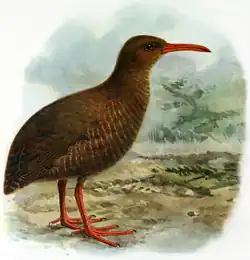 |
| 1894 | Kona grosbeak | Chloridops kona | Hawaiʻi Island, Hawaii, United States | 1988 (IUCN) | Undetermined.[219] |  |
| North Island takahē | Porhyrio mantelli | North Island, New Zealand | 2000 (IUCN) | Climate-induced reduction of grasslands and hunting.[220] |  | |
| 1895 | Hawkins's rail | Diaphorapteryx hawkinsi | Chatham Islands, New Zealand | 2005 (IUCN) | Hunting.[221] |  |
| Chatham fernbird | Poodytes rufescens | Chatham Islands, New Zealand | 1988 (IUCN) | Predation by introduced cats.[222] |  | |
| Cronin's tetratheca | Tetratheca fasciculata | Wagin, Western Australia | Undetermined.[223] | |||
| Lyall's wren | Traversia lyalli | New Zealand | 1895 1986 (IUCN) |
Habitat loss and predation by introduced cats.[224] |  | |
| c. 1895 | New Zealand bittern | Ixobrychus novaezelandiae | New Zealand | 1988 (IUCN)[225] | Probably predation by introduced stoats, after its numbers had already been depleted by rats and cats.[226] |  |
| 1896 | Byttneria ivorensis | Ivory Coast | 1998 (IUCN) | Undetermined.[227] | ||
| Greater koa finch | Rhodacanthis palmeri | Hawaiʻi Island, Hawaii, United States | 1906 1988 (IUCN) |
Possibly habitat destruction and introduced avian malaria.[228] |  | |
| Newfoundland wolf[AF] | Canis lupus beothucus | Newfoundland, Canada | Hunting.[229] |  | ||
| Short-tailed hopping mouse | Notomys amplus | South Australia and Northern Territory, Australia | 2016 (IUCN) | Predation by cats and foxes.[230] |  | |
| 1897 | Eleocharis lepta | Cape Peninsula, South Africa | Undetermined.[231] | |||
| Gull Island vole | Microtus pennsylvanicus nesophilus | Great Gull and Little Gull Islands, New York | Habitat destruction.[232] | |||
| Martinique giant rice rat | Megalomys desmarestii | Martinique | 1994 (IUCN) | Predation by introduced mongooses.[233] |  | |
| Nelson's rice rat | Oryzomys nelsoni | Central María Madre Island, Mexico | 1996 (IUCN) | Competition with introduced black rats.[234] |  | |
| Guadalupe towhee | Pipilio maculatus consobrinus | Guadalupe Island, Mexico | 1954 | Habitat destruction by introduced goats and predation by cats.[10] | ||
| Guadalupe wren | Thryomanes bewickii brevicauda | 1906 | Habitat destruction by introduced goats.[10] | |||
| Stephens Island piopio | Turnagra capensis minor | Stephens Island, New Zealand | 1898 | Predation by introduced cats.[10] | ||
| 1897–1898 | Bulldog rat | Rattus nativitatis | Christmas Island, Australia | 2016 (IUCN) | Presumed extinct after the introduction of diseases carried by black rats in 1900.[235] | 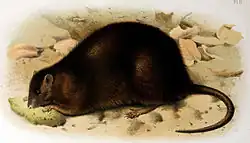 |
| 1898 | Angraecum potamophilum | Mahajanga, Madagascar | Undetermined.[236] | |||
| Woolly-stalked begonia | Begonia eiromischa | Betong Island, Malaysia | 2007 (IUCN) | Deforestation.[237] | ||
| Hawaii mamo | Drepanis pacifica | Hawaiʻi Island, Hawaii, United States | 1988 (IUCN) | Hunting, habitat destruction, and introduced disease.[238] |  | |
| 1899 | Culebra Island amazon | Amazona vittata gracilipes | Culebra Island of Puerto Rico | 1912 | Deforestation and persecution by crop farmers.[10] | |
| Kauaʻi nukupuʻu[AG] | Hemignathus hanapepe | Kauaʻi, Hawaii, United States | 2021 2024 (IUCN) |
Undetermined.[240] |  | |
| Pseudophilautus halyi | Pattipola, Sri Lanka | 2004 (IUCN) | Possibly habitat loss.[241] | |||
| before 1900 | Ukrainian migratory lamprey | Eudontomyzon sp. nov. 'migratory' | Dniestr, Dniepr, and Don River drainages | 2008 (IUCN) | Undetermined.[242] | |
| Sooty crayfish | Pacifastacus nigrescens | San Francisco Bay, California, United States | 2010 | Invasive fish and crayfish species, and urban development.[243] |  |
See also
Notes
- ↑ One egg was found in 1830, but it could have been from an Australian emu introduced in 1826, or a hybrid (Hume, 2017).
- ↑ In captivity. Last recorded in the wild in 1805 (Hume, 2017).
- ↑ Type specimen of unknown provenance. Birds of similar color were described by Tahiti natives in 1928, but were not observed by scientists (IUCN).
- ↑ Unconfirmed sighting from 1837.[20]
- ↑ The only known specimens were collected by Jules Dumont d'Urville during the Astrolabe expedition, which returned to France in that year.
- ↑ In captivity. Last seen in the wild in 1775 (IUCN).
- ↑ Two haplotypes are found in remains from the Vandal and Byzantine periods: one shared with Iberian bears that could have been introduced by humans, and another unique to Africa.[32] It is not known which type survived until more recent times, because the 1834 holotype is lost.[33]
- ↑ Unconfirmed sightings in 1937 and 1940 (IUCN).
- ↑ Unconfirmed reports by natives until 1860.[38]
- ↑ Hybrid descendants of C. niger and C. becki survive in nearby Isabela Island.[53]
- ↑ In Sulu, where it was introduced in the 14th century.[55] Most recent remains in Java dated to 1350.[56]
- ↑ It was proposed that the extant Bornean elephant (E. m. borneensis) is synonymous with E. m. sondaicus. If true, this would mean the Javan elephant is not globally extinct.[55]
- ↑ In captivity.[62]
- ↑ In captivity (IUCN).
- ↑ Reports from 1894 are likely of American mink expanding into the sea mink's former range (IUCN).
- ↑ In Réunion. Last seen in Mauritius in 1859 (IUCN).
- ↑ Genetics do not support subspecific differentiation between the Cape lion and living lions in Eastern Africa; if placed in a single subspecies, it would be P. l. melanochaita because of being the older name.[94]
- ↑ Only known from the holotype, though a scops owl of unknown species was filmed in Siau in 2017.[95]
- ↑ It's been argued (based on genetic data) that most or all elk subspecies in North America are actually the same, which would be C. c. canadensis due to being named first.[98][99]
- ↑ Two unconfirmed sightings in 2003 (IUCN).
- ↑ Unconfirmed kill in 1878.[138]
- ↑ Unconfirmed sighting in 2010 (IUCN).
- ↑ Unconfirmed sighting in 1936 (Hume, 2017).
- ↑ In captivity. Last seen in the wild between 1860 and 1865 (Bryden, 1889).
- ↑ Unconfirmed sighting near Cottage Garden in 1976.
- ↑ Unconfirmed report in 1984 (IUCN).
- ↑ 1891 reports were based on hearsay (Taylor, 1979).
- ↑ Unconfirmed sightings in 1971 and 1973 (IUCN).
- ↑ Unconfirmed reports until 1995 (Hume, 2017).
- ↑ Unconfirmed sighting in 1937 (IUCN).
- ↑ A 1907 sighting is considered erroneous (IUCN).
- ↑ Unconfirmed sighting in 1911 (Glover, 1942).
- ↑ Unconfirmed report from 2007.[239]
References
- ↑ S.L. Pimm, G.J. Russell, J.L. Gittleman and T.M. Brooks, The Future of Biodiversity, Science 269: 347–350 (1995)
- 1 2 3 Conservation Biology of Freshwater Turtles and Tortoises: A Compilation Project of the IUCN/SSC Tortoise and Freshwater Turtle Specialist Group. A.G.J. Rhodin, P.C.H. Pritchard, P.P. van Dijk, R.A. Saumure, K.A. Buhlmann, J.B. Iverson, and R.A. Mittermeier, Eds. Chelonian Research Monographs (ISSN 1088-7105) No. 5, doi:10.3854/crm.5.000e.fossil.checklist.v1.2015
- ↑ World Conservation Monitoring Centre (1996). "Cylindraspis peltastes". IUCN Red List of Threatened Species. 1996 e.T6063A12388776. doi:10.2305/IUCN.UK.1996.RLTS.T6063A12388776.en.
- ↑ World Conservation Monitoring Centre (1996). "Cylindraspis vosmaeri". IUCN Red List of Threatened Species. 1996 e.T6065A12391587. doi:10.2305/IUCN.UK.1996.RLTS.T6065A12391587.en.
- ↑ https://www.artensterben.de/en/borys-white-bat/
- ↑ Brial, P. (2001). Une espèce inconnue de microchiroptère observée par Bory de Saint-Vincent à l'île de la Réunion en 1801. Bulletin de la Société Geographique de la Réunion, 1(5).
- ↑ Akçakaya, H.R. (2021). "Sympterichthys unipennis". IUCN Red List of Threatened Species. 2021 e.T123423283A207621852. doi:10.2305/IUCN.UK.2021-3.RLTS.T123423283A207621852.en. Assessed as extinct in 2020, but upgraded to Data Deficient in 2021.
- ↑ Cole, N. (2021). "Typhlops cariei". IUCN Red List of Threatened Species. 2021 e.T22607A166933641. doi:10.2305/IUCN.UK.2021-2.RLTS.T22607A166933641.en.
- ↑ Rebelo, A.G. (2020). "Leucadendron grandiflorum". IUCN Red List of Threatened Species. 2020 e.T113168368A185558142. doi:10.2305/IUCN.UK.2020-3.RLTS.T113168368A185558142.en.
- 1 2 3 4 5 6 7 8 9 10 11 12 13 14 15 16 17 18 19 20 21 22 23 24 25 26 27 28 29 30 31 32 33 34 35 36 37 38 39 40 41 42 43 44 45 Hume, J.P. (2017) Extinct Birds. Bloomsbury Publishing, 560 pages.
- ↑ https://www.iucnredlist.org/species/67379124/67379134
- ↑ BirdLife International (2016). "Dromaius baudinianus". IUCN Red List of Threatened Species. 2016 e.T22724449A94867311. doi:10.2305/IUCN.UK.2016-3.RLTS.T22724449A94867311.en.
- ↑ Gandy, M. (2016). Moth. Reaktion Books.
- ↑ Blakemore (2019). "Extinction of Japan's first formally described earthworm Amynthas japonicus (Horst, 1883) (Annelida, Oligochaeta, Megadrilacea, Megascolecidae)" (PDF). Bulletin of the Kanagawa Prefectural Museum. 48: 55–60. Retrieved May 10, 2019.
- ↑ Torres, A.G.; Kesner-Reyes, K. & Capuli, E. (2021). "Clupea manulensis". IUCN Red List of Threatened Species. 2021 e.T162160049A162160065. doi:10.2305/IUCN.UK.2021-1.RLTS.T162160049A162160065.en. Retrieved January 10, 2023.
- ↑ BirdLife International (2016). "Caloenas maculata". IUCN Red List of Threatened Species. 2016 e.T22734732A95095848. doi:10.2305/IUCN.UK.2016-3.RLTS.T22734732A95095848.en.
- ↑ BirdLife International (2017). "Pomarea pomarea". IUCN Red List of Threatened Species. 2017 e.T22724444A119193265. doi:10.2305/IUCN.UK.2017-3.RLTS.T22724444A119193265.en.
- ↑ BirdLife International (2016). "Aplonis mavornata". IUCN Red List of Threatened Species. 2016 e.T22710499A94248417. doi:10.2305/IUCN.UK.2016-3.RLTS.T22710499A94248417.en.
- ↑ BirdLife International (2017). "Myadestes woahensis". IUCN Red List of Threatened Species. 2017 e.T22708564A111775767. doi:10.2305/IUCN.UK.2017-1.RLTS.T22708564A111775767.en.
- ↑ Hume, J. P. (2011). "Systematics, morphology, and ecology of pigeons and doves (Aves: Columbidae) of the Mascarene Islands, with three new species". Zootaxa. 3124: 1–62. doi:10.11646/zootaxa.3124.1.1. ISBN 978-1-86977-825-5. S2CID 86886330.
- ↑ BirdLife International (2016). "Zapornia monasa". IUCN Red List of Threatened Species. 2016 e.T22692708A93366211. doi:10.2305/IUCN.UK.2016-3.RLTS.T22692708A93366211.en.
- ↑ BirdLife International (2016). "Aplonis corvina". IUCN Red List of Threatened Species. 2016 e.T22710496A94248268. doi:10.2305/IUCN.UK.2016-3.RLTS.T22710496A94248268.en.
- ↑ There were unconfirmed reports from locals in 1890. BirdLife International (2017). "Carpodacus ferreorostris". IUCN Red List of Threatened Species. 2017 e.T22720622A111776645. doi:10.2305/IUCN.UK.2017-1.RLTS.T22720622A111776645.en. Retrieved November 18, 2021.
- ↑ BirdLife International (2016). "Zoothera terrestris". IUCN Red List of Threatened Species. 2016 e.T22708535A94163698. doi:10.2305/IUCN.UK.2016-3.RLTS.T22708535A94163698.en.
- ↑ The Reptile Database
- ↑ Allison, A.; Hamilton, A.; Tallowin, O. (2012). "Tachygyia microlepis". IUCN Red List of Threatened Species. 2012 e.T21286A2775072. doi:10.2305/IUCN.UK.2012.RLTS.T21286A2775072.en.
- ↑ Heinicke, Matthew P.; Nielsen, Stuart V.; Bauer, Aaron M.; Kelly, Ryan; Geneva, Anthony J.; Daza, Juan D.; Keating, Shannon E.; Gamble, Tony (2023-06-19). "Reappraising the evolutionary history of the largest known gecko, the presumably extinct Hoplodactylus delcourti, via high-throughput sequencing of archival DNA". Scientific Reports. 13 (1): 9141.
- ↑ Oldfield, S. (2020). "Streblorrhiza speciosa". IUCN Red List of Threatened Species. 2020 e.T30393A149811572. doi:10.2305/IUCN.UK.2020-2.RLTS.T30393A149811572.en. Retrieved November 12, 2021.
- ↑ "Deyeuxia lawrencei". Environment.gov.au. Retrieved June 26, 2026.
- ↑ BirdLife International (2016). "Coua delalandei". IUCN Red List of Threatened Species. 2016 e.T22684143A93016420. doi:10.2305/IUCN.UK.2016-3.RLTS.T22684143A93016420.en.
- ↑ BirdLife International (2016). "Mascarinus mascarin". IUCN Red List of Threatened Species. 2016 e.T22685258A93065531. doi:10.2305/IUCN.UK.2016-3.RLTS.T22685258A93065531.en.
- ↑ Calvignac, S. et al. (2008) "Ancient DNA evidence for the loss of a highly divergent brown bear clade during historical times." Molecular Ecology, Vol. 17: 1962–1970.
- 1 2 Hamdine, W. et al. (1998) "Histoire récente de l'ours brun au Maghreb". C. R. Acad. Sci. Paris, Sciences de la Vie / Life Sciences, Vol. 321, pp. 565–570.
- ↑ BirdLife International (2024). "Akialoa ellisiana". IUCN Red List of Threatened Species. 2024 e.T103823212A244864865. doi:10.2305/IUCN.UK.2024-2.RLTS.T103823212A244864865.en.
- ↑ BirdLife International (2016). "Fregilupus varius". IUCN Red List of Threatened Species. 2016 e.T22710840A94263439. doi:10.2305/IUCN.UK.2016-3.RLTS.T22710840A94263439.en.
- ↑ BirdLife International (2017). "Moho apicalis". IUCN Red List of Threatened Species. 2017 e.T22704329A111776064. doi:10.2305/IUCN.UK.2017-1.RLTS.T22704329A111776064.en.
- ↑ BirdLife International (2016). "Mascarenotus sauzieri". IUCN Red List of Threatened Species. 2016 e.T22728861A94999192. doi:10.2305/IUCN.UK.2016-3.RLTS.T22728861A94999192.en.
- ↑ Pyle, R.L., and P. Pyle. 2017. The Birds of the Hawaiian Islands: Occurrence, History, Distribution, and Status. B.P. Bishop Museum, Honolulu, HI, U.S.A. Version 2 (January 1, 2017) http://hbs.bishopmuseum.org/birds/rlp-monograph/pdfs/08-DREP/NUKU.pdf
- 1 2 Cheke, A. & Hume, J.P. (2009) Lost land of the dodo: The ecological history of Mauritius, Réunion and Rodrigues. T & AD Poyser, London, 480 pages.
- ↑ "Trianthema cypseleoides". Environment.gov.au. Retrieved June 26, 2026.
- ↑ Tsang, S.M. (2020). "Pteropus coxi". IUCN Red List of Threatened Species. 2020 e.T84931267A95642285. doi:10.2305/IUCN.UK.2020-2.RLTS.T84931267A95642285.en.
- ↑ World Conservation Monitoring Centre (1996). "Cylindraspis indica". IUCN Red List of Threatened Species. 1996 e.T6061A12383518. doi:10.2305/IUCN.UK.1996.RLTS.T6061A12383518.en.
- ↑ BirdLife International (2023). "Hypotaenidia dieffenbachii". IUCN Red List of Threatened Species. 2023 e.T22692455A229313877. doi:10.2305/IUCN.UK.2023-1.RLTS.T22692455A229313877.en.
- ↑ Bouchet, P. (1996). "Littoraria flammea". IUCN Red List of Threatened Species. 1996 e.T12242A3329078. doi:10.2305/IUCN.UK.1996.RLTS.T12242A3329078.en. Retrieved August 7, 2007.
- ↑ Dulvy, N. K., Pinnegar, J. K., & Reynolds, J. D. (2009). Holocene extinctions in the sea. In Holocene Extinctions, pgs. 129–150.
- ↑ World Conservation Monitoring Centre (1998). "Weinmannia spiraeoides". IUCN Red List of Threatened Species. 1998 e.T31036A9602217. doi:10.2305/IUCN.UK.1998.RLTS.T31036A9602217.en. Retrieved November 16, 2021.
- ↑ Burbidge, A.A.; Woinarski, J. (2016). "Notomys macrotis". IUCN Red List of Threatened Species. 2016 e.T14865A22401041. doi:10.2305/IUCN.UK.2016-1.RLTS.T14865A22401041.en. Retrieved November 12, 2021.
- ↑ BirdLife International (2016). "Cyanoramphus zealandicus". IUCN Red List of Threatened Species. 2016 e.T22685182A93061882. doi:10.2305/IUCN.UK.2016-3.RLTS.T22685182A93061882.en.
- ↑ Burbidge, A.A.; Woinarski, J. (2016). "Notomys mordax". IUCN Red List of Threatened Species. 2016 e.T14866A22401111. doi:10.2305/IUCN.UK.2016-1.RLTS.T14866A22401111.en. Retrieved November 11, 2021.
- ↑ "Liverpool Plains striped bandicoot". IUCN Red List. Retrieved March 6, 2026.
- ↑ de Lange, P. (2014). "Logania depressa". IUCN Red List of Threatened Species. 2014 e.T62798304A62798308. doi:10.2305/IUCN.UK.2014-2.RLTS.T62798304A62798308.en. Retrieved June 1, 2024.
- ↑ "Ozothamnus selaginoides ? Clubmoss Everlasting, Table Mountain Daisy Bush". Environment.gov.au. Retrieved June 26, 2026.
- ↑ van Dijk, P.P.; Rhodin, A.G.J.; Cayot, L.J.; Caccone, A. (2017). "Chelonoidis niger". IUCN Red List of Threatened Species. 2017 e.T9023A3149101. doi:10.2305/IUCN.UK.2017-3.RLTS.T9023A3149101.en.
- ↑ Rookmaaker, L.C. & Groves, C.P. (1977) The extinct Cape rhinoceros, Diceros bicornis bicornis (Linnaeus, 1758). In Szugetierkundliche Mitteilwnge, pg. 117–126.
- 1 2 Alfred, R., Ahmad, A. H., Payne, J., Williams, C., Ambu, L. N., How, P. M., & Goossens, B. (2012). Home range and ranging behaviour of Bornean elephant (Elephas maximus borneensis) females. PLoS One, 7(2), e31400.
- ↑ Morwood, M. J., Sutikna, T., Saptomo, E. W., Westaway, K. E., Due, R. A., Moore, M. W., ... & Soejono, R. P. (2008). Climate, people and faunal succession on Java, Indonesia: evidence from Song Gupuh. Journal of Archaeological Science, 35(7), 1776–1789.
- ↑ There was an unconfirmed sighting in 1976. BirdLife International (2020). "Eriocnemis godini". IUCN Red List of Threatened Species. 2020 e.T22687922A182244989. doi:10.2305/IUCN.UK.2020-3.RLTS.T22687922A182244989.en.
- ↑ Watanabe, J., Matsuoka, H., & Hasegawa, Y. (2018). Pleistocene fossils from Japan show that the recently extinct Spectacled Cormorant (Phalacrocorax perspicillatus) was a relict. The Auk: Ornithological Advances, 135(4), 895–907.
- ↑ BirdLife International (2023). "Urile perspicillatus". IUCN Red List of Threatened Species. 2023 e.T22696750A226827998. doi:10.2305/IUCN.UK.2023-1.RLTS.T22696750A226827998.en.
- ↑ "Imber's petrel | New Zealand Birds Online". www.nzbirdsonline.org.nz. Retrieved May 20, 2022.
- ↑ Some animals were said to survive in captivity until the 1870s, but these could have been imported from Australia (Hume, 2017).
- ↑ It may have died in the wild between 1825 and 1854 (Hume, 2017), probably early on as it was not recorded by Ensign in 1838–1839. Moore, J.L. (1985). "Ensign Best's bird observations on Norfolk Island". Notornis. 32 (4): 319–322. doi:10.63172/898756ghyene.
- ↑ BirdLife International (2016). "Nestor productus". IUCN Red List of Threatened Species. 2016 e.T22684834A93049105. doi:10.2305/IUCN.UK.2016-3.RLTS.T22684834A93049105.en.
- ↑ IUCN (January 17, 2022). Diospyros angulata: Tatayah, V., Baider, C., Florens, F.B.V. & Schmidt, H.: The IUCN Red List of Threatened Species 2025: e.T30521A2793597 (Report). International Union for Conservation of Nature. doi:10.2305/IUCN.UK.2025-2.RLTS.T30521A2793597.en.
- ↑ Celestus occiduus at the Reptarium.cz Reptile Database. Accessed January 1, 2022.
- ↑ Groh, K. (2017). "Atlantica engonata". IUCN Red List of Threatened Species. 2017 e.T6739A76141846. doi:10.2305/IUCN.UK.2017-3.RLTS.T6739A76141846.en. Retrieved June 19, 2023.
- ↑ Groh, K. (2017). "Atlantica retexta". IUCN Red List of Threatened Species. 2017 e.T171112A1321424. doi:10.2305/IUCN.UK.2017-3.RLTS.T171112A1321424.en. Retrieved June 19, 2023.
- ↑ BirdLife International (2016). "Pinguinus impennis". IUCN Red List of Threatened Species. 2016 e.T22694856A93472944. doi:10.2305/IUCN.UK.2016-3.RLTS.T22694856A93472944.en.
- ↑ "După 200 de ani, zimbrul se întoarce în Carpaţi FOTOGALERII" (in Romanian). March 23, 2012.
- ↑ Lambdon, P.W.; Ellick, S. (2016). "Acalypha rubrinervis". IUCN Red List of Threatened Species. 2016 e.T37854A67371775. doi:10.2305/IUCN.UK.2016-1.RLTS.T37854A67371775.en.
- ↑ IUCN SSC Amphibian Specialist Group (2020). "Pseudophilautus leucorhinus". IUCN Red List of Threatened Species. 2020 e.T58862A156582678. doi:10.2305/IUCN.UK.2020-3.RLTS.T58862A156582678.en. Retrieved November 18, 2021.
- ↑ Thoma, R.F.; Cordeiro, J.; Jones, T. (2018) [errata version of 2010 assessment]. "Procambarus angustatus". IUCN Red List of Threatened Species. 2010 e.T18220A129681244. doi:10.2305/IUCN.UK.2010-3.RLTS.T18220A7830256.en.
- ↑ Tsang, S.M. (2020). "Pteropus allenorum". IUCN Red List of Threatened Species. 2020 e.T84882966A84882990. doi:10.2305/IUCN.UK.2020-2.RLTS.T84882966A84882990.en.
- ↑ Woinarski, J.C.Z.; Burbidge, A.A. (2025). "Perameles notina". IUCN Red List of Threatened Species. 2025 e.T217035453A217035466. Retrieved October 13, 2025.
- ↑ IUCN SSC Amphibian Specialist Group (2020). "Pseudophilautus variabilis". IUCN Red List of Threatened Species. 2020 e.T58931A156585835. doi:10.2305/IUCN.UK.2020-3.RLTS.T58931A156585835.en. Retrieved November 18, 2021.
- ↑ BirdLife International (2016). "Chaetoptila angustipluma". IUCN Red List of Threatened Species. 2016 e.T22704348A93964400. doi:10.2305/IUCN.UK.2016-3.RLTS.T22704348A93964400.en.
- ↑ IUCN SSC Amphibian Specialist Group (2020). "Pseudophilautus pardus". IUCN Red List of Threatened Species. 2020 e.T136163A156588728. doi:10.2305/IUCN.UK.2020-3.RLTS.T136163A156588728.en. Retrieved November 18, 2021.
- ↑ Helgen, K.; Turvey, S.T. (2016). "Neovison macrodon". IUCN Red List of Threatened Species. 2016 e.T40784A45204492. doi:10.2305/IUCN.UK.2016-1.RLTS.T40784A45204492.en.
- ↑ Turvey, Sam (2009). Holocene extinctions. Oxford University Press. ISBN 978-0-19-953509-5. Retrieved February 29, 2012.
- ↑ Fontaine B., Bouchet P., Van Achterberg K., Alonso-Zarazaga M. A., Araujo R. et al. (2007). "The European union's 2010 target: Putting rare species in focus." Biological Conservation 139: 167–185. Table 2 on the page 173. doi:10.1016/j.biocon.2007.06.012. PDF.
- ↑ Battiston, R. (2020). "Pseudoyersinia brevipennis". IUCN Red List of Threatened Species. 2020 e.T44792108A44798207. doi:10.2305/IUCN.UK.2020-2.RLTS.T44792108A44798207.en.
- ↑ BirdLife International (2016). "Chlorostilbon elegans". IUCN Red List of Threatened Species. 2016 e.T22728709A94994346. doi:10.2305/IUCN.UK.2016-3.RLTS.T22728709A94994346.en.
- ↑ BirdLife International (2020). "Siphonorhis americana". IUCN Red List of Threatened Species. 2020 e.T22689738A178420953. doi:10.2305/IUCN.UK.2020-3.RLTS.T22689738A178420953.en.
- ↑ Woinarski, J.; Burbidge, A.A. (2016). "Conilurus albipes". IUCN Red List of Threatened Species. 2016 e.T5223A22450334. doi:10.2305/IUCN.UK.2016-1.RLTS.T5223A22450334.en.
- ↑ Blakemore, R. J. (2017). "Tokea orthostichon". IUCN Red List of Threatened Species. 2017 e.T103192401A103193535. doi:10.2305/IUCN.UK.2017-2.RLTS.T103192401A103193535.en. Retrieved May 23, 2022.
- ↑ Mickleburgh, S.; Hutson, A.M.M.; Bergmans, W. & Howell, K. (2008). "Pteropus subniger". IUCN Red List of Threatened Species. 2008 e.T18761A8580195. doi:10.2305/IUCN.UK.2008.RLTS.T18761A8580195.en.
- ↑ Williams, M.C. (2020). "Deloneura immaculata". IUCN Red List of Threatened Species. 2020 e.T6331A168301470. doi:10.2305/IUCN.UK.2020-2.RLTS.T6331A168301470.en.
- ↑ Extinction and Hope
- ↑ IUCN SSC Amphibian Specialist Group (2020). "Pseudophilautus temporalis". IUCN Red List of Threatened Species. 2020 e.T58924A156585775. doi:10.2305/IUCN.UK.2020-3.RLTS.T58924A156585775.en. Retrieved November 18, 2021.
- ↑ Olson, S. L. (1986). Gallirallus sharpei (Buttikofer) nov. comb., a Valid Species of Rail (Rallidae) of Unknown Origin. Le Gerfaut (7): 263–269.
- ↑ Groh, K. (2017). "Janulus pompylius". IUCN Red List of Threatened Species. 2017 e.T171067A1320780. doi:10.2305/IUCN.UK.2017-3.RLTS.T171067A1320780.en. Retrieved June 16, 2023.
- ↑ World Conservation Monitoring Centre (1996). "Libythea cinyras". IUCN Red List of Threatened Species. 1996 e.T11934A3316737. doi:10.2305/IUCN.UK.1996.RLTS.T11934A3316737.en.
- ↑ Rossi, L., Scuzzarella, C. M., & Angelici, F. M. (2020). Extinct or Perhaps Surviving Relict Populations of Big Cats: Their Controversial Stories and Implications for Conservation. In Problematic Wildlife II (pp. 393–417). Springer, Cham.
- ↑ Kitchener, A. C.; Breitenmoser-Würsten, C.; Eizirik, E.; Gentry, A.; Werdelin, L.; Wilting, A.; Yamaguchi, N.; Abramov, A. V.; Christiansen, P.; Driscoll, C.; Duckworth, J. W.; Johnson, W.; Luo, S.-J.; Meijaard, E.; O'Donoghue, P.; Sanderson, J.; Seymour, K.; Bruford, M.; Groves, C.; Hoffmann, M.; Nowell, K.; Timmons, Z.; Tobe, S. (2017). "A revised taxonomy of the Felidae: The final report of the Cat Classification Task Force of the IUCN Cat Specialist Group" (PDF). Cat News (Special Issue 11).
- ↑ http://datazone.birdlife.org/species/factsheet/siau-scops-owl-otus-siaoensis/text
- ↑ Annual Report of the Pennsylvania Department of Agriculture (1897), p. 334.
- ↑ U.S. Fish and Wildlife Service (2016). "Cervus canadensis canadensis (Eastern Elk)" , fws.gov; retrieved June 23, 2017.
- ↑ Brook, S.M.; Pluháček, J.; Lorenzini, R.; Lovari, S.; Masseti, M.; Pereladova, O.; Mattioli, S. (2018). "Cervus canadensis". IUCN Red List of Threatened Species. 2018 e.T55997823A142396828. doi:10.2305/IUCN.UK.2018-2.RLTS.T55997823A142396828.en.
- ↑ Gill et al. (2013) Are elk native to Texas?
- ↑ Griffiths, O. (1996). "Gonidomus newtoni". IUCN Red List of Threatened Species. 1996 e.T9329A12982220. doi:10.2305/IUCN.UK.1996.RLTS.T9329A12982220.en. Retrieved November 17, 2021.
- ↑ Champion, J.H. (2020) Biogeography and phylogenetics of the Hawaiian endemic Hibiscadelphus, Hau Kuahiwi (Malvaceae).
- ↑ "Hibiscadelphus bombycinus". IUCN Red List of Threatened Species. 1998 e.T30774A9577547. 1998. doi:10.2305/IUCN.UK.1998.RLTS.T30774A9577547.en.
- ↑ https://www.iucnredlist.org/species/35036/9907653
- ↑ Griffiths, O. (1996). "Pachystyla rufozonata". IUCN Red List of Threatened Species. 1996 e.T15864A5244836. doi:10.2305/IUCN.UK.1996.RLTS.T15864A5244836.en. Retrieved November 14, 2021.
- ↑ IUCN SSC Amphibian Specialist Group (2020). "Pseudophilautus nanus". IUCN Red List of Threatened Species. 2020 e.T58877A156583351. doi:10.2305/IUCN.UK.2020-3.RLTS.T58877A156583351.en. Retrieved November 18, 2021.
- ↑ IUCN SSC Amphibian Specialist Group (2020). "Pseudophilautus nasutus". IUCN Red List of Threatened Species. 2020 e.T58878A156583411. doi:10.2305/IUCN.UK.2020-3.RLTS.T58878A156583411.en. Retrieved November 18, 2021.
- ↑ Jaffré, T. et al. (1998). "Xanthostemon sebertii". IUCN Red List of Threatened Species. 1998 e.T31311A9623853. doi:10.2305/IUCN.UK.1998.RLTS.T31311A9623853.en. Retrieved November 17, 2021.
- ↑ Prie, V. (2010). "Belgrandia varica". IUCN Red List of Threatened Species. 2010 e.T155668A4818436. doi:10.2305/IUCN.UK.2010-4.RLTS.T155668A4818436.en. Retrieved November 13, 2021.
- ↑ BirdLife International (2016). "Coenocorypha barrierensis". IUCN Red List of Threatened Species. 2016 e.T62178398A95191768. doi:10.2305/IUCN.UK.2016-3.RLTS.T62178398A95191768.en.
- ↑ Mollusc Specialist Group (1996). "Campolaemus perexilis". IUCN Red List of Threatened Species. 1996 e.T3714A10036311. doi:10.2305/IUCN.UK.1996.RLTS.T3714A10036311.en. Retrieved November 17, 2021.
- ↑ Mollusc Specialist Group (1996). "Chilonopsis blofeldi". IUCN Red List of Threatened Species. 1996 e.T4635A11050958. doi:10.2305/IUCN.UK.1996.RLTS.T4635A11050958.en.
- ↑ Mollusc Specialist Group (1996). "Chilonopsis exulatus". IUCN Red List of Threatened Species. 1996 e.T4636A11046264. doi:10.2305/IUCN.UK.1996.RLTS.T4636A11046264.en. Retrieved November 15, 2021.
- ↑ Mollusc Specialist Group (1996). "Chilonopsis helena". IUCN Red List of Threatened Species. 1996 e.T4637A11052036. doi:10.2305/IUCN.UK.1996.RLTS.T4637A11052036.en. Retrieved November 17, 2021.
- ↑ Mollusc Specialist Group (1996). "Chilonopsis subplicatus". IUCN Red List of Threatened Species. 1996 e.T4640A11052120. doi:10.2305/IUCN.UK.1996.RLTS.T4640A11052120.en. Retrieved November 16, 2021.
- ↑ Mollusc Specialist Group (1996). "Chilonopsis subtruncatus". IUCN Red List of Threatened Species. 1996 e.T4641A11052989. doi:10.2305/IUCN.UK.1996.RLTS.T4641A11052989.en. Retrieved November 16, 2021.
- ↑ Mollusc Specialist Group (1996). "Helenoconcha leptalea". IUCN Red List of Threatened Species. 1996 e.T9765A13014709. doi:10.2305/IUCN.UK.1996.RLTS.T9765A13014709.en. Retrieved November 17, 2021.
- ↑ Mollusc Specialist Group (1996). "Helenoconcha minutissima". IUCN Red List of Threatened Species. 1996 e.T9766A13014755. doi:10.2305/IUCN.UK.1996.RLTS.T9766A13014755.en. Retrieved November 14, 2021.
- ↑ Mollusc Specialist Group (1996). "Helenoconcha polyodon". IUCN Red List of Threatened Species. 1996 e.T9767A13014801. doi:10.2305/IUCN.UK.1996.RLTS.T9767A13014801.en. Retrieved November 14, 2021.
- ↑ Mollusc Specialist Group (1996). "Helenoconcha pseustes". IUCN Red List of Threatened Species. 1996 e.T9768A13014847. doi:10.2305/IUCN.UK.1996.RLTS.T9768A13014847.en. Retrieved November 17, 2021.
- ↑ Mollusc Specialist Group (1996). "Helenoconcha sexdentata". IUCN Red List of Threatened Species. 1996 e.T9769A13014893. doi:10.2305/IUCN.UK.1996.RLTS.T9769A13014893.en. Retrieved November 16, 2021.
- ↑ Mollusc Specialist Group (1996). "Helenodiscus bilamellata". IUCN Red List of Threatened Species. 1996 e.T9770A13014939. doi:10.2305/IUCN.UK.1996.RLTS.T9770A13014939.en. Retrieved November 15, 2021.
- ↑ Mollusc Specialist Group (1996). "Helenodiscus vernoni". IUCN Red List of Threatened Species. 1996 e.T9771A13014985. doi:10.2305/IUCN.UK.1996.RLTS.T9771A13014985.en. Retrieved November 17, 2021.
- ↑ Cockburn, K.N.A. (2020). "Lepidochrysops hypopolia". IUCN Red List of Threatened Species. 2020 e.T11537A168301541. doi:10.2305/IUCN.UK.2020-2.RLTS.T11537A168301541.en.
- ↑ Mollusc Specialist Group (1996). "Pupilla obliquicosta". IUCN Red List of Threatened Species. 1996 e.T18912A8687380. doi:10.2305/IUCN.UK.1996.RLTS.T18912A8687380.en. Retrieved November 16, 2021.
- ↑ Battiston, R. (2020). "Ameles fasciipennis". IUCN Red List of Threatened Species. 2020 e.T44791445A170111359. doi:10.2305/IUCN.UK.2020-2.RLTS.T44791445A170111359.en.
- ↑ Griffiths, O. (1996). "Ctenoglypta newtoni". IUCN Red List of Threatened Species. 1996 e.T5794A11706340. doi:10.2305/IUCN.UK.1996.RLTS.T5794A11706340.en. Retrieved November 15, 2021.
- ↑ Grubb, P., & d'Huart, J.P. (2010) Rediscovery of the Cape warthog Phacochoerus aethiopicus: a review. Journal of East African Natural History, 99(2), 77–102.
- ↑ IUCN SSC Amphibian Specialist Group (2020). "Pseudophilautus oxyrhynchus". IUCN Red List of Threatened Species. 2020 e.T58883A156583754. doi:10.2305/IUCN.UK.2020-3.RLTS.T58883A156583754.en. Retrieved November 18, 2021.
- ↑ BirdLife International (2016). "Gallinula nesiotis". IUCN Red List of Threatened Species. 2016 e.T22728763A94995836. doi:10.2305/IUCN.UK.2016-3.RLTS.T22728763A94995836.en.
- ↑ BirdLife International (2018). "Pareudiastes pacificus". IUCN Red List of Threatened Species. 2018 e.T22692854A129449004. doi:10.2305/IUCN.UK.2018-2.RLTS.T22692854A129449004.en.
- ↑ Bonaccorso, F.J.; Helgen, K.; Allison, A. (2019). "Pteropus pilosus". IUCN Red List of Threatened Species. 2019 e.T18749A22086230. doi:10.2305/IUCN.UK.2019-3.RLTS.T18749A22086230.en.
- ↑ Freyhof, J. & Ford, M. (2022). "Luciobarbus nasus". IUCN Red List of Threatened Species. 2022 e.T217675561A137276808. doi:10.2305/IUCN.UK.2022-1.RLTS.T217675561A137276808.en. Retrieved April 30, 2023.
- ↑ Martínez–Ortí, A. L. B. E. R. T. O., & Borreda, V. (2012). New systematics of Parmacellidae P. Fischer 1856 (Gastropoda, Pulmonata), with the recovery of the genus–name Drusia Gray 1855 and the description of Escutiella subgen. nov. Journal of Conchology, 41(1), 1–18.
- ↑ Tsang, S.M. (2020). "Pteropus brunneus". IUCN Red List of Threatened Species. 2020 e.T18718A22078015. doi:10.2305/IUCN.UK.2020-3.RLTS.T18718A22078015.en.
- ↑ Ismail, S.; Huber, M.J.; Mougal, J. (2011). "Vernonia sechellensis". IUCN Red List of Threatened Species. 2011 e.T191546A8844089. doi:10.2305/IUCN.UK.2011-2.RLTS.T191546A8844089.en. Retrieved April 28, 2026.
- ↑ Pryce, D.; White, L. (2014). "Chilonopsis nonpareil". IUCN Red List of Threatened Species. 2014 e.T4639A64303734. doi:10.2305/IUCN.UK.2014-3.RLTS.T4639A64303734.en. Retrieved November 14, 2021.
- ↑ BirdLife International (2016). "Psittacula exsul". IUCN Red List of Threatened Species. 2016 e.T22685465A93074571. doi:10.2305/IUCN.UK.2016-3.RLTS.T22685465A93074571.en.
- ↑ Renko, Amanda. "EXTINCT: Seeking a bird last seen in 1878". Star Gazette. Retrieved June 23, 2017.
- ↑ BirdLife International (2016). "Camptorhynchus labradorius". IUCN Red List of Threatened Species. 2016 e.T22680418A92862623. doi:10.2305/IUCN.UK.2016-3.RLTS.T22680418A92862623.en.
- ↑ BirdLife International (2016). "Coturnix novaezelandiae". IUCN Red List of Threatened Species. 2016 e.T22678955A92795779. doi:10.2305/IUCN.UK.2016-3.RLTS.T22678955A92795779.en.
- ↑ Cluny, W.; Plummer, J.; Kallow, S. (2022). "Musa fitzalanii". IUCN Red List of Threatened Species. 2022 e.T111907266A158544179. doi:10.2305/IUCN.UK.2022-2.RLTS.T111907266A158544179.en.
- ↑ Burbidge, A.A.; Woinarski, J. (2016). "Potorous platyops". IUCN Red List of Threatened Species. 2016 e.T18103A21960570. doi:10.2305/IUCN.UK.2016-2.RLTS.T18103A21960570.en.
- ↑ IUCN SSC Amphibian Specialist Group (2020). "Pseudophilautus maia". IUCN Red List of Threatened Species. 2020 e.T136000A156588623. doi:10.2305/IUCN.UK.2020-3.RLTS.T136000A156588623.en. Retrieved November 18, 2021.
- ↑ Sillero-Zubiri, C. (2015). "Dusicyon australis". IUCN Red List of Threatened Species. 2015 e.T6923A82310440. doi:10.2305/IUCN.UK.2015-4.RLTS.T6923A82310440.en.
- ↑ BirdLife International (2018). "Ophrysia superciliosa". IUCN Red List of Threatened Species. 2018 e.T22679141A132051220. doi:10.2305/IUCN.UK.2018-2.RLTS.T22679141A132051220.en.
- ↑ BirdLife International (2016). "Chlorostilbon bracei". IUCN Red List of Threatened Species. 2016 e.T22687333A93148138. doi:10.2305/IUCN.UK.2016-3.RLTS.T22687333A93148138.en.
- ↑ World Conservation Monitoring Centre (1998). "Sterculia khasiana". IUCN Red List of Threatened Species. 1998 e.T32923A9741958. doi:10.2305/IUCN.UK.1998.RLTS.T32923A9741958.en. Retrieved November 16, 2021.
- ↑ Cooke, S. B., Mychajliw, A. M., Southon, J., & MacPhee, R. D. (2017). The extinction of Xenothrix mcgregori, Jamaica's last monkey. Journal of Mammalogy, 98(4), 937–949.
- ↑ Turvey, S.T.; Helgen, K. (2017). "Oryzomys antillarum". IUCN Red List of Threatened Species. 2017 e.T136540A22388029. doi:10.2305/IUCN.UK.2017-3.RLTS.T136540A22388029.en.
- ↑ Seddon, M.B. (2011). "Leiostyla gibba". IUCN Red List of Threatened Species. 2011 e.T11458A3279526. doi:10.2305/IUCN.UK.2011-1.RLTS.T11458A3279526.en. Retrieved November 14, 2021.
- ↑ Powell, R. (2011). "Cyclura onchiopsis". IUCN Red List of Threatened Species. 2011 e.T173001A6955940. doi:10.2305/IUCN.UK.2011-1.RLTS.T173001A6955940.en.
- ↑ Seddon, M.B. (2011). "Discula tetrica". IUCN Red List of Threatened Species. 2011 e.T6731A12802025. doi:10.2305/IUCN.UK.2011-1.RLTS.T6731A12802025.en. Retrieved November 16, 2021.
- ↑ Keraea garachicoensis at the IUCN Red List.
- ↑ Seddon, M.B. (2011). "Leiostyla abbreviata". IUCN Red List of Threatened Species. 2011 e.T11455A3278905. doi:10.2305/IUCN.UK.2011-1.RLTS.T11455A3278905.en. Retrieved November 17, 2021.
- ↑ Seddon, M.B. (2011). "Leiostyla lamellosa". IUCN Red List of Threatened Species. 2011 e.T11459A3279758. doi:10.2305/IUCN.UK.2011-1.RLTS.T11459A3279758.en.
- ↑ Seddon, M.B. (2011) [amended version of 2019 assessment]. "Pseudocampylaea lowii". IUCN Red List of Threatened Species. 2011 e.T18487A152186128. doi:10.2305/IUCN.UK.2019-2.RLTS.T18487A152186128.en.
- ↑ BirdLife International (2018). "Pterodroma caribbaea". IUCN Red List of Threatened Species. 2018 e.T22698097A132625182. doi:10.2305/IUCN.UK.2018-2.RLTS.T22698097A132625182.en.
- ↑ Andriafidison, D.; Cardiff, S.G.; Goodman, S.M.; Hutson, A.M.; Jenkins, R.K.B.; Kofoky, A.F.; Racey, P.A.; Ranivo, J.; Ratrimomanarivo, F.H.; Razafimanahaka, H.J. (2019). "Scotophilus borbonicus". IUCN Red List of Threatened Species. 2019 e.T20064A22024708. doi:10.2305/IUCN.UK.2019-3.RLTS.T20064A22024708.en. Retrieved November 19, 2021.
- ↑ Koeck, M. (2019). "Characodon garmani". IUCN Red List of Threatened Species. 2019 e.T4530A3000349. doi:10.2305/IUCN.UK.2019-2.RLTS.T4530A3000349.en.
- 1 2 3 Miller, R.R., Williams, J.D., & Williams, J.E. (1989). Extinctions of North American fishes during the past century. Fisheries, 14(6), 22–38.
- ↑ Seddon, M.B. (1996). "Mautodontha acuticosta". IUCN Red List of Threatened Species. 1996 e.T12879A3393916. doi:10.2305/IUCN.UK.1996.RLTS.T12879A3393916.en. Retrieved November 20, 2021.
- ↑ Seddon, M.B. (1996). "Mautodontha consimilis". IUCN Red List of Threatened Species. 1996 e.T12882A3394168. doi:10.2305/IUCN.UK.1996.RLTS.T12882A3394168.en. Retrieved November 20, 2021.
- ↑ Seddon, M.B. (1996). "Mautodontha consobrina". IUCN Red List of Threatened Species. 1996 e.T12883A3394214. doi:10.2305/IUCN.UK.1996.RLTS.T12883A3394214.en. Retrieved November 20, 2021.
- ↑ Seddon, M.B. (1996). "Mautodontha maupiensis". IUCN Red List of Threatened Species. 1996 e.T12884A3394260. doi:10.2305/IUCN.UK.1996.RLTS.T12884A3394260.en. Retrieved November 20, 2021.
- ↑ Seddon, M.B. (1996). "Mautodontha parvidens". IUCN Red List of Threatened Species. 1996 e.T12885A3394306. doi:10.2305/IUCN.UK.1996.RLTS.T12885A3394306.en. Retrieved November 20, 2021.
- ↑ Seddon, M.B. (1996). "Mautodontha punctiperforata". IUCN Red List of Threatened Species. 1996 e.T12886A3394352. doi:10.2305/IUCN.UK.1996.RLTS.T12886A3394352.en. Retrieved November 20, 2021.
- ↑ Seddon, M.B. (1996). "Mautodontha saintjohni". IUCN Red List of Threatened Species. 1996 e.T12887A3394398. doi:10.2305/IUCN.UK.1996.RLTS.T12887A3394398.en. Retrieved November 20, 2021.
- ↑ Seddon, M.B. (1996). "Mautodontha subtilis". IUCN Red List of Threatened Species. 1996 e.T12888A3394444. doi:10.2305/IUCN.UK.1996.RLTS.T12888A3394444.en. Retrieved November 20, 2021.
- ↑ Seddon, M.B. (1996). "Mautodontha unilamellata". IUCN Red List of Threatened Species. 1996 e.T12889A3394490. doi:10.2305/IUCN.UK.1996.RLTS.T12889A3394490.en. Retrieved November 20, 2021.
- ↑ Mollusc Specialist Group (1996). "Mautodontha zebrina". IUCN Red List of Threatened Species. 1996 e.T12890A3394644. doi:10.2305/IUCN.UK.1996.RLTS.T12890A3394644.en. Retrieved November 20, 2021.
- ↑ Turvey, S.T.; Helgen, K. (2017). "Megalomys luciae". IUCN Red List of Threatened Species. 2017 e.T12981A22377126. doi:10.2305/IUCN.UK.2017-3.RLTS.T12981A22377126.en.
- ↑ IUCN SSC Amphibian Specialist Group (2020). "Nannophrys guentheri". IUCN Red List of Threatened Species. 2020 e.T58390A156580255. doi:10.2305/IUCN.UK.2020-3.RLTS.T58390A156580255.en. Retrieved November 18, 2021.
- ↑ IUCN SSC Amphibian Specialist Group (2020). "Pseudophilautus extirpo". IUCN Red List of Threatened Species. 2020 e.T58840A156582033. doi:10.2305/IUCN.UK.2020-3.RLTS.T58840A156582033.en. Retrieved November 18, 2021.
- ↑ Bryden, H. (1889). Kloof and Karoo. London: Longmans, Green and Co. pp. 393–403. ASIN B00CNE0EZC.
- ↑ Hack, M.A.; East, R.; Rubenstein, D.I. (2008). "Equus quagga ssp. quagga". IUCN Red List of Threatened Species. 2008 e.T7957A12876306. doi:10.2305/IUCN.UK.2008.RLTS.T7957A12876306.en.
- ↑ https://europeanjournaloftaxonomy.eu/index.php/ejt/article/view/3007/13499#
- ↑ https://www.iucnredlist.org/species/175294/85430949
- ↑ IUCN SSC Amphibian Specialist Group (2020). "Pseudophilautus adspersus". IUCN Red List of Threatened Species. 2020 e.T58811A156580927. doi:10.2305/IUCN.UK.2020-3.RLTS.T58811A156580927.en. Retrieved November 18, 2021.
- ↑ Lambdon, P.W.; Stroud, S.; Gray, A.; Niissalo, M.; Renshaw, O. (2012). "Sporobolus durus". IUCN Red List of Threatened Species. 2012 e.T43927A2990995. doi:10.2305/IUCN.UK.2012-1.RLTS.T43927A2990995.en. Retrieved November 16, 2021.
- ↑ Millar, A.J.K. (Royal Botanic Gardens Sydney Australia) (2003). "Vanvoorstia bennettiana". IUCN Red List of Threatened Species. 2003 e.T43993A10838671. doi:10.2305/IUCN.UK.2003.RLTS.T43993A10838671.en.
- ↑ Helgen, K.; Leary, T.; Wright, D (2016). "Uromys imperator". IUCN Red List of Threatened Species. 2016 e.T22803A22447074. doi:10.2305/IUCN.UK.2016-1.RLTS.T22803A22447074.en. Retrieved November 20, 2021.
- ↑ Helgen, K.; Leary, T.; Wright, D (2016). "Uromys porculus". IUCN Red List of Threatened Species. 2016 e.T22805A22446647. doi:10.2305/IUCN.UK.2016-1.RLTS.T22805A22446647.en.
- ↑ Holmes, Branden. "Wendlandia psychotrioides". Recentlyextinctspecies.com. Retrieved June 26, 2026.
- ↑ "Rhinoceros sondaicus Desmarest, 1822". Global Biodiversity Information Facility. Retrieved May 13, 2023.
- ↑ MIller, A. (2004). "Valerianella affinis". IUCN Red List of Threatened Species. 2004 e.T45081A10970572. doi:10.2305/IUCN.UK.2004.RLTS.T45081A10970572.en. Retrieved November 16, 2021.
- ↑ Miller, A. (2004). "Pluchea glutinosa". IUCN Red List of Threatened Species. 2004 e.T44850A10953225. doi:10.2305/IUCN.UK.2004.RLTS.T44850A10953225.en. Retrieved November 16, 2021.
- ↑ Walker, Brett (2008). The Lost Wolves of Japan. University of Washington Press.
- ↑ Knight, J. (1997) "On the extinction of the Japanese wolf." Asian Folklore Studies, Vol. 56, Nº1.
- ↑ BirdLife International (2016). "Columba versicolor". IUCN Red List of Threatened Species. 2016 e.T22690218A93265793. doi:10.2305/IUCN.UK.2016-3.RLTS.T22690218A93265793.en.
- ↑ https://www.iucnredlist.org/species/65611924/66172664
- ↑ "Diuris bracteata". Environment.gov.au. Retrieved June 26, 2026.
- ↑ https://www.iucnredlist.org/species/43920/2989932
- ↑ Burbidge, A.A.; Woinarski, J. (2016). "Lagorchestes leporides". IUCN Red List of Threatened Species. 2016 e.T11163A21954274. doi:10.2305/IUCN.UK.2016-2.RLTS.T11163A21954274.en.
- ↑ Tim Flannery; Peter Schouten (2001). A gap in nature. Atlantic Monthly Press. ISBN 978-0-87113-797-5.
- ↑ Fukui, D.; Sano, A. (2020). "Pipistrellus sturdeei". IUCN Red List of Threatened Species. 2020 e.T17365A22123157. doi:10.2305/IUCN.UK.2020-2.RLTS.T17365A22123157.en.
- ↑ Acevedo, P., & Cassinello, J. (2009). Biology, ecology and status of Iberian ibex Capra pyrenaica: a critical review and research prospectus. Mammal Review, 39(1), 17–32.
- ↑ BirdLife International (2016). "Gallirallus lafresnayanus". IUCN Red List of Threatened Species. 2016 e.T22692388A93351848. doi:10.2305/IUCN.UK.2016-3.RLTS.T22692388A93351848.en.
- ↑ Freyhof, J. & Kottelat, M. (2008). "Coregonus restrictus". IUCN Red List of Threatened Species. 2008 e.T135570A4149314. doi:10.2305/IUCN.UK.2008.RLTS.T135570A4149314.en. Retrieved January 13, 2018.
- ↑ Taylor, R.H. (1979) "How the Macquarie Island parakeet became extinct." New Zealand Journal of Ecology, pp. 42–45.
- ↑ BirdLife International (2016). "Hypotaenidia poeciloptera". IUCN Red List of Threatened Species. 2016 e.T22728740A94995068. doi:10.2305/IUCN.UK.2016-3.RLTS.T22728740A94995068.en.
- ↑ Van der Straeten , E. (2017) [errata version of 2016 assessment]. "Leimacomys buettneri". IUCN Red List of Threatened Species. 2016 e.T11387A115101982. doi:10.2305/IUCN.UK.2016-3.RLTS.T11387A22460002.en. Retrieved June 22, 2021.
- ↑ Miller, A. (2004). "Psiadia schweinfurthii". IUCN Red List of Threatened Species. 2004 e.T44867A10949148. doi:10.2305/IUCN.UK.2004.RLTS.T44867A10949148.en. Retrieved November 16, 2021.
- ↑ World Conservation Monitoring Centre (1996). "Tritocleis microphylla". IUCN Red List of Threatened Species. 1996 e.T22209A9365407. doi:10.2305/IUCN.UK.1996.RLTS.T22209A9365407.en. Retrieved December 16, 2022.
- ↑ BirdLife International (2016). "Rhodacanthis flaviceps". IUCN Red List of Threatened Species. 2016 e.T22720745A94681389. doi:10.2305/IUCN.UK.2016-3.RLTS.T22720745A94681389.en.
- ↑ BirdLife International (2017). "Akialoa lanaiensis". IUCN Red List of Threatened Species. 2017 e.T103823431A119549974. doi:10.2305/IUCN.UK.2017-3.RLTS.T103823431A119549974.en.
- ↑ "Amperea xiphoclada var. pedicellata". Environment.gov.au. Retrieved June 26, 2026.
- ↑ BirdLife International (2016). "Ciridops anna". IUCN Red List of Threatened Species. 2016 e.T22720840A94686158. doi:10.2305/IUCN.UK.2016-3.RLTS.T22720840A94686158.en.
- ↑ Holmes, Branden. "Embelia flueckigeri". Recentlyextinctspecies.com. Retrieved June 26, 2026.
- ↑ Leary, T.; Helgen, K.; Hamilton, S. (2020). "Nyctimene sanctacrucis". IUCN Red List of Threatened Species. 2020 e.T14961A22008025. doi:10.2305/IUCN.UK.2020-2.RLTS.T14961A22008025.en.
- ↑ Turvey, S.T.; Dávalos, L. (2019). "Oligoryzomys victus". IUCN Red List of Threatened Species. 2019 e.T15255A22357957. doi:10.2305/IUCN.UK.2019-1.RLTS.T15255A22357957.en.
- ↑ Burbidge, A.A.; Woinarski, J. (2016). "Pseudomys glaucus". IUCN Red List of Threatened Species. 2016 e.T18564A22399634. doi:10.2305/IUCN.UK.2016-1.RLTS.T18564A22399634.en. Retrieved November 12, 2021.
- ↑ https://www.iucnredlist.org/species/19892137/20003983
- ↑ https://www.iucnredlist.org/species/179309/1574781#geographic-range
- ↑ E. H. Bryan Jr. (1934). "A review of the Hawaiian Diptera, with descriptions of new species" (PDF). Proceedings of the Hawaiian Entomological Society. 8 (3): 399–468.
- ↑ World Conservation Monitoring Centre (1996). "Drosophila lanaiensis". IUCN Red List of Threatened Species. 1996 e.T6844A12810403. doi:10.2305/IUCN.UK.1996.RLTS.T6844A12810403.en. Retrieved December 16, 2022.
- ↑ "Leichhardtia araujacea". Environment.gov.au. Retrieved June 26, 2026.
- ↑ BirdLife International (2016). "Palaeornis wardi". IUCN Red List of Threatened Species. 2016 e.T22685437A93073309. doi:10.2305/IUCN.UK.2016-3.RLTS.T22685437A93073309.en.
- ↑ BirdLife International (2016). "Cabalus modestus". IUCN Red List of Threatened Species. 2016 e.T22728873A94999473. doi:10.2305/IUCN.UK.2016-3.RLTS.T22728873A94999473.en.
- ↑ BirdLife International (2016). "Chloridops kona". IUCN Red List of Threatened Species. 2016 e.T22728825A94998118. doi:10.2305/IUCN.UK.2016-3.RLTS.T22728825A94998118.en.
- ↑ BirdLife International (2016). "Porphyrio mantelli". IUCN Red List of Threatened Species. 2016 e.T22728833A94998264. doi:10.2305/IUCN.UK.2016-3.RLTS.T22728833A94998264.en.
- ↑ BirdLife International (2017). "Diaphorapteryx hawkinsi". IUCN Red List of Threatened Species. 2017 e.T22733394A119260892. doi:10.2305/IUCN.UK.2017-3.RLTS.T22733394A119260892.en.
- ↑ "Chatham Island fernbird | New Zealand Birds Online". nzbirdsonline.org.nz. Retrieved May 23, 2022.
- ↑ "Tetratheca fasciculata ? Cronin's Tetratheca". Environment.gov.au. Retrieved June 26, 2026.
- ↑ BirdLife International (2016). "Traversia lyalli". IUCN Red List of Threatened Species. 2016 e.T22698593A93691279. doi:10.2305/IUCN.UK.2016-3.RLTS.T22698593A93691279.en.
- ↑ BirdLife International (2016). "Ixobrychus novaezelandiae". IUCN Red List of Threatened Species. 2016 e.T22697307A93607264. doi:10.2305/IUCN.UK.2016-3.RLTS.T22697307A93607264.en.
- ↑ "New Zealand little bittern | New Zealand Birds Online". www.nzbirdsonline.org.nz. Retrieved May 21, 2022.
- ↑ Assi, A. (1998). "Byttneria ivorensis". IUCN Red List of Threatened Species. 1998 e.T32226A9689066. doi:10.2305/IUCN.UK.1998.RLTS.T32226A9689066.en. Retrieved November 13, 2021.
- ↑ BirdLife International (2016). "Rhodacanthis palmeri". IUCN Red List of Threatened Species. 2016 e.T22720749A94681538. doi:10.2305/IUCN.UK.2016-3.RLTS.T22720749A94681538.en.
- ↑ Glover, A. (1942), Extinct and vanishing mammals of the western hemisphere, with the marine species of all the oceans, American Committee for International Wild Life Protection, pp. 205–206.
- ↑ Burbidge, A.A.; Woinarski, J. (2016). "Notomys amplus". IUCN Red List of Threatened Species. 2016 e.T14861A22401450. doi:10.2305/IUCN.UK.2016-1.RLTS.T14861A22401450.en. Retrieved November 11, 2021.
- ↑ https://www.iucnredlist.org/species/44393322/44400658
- ↑ Heywood, N. C. "Gull Island Vole".
- ↑ Turvey, S.T.; Helgen, K. (2017). "Megalomys desmarestii". IUCN Red List of Threatened Species. 2017 e.T12980A22377057. doi:10.2305/IUCN.UK.2017-3.RLTS.T12980A22377057.en.
- ↑ Timm, R.; Álvarez-Castañeda, S.T.; Lacher, T. (2017). "Oryzomys nelsoni". IUCN Red List of Threatened Species. 2017 e.T15583A22388135. doi:10.2305/IUCN.UK.2017-3.RLTS.T15583A22388135.en.
- ↑ Lamoreux, J.; Burbidge, A.A.; Woinarski, J. (2016). "Rattus nativitatis". IUCN Red List of Threatened Species. 2016 e.T19351A22443478. doi:10.2305/IUCN.UK.2016-1.RLTS.T19351A22443478.en. Retrieved November 11, 2021.
- ↑ https://www.iucnredlist.org/species/68501336/68695911
- ↑ https://www.iucnredlist.org/species/63545/12690047
- ↑ BirdLife International (2016). "Drepanis pacifica". IUCN Red List of Threatened Species. 2016 e.T22720848A94686625. doi:10.2305/IUCN.UK.2016-3.RLTS.T22720848A94686625.en.
- ↑ BirdLife International (2024). "Hemignathus hanapepe". IUCN Red List of Threatened Species. 2024 e.T103823616A250432785. doi:10.2305/IUCN.UK.2024-2.RLTS.T103823616A250432785.en.
- ↑ BirdLife International (2018). "Hemignathus hanapepe". IUCN Red List of Threatened Species. 2018 e.T103823616A125584125. doi:10.2305/IUCN.UK.2018-2.RLTS.T103823616A125584125.en. Retrieved December 16, 2022.
- ↑ IUCN SSC Amphibian Specialist Group (2020). "Pseudophilautus halyi". IUCN Red List of Threatened Species. 2020 e.T58852A156582452. doi:10.2305/IUCN.UK.2020-3.RLTS.T58852A156582452.en. Retrieved November 18, 2021.
- ↑ Freyhof, J.; Kottelat, M. (2008). "Eudontomyzon sp. nov. migratory". IUCN Red List of Threatened Species. 2008 e.T135505A4134478. doi:10.2305/IUCN.UK.2008.RLTS.T135505A4134478.en. Retrieved November 13, 2021.
- ↑ Schuster, G.A.; Taylor, C.A.; Cordeiro, J. (2010). "Pacifastacus nigrescens". IUCN Red List of Threatened Species. 2010 e.T15867A5247659. doi:10.2305/IUCN.UK.2010-3.RLTS.T15867A5247659.en.
| Phenomena |  | ||||
|---|---|---|---|---|---|
| Models | |||||
| Causes | |||||
| Theories and concepts | |||||
| Extinction events |
| ||||
| Extinct species | |||||
| Organizations | |||||
| See also | |||||

