Leiothrix (bird)
| Leiothrix | |
|---|---|
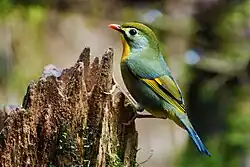 | |
| Red-billed leiothrix Leiothrix lutea | |
Scientific classification  | |
| Kingdom: | Animalia |
| Phylum: | Chordata |
| Class: | Aves |
| Order: | Passeriformes |
| Family: | Leiothrichidae |
| Genus: | Leiothrix Swainson, 1832 |
| Type species | |
| Parus furcatus Temminck, 1824,[1] = Sylvia lutea Scopoli, 1786 | |
| Species | |
Leiothrix is a genus of passerine birds in the family Leiothrichidae. They belong to a clade also containing at least the liocichlas, barwings, minlas and sibias. The sibias are possibly their closest living relatives.
Taxonomy
The genus Leiothrix was introduced in 1832 by the English naturalist William Swainson with the red-billed leiothrix as the type species.[2][3] The genus name combines the Ancient Greek leios meaning "smooth" and thrix meaning "hair".[4]
The genus contains two species:[5][6]
| Common name | Scientific name and subspecies | Range | Size and ecology | IUCN status and estimated population |
|---|---|---|---|---|
| Red-billed leiothrix
|
Leiothrix lutea (Scopoli, 1786) Five subspecies
|
China, and the Himalaya in northern India, Bhutan, Nepal, and parts of Tibet. | Size: 14–15 cm Habitat: Thick shrubs and woodland Diet: Insects, fruit, seeds |
LC |
| Silver-eared mesia
|
Leiothrix argentauris (Hodgson, 1837) Nine subspecies
|
Southeast Asia, from Nepal east to southwestern China and south to Sumatra. | Size: 15–17 cm Habitat: Thick shrubs and woodland Diet: Insects, fruit, seeds |
LC |


Some authors have split silver-eared mesia into two species, L. argentauris in mainland Asia, and Sumatram mesia L. laurinae (with rookmakeri as a subspecies of it) on Sumatra,[7] but this has not been followed by either the IOC World Bird List or the AviList.[5][6]
Because of their plumage and song, they are frequently kept as cagebirds..[8]
References


- ↑ "Leiothrichidae". aviansystematics.org. The Trust for Avian Systematics. Retrieved 2023-07-15.
- ↑ Swainson, William; Richardson, J. (1831). Fauna Boreali-Americana, or, The Zoology of the Northern Parts of British America. Vol. 2: The Birds. London: J. Murray. pp. 233, 490. The title page bears the year 1831 but the volume was not published until 1832.
- ↑ Mayr, Ernst; Paynter, Raymond A. Jr, eds. (1964). Check-List of Birds of the World. Vol. 10. Cambridge, Massachusetts: Museum of Comparative Zoology. p. 381.
- ↑ Jobling, James A. (2010). The Helm Dictionary of Scientific Bird Names. London: Christopher Helm. p. 221. ISBN 978-1-4081-2501-4.
- 1 2 Gill, Frank; Donsker, David; Rasmussen, Pamela, eds. (January 2022). "Laughingthrushes and allies". IOC World Bird List Version 12.1. International Ornithologists' Union. Retrieved 6 June 2022.
- 1 2 AviList Core Team (2025). "AviList: The Global Avian Checklist, v2025". doi:10.2173/avilist.v2025. Retrieved 2026-06-15.
- ↑ Hoyo, Josep del (2020). All the Birds of the World. Barcelona: Lynx edicions. p. 659. ISBN 978-84-16728-37-4.
- ↑ "Leiothrix lutea Red-billed Leiothrix Léiothrix jaune", The Birds of Africa : The Malagasy Region, Christopher Helm, retrieved 2026-08-19
- Cibois, Alice (January 2003). "Mitochondrial DNA Phylogeny of Babblers (Timaliidae)". Auk. 120 (1): 1–20. Archived from the original on January 8, 2008 – via FindArticles.
- Collar, N. J. & Robson C. 2007. Family Timaliidae (Babblers) pp. 70 – 291 in; del Hoyo, J., Elliott, A. & Christie, D.A. eds. Handbook of the Birds of the World, Vol. 12. Picathartes to Tits and Chickadees. Lynx Edicions, Barcelona.