The Penguin Parade
| The Penguin Parade | |
|---|---|
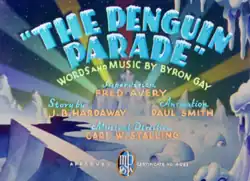 Title card | |
| Directed by | Fred Avery |
| Story by | J. B. Hardaway |
| Produced by | Leon Schlesinger |
| Starring | Mel Blanc |
| Music by | Carl W. Stalling |
| Animation by | Paul Smith |
| Color process | Technicolor |
Production company | |
| Distributed by | Warner Bros. Productions The Vitaphone Corporation |
Release date |
|
Running time | 7 min |
| Country | United States |
| Language | English |
The Penguin Parade is a 1938 American animated comedy short film directed by Fred Avery.[1] It is the 93rd film in the Merrie Melodies series, featuring the titular song by Byron Gay.[2][3]
Plot
Penguins operate Club Iceberg. A rich penguin gets himself a drink from a walrus bartender, who literally pours every ingredient into the penguin and shakes him, causing him to become incredibly drunk. The penguin listens to a story told by another walrus and laughs with him. After a lengthy introduction from the master of ceremonies, the Penguin Parade occurs, with penguins marching down a staircase and walking on each other's feet into mid-air before falling in a coordinated manner.
The next performance involves a Bing Crosby-like crooner penguin, who sings "When My Dreamboat Comes Home", followed by three singers who sing at a lighter and faster pace. An orchestra then plays a jazz piece. After its conclusion, the penguins relax for a bit and is spurred into playing the next piece by a drummer penguin. A walrus cellist uses a stove-like cello which the conductor shovels coals into, causing the performance to speed up further. A walrus caricature of Fats Waller plays a piano which falls down and is raised. A female walrus dances with three penguins. After a thrilling encore, the performance concludes and the band expresses to the patrons that they are too tired to continue performing for the night in this manner.
Voice cast
- Mel Blanc as Drunk Penguin/Dancing Penguin
- Cliff Nazarro as Double Talking MC/Bong Crosby
- Tex Avery as Walrus
- Paul Taylor Group (Vocal Quartet)[4]
Reception
Motion Picture Exhibitor (April 15, 1938): "A musical revue at an Artie Penguin Night Club. "Fats Waller" pounds out music. There is an amusing little double talking M.C. Animation is very smooth, music is hot, tuneful. This constitutes a moderately funny cartoon for all classes."[5]
Home media
- Laserdisc - Golden Age of Looney Tunes: Volume 2, Side 1 (unrestored)
- Blu-Ray - Looney Tunes Collector's Choice: Volume 2 (restored)[6]
References
- ↑ Beck, Jerry; Friedwald, Will (1989). Looney Tunes and Merrie Melodies: A Complete Illustrated Guide to the Warner Bros. Cartoons. Henry Holt and Co. p. 70. ISBN 0-8050-0894-2.
- ↑ Lenburg, Jeff (1999). The Encyclopedia of Animated Cartoons. Checkmark Books. pp. 104–106. ISBN 0-8160-3831-7. Retrieved June 6, 2020.
- ↑ Parten, James (March 31, 2020). "Merrie Melodies 1937-38: More Old Friends". Cartoon Research. Retrieved July 6, 2026.
- ↑ Scott, Keith (2022). Cartoon Voices of the Golden Age, 1930-1970: Volume 2 - Studio Filmographies with Voice Credits. Orlando, Florida: BearManor Media. p. 28. ISBN 979-8-88771-010-5. Retrieved December 28, 2023.
- ↑ Sampson, Henry T. (1998). That's Enough, Folks: Black Images in Animated Cartoons, 1900-1960. Scarecrow Press. p. 197. ISBN 978-0810832503.
- ↑ "Warner Archive: Looney Tunes Collector's Choice Volume 2 Detailed for Blu-ray". www.blu-ray.com. Retrieved July 16, 2026.
External links
- 1938 films
- Merrie Melodies short films
- Films directed by Tex Avery
- Films scored by Carl W. Stalling
- 1930s Warner Bros. animated short films
- Animated films about penguins
- 1938 English-language films
- English-language short films
- 1938 animated short films
- Films produced by Leon Schlesinger
- Warner Bros. Cartoons animated short films
- Animated films about music and musicians