Daffy Duck in Hollywood
| Daffy Duck in Hollywood | |
|---|---|
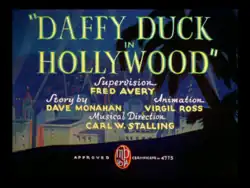 Title card | |
| Directed by | Fred Avery |
| Story by | Dave Monahan |
| Produced by | Leon Schlesinger |
| Starring | Mel Blanc Rolfe Sedan Sara Berner Jim Bannon[1] |
| Music by | Carl W. Stalling |
| Animation by | Virgil Ross |
| Color process | Technicolor |
Production company | |
| Distributed by | Warner Bros. Pictures The Vitaphone Corporation |
Release date |
|
Running time | 8 min |
| Country | United States |
| Language | English |
Daffy Duck in Hollywood is a 1938 American animated comedy short film directed by Fred Avery.[3] The cartoon was released on December 12, 1938. It is part of the Merrie Melodies series and the sixth cartoon to star Daffy Duck. The short is Avery's last Daffy Duck cartoon.[4]
Plot
At Wonder Studios, producer I.M. Stupendous quickly refuses Daffy Duck's request for an acting role, only for the phone to ring and reveal Daffy, who emerges to pinch his nose. Stupendous then "phones" director von Hamburger (a parody of Josef von Sternberg) in a face-to-face conversation and orders him to finish the romance film he's working on that day, which Daffy decides to disrupt.
On the set, all the crew rushes to follow Hamburger's order for a close-up, who starts smoking a cigarette. Daffy then swipes and starts smoking the cigarette, spelling out Warner Bros. with the smoke. Hamburger asks how the sound is, and Daffy whistles into the microphone which gives a bad reaction to the crew member checking it. He orders the lights turned which Daffy has connected the emergency fire hose to, causing water to gush out of the lights and down on the set where the actors are, disrupting the filming process. Daffy then plants bullets in the camera. When the camera rolls on Hamburger's orders, it starts shooting bullets. Hamburger begins crying while stating "This isn't a gangster picture!" Daffy sympathetically gives him a gift, promising to stop being screwy, and walks away. However, Daffy then pops up out of the gift box, bites Hamburger's nose and starts jumping around.
As filming begins, a typical romantic scene between a rooster and hen plays out. When the inevitable kiss comes up, Daffy jumps in and kisses the hen; he is so excited that he does it again. Hamburger declares "It's ruined, cut!" The time being noon, Hamburger asks for lunch: turkey with all the trimmings. However, Daffy is under the platter and bites Hamburger's nose again, then jumps away. Then, in the film room, Daffy begins clipping and pasting together random film clips into a collage film.
Hamburger tells Stupendous that his film is finished, Stupendous quotes "Well it better be good" as Daffy swaps out the films. Hamburger shows the "film". At first the title card reads "Gold Is Where You Find It" (a movie produced by Warner Bros. the same year), showing film clips of gold mining, but then suddenly plays humorous live action clips of random scenes with appropriate mismatched audio (a lion roaring in Central Park Zoo, a US military parade, square dancing, the World Championship Fight in Madison Round Garden, and a beauty contest). Despite Hamburger's obvious (and justified) fear, Stupendous approves highly of the film as he finds that Hamburger has fainted.
As a result, Daffy is now the director, uttering the same line asking for turkey at lunchtime as Hamburger complete with Hamburger's accent and clothing. Hamburger retaliates by hiding under a platter, biting Daffy's nose, then jumping away as Daffy did earlier.
Home media
- VHS - Daffy!
- VHS - The Golden Age of Looney Tunes - Vol. 9: Hooray For Hollywood
- VHS - Looney Tunes: The Collector's Edition - Vol. 8: Tex-Book Looney
- LaserDisc - Daffy! and Porky!
- LaserDisc - The Golden Age of Looney Tunes - Vol. 1
- DVD - Looney Tunes Golden Collection: Volume 3[5]
- Blu-ray - Jezebel[6]
- Blu-ray - Cats Don't Dance[7]
References
- ↑ Scott, Keith (2022). Cartoon Voices from the Golden Age, 1930-70. BearManor Media. p. 32. ISBN 979-8-88771-010-5.
- ↑ Maltin, Leonard (1987). Of Mice And Magic: A History Of American Animated Cartoons (Revised ed.). New York, NY: Plume. p. 423. ISBN 0-452-25993-2.
- ↑ Beck, Jerry; Friedwald, Will (1989). Looney Tunes and Merrie Melodies: A Complete Illustrated Guide to the Warner Bros. Cartoons. Henry Holt and Co. p. 81. ISBN 0-8050-0894-2.
- ↑ Lenburg, Jeff (1999). The Encyclopedia of Animated Cartoons. Checkmark Books. pp. 70–72. ISBN 0-8160-3831-7. Retrieved June 6, 2020.
- ↑ Release and content information: "The Bugs Bunny/Looney Tunes comedy Hour - The Looney Tunes Golden Collection Volume 3". TVShowsOnDVD.com. Archived from the original on February 1, 2014. Retrieved January 20, 2014.
- ↑ "Warner Archive Announces August Releases". www.blu-ray.com. Retrieved July 15, 2026.
- ↑ "Warner Archive Announces September Releases". www.blu-ray.com. Retrieved August 16, 2023.
External links


- 1938 films
- 1930s color films
- Merrie Melodies short films
- Films directed by Tex Avery
- Films about Hollywood, Los Angeles
- Films set in studio lots
- Animated films set in Los Angeles
- Daffy Duck films
- Porky Pig films
- Short films with live action and animation
- 1930s Warner Bros. animated short films
- Films scored by Carl W. Stalling
- 1938 animated short films
- Films produced by Leon Schlesinger
- Warner Bros. Cartoons animated short films
- American self-reflexive films