Supersingular prime (algebraic number theory)
In algebraic number theory, a supersingular prime for a given elliptic curve is a prime number with a certain relationship to that curve. If the curve is defined over the rational numbers, then a prime is supersingular for E if the reduction of modulo is a supersingular elliptic curve over the residue field .[1]


Equivalently, for a prime of good reduction for , the prime is supersingular for if and only if the trace of the Frobenius endomorphism is zero, that is, .[1] This condition means that the reduction of modulo has the maximum possible endomorphism ring—an order in a quaternion algebra—rather than an order in an imaginary quadratic field.[2]


Distribution
Complex multiplication case
When has complex multiplication (CM) by an order in an imaginary quadratic field , the distribution of supersingular primes is well understood. A classical result of Deuring (1941) implies that a prime of good reduction is supersingular for if and only if is inert or ramified in .[2] By the Chebotarev density theorem, these primes constitute exactly half of all primes, so the set of supersingular primes for a CM curve has natural density .[3]


Non-CM case
When does not have complex multiplication, the situation is more subtle. In 1968, Serre proved that the set of supersingular primes has asymptotic density zero by applying the Chebotarev density theorem to the number fields generated by coordinates of the torsion points of .[3][4] Serre later obtained the unconditional upper bound

for any , where denotes the number of supersingular primes up to , and showed that under the Generalized Riemann Hypothesis (GRH) one could achieve the bound .[5][4] The unconditional exponent was subsequently improved by Wan (1990), who showed


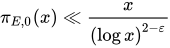
by incorporating sieve-theoretic techniques.[6]
Despite this rarity, Noam Elkies proved in 1987 that every elliptic curve over has infinitely many supersingular primes.[7] His proof uses the theory of complex multiplication and Deuring's lifting lemma: given any finite set of primes, one can find a negative fundamental discriminant such that the Hilbert class polynomial evaluated at the j-invariant has a prime factor outside , and this prime is necessarily supersingular for .[7] Elkies later extended this result to elliptic curves defined over any number field with at least one real embedding.[8]


Lang–Trotter conjecture
Lang & Trotter (1976) conjectured that the number of supersingular primes less than a bound satisfies


as , where is an explicit constant depending on .[9] This prediction arises from a probabilistic heuristic: by the Hasse bound, , so the "probability" that for a random prime is roughly , and summing this over primes up to gives an expected count on the order of .[9] As of 2026, this conjecture remains open.[10]


Example
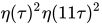
Consider the elliptic curve , which is the modular curve with j-invariant . The supersingular primes for this curve begin: 2, 19, 29, 199, 569, 809, 1289, 1439, 2539, 3319, ... (sequence A006962 in the OEIS).[4] These are exactly the primes for which the coefficient of in vanishes modulo , where is the Dedekind eta function.




Generalization
More generally, if is any global field—that is, a finite extension of or of —and is an abelian variety defined over , then a supersingular prime for A is a finite place of such that the reduction of modulo is a supersingular abelian variety.[1] It is conjectured that every abelian variety over a number field has infinitely many supersingular primes, but this is known only in special cases.[8]


See also
Notes
- 1 2 3 Silverman 1986, pp. 137–144.
- 1 2 Deuring 1941.
- 1 2 Serre 1998, p. I-25.
- 1 2 3 Elkies 1991, p. 127.
- ↑ Serre 1981, p. 357.
- ↑ Wan 1990.
- 1 2 Elkies 1987.
- 1 2 Elkies 1989.
- 1 2 Lang & Trotter 1976.
- ↑ Cojocaru, Fouvry & Murty 2005.
References
- Deuring, Max (1941). "Die Typen der Multiplikatorenringe elliptischer Funktionenkörper". Abh. Math. Sem. Hansischen Univ. 14: 197–272. doi:10.1007/BF02940746. S2CID 122656006.
- Elkies, Noam D. (1987). "The existence of infinitely many supersingular primes for every elliptic curve over Q". Invent. Math. 89 (3): 561–567. Bibcode:1987InMat..89..561E. doi:10.1007/BF01388985. MR 0903384. S2CID 123646933.
- Elkies, Noam D. (1989). "Supersingular primes for elliptic curves over real number fields". Compositio Math. 72 (2): 165–172.
- Elkies, Noam D. (1991). "Distribution of supersingular primes". Astérisque. 198–200: 127–132. MR 1144318.
- Lang, Serge; Trotter, Hale F. (1976). Frobenius distributions in GL2-extensions. Lecture Notes in Mathematics. Vol. 504. New York: Springer-Verlag. ISBN 0-387-07550-X. Zbl 0329.12015.
- Ogg, A. P. (1980). "Modular Functions". In Cooperstein, Bruce; Mason, Geoffrey (eds.). The Santa Cruz Conference on Finite Groups. Held at the University of California, Santa Cruz, Calif., June 25–July 20, 1979. Proc. Symp. Pure Math. Vol. 37. Providence, RI: American Mathematical Society. pp. 521–532. ISBN 0-8218-1440-0. Zbl 0448.10021.
- Serre, Jean-Pierre (1981). "Quelques applications du théorème de densité de Chebotarev". Publications Mathématiques de l'IHÉS. 54: 323–401.
- Serre, Jean-Pierre (1998). Abelian ℓ-adic Representations and Elliptic Curves. Research Notes in Mathematics. Vol. 7 (Revised reprint of the 1968 original ed.). Wellesley, MA: A K Peters. ISBN 1-56881-077-6.
- Silverman, Joseph H. (1986). The Arithmetic of Elliptic Curves. Graduate Texts in Mathematics. Vol. 106. New York: Springer-Verlag. ISBN 0-387-96203-4. Zbl 0585.14026.
- Wan, Daqing (1990). "On the Lang–Trotter conjecture". Journal of Number Theory. 35 (3): 247–268. doi:10.1016/0022-314X(90)90117-A.
- Cojocaru, Alina Carmen; Fouvry, Étienne; Murty, M. Ram (2005). "The square sieve and the Lang–Trotter conjecture". Canadian Journal of Mathematics. 57 (6): 1155–1177. doi:10.4153/CJM-2005-045-7.