Storming of Christianspris
| Storming of Christianspris | |||||||||
|---|---|---|---|---|---|---|---|---|---|
| Part of the Torstenson War | |||||||||
 Contemporary map of Christianspris by Conrad Mardefelt | |||||||||
| |||||||||
| Belligerents | |||||||||
 Swedish Empire |
 Denmark–Norway | ||||||||
| Commanders and leaders | |||||||||
|
Lennart Torstensson |
Axel Urup (POW) | ||||||||
| Units involved | |||||||||
|
Two regiments |
Christianspris garrison | ||||||||
| Strength | |||||||||
| Unknown, but more than the Danes | 50–60 men | ||||||||
| Casualties and losses | |||||||||
| Unknown | Everyone but one killed | ||||||||
The storming of Christianspris occurred on 18 and 19 December 1643 during the Torstenson War between Denmark and Sweden.
After Sweden went to war with Denmark in 1643, a Swedish army under the command of Lennart Torstensson invaded Jutland, quickly capturing multiple towns before moving toward the fortress of Christianspris, which had a garrison of 50 to 60 men led by Axel Urup.
After a failed storming on 18 December, the Swedes attacked once more on 19 December in a two-pronged attack. One regiment went overland toward the fortress's ramparts while another regiment crossed toward the fortress using confiscated boats. The Swedes managed to overwhelm the outnumbered Danish garrison, killing all of them except Urup, who was made a prisoner of war.
Background
Frustrated by perceived Danish disruptions of Swedish activities in the Thirty Years' War, Axel Oxenstierna, the chancellor of Sweden, began planning a preemptive war with Denmark in May 1643.[1] According to his plan, a Swedish army under the command of Lennart Torstensson was to invade Jutland from Germany, and then be transported to the Danish islands. Another army under the command of Gustav Horn would invade Scania.[2][3]
Prelude
After being ordered to attack Denmark in October 1643, Torstensson prepared defenses on the borders of Bohemia and Moravia before marching northwest.[4][5] He led about 15,000[6] or 16,000 men in total, 12,000 of whom were national troops.[7][4][8] Only after arriving at Havelberg on 6 December were Torstensson's officers informed of the attack on Denmark.[5][9][8]
The Swedish army assembled at Ratzeburg on 11 December and invaded Holstein on 13 December. They captured Segelburg, Itzehoe, Kiel, and Breitenburg, and then moved toward Christianspris.[5][10]
Storming
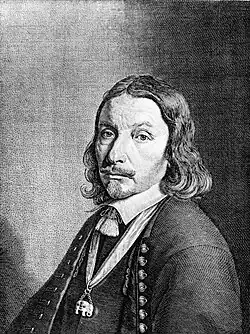
Christianspris, a bastion fort around a mile north of Kiel, had a garrison of between 50[11][12] to 60[11] men under the command of Axel Urup. Additionally, the fortress was well maintained, difficult to reach, and equipped with artillery. On 16 December, Conrad Mardefelt, the quartermaster general was sent to the fortress to negotiate its surrender.[6][12] However, all demands to surrender were refused by the Danes.[6][11][12] Nevertheless, Mardefelt had a good view of the Danish defenses and drew up a plan for the ensuing siege.[6] On 17 December, the Swedes began bombarding Christianspris from Kiel.[13]
Unwilling to wait, Torstensson stormed Christianspris on 18 December. However, the attack was repelled.[13] On 19 December, the Swedes attacked once again with two regiments. One force marched overland against the fortress's ramparts,[11][14][13] while another crossed over to Christianspris in confiscated boats that had been armed with guns. The Swedes surprised the Danish defenders, swarming towards the fortress in the dark.[11][15] The Danish defenses on the sandbank consisted only of palisades and chevaux-de-frise.[13][14]
The Danish defenders were quickly overwhelmed by the larger Swedish force, and were all killed except Urup, who was captured.[16][15][14]
Aftermath
After capturing the fortress, the Swedes took money, materiel, and artillery.[17] Additionally, they renamed the fortress as Kristinapris, after Christina, Queen of Sweden.[18]
As rumors of the storming spread, the fortress of Rendsburg capitulated to the Swedes without a fight.[18] Other towns also surrendered.[17] By the end of the year, the entirety of Holstein, excluding Glückstadt and Krempe, was under Swedish occupation.[19]
See also
- Siege of Laholm Castle – Part of the Torstenson War
- Siege of Hammershus – Part of the Torstenson War
Citations
- ↑ von Essen 2020, pp. 97 & 99.
- ↑ von Essen 2020, pp. 97–101.
- ↑ Sundberg 2010, p. 111.
- 1 2 von Essen 2020, p. 101.
- 1 2 3 Walde 1916, p. 218.
- 1 2 3 4 Pohl 2020, p. 163.
- ↑ Wolke 2018, p. 68.
- 1 2 Englund 1993, p. 306.
- ↑ Palmstierna & Zeeh 1944, p. 71.
- ↑ Palmstierna & Zeeh 1944, p. 72.
- 1 2 3 4 5 Englund 1993, p. 308.
- 1 2 3 Barløse 1972, p. 63.
- 1 2 3 4 Pohl 2020, p. 164.
- 1 2 3 Barløse 1972, p. 64.
- 1 2 Bäckström 2018, p. 74.
- ↑ Englund 1993, pp. 308 & 310.
- 1 2 Bäckström 2018, p. 77.
- 1 2 Englund 1993, p. 310.
- ↑ Sundberg 2010, p. 113.
References
- Englund, Peter (1993). Ofredsår: om den Svenska Stormaktstiden och en man i dess mitt [Years of unrest: about the Swedish Empire and a man in its midst] (in Swedish). Stockholm: Atlantis. ISBN 9789174863499.
- Bäckström, Olli (2018). Katajala, Kimmo; Hirvonen, Helena (eds.). Snapphanar and Power States: Insurgency and the Transformation of War in Sweden and Denmark 1643–1645. Joensuu: University of Eastern Finland. ISBN 9789526129020.
- von Essen, Michael Fredholm (2020). The Lion from the North: The Swedish Army during the Thirty Years War 1632-48. Vol. 2. Helion & Company. ISBN 9781913118839.
- Sundberg, Ulf (2010). Sveriges krig 1630-1814 [Sweden's wars 1630–1814] (in Swedish). Svenskt militärhistoriskt bibliotek. ISBN 9789185789634.
- Palmstierna, Carl-Fredrik; Zeeh, Erik (1944). Slaget vid Femern [Battle of Fehrmarn] (PDF) (in Swedish). Gothenburg: Sjöhistoriska samfundet.
- Walde, O. (1916). Storhetstidens litterära krigsbyten [The Literary War Booty of the Age of Greatness] (PDF) (in Swedish). Almqvist & Wiksells.
- Wolke, Lars Ericson (2018). "Lennart Torstensson: Fader till det svenska artilleriet". Sveriges tio främsta fältherrar [Sweden's ten greatest generals] (in Swedish). Svenskt militärhistoriskt bibliotek. ISBN 9789188053787.
- Pohl, Per-Ole (2020). "Christianspries – Eine Festung des Dreißigjährigen Krieges im Lichte historischer Bildquellen" [Christianspries – A Fortress from the Thirty Years' War Seen in the Light of Historical Pictorial Sources]. In Atzbach, Rainer; Ottersbach, Christian; Sørensen, Claus; Kock, Jan; Wille-Jørgensen, Dorthe (eds.). Castles and Fortifications of the Reformation Period (PDF). The Danish Castle Research Association.
- Barløse, Børge L. (1972). "Christianspris - Frederiksort: fæstningen, som ikke kom til orde". Sønderjydske Årbøger. 1 (84): 60–79. doi:10.7146/soenderjydskeaarboeger.v84i1.80329 – via tidsskrift.dk.