Shah Abdol-Azim Shrine
| Shah Abdol-Azim Shrine | |
|---|---|
شاه عبدالعظیم | |
 | |
  Location of the funerary complex in Iran | |
| Religion | |
| Affiliation | Shia Islam |
| Shrine and mosque complex | |
| Status | Active |
| Location | |
| Location | Rey, Ray County, Tehran Province |
| Country | Iran |
Interactive map of Shah Abdol-Azim Shrine | |
| Coordinates | 35°35′08″N 51°26′07″E / 35.58556°N 51.43528°E |
| Architecture | |
| Type | Islamic architecture |
| Style | |
| Completed | 9th century CE |
 | |
Official name | Shāh Abdol-Azīm Shrine |
| Type | Built |
| Designated | 1942 |
| Reference no. | 406 |
Conservation organization | Cultural Heritage, Handicrafts and Tourism Organization of Iran |
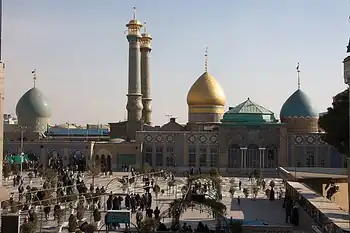
The Shah Abdol-Azim Shrine (Persian: شاه عبدالعظیم; Arabic: مرقد الشاه عبد العظيم الحسني)[a] is a Shia religious complex located in Rey, in the province of Tehran, Iran. The complex contains the tomb of Abd al-Azim al-Hasani, a descendant of the second Shia Imam Hasan.[4] Al-Najashi reported that when he died and his body was prepared for washing, a note was found in his pocket containing his genealogy, which read: “I am Abu al-Qasim Abd al-Azim ibn Abd Allah ibn Ali ibn al-Hasan ibn Zayd ibn al-Hasan ibn Ali ibn Abi Talib.”[5]
He was entombed here after his death in the 9th century CE. Adjacent to the shrine within the complex, are the mausoleums Tahir (a son of the fourth Shia Imam Sajjad) and Hamzeh (a brother of the eighth Shia Imam Reza). The complex was added to the Iran National Heritage List in 1942, administered by the Cultural Heritage, Handicrafts and Tourism Organization of Iran. The complex is a holy site in Shia Islam.
History
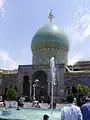
The shrine complex dates back to the Ilkhanid, Safavid, and Qajar periods. The original shrine of Abd al-Azim was extensively renovated by Muhammad ibn Zayd al-Da'i al-Alawi during the second half of the 3rd century AH, corresponding to the 9th century CE. The main entrance to the shrine, located to the north of the tomb, was constructed under the patronage of the Buyid rulers and later completed through the efforts of Majd al-Mulk Qummi. The lower section of the shrine is square, with each side measuring approximately eight meters. Above it, following the architectural tradition of Seljuk buildings, four squinches were constructed over the four corners of the chamber, transitioning to an octagonal structure and then to a sixteen-sided polygon. The main dome of the shrine was built above this sixteen-sided structure. The interior of all these sections is decorated with mirror work. Major renovations and alterations to this part of the shrine were carried out during the reign of Tahmasp I of the Safavid Empire. The courtyards and iwans date from the Safavid period.
During the Qajar period, numerous renovations and additions were made to the shrine. The gilded covering of the dome was installed by order of Naser al-Din Shah in 1270 AH (1835 CE). Ibn Qūlawayh al-Qummī (d. 978 CE) "includes the shrine in his Kāmil al-Ziyārāt, one of the earliest pilgrimage guides for the Shiʿa, which suggests that the tomb of ʿAbd al-Aẓīm was already of some importance by the tenth century."[6][7] The tomb of Abdol-Azim had also come under the patronage of Sunni rulers at times, a notable example being the mausoleum constructed over Abdol-Azim's tomb in the 1090s CE by orders of the Seljuk vizier Majd al-Mulk Asʿad b. Muḥammad b. Mūsā.[8][9][10][11] This door has an inscription in Thuluth script. Abdol Azim migrated to Ray out of persecution and subsequently died there. A piece of paper was found in his pocket outlining his ancestry as being: ‘Abdul ‘Adhīm son of ‘Abdillāh son of ‘Alī son of Hasan son of Zayd son of Hasan ibn ‘Alī. Shah Abdol Azim was sent to Ray by Imam Reza.
Notable burials
The shrine is the burial site for many notable individuals, including members of the Qajar family, and many notable political figures, scholars, and clerics, from the Medieval period to contemporary time.
Gallery




See also
Notes
References
- ↑ "Abdol Azim Hasani". iribnews.ir.
- ↑ "Shrine of Shah Abdol-Azim". aparat.com.
- ↑ "Shah Abd al-Azim". mashreghnews.ir.
- ↑ al-Qummi, Ja'far ibn Qūlawayh (2008). "107". Kāmil al-Ziyārāt. trans. Sayyid Mohsen al-Husaini al-Mīlāni. Shiabooks.ca Press. p. 658.
- ↑ al-Najashi. Rijal al-Najashi (in Arabic). p. 248.
- ↑ Ibn Qūlawayh al-Qummī, Kāmil al-Ziyārāt (Beirut, 1418/1997), pp. 536–537
- ↑ Bernheimer, Teresa. "Shared Sanctity: Some Notes on Ahl al-Bayt Shrines in the Early Ṭālibid Genealogies" (PDF). Archived from the original (PDF) on August 15, 2019.
- ↑ ʿAbd al-Jalīl b. Abū al-Ḥasan al-Qazwīnī (fl. 1189), Kitāb al-Naqḍ (Tehran, 1371/1952), p. 220
- ↑ W. Barthold, An Historical Geography of Iran (Princeton, 1984), p. 127
- ↑ Sheila Blair, The Monumental Inscriptions from Early Islamic Iran and Tran-soxania (Leiden, 1992), p. 185
- ↑ Leisten, Architektur für Tote, pp. 240–241.
Further reading
- Kondo, Nobuaki (2018). "State and Shrine in Iran: Waqf Administration of the Shah ͑ Abd al-͑ Azim Shrine under the Qajars". In Miura, Toru (ed.). Comparative Study of the Waqf from the East: Dynamism of Norm and Practice in Religious and Familial Donations. Tokyo. pp. 1–25.
{{cite book}}: CS1 maint: location missing publisher (link) - Kondo, Nobuaki. "The Shah ʿAbd al-ʿAzim Shrine and its Vaqf under the Safavids".
External links
 Media related to Shah Abdol-Azim Shrine at Wikimedia Commons


| |||||||||
| |||||||||
| |||||||||
| |||||||||
| |||||||||
| |||||||||
| |||||||||


- Religious buildings and structures completed in the 9th century
- Buildings and structures in Tehran province
- Mausoleums, shrines and tombs on the Iran National Heritage List
- Imamzadehs in Iran
- Mausoleums in Iran
- Mosque buildings with domes in Iran
- Mosque buildings with minarets in Iran
- Safavid architecture in Iran
- Shia mosques in Iran
- Tourist attractions in Tehran province
- Twelver Shia mosques
- Twelver Shia shrines