Setebos (moon)
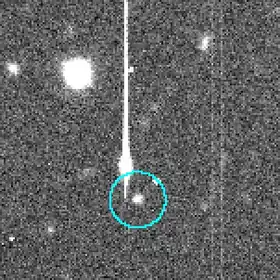 Discovery image of Setebos (encircled) | |
| Discovery | |
|---|---|
| Discovered by |
|
| Discovery date | July 18, 1999 |
| Designations | |
Designation | Uranus XIX |
| Pronunciation | /ˈsɛtɛbʌs/,[1] /-bɒs/[2] |
| Adjectives | Setebosian /ˌsɛtɛˈboʊsiən/[3] |
| Orbital characteristics | |
Mean orbit radius | 17,418,000 km[4][5] |
| Eccentricity | 0.5914[5] |
| 2225.21 d | |
| Inclination | 158° (to the ecliptic)[4] |
| Satellite of | Uranus |
| Physical characteristics | |
| 47 km | |
| 4.255 ± 0.017 h[6] | |
| Albedo | 0.04 (Assumed) |
| 23,3 | |
| 10,6 | |
Setebos (/ˈsɛtɛbʌs/), also known as Uranus XIX, is one of the largest irregular satellites of Uranus.
Discovery and naming
It was discovered on 18 July 1999 by John J. Kavelaars et al. and provisionally designated S/1999 U 1.[7]
Confirmed as Uranus XIX, it is named after the god Setebos worshipped by Caliban and Sycorax in William Shakespeare's play The Tempest.
A crater on Umbriel is also named after Setebos, but with the spelling Setibos.
Orbit
Setebos orbits Uranus at an average distance of 16,256,000 km, in 1978 days, at an inclination of about 152° to the ecliptic, in a retrograde direction and with a high eccentricity of 0.445. The orbital elements are continuously changing due to solar and planetary perturbations.
Physical characteristics
Setebos's estimated diameter is 47 kilometers, assuming an albedo of 4%.
The satellite appears neutral (grey) in visible light (colour indices B−V=0.77, R−V=0.35),[8] similar to Prospero.
Measurements of Setebos's light curve by the Kepler space telescope indicate that its rotation period is about 4 hours and 15.3 min.[6] which makes it one of the fastest-rotating moons in the Solar System.
Origin
Setebos probably did not form near Uranus but was captured by Uranus later. The orbital parameters suggest that it may belong to the same dynamic cluster as Sycorax and Prospero, suggesting a common origin.[9] However, Sycorax has a much redder color than the other moons, which tend to be grey in color.
Exploration
Setebos has not been imaged up close by a space probe. All Uranian irregular moons including Setebos are planned to be distant observation targets for the proposed Uranus Orbiter and Probe (UOP), which will measure the Uranian irregular moons' rotation periods and shapes by watching their brightness change over time.[10] The UOP may not be able to do a close flyby of Setebos because the moon does not orbit near the ecliptic plane.[10]
See also
References
Citations
- ↑ Shakespeare Recording Society (1995) The Tempest (audio CD)
- ↑ Benjamin Smith (1903) The Century Dictionary and Cyclopedia
- ↑ Campbell, Pyre, Weaver (1932) Poetry and criticism of the romantic movement
- 1 2 Sheppard, Jewitt & Kleyna 2005, p. 523, Table 3.
- 1 2 Yeomans, Donald K. (2007-06-28). "Planetary Satellite Mean Orbital Parameters". JPL/NASA. Retrieved 2008-01-19.
- 1 2 Farkas-Takács, A.; Kiss, Cs.; Pál, A.; Molnár, L.; Szabó, Gy. M.; Hanyecz, O.; et al. (September 2017). "Properties of the Irregular Satellite System around Uranus Inferred from K2, Herschel, and Spitzer Observations". The Astronomical Journal. 154 (3): 13. arXiv:1706.06837. Bibcode:2017AJ....154..119F. doi:10.3847/1538-3881/aa8365. S2CID 118869078. 119.
- ↑ Gladman, B. J.; Kavelaars, J. J.; Holman, M. J., Petit, J.-M.; Scholl, H.; Nicholson, P. D.; and Burns, J. A.; The Discovery of Uranus XIX, XX, and XXI, Icarus, 147 (2000), pages 320–324
- ↑ Grav, Holman & Fraser 2004.
- ↑ Grav, Tommy; Holman, Matthew J.; Gladman, Brett J.; Aksnes, Kaare Photometric survey of the irregular satellites, Icarus, 166, (2003), pp. 33–45. arXiv:astro-ph/0301016
- 1 2 Verbiscer, Anne J.; Denk, Tilmann; Mottola, Stefano; Porter, Simon B. (July 2023). Observing the Irregular Moons of Uranus by a Uranus Flagship Mission (PDF). Uranus Flagship: Investigations and Instruments for Cross-Discipline Science Workshop (poster). Bibcode:2023LPICo2808.8187V. 8187. Archived from the original (PDF) on 2024-02-29.
Bibliography
- Grav, Tommy; Holman, Matthew J.; Fraser, Wesley C. (2004-09-20). "Photometry of Irregular Satellites of Uranus and Neptune". The Astrophysical Journal. 613 (1): L77–L80. arXiv:astro-ph/0405605. Bibcode:2004ApJ...613L..77G. doi:10.1086/424997. S2CID 15706906.
- Sheppard, S.S.; Jewitt, D.; Kleyna, J. (2005). "An ultradeep survey for irregular satellites of Uranus: Limits to completeness". The Astronomical Journal. 129 (1): 518–525. arXiv:astro-ph/0410059. Bibcode:2005AJ....129..518S. doi:10.1086/426329. S2CID 18688556.
External links
- "Setebos" (profile). Archived from the original on 2007-06-09. via "Solar System Exploration". NASA.
- Jewitt, D.C. (c. 2008). "Hawaii Irregular Satellites Survey". Uranus' moons. David Jewitt pages. University of Hawaiʻi. Archived from the original on 2008-12-26. Retrieved 2023-08-03.
- Sheppard, S.S. "Uranus' known satellites".
- "Natural satellites". Ephemeris service. Minor Planet Center (MPC). Harvard–Smithsonian Center for Astrophysics (CfA).
| Geography |  | ||||||
|---|---|---|---|---|---|---|---|
| Major moons | |||||||
| Astronomy |
| ||||||
| Exploration |
| ||||||
| Related | |||||||

Natural satellites of the Solar System | ||
|---|---|---|
| Planetary satellites of |    | |
| Dwarf planet satellites of | ||
| Minor-planet moons | ||
| Ranked by size | ||