Puck (moon)
 Puck as imaged by Voyager 2 in January 1986. The image is centered on Puck's south pole. Despite the low resolution, several craters have been identified, including Bogle on the upper right | |
| Discovery[1] | |
|---|---|
| Discovered by | Stephen P. Synnott / Voyager 2 |
| Discovery date | December 30, 1985 |
| Designations | |
Designation | Uranus XV |
| Pronunciation | /ˈpʌk/[2] |
| Adjectives | Puckian[3] |
| Orbital characteristics[4] | |
| 86007 km | |
| Eccentricity | 0.009 |
| 0.7618 d | |
Average orbital speed | 8.21 km/s[a] |
| Inclination | 1.1° (to the Laplace plane) 0.327° (to Uranus's equator)[5] |
| Satellite of | Uranus |
| Physical characteristics | |
| 81±2 km[6] | |
| ~82000 km2[a] | |
| Volume | 2226100±7.8% km3[7] |
| Mass | (1.91±0.64)×1018 kg[5][7] |
Mean density | ~0.858 g/cm3[a] |
| ~0.019 m/s2[a] | |
| ~0.056 km/s[a] | |
| assumed synchronous | |
| assumed zero | |
| Albedo | |
| 20.5[8] | |
Puck is the sixth-largest moon of Uranus, and its largest inner moon. It was discovered in December 1985 by the Voyager 2 spacecraft.[1] Following the convention of naming Uranus's moons after characters from Shakespeare's literary works, its name was taken from A Midsummer Night's Dream.
The orbit of Puck lies between the rings of Uranus and the first of Uranus's large moons, Miranda. Puck is approximately spherical in shape and has diameter of about 162 km (101 mi).[6] It has a dark, heavily cratered surface, which shows spectral signs of water ice.[9]
Discovery and naming
Of the moons discovered by the Voyager 2 imaging team, only Puck was discovered early enough that the probe could be programmed to image it in some detail.[1] Puck was discovered from the images Voyager 2 took on 30 December 1985. It was given the temporary designation S/1985 U 1.[10]
The moon was later named after the character Puck who appears in Shakespeare's A Midsummer Night's Dream, a little sprite who travels around the globe at night with the fairies. In Celtic mythology and English folklore, a Puck is a mischievous sprite, imagined as an evil demon by Christians.
It is also designated Uranus XV.[11]
Physical characteristics
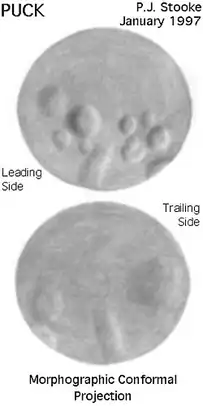
With a radius of about 81 km (50 mi),[6] Puck is the largest inner moon of Uranus, orbiting inside the orbit of Miranda. It is intermediate in size between Portia (the second-largest inner moon) and Miranda (the smallest of the five major moons). One of the images taken by Voyager 2 had high enough resolution to constrain its shape in all three dimensions, which revealed that Puck has a shape consistent within errors to being a sphere.[6] The ratio between its equatorial axes a/b is 0.93–1, and the polar axis c is at least 95% of b.[6]
Its surface is heavily cratered[8] and is grey in color.[6] There are three named craters on the surface of Puck, the largest being about 45 km (28 mi) in diameter.[1] It has a geometric albedo in visible light of approximately 10%, which is relatively dark,[12] and is about 10% brighter on its leading hemisphere than its trailing hemisphere.[13] Observations with the Hubble Space Telescope and large terrestrial telescopes found water-ice absorption features in the spectrum of Puck.[12][9]
Puck's orbit is located between the rings of Uranus and Miranda. Its surface is coated with a dark material similar to that found in the main rings.[9] The dark material is probably made of rocks or radiation-processed organics; it is possible that material spiralling inwards from Uranus's μ ring coats Puck's leading hemisphere as well.[14]
Little is known about the internal structure of Puck. It is probably made of a mixture of water ice and rocks, and may have been collisionally disrupted and reaccreted as a rubble pile.[14] The presence of a 3.0 deep 3.0 micron feature attributed to the O-H stretching mode suggests that water ice or hydrated minerals are a common component on Puck's surface.[15] Puck, as well as the other inner satellites of Uranus, is darker than the average inner Neptunian satellite, which could be either due to a higher level of solar irradiation at Uranus as opposed to Neptune, or a distinct composition.[15] The absence of craters with bright rays implies that Puck is not differentiated, meaning that ice and non-ice components have not separated from each other into a core and mantle.[1]
Named features
Puck has three craters named Bogle, Butz, and Lob, which are named after mischievous spirits from Scottish, German, and British folklore respectively. Details about these craters are currently unknown.

| Crater | Coordinates | Diameter (km) | Approval date | Named after | Ref |
|---|---|---|---|---|---|
| Bogle | — | ~47 km[14] | 1988 | Bogle (Celtic) | WGPSN |
| Butz | — | — | 1988 | Butz (German) | WGPSN |
| Lob | — | — | 1988 | Lob (English) | WGPSN |
See also
Notes
References
Citations
- 1 2 3 4 5 Smith Soderblom et al. 1986.
- ↑ "Puck". Lexico UK English Dictionary. Oxford University Press. Archived from the original on March 2, 2020.
- ↑ Sedgwick (1999) Shakespeare and the young writer
- ↑ "Planetary Satellite Mean Elements". ssd.jpl.nasa.gov. Retrieved 2026-08-30.
- 1 2 Jacobson & Park 2025.
- 1 2 3 4 5 6 Karkoschka, Voyager 2001.
- 1 2 French et al. 2024.
- 1 2 Thomas Veverka et al. 1987.
- 1 2 3 Dumas Smith et al. 2003.
- ↑ IAUC 4159.
- ↑ USGS: Planet and Satellite Names and Discoverers.
- 1 2 Karkoschka, Hubble 2001.
- ↑ Showalter & Lissauer 2006.
- 1 2 3 Cartwright, Beddingfield & Nordheim 2021.
- 1 2 Belyakov, Matthew; Davis, M. Ryleigh; Milby, Zachariah; Wong, Ian; Brown, Michael E. (2024-05-01). "JWST Spectrophotometry of the Small Satellites of Uranus and Neptune". The Planetary Science Journal. 5 (5): 119. arXiv:2404.06660. Bibcode:2024PSJ.....5..119B. doi:10.3847/PSJ/ad3d55. ISSN 2632-3338.
Sources
- Karkoschka, Erich (2001). "Voyager's Eleventh Discovery of a Satellite of Uranus and Photometry and the First Size Measurements of Nine Satellites". Icarus. 151 (1): 69–77. Bibcode:2001Icar..151...69K. doi:10.1006/icar.2001.6597. S2CID 121585538.
- Karkoschka, Erich (2001). "Comprehensive Photometry of the Rings and 16 Satellites of Uranus with the Hubble Space Telescope" (PDF). Icarus. 151 (1): 51–68. Bibcode:2001Icar..151...51K. doi:10.1006/icar.2001.6596. S2CID 121044546.
- Thomas, P.; Veverka, J.; Johnson, T.V.; Brown, Robert Hamilton (1987). "Voyager observations of 1985U1". Icarus. 72 (1): 79–83. Bibcode:1987Icar...72...79T. doi:10.1016/0019-1035(87)90121-7.
- Smith, B. A.; Soderblom, L. A.; Beebe, A.; Bliss, D.; Boyce, J. M.; Brahic, A.; Briggs, G. A.; Brown, R. H.; Collins, S. A. (4 July 1986). "Voyager 2 in the Uranian System: Imaging Science Results". Science. 233 (4759): 43–64. Bibcode:1986Sci...233...43S. doi:10.1126/science.233.4759.43. PMID 17812889. S2CID 5895824.
- Dumas, Christophe; Smith, Bradford A.; Terrile, Richard J. (2003). "Hubble Space Telescope NICMOS Multiband Photometry of Proteus and Puck". The Astronomical Journal. 126 (2): 1080–1085. Bibcode:2003AJ....126.1080D. doi:10.1086/375909.
- Marsden, Brian G. (January 16, 1986). "Satellites of Uranus and Neptune". IAU Circular (4159). Retrieved 2012-01-24.
- USGS/IAU (July 21, 2006). "Planet and Satellite Names and Discoverers". Gazetteer of Planetary Nomenclature. USGS Astrogeology. Retrieved 2012-01-24.
- French, Richard G.; Hedman, Matthew M.; Nicholson, Philip D.; Longaretti, Pierre-Yves; McGhee-French, Colleen A. (2024-03-15). "The Uranus system from occultation observations (1977–2006): Rings, pole direction, gravity field, and masses of Cressida, Cordelia, and Ophelia". Icarus. 411 115957. arXiv:2401.04634. Bibcode:2024Icar..41115957F. doi:10.1016/j.icarus.2024.115957. ISSN 0019-1035.
- Cartwright, Richard J.; Beddingfield, Chloe B.; Nordheim, Tom A.; et al. (June 2021). "The Science Case for Spacecraft Exploration of the Uranian Satellites: Candidate Ocean Worlds in an Ice Giant System". The Planetary Society Journal. 2 (3): 120. arXiv:2105.01164. Bibcode:2021PSJ.....2..120C. doi:10.3847/PSJ/abfe12.
- Jacobson, Robert A.; Park, Ryan S. (2025-02-03). "The Orbits of Uranus, Its Satellites and Rings, the Gravity Field of the Uranian System, and the Orientation of the Poles of Uranus and Its Satellites*". The Astronomical Journal. 169 (2): 65. Bibcode:2025AJ....169...65J. doi:10.3847/1538-3881/ad99d1. ISSN 0004-6256.
{{cite journal}}: CS1 maint: ref duplicates default (link) - Showalter, Mark R.; Lissauer, Jack J. (2006-02-17). "The Second Ring-Moon System of Uranus: Discovery and Dynamics". Science. 311 (5763): 973–977. Bibcode:2006Sci...311..973S. doi:10.1126/science.1122882. PMID 16373533. S2CID 13240973.
External links

| Geography |  | ||||||
|---|---|---|---|---|---|---|---|
| Major moons | |||||||
| Astronomy |
| ||||||
| Exploration |
| ||||||
| Related | |||||||

Natural satellites of the Solar System | ||
|---|---|---|
| Planetary satellites of |    | |
| Dwarf planet satellites of | ||
| Minor-planet moons | ||
| Ranked by size | ||