Sasuke (manga)
| Sasuke | |
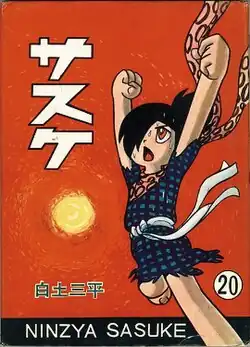 20th tankōbon volume cover published by Seirindō, featuring Sasuke | |
| サスケ | |
|---|---|
| Genre | Action, Drama, Historical[1] |
| Manga | |
| Written by | Sanpei Shirato |
| Published by |
|
| Magazine | Shōnen |
| Original run | July 1, 1961 – March 1, 1966 |
| Volumes | 20 |
| Anime television series | |
| Produced by | Kazuo Otomo |
| Written by | Junji Tashiro |
| Music by | Masafumi Tanaka |
| Studio | TCJ |
| Licensed by | |
| Original network | TBS Television |
| Original run | September 3, 1968 – March 25, 1969 |
| Episodes | 29 |
| Manga | |
| Written by | Sanpei Shirato |
| Published by | Shogakukan |
| Imprint | Shōnen Sunday Comics |
| Magazine | Weekly Shōnen Sunday |
| Original run | July 20, 1968 – May 25, 1969 |
Sasuke (Japanese: サスケ) is a Japanese manga series written and illustrated by Sanpei Shirato. It was serialized in Kobunsha's Monthly magazine Shōnen from July 1961 to March 1966. A remake ran in Shogakukan's shōnen manga magazine Weekly Shōnen Sunday from July 1968 to May 1969. In 1963, the manga, together with Shirato's other series Seton's Wild Animals, won the 4th Kodansha Children's Manga Award.
TCJ produced a 29-episode anime television series adaptation that aired between September 1968 to March 1969 on TBS Television. The series was licensed for North America by AnimEigo.[2]
Plot
The story takes place in Japan at the beginning of the 17th century, during the Edo period, following the political chaos of the Sengoku period. At the time, the powerful lord Ieyasu Tokugawa was about to take control of the country. Other feudal lords allied with Hideyori Toyotomi, including Yukimura Sanada and his ninja clan, fought against him. The elite of this formidable clan were the so-called Sarutobi warriors, who were reputed to be invincible. Despite the warriors' mastery, the struggle for power turned in Tokugawa's favor following his victory over his enemies and the death of Sanada. Tokugawa instructs his right-hand man, Hanzō Hattori, to hunt down all the surviving members of the Sanada clan, especially the Sarutobi, whom he considers a serious threat. Hattori, commander of the Iga ninja clan, begins a manhunt that will end only when the last surviving Sanada is dead.
Among the survivors of Yukimura Sanada's clan is Daisuke Ozaru, the most fearsome of the Sarutobi. Ozaru has a wife and a son named Sasuke. After being wounded in a clash, Ozaru manages, after great difficulty, to return home disguised as a traveler. The assassins pursuing him catch up with him and kill his wife. Little Sasuke is devastated by the death of his beloved mother, especially because he does not know that the traveler who arrived that evening is his father and believes he is now alone. Ozaru, meanwhile, cannot reveal his true identity. Father and son embark on a dangerous but educational journey across Japan. Along the way, Sasuke gradually learns the techniques of the Sarutobi from his father as they encounter various opponents.
Media
Manga


Written and illustrated by Sanpei Shirato, Sasuke was serialized in Kobunsha's Monthly magazine Shōnen in two periods with a total of 55 installments.[3] The first period was published from July 1 1961[4][5] to February 1, 1965.[6][7] The second period was published from the magazine's May 1, 1965 issue[8][9] and finished in the March 1, 1966 issue of Shōnen.[10][11]
Several publishers published the series in long term, first Seirindō published 20 tankōbon volumes as rental from July 1962 to 1965; Shueisha published 15 volumes from September 30, 1966, to April 30, 1967; Akita Shoten published Shirato's Comics anthology from December 25, 1969, to November 10, 1970, in eight volumes; Kodansha published 15 volumes from January 30, to August 5, 1974; Shogakukan republished the series four times in new edition, first, from May 10, 1990, to December 10, 1990, in eight bunkoban volumes, the second time, in ten volumes from December 10, 1995, to April 10, 1996, and in nine volumes from October 14, 2005, to June 9, 2006.[12] It was republished again in a new edition from June 30, 2009, to October 10, 2009, by Akita Shoten.[13][12]
At the same time as the anime adaptation aired, a remake of Sasuke manga by Shirato himself was serialized in Shogakukan's shōnen manga magazine Weekly Shōnen Sunday with a total of 42 installments.[3] The manga first appeared on July 13, 1968,[a] and its first installment was published in the magazine's August 1968 issue on July 20, 1968.[b] The series finished its final installment in the issue published May 25, 1969.[19][20]
Anime
An anime television series adaptation produced by TCJ aired from September 1968 to March 1969 on TBS Television, with a total of 29 episodes.[21][22] A Blu-ray containing all 29 episodes of the series was released in two volumes from January 26, to February 23, 2018.[23]
On February 10, 2025, AnimEigo announced they had licensed a Sasuke anime series for a North American Blu-ray release with an English dub.[2] It was released on October 14, 2025.[24]
Influence
Sasuke influenced later portrayals of ninja in manga by combining the conventions of children's adventure stories with a more physically grounded depiction of ninjutsu, training, and combat. Manga critic Natsume Fusanosuke has discussed Shirato's ninja manga as part of a postwar shift toward more realistic representations of the human body, with training sequences and detailed explanations of techniques replacing the unrestricted physical abilities common in earlier children's comics.[25]
The manga's influence is particularly evident in the work of Masashi Kishimoto, creator of Naruto. Kishimoto has cited Shirato's Sasuke as an inspiration for the character Sasuke Uchiha, while also identifying the animated adaptation of Sasuke as an influence on his interest in ninja stories.[26]
Sasuke also formed part of Shirato's transition from children's adventure manga toward historically oriented and politically conscious works. Its combination of ninja action, historical settings, and criticism of authority anticipated elements that Shirato developed more extensively in Kamui-den and other works published in Garo (magazine).[27]
The character's lasting recognition was reinforced by the 1968–1969 anime adaptation, which introduced Shirato's ninja imagery to a wider television audience. The continuing circulation of both the manga and anime helped preserve Sasuke as a reference point within the history of Japanese ninja fiction.[28]
Reception
In 1963, Sanpei Shirato received the fourth Kodansha Children's Manga Award for Sasuke and Seton's Wild Animals, recognizing the two series together.[29][30][31] The award was one of the major early recognitions of Shirato's work for younger readers and came while Sasuke was still in serialization.[32]
The series has subsequently been regarded as an important example of Shirato's early ninja manga. Manga historian Ryan Holmberg has traced Sasuke to the traditions of Japanese kōdan and children's adventure literature while also noting Shirato's earlier experience with adventure-oriented kamishibai and the influence of storyteller Yamakawa Sōji.[33] This mixture helped distinguish Sasuke from purely fantastical ninja stories: Shirato retained the conventions of the ninja adventure while grounding the protagonist's experiences in a more historically oriented setting and increasingly physical style of action.[34]
Later assessments of Shirato's career have also identified Sasuke as one of the works through which he established his reputation as a major postwar manga artist. The series was among his best-known works before Kamui-den, and its success helped establish Shirato's distinctive treatment of ninja stories and historical adventure.[35] Its serialization from 1961 to 1966 also overlapped with the period in which Shirato moved increasingly toward historical and socially conscious subjects, culminating in Kamui-den and his other major works of the 1960s.[36]
Sasuke also gained a lasting place in the history of Japanese ninja manga through its later adaptations and continued recognition. The manga was adapted into a television anime that aired from 1968 to 1969, introducing Shirato's interpretation of Sasuke to a wider television audience.[37] The character and series have subsequently been cited as an important point of reference for later creators of ninja manga. Masashi Kishimoto, creator of Naruto, has specifically cited the animated Sasuke as an influence on his conception of ninja fiction, while the manga Sasuke also inspired his development of the character Sasuke Uchiha.[38]
The series' reception has therefore extended beyond its original award recognition. It is now regarded as an important early work in Shirato's development as a manga artist and as a bridge between the popular ninja adventure manga of the early 1960s and the more historically and politically oriented manga he produced later in the decade.[34]
Critical response
Retrospective criticism has emphasized the distinctive realism of Sanpei Shirato's treatment of the ninja genre in Sasuke. Manga critic and scholar Natsume Fusanosuke placed Shirato's ninja stories within the postwar transformation of manga representations of the body, noting that Shirato gave his characters more realistic physiques than earlier children's manga and depicted ninjutsu through physically demanding training and detailed explanations of how techniques could work.[25] His discussion places Sasuke within a broader postwar movement toward more physically grounded historical and ninja fiction, in contrast to the freely supernatural bodies common in earlier children's comics.[25]
Ryan Holmberg similarly described Sasuke as an ostensibly kōdan-based work that drew on Shirato's earlier experience with kamishibai and children's adventure storytelling. He connected the series to the traditions of adventure narratives that preceded modern manga while noting that Shirato increasingly incorporated realism and physical specificity into the ninja story.[39]
Japanese retrospective criticism has particularly praised the contrast between the series' childlike visual design and its severe subject matter. One assessment of Sasuke described Shirato's drawing style as more deformed and approachable than that of Kamui-den, but emphasized that the story nevertheless deals with death, political power, and the harsh conditions of feudal society. The same review regarded the manga's ending as especially striking for its bleak treatment of loss and the protagonist's uncertain fate.[40]
The series has also been praised for demystifying the ninja. Retrospective criticism of Shirato's work has stressed that his ninja are not simply superhuman figures with magical abilities, but people whose effectiveness depends on intelligence, physical conditioning, technical knowledge, and endurance.[41] This emphasis on training and corporeal skill corresponds with Fusanosuke's broader analysis of Shirato's contribution to the representation of bodies in postwar ninja manga.[25]
The manga's political dimension has also attracted attention. Retrospective commentary has interpreted Shirato's depiction of feudal authority through a critical view of political power, with government officials and ruling figures frequently associated with oppression and the disruption of the lives of ordinary people.[40] This reading places Sasuke between the popular children's ninja adventure and the more explicitly political historical manga that Shirato would develop in Kamui-den.[40]
Contemporary reader reception has likewise highlighted the tonal difference between the manga and its television adaptation. Reviews of the collected manga note that the later portions are considerably harsher than the anime, portraying Sasuke's adolescence through prolonged hardship and suffering rather than maintaining the lighter tone associated with the animated series.[42] The collected edition has received generally positive user ratings, although some readers have criticized the abrupt changes in Sasuke's character development and the unexpectedly bleak conclusion.[43]
Notes
- ↑ It appeared in the magazine's 31st issue of 1968 (cover date July 28),[14] which was released on July 13.[15]
- ↑ It started in the magazine's 32nd issue of 1968 (cover date August 4),[16][17] which was released on July 20.[18]
References
- ↑ サスケ. Mangapedia (in Japanese). Voyage Group. Archived from the original on November 28, 2020. Retrieved June 24, 2024.
- 1 2 "AnimEigo Announces Black Jack OVAs, Romeo's Blue Skies, Vampire Princess Miyu HD, Sasuke". Anime News Network. February 10, 2025. Retrieved February 10, 2025.
- 1 2 サスケ. asa8.com (in Japanese). Archived from the original on December 7, 2023. Retrieved June 24, 2024.
- ↑ 少年 1961年 表示号数7. Media Arts Database (in Japanese). Agency for Cultural Affairs. Retrieved June 21, 2024.
{{cite web}}: CS1 maint: deprecated archival service (link) - ↑ もくじ [Contents]. Shōnen (in Japanese). No. 7. Kobunsha. 1961. Table of contents. Archived from the original on June 25, 2024. Retrieved June 24, 2024.
- ↑ 少年 1965年 表示号数2. Media Arts Database (in Japanese). Agency for Cultural Affairs. Retrieved June 24, 2024.
{{cite web}}: CS1 maint: deprecated archival service (link) - ↑ もくじ [Contents]. Shōnen (in Japanese). No. 2. Kobunsha. 1965. Table of contents. Archived from the original on June 25, 2024. Retrieved June 24, 2024.
- ↑ 少年 1965年 表示号数5. Media Arts Database (in Japanese). Agency for Cultural Affairs. Retrieved June 24, 2024.
{{cite web}}: CS1 maint: deprecated archival service (link) - ↑ もくじ [Contents]. Shōnen (in Japanese). No. 5. Kobunsha. 1965. Table of contents. Archived from the original on June 25, 2024. Retrieved June 24, 2024.
- ↑ 少年 1966年 表示号数3. Media Arts Database (in Japanese). Agency for Cultural Affairs. Retrieved June 24, 2024.
{{cite web}}: CS1 maint: deprecated archival service (link) - ↑ もくじ [Contents]. Shōnen (in Japanese). No. 3. Kobunsha. 1966. Table of contents. Archived from the original on June 25, 2024. Retrieved June 24, 2024.
- 1 2 サスケ 作品の変遷. asa8.com (in Japanese). Retrieved June 24, 2024.
- ↑ 「白土三平選集」全16巻予約でイラスト手ぬぐいが. Comic Natalie (in Japanese). Natasha, Inc. April 1, 2009. Archived from the original on June 28, 2024. Retrieved June 24, 2024.
- ↑ 週刊少年サンデー 1968年 表示号数31 (in Japanese). Agency for Cultural Affairs. Retrieved June 21, 2024.
{{cite web}}: CS1 maint: deprecated archival service (link) - ↑ もくじ [Contents]. Weekly Shōnen Sunday (in Japanese). No. 30. Shogakukan. 1965. Table of contents. Archived from the original on June 25, 2024. Retrieved June 24, 2024.
第31号は7月13日(土)
- ↑ 週刊少年サンデー 1968年 表示号数32 (in Japanese). Agency for Cultural Affairs. Retrieved June 25, 2024.
{{cite web}}: CS1 maint: deprecated archival service (link) - ↑ もくじ [Contents]. Weekly Shōnen Sunday. No. 32. Shogakukan. 1968. Archived from the original on June 25, 2024. Retrieved June 24, 2024.
- ↑ もくじ [Contents]. Weekly Shōnen Sunday (in Japanese). No. 31. Shogakukan. 1968. Table of contents. Archived from the original on June 25, 2024. Retrieved June 25, 2024.
第32号は、7月20日(土)発売!!!
- ↑ 週刊少年サンデー 1969年 表示号数22 (in Japanese). Agency for Cultural Affairs. Retrieved June 21, 2024.
{{cite web}}: CS1 maint: deprecated archival service (link) - ↑ もくじ [Contents]. Weekly Shōnen Sunday (in Japanese). No. 22. Shogakukan. 1969. Table of contents. Archived from the original on June 25, 2024. Retrieved June 24, 2024.
- ↑ サスケ (全29回) (in Japanese). Archived from the original on December 7, 2023. Retrieved June 24, 2024.
- ↑ サスケ. Mangapedia (in Japanese). Archived from the original on November 28, 2020. Retrieved June 24, 2024.
- ↑ 白土三平原作のアニメ「サスケ」放送開始50周年を記念したBlu-ray発売. Comic Natalie (in Japanese). Natasha, Inc. January 26, 2018. Retrieved June 24, 2024.
- ↑ "AnimEigo to Release Hotori: Simply Wishing for Hope, Alien Nine Anime". Anime News Network. August 9, 2025. Retrieved August 27, 2025.
- 1 2 3 4 Fusanosuke, Natsume (March 8, 2023). "The Tradition of Training Images in Manga". The Comics Journal. Retrieved August 20, 2026.
- ↑ "Farewell, Naruto: The Curtain Closes on the World's Best-Loved Ninja". Nippon.com. Retrieved August 20, 2026.
- ↑ Fusanosuke, Natsume (December 2, 2021). "Remembering Two Titans of Manga: Shirato Sanpei and Saitō Takao". The Comics Journal. Retrieved August 20, 2026.
- ↑ "サスケ". Eiken (in Japanese). Retrieved August 20, 2026.
- ↑ Hodgkins, Crystalyn (October 26, 2021). "Manga Creator Brothers Sanpei Shirato, Tetsuji Okamoto Pass Away of Pneumonia 4 Days Apart". Anime News Network. Retrieved August 20, 2026.
- ↑ Komatsu, Mikikazu (October 26, 2021). "Kamui Manga Author Sanpei Shirato and His Brother Tetsuji Okamoto Passed Away". Crunchyroll. Retrieved August 20, 2026.
- ↑ 「カムイ伝」「サスケ」白土三平さん89歳で死去…作画手がけた弟も4日後に (in Japanese). Yomiuri Shimbun. October 27, 2021. Archived from the original on May 20, 2022. Retrieved August 20, 2026.
- ↑ "Kodansha Manga Award". Hahn Library. Retrieved August 20, 2026.
- ↑ "The Name Garo: Shirato Sanpei and the Indo-Manga Connection". The Comics Journal. Retrieved August 20, 2026.
- 1 2 "The Name Garo: Shirato Sanpei and the Indo-Manga Connection". The Comics Journal. Retrieved August 20, 2026.
- ↑ Hodgkins, Crystalyn (October 26, 2021). "Manga Creator Brothers Sanpei Shirato, Tetsuji Okamoto Pass Away of Pneumonia 4 Days Apart". Anime News Network. Retrieved August 20, 2026.
- ↑ Komatsu, Mikikazu (October 26, 2021). "Kamui Manga Author Sanpei Shirato and His Brother Tetsuji Okamoto Passed Away". Crunchyroll. Retrieved August 20, 2026.
- ↑ "株式会社エイケン オフィシャルサイト — サスケ". Eiken (in Japanese). Retrieved August 20, 2026.
- ↑ "Farewell, Naruto: The Curtain Closes on the World's Best-Loved Ninja". Nippon.com. Retrieved August 20, 2026.
- ↑ Holmberg, Ryan (September 27, 2013). "The Name Garo: Shirato Sanpei and the Indo-Manga Connection". The Comics Journal. Retrieved August 20, 2026.
- 1 2 3 "白土三平「サスケ」―白土流マルクス主義思想と江戸幕府の武断政治と文治政治の分割点". ひとめぼれクラフト (in Japanese). July 19, 2022. Retrieved August 20, 2026.
- ↑ "SASUKE IL PICCOLO NINJA". Giornale POP (in Italian). June 11, 2020. Retrieved August 20, 2026.
- ↑ "サスケ 1 | 無料漫画(マンガ)ならコミックシーモア | 白土三平". コミックシーモア (in Japanese). Retrieved August 20, 2026.
- ↑ "白土三平のレビュー一覧". BookLive (in Japanese). Retrieved August 20, 2026.
External links
- Sasuke (anime) at Anime News Network's encyclopedia
| TCJ era |
|
|---|---|
| Eiken era |
|
